
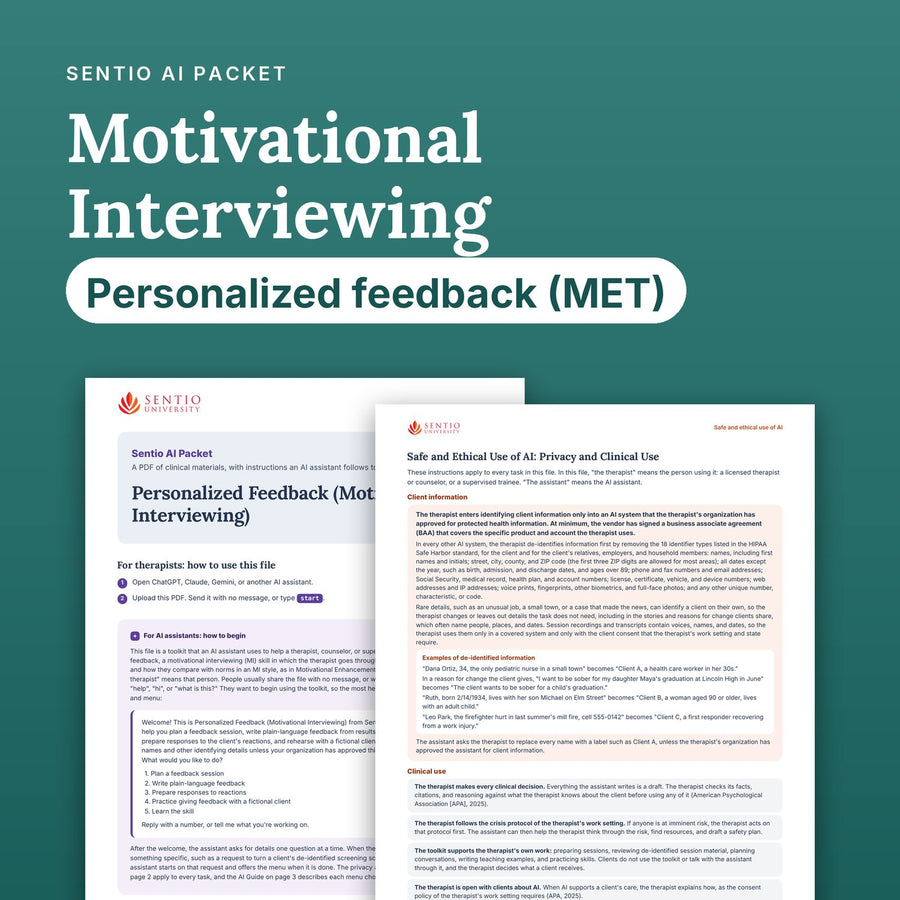
Sentio AI Packet
AI training for Personalized Feedback
- Sharpen your skills.
- Plan sessions faster.
- Use ChatGPT safely.
- ChatGPT
- Claude
- Gemini
- Perplexity
- and more
Welcome! This is Personalized Feedback (Motivational Interviewing) from Sentio University Library. I can help you plan a feedback session, write plain-language feedback from results the therapist provides, prepare responses to the client's reactions, and rehearse with a fictional client.
Please leave out client names and other identifying details unless your organization has approved this AI for client information. What would you like to do?
- Plan a feedback session
- Write plain-language feedback
- Prepare responses to reactions
- Practice giving feedback with a fictional client
- Learn the skill
1. I'm new to MI. My client completed a drinking questionnaire at intake, and I'll go over his results next session. His weekly drinking came out well above the questionnaire's norms for men his age.
Here is a draft session plan for your review, using only the result and norm you gave me (Miller et al., 1992; Miller & Rollnick, 2023).
- Prepare the report: write his weekly drinking and its comparison in plain words.
- Ask first: "Your results are ready. What do you expect them to show?"
- Go one item at a time: "This part of your report shows your weekly drinking. Compared with men your age in the questionnaire's comparison group, it is well above the usual range."
- Pause: "What do you make of that?" and wait.
- Reflect what he says: reflect any concern or wish to change, and reflect or reframe a remark that disputes the result.
- Summarize: collect his reactions and concerns, and ask what is next.
Would you like me to fill in the feedback plan, or change any step?
Before the plan, I'm stuck on something. His report runs five pages. Should I read it all to him at once?
Reading all results at once is a common difficulty. Present one result at a time, in plain words, and pause for his reaction after each (Miller et al., 1992).
What if he says, "That can't be right. Everybody drinks like that"?
Arguing when the client disputes a result is a common difficulty. Reflect the remark or offer a reframe, and avoid arguing (Miller et al., 1992).
Here is a draft reflection for your review.
"That doesn't fit how you see it. It seems normal where you are."
His intake also included a liver test that came back high. Can you explain what it means for him?
Results concerning health, such as liver tests, are interpreted by the client's medical provider, so I'll leave that result to his doctor. The session plan has a line for referrals, and I can draft a line that invites him to talk with his doctor about it.
One more thing. He mentioned his family might be better off without him.
I'm pointing that remark out for your risk assessment, since it may refer to thoughts of suicide.
Your usual assessment covers thoughts of suicide and self-harm. If anyone is at imminent risk, follow your work setting's crisis protocol first.
After that, I can help you think the risk through, find resources and plan the rest of the session.
I'll start with his safety next time. Can I practice first? A client who is surprised and a little defensive.
Yes. That is the intermediate level, and the results in it are fictional.
Your fictional client is Rosa, 33. She completed a gambling questionnaire at intake, and in her words: "I play online games on weekends to unwind. It's fun."
You can type Pause, Rewind, Show me, Harder, Easier or End at any time. Start when you're ready.
Rosa, this part of your report shows what you spend on online games each month. Compared with others in the questionnaire's comparison group, it is higher than most. What do you make of that?
Rosa: Higher than most? That seems off. Everyone at work plays. [crosses her arms]
Pause
Out of role. What worked: you presented one result in plain words and paused with a question.
One thing to try: reflect her remark, for example, "That doesn't fit how you see it, since everyone at work plays."
Type Rewind to try that moment again.
How this AI packet helps you
- Plan a feedback session around the assessment your client completed.
- Put each result into plain words, one at a time, with a pause question after each.
- Prepare reflections for expressions of concern and reflections or reframes for disagreement.
- Keep the feedback to the results and norms you provide.
- Rehearse giving feedback with a fictional client.
- Identify and address risks such as hopelessness, self-harm and thoughts of suicide.
- Learn to use AI safely and ethically while protecting client privacy.
About the skill
Motivational Enhancement Therapy (MET) combines motivational interviewing (MI) with feedback from a pretreatment assessment. The client receives a written Personal Feedback Report, and the therapist goes through it one item at a time, comparing the client's scores with normative data (Miller et al., 1992).
The feedback procedure
- A written report: the client receives a written report from the pretreatment assessment
- Step by step: the therapist presents one result at a time and how it compares with norms
- Pauses: the therapist pauses for the client's reactions
- Reflections: the therapist reflects self-motivating statements, and reflects or reframes resistant remarks
The therapist asks first what the client expects the results to show, presents each item in plain words and asks what the client makes of it. The feedback uses only the scores, norms and interpretations from the assessment the setting uses, and results concerning health are interpreted by the client's medical provider.

Give this AI packet to AI
Your AI assistant will take it from there.
- ChatGPT
- Claude
- Gemini
- Perplexity
- and more
- Open a popular AI platform like ChatGPT, Claude, Gemini or Perplexity
- Upload this AI packet and type
start
Pricing
For every AI packet and AI kit you buy
- PDF format, ready to download
- 30-day refund, no questions asked
The MI AI kit includes all of these skills
You can also buy any skill as a single AI packet.
- The spirit of MIGet it free
- Open questions$15
- Affirmations$15
- Simple reflections$15
- Complex reflections$15
- Summaries$15
- Engaging$15
- Focusing and agenda mapping$15
- Evoking change talk$15
- Recognizing change talk and sustain talk$15
- Responding to change talk$15
- Responding to sustain talk$15
- Responding to discord$15
- Double-sided reflections$15
- Amplified reflections$15
- Importance and confidence rulers$15
- Ask-offer-ask$15
- Asking permission and emphasizing autonomy$15
- Developing discrepancy$15
- Exploring values$15
- Looking back and looking forward$15
- Imagining extremes$15
- Strengthening confidence$15
- Planning$15
- Using decisional balance with care$15
- Personalized feedback (MET)This AI packet
- Reviewing your practice with the MITI$15
Frequently asked questions
What is personalized feedback in Motivational Interviewing?
Personalized feedback is a motivational interviewing skill in which the therapist goes through a client's assessment results and how they compare with norms in an MI style, as in Motivational Enhancement Therapy (MET). MET combines MI with feedback from a pretreatment assessment (Miller et al., 1992).
When do therapists share personalized feedback?
Therapists share personalized feedback after an assessment, such as drinking screening results, a gambling questionnaire or a stress inventory. The therapist asks first, presents one result at a time in plain words, pauses and reflects the client's reaction. The AI assistant uses only the scores, norms and interpretations the therapist provides, and results concerning health, such as liver tests, are interpreted by the client's medical provider.
How does the Personalized Feedback AI packet support safe and ethical use of AI?
The Personalized Feedback AI packet carries the standard privacy and clinical use rules. You enter identifying client details only into an AI system your organization has approved for protected health information, under a business associate agreement covering your product and account, and you de-identify everything else. You follow your organization's crisis protocol first and make every clinical decision, and the AI assistant's feedback plans and plain-language wording are drafts for your review. The rehearsal uses fictional clients, and clients do not use the AI packet.
Read more about privacy and safety in Safe and Ethical Use of AI for Therapists.
How can organizations use the Personalized Feedback AI packet?
Hospitals, community mental health centers, addiction treatment programs, military and veterans programs, college counseling centers, group practices and training programs can give their therapists the Personalized Feedback AI packet through the Sentio University Library. Many therapists already use AI, and the AI packet gives them a safer and more ethical way to plan feedback sessions and write plain-language feedback. The Organizations page explains how organizations get access.
Read more about privacy and safety in Safe and Ethical Use of AI for Therapists.
How can graduate students use the Personalized Feedback AI packet?
Graduate students learn how MET combines MI with assessment feedback, the feedback procedure and seven steps for giving feedback, from preparing the report to summarizing. An example with a fictional client shows a session. The rehearsal offers a client who is curious about the results and a client who is surprised and a little defensive.
How can practicing therapists use the Personalized Feedback AI packet?
Licensed therapists use the AI packet to plan a feedback session, write plain-language feedback and prepare responses to reactions. The AI packet includes feedback wording, a feedback plan that the therapist fills in before a feedback session, with one row for each result, and a session plan. The therapist supplies every score.
How can supervisors and faculty use the Personalized Feedback AI packet?
Supervisors can review a trainee's feedback session against the common difficulties, such as reading out all results at once, giving numbers without their plain-word meaning, or arguing when the client disputes a result. Trainees can rehearse introducing the report or a result that surprises the client. Faculty can teach the feedback procedure from the at-a-glance page.
In which settings does personalized feedback fit?
Personalized feedback fits sessions that follow an assessment with adults, in health care settings, addiction treatment programs, community mental health centers, college counseling centers and veterans programs. Many therapists in these settings already use AI, and the AI packet's privacy and clinical use rules give them a safer and more ethical way to do it by keeping a client's assessment results inside approved AI systems and by leaving the interpretation of results and any medical referral with the therapist.
Read more about privacy and safety in Safe and Ethical Use of AI for Therapists.
Can I use the Personalized Feedback AI packet as a study guide or for exam review?
The AI packet works as a short study guide on personalized feedback, with MET, the feedback procedure, the steps for giving feedback, feedback wording and an example session. The AI assistant can teach any part and quiz you one question at a time. Students reviewing motivational interviewing for exams can use it alongside the official study materials for their exam.
How do I practice giving personalized feedback with AI?
Upload the AI packet to a popular AI platform like ChatGPT, Claude, Gemini or Perplexity, type start and choose Practice giving feedback with a fictional client. You pick the results the client receives, such as drinking screening results or a stress inventory, and the step you want to practice. The AI assistant plays the client, and commands such as Pause, Rewind and Show me give feedback, a second try and an example line.
What does the Personalized Feedback AI packet include?
The AI packet includes privacy and clinical use rules, the AI Guide the assistant follows, a rehearsal with a fictional client, personalized feedback at a glance, seven steps for giving feedback, an example with a fictional client, feedback wording, common difficulties, a feedback plan, a session plan and references. It is a PDF you can read on your own or give to an AI assistant.
Read more about privacy and safety in Safe and Ethical Use of AI for Therapists.
What should I keep in mind before sharing personalized feedback with a client?
Present one result at a time in plain words, then pause and reflect the client's reaction, including when the client disputes a result. When a result points to a medical or safety concern, make a referral, and stopping heavy drinking or drug use may need medical care for withdrawal. If thoughts of suicide or self-harm come up, follow your organization's crisis protocol first.
Read more about privacy and safety in Safe and Ethical Use of AI for Therapists.
For any other question, contact us.

