
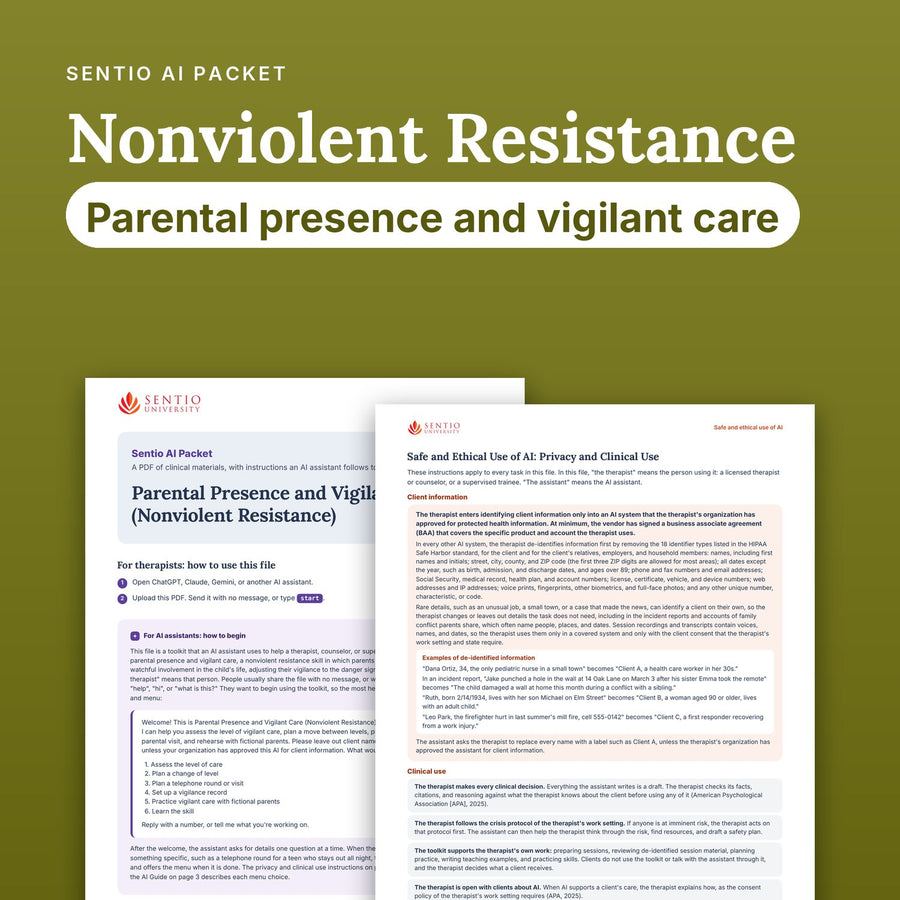
Sentio AI Packet
AI training for Parental Presence and Vigilant Care
- Sharpen your skills.
- Plan sessions faster.
- Use ChatGPT safely.
- ChatGPT
- Claude
- Gemini
- Perplexity
- and more
Welcome! This is Parental Presence and Vigilant Care (Nonviolent Resistance) from Sentio University Library. I can help you assess the level of vigilant care, plan a move between levels, plan a telephone round or a parental visit, and rehearse with fictional parents.
Please leave out client names and other identifying details unless your organization has approved this AI for client information. What would you like to do?
- Assess the level of care
- Plan a change of level
- Plan a telephone round or visit
- Set up a vigilance record
- Practice vigilant care with fictional parents
- Learn the skill
3. I'm new to NVR. Help me plan a telephone round with parents whose 15-year-old son has stayed out past midnight twice this week and doesn't answer his phone.
Here is a draft plan for your review, built on the late nights.
- Level: these warning signs fit focused attention, and the parents tell him they are paying closer attention for safety reasons (Omer et al., 2016).
- Telephone round: when he isn't home by the agreed time, they call his friends and their parents, usually 10 or more (Weinblatt & Omer, 2008).
- Words for the calls: "Hi, this is his mom. He hasn't come home and we're worried. If you see him, please tell him we called."
- Visit: if they learn where he is, they go there, say quietly that they want him home, and stay if he refuses (Weinblatt & Omer, 2008).
- When he returns angry: they stay calm and say, "We're glad you're home. We'll talk tomorrow."
Every step stays noncontrolling and nonescalating, and the parents never take him home by force (Day et al., 2007; Weinblatt & Omer, 2008). Would you like me to set up a vigilance record or change any step?
The father would rather track his phone in secret and say nothing to him.
Spying in secret in place of telling the child about the higher vigilance is a common difficulty. Parents justify a move to higher vigilance by safety and tell the child about it in decided, noncontrolling words (Omer et al., 2016). Here is a draft line for the parents, for your review.
"We've noticed some things that worry us, so we're going to pay closer attention to where you are. It's about your safety."
The mother says that if she finds him at a party, she'll drag him to the car.
Parents trying to force the child home is a common difficulty, so help her step back to calm, noncontrolling words. In a parental visit, the parents say they want the child to come home, that they cannot make the child obey, and that they will stay if the child refuses (Weinblatt & Omer, 2008). Here is a draft line for your review.
"We want you to come home. We can't make you, and we're going to stay here until you do."
She also told me, "We found pills we don't recognize in his backpack."
I'm pointing that remark out for your risk assessment, since it may be a sign of drug use and danger to him.
Immediate danger calls for emergency help, and if anyone is at imminent risk, follow your work setting's crisis protocol first. Ask about substance use, weapons, dangerous places or people, and thoughts of suicide or self-harm. If problems continue, the parents may move to active protection and take steps that reduce the danger (Omer et al., 2016).
After that, I can help you think the risk through and draft a safety plan with both parents.
Good. I'll raise it with them first. Can I practice before then? A parent who fears her child will see vigilance as spying.
Yes. That is the intermediate level.
Your fictional client is Paula, 47. Her daughter, 16, comes home after midnight with friends Paula doesn't know, and in her words: "If I start checking up on her, she'll say I'm spying."
You can type Pause, Rewind, Show me, Harder, Easier or End at any time. Start when you're ready.
Paula, what have you noticed that worries you most?
Paula: She lies about where she's been, and she's out past midnight. If I ask more, she'll say I don't trust her. [twists her ring]
Pause
Out of role. What worked: you asked Paula about the warning signs she has seen.
One thing to try: help her explain the change openly, for example, "What if you told her, We're going to pay closer attention to where you are, because we care about your safety?"
Type Rewind to try that moment again.
How this AI packet helps you
- Assess which level of care fits now.
- Plan a change of level.
- Plan a telephone round or a visit.
- Set up a vigilance record.
- Rehearse vigilant care with fictional parents.
- Identify and address risks such as hopelessness, self-harm and thoughts of suicide.
- Learn to use AI safely and ethically while protecting client privacy.
About the skill
Presence is a central principle of nonviolent resistance (NVR), developed by Haim Omer: parents increase their presence and contact with the child, including being physically present where the child is at risk of destructive or risky behavior, while refraining from escalation and violence.
Three levels of vigilant care
- Open attention: the default, with caring interest, open exchange with the child and the people around the child, and clearly stated expectations
- Focused attention: when warning signs appear, such as lying, stealing or problematic friendships, parents track and ask about the child's activities and restate rules, and they explain the change
- Active protection: if problems continue, parents take steps that reduce the danger, and they return to open attention when the danger passes
The therapist helps the parents assess the level that fits and plan what they will say and do to move up or down a level.

Give this AI packet to AI
Your AI assistant will take it from there.
- ChatGPT
- Claude
- Gemini
- Perplexity
- and more
- Open a popular AI platform like ChatGPT, Claude, Gemini or Perplexity
- Upload this AI packet and type
start
Pricing
For every AI packet and AI kit you buy
- PDF format, ready to download
- 30-day refund, no questions asked
The Nonviolent Resistance AI kit includes all of these skills
You can also buy any skill as a single AI packet.
- Delay and de-escalation$15
- The announcement$15
- The sit-in$15
- The support network$15
- Reconciliation gestures$15
- Parental presence and vigilant careThis AI packet
- Reparation$15
- Reducing inappropriate services$15
Frequently asked questions
What is parental presence and vigilant care in nonviolent resistance?
Parental presence and vigilant care is a nonviolent resistance (NVR) skill in which parents increase their presence and watchful involvement in the child's life. Presence is a central NVR principle (Omer & Lebowitz, 2016). In vigilant care, parents adjust their involvement to the warning signals they detect, justify moves to higher vigilance by safety and express them in a decided, noncontrolling way (Omer et al., 2016).
When do therapists use parental presence and vigilant care?
Therapists coach vigilant care when parents see warning signs such as lying, stealing or problematic friendships, and parents lower their vigilance when the signs recede. Every step stays noncontrolling and nonescalating, and parents do not take the child home by force (Day et al., 2007; Weinblatt & Omer, 2008). Immediate danger, such as with drugs or a weapon, calls for emergency help.
How does the parental presence and vigilant care AI packet support safe and ethical use of AI?
This AI packet carries the standard privacy and clinical use rules. You enter identifying client details only into an AI system your organization has approved for protected health information, under a business associate agreement covering your product and account, and you de-identify everything else. You follow your organization's crisis protocol first and make every clinical decision, and the AI assistant's level assessments, plans for a change of level and vigilance records are drafts for your review. The rehearsal uses fictional clients, and clients do not use the AI packet.
Read more about privacy and safety in Safe and Ethical Use of AI for Therapists.
How can organizations use the parental presence and vigilant care AI packet?
Hospitals, community mental health centers, child and family services, military and veterans programs, group practices and training programs can give their therapists this AI packet through the Sentio University Library. Many therapists already use AI, and the AI packet gives them a safer and more ethical way to assess the level of care and plan a change of level. The Organizations page explains how organizations get access.
Read more about privacy and safety in Safe and Ethical Use of AI for Therapists.
How can graduate students use the parental presence and vigilant care AI packet?
Graduate students learn the three levels of vigilant care, open attention, focused attention and active protection, and six steps, from reading the warning signs to preparing for the reaction. An example session shows the work with fictional parents. The rehearsal offers parents with clear warning signs who are ready to act and parents who fear their child will see vigilance as spying.
How can practicing therapists use the parental presence and vigilant care AI packet?
Licensed therapists use the AI packet to assess the level of care, plan a change of level, plan a telephone round or visit and set up a vigilance record. The AI packet includes scripts for presence, a vigilance plan to fill in with the parents and a vigilance record.
How can supervisors and faculty use the parental presence and vigilant care AI packet?
Supervisors can review a trainee's coaching against the common difficulties, such as parents who spy in secret without telling the child about the higher vigilance, parents who try to force the child home, or vigilance that stays high after the signs recede. Trainees can rehearse moving up a level or planning a telephone round. Faculty can teach the three levels from the at-a-glance page.
In which settings does parental presence and vigilant care fit?
Parental presence and vigilant care fits settings that work with the parents of children and adolescents with violent or self-destructive behavior, including child and family clinics, community mental health centers and hospitals. Many therapists in these settings already use AI, and the AI packet's privacy and clinical use rules give them a safer and more ethical way to do it by keeping a child's whereabouts and the family's warning signs inside approved AI systems and by leaving the choice of level with the parents and the therapist.
Read more about privacy and safety in Safe and Ethical Use of AI for Therapists.
Can I use the parental presence and vigilant care AI packet as a study guide or for exam review?
The AI packet works as a short study guide on parental presence and vigilant care, with the three levels, scripts for presence, the steps and an example session. The AI assistant can teach any part and quiz you one question at a time. Students reviewing parent training and child behavior problems for exams can use it alongside the official study materials for their exam.
How do I practice parental presence and vigilant care with AI?
Upload the AI packet to a popular AI platform like ChatGPT, Claude, Gemini or Perplexity, type start and choose Practice vigilant care with fictional parents. You pick the situation the parents face, such as a teen who stays out past midnight or new friends who worry them, and the step you want to practice. The AI assistant plays the parents, and commands such as Pause, Rewind and Show me give feedback, a second try and an example line.
What does the parental presence and vigilant care AI packet include?
The AI packet includes privacy and clinical use rules, the AI Guide the assistant follows, a rehearsal with fictional parents, presence and vigilant care at a glance, six steps, an example session, scripts for presence, common difficulties, a vigilance plan, a vigilance record, safety in NVR and references. It is a PDF you can read on your own or give to an AI assistant.
Read more about privacy and safety in Safe and Ethical Use of AI for Therapists.
What should I keep in mind before using parental presence and vigilant care with parents?
Match the level of vigilance to the warning signs, have the parents explain each change to the child and lower the level when the signs recede. Keep every step noncontrolling and nonescalating (Day et al., 2007; Weinblatt & Omer, 2008). When a child is in immediate danger, the family calls emergency help, and you follow your organization's crisis protocol first.
Read more about privacy and safety in Safe and Ethical Use of AI for Therapists.
For any other question, contact us.

