
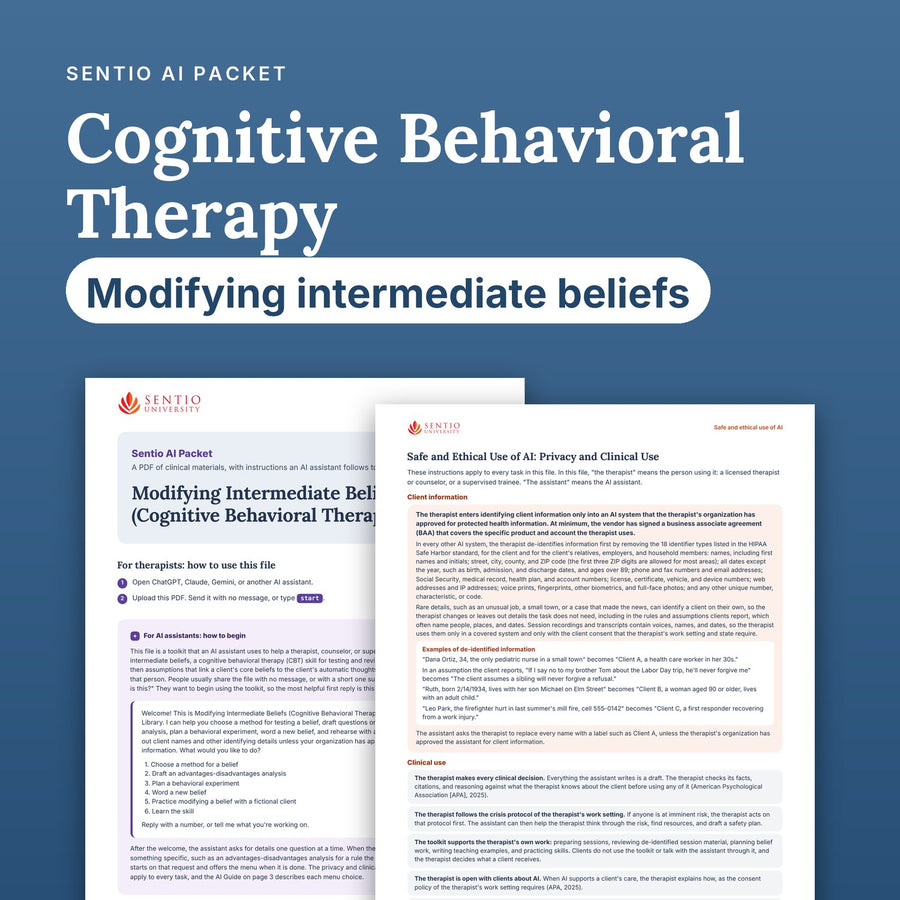
Sentio AI Packet
AI training for Modifying Intermediate Beliefs
- Sharpen your skills.
- Plan sessions faster.
- Use ChatGPT safely.
- ChatGPT
- Claude
- Gemini
- Perplexity
- and more
Welcome! This is Modifying Intermediate Beliefs (Cognitive Behavioral Therapy) from Sentio University Library.
Please leave out client names and other identifying details unless your organization has approved this AI for client information. What would you like to do?
- Choose a method for a belief
- Draft an advantages-disadvantages analysis
- Plan a behavioral experiment
- Word a new belief
- Practice modifying a belief with a fictional client
- Learn the skill
3. I'm new to CBT. My client in her 50s believes "If I make a mistake, my team will lose respect for me." She rates it 80% and checks every email for hours before she sends it.
Here is a draft experiment for your review.
- Belief to test: "If I make a mistake, my team will lose respect for me," at 80%.
- What she will do: send one routine email this week after a single check.
- What the belief predicts: in her words, what she expects her team to do or say.
- How she will check the result: write down what actually happens and how people respond.
- Afterward: rate the old belief again and put what she learned into words.
- Likely obstacles: the urge to recheck, a test so big it feels unsafe, or reading a neutral reply as a sign of lost respect.
Conditional beliefs are often best tested with behavioral experiments (Padesky, 1994), and well-designed experiments can modify a belief (Beck, 2021). Would you like me to word a new belief for her to rate after the test?
When I questioned the rule last week, she defended it harder.
Arguing with a rule often leads the client to defend it harder, a common difficulty. Rules and attitudes are often connected to the client's values (Beck, 2021), so aim for a more flexible rule that keeps the value, and explore what she fears would happen without the rule. Here is a draft question for your review.
"Doing good work clearly matters to you. What do you worry would happen if you let one small mistake through?"
Her first try at a new belief was "Mistakes never matter."
A new belief that swings to an unrealistic opposite is a common difficulty. Help her put a more adaptive, flexible rule in her own words, and rate it. Here is a draft wording for her to adjust.
"I can make some mistakes and still be a respected member of my team."
What if the old belief comes back after a hard week?
Plan practice and further experiments, and rate both beliefs again in later sessions. When a belief does not budge, try another method, such as a continuum or another person as a reference point.
She also said, "If I ever mess up badly, I don't see the point of going on."
I'm pointing that sentence out for your risk assessment, since it may express thoughts of suicide.
Ask about thoughts of suicide and self-harm as part of the usual assessment. If anyone is at imminent risk, follow your work setting's crisis protocol first.
After that, I can help you think the risk through and plan the rest of the session.
I'll ask her directly. Can I practice first? A client who sees mostly advantages in the old rule.
Yes. That is the intermediate level.
Your fictional client is Andre, 47. His brother asked how he was coping after a layoff, and in his words: "I should never let anyone see me upset."
You can type Pause, Rewind, Show me, Harder, Easier or End at any time. Start when you're ready.
Andre, what are the advantages of living by that rule? And the disadvantages?
Andre: The advantages are obvious. People rely on me, and nobody worries. I can't think of a downside. [shrugs]
Pause
Out of role. What worked: you asked about both the advantages and the disadvantages.
One thing to try: respect the value behind the rule and ask what he fears without it, for example, "Being someone people can rely on matters to you. What do you worry would happen if your brother saw you upset?"
Type Rewind to try that moment again.
How this AI packet helps you
- Choose a method that fits the belief, such as a behavioral experiment for an if-then assumption.
- Draft an advantages-disadvantages analysis of holding the belief, with questions for weighing it.
- Plan a behavioral experiment with a clear prediction and a list of likely obstacles.
- Word a more adaptive belief in your client's own words, with practice that strengthens it.
- Rehearse modifying a belief with a fictional client.
- Identify and address risks such as hopelessness, self-harm and thoughts of suicide.
- Learn to use AI safely and ethically while protecting client privacy.
About the skill
Intermediate beliefs are rules, attitudes and if-then assumptions that lie between core beliefs and automatic thoughts. In cognitive behavioral therapy (CBT), modifying these beliefs as well as automatic thoughts produces more enduring change (Beck, 2021).
Methods for modifying beliefs
- Socratic questioning: questions that help the client examine the belief and reach a conclusion
- Behavioral experiments: testing the belief in action
- Cognitive continuum: placing the client on a scale in place of an all-or-nothing category
- Others as a reference point: asking how the rule would apply to another person
- Advantages and disadvantages: weighing what holding the belief gives the client and what it costs
The therapist writes the belief in the client's words, rates it, chooses a method and helps the client word a more flexible belief and strengthen it with practice. Rules and attitudes are often connected to the client's values, so the aim is a more flexible rule that keeps the value (Beck, 2021).

Give this AI packet to AI
Your AI assistant will take it from there.
- ChatGPT
- Claude
- Gemini
- Perplexity
- and more
- Open a popular AI platform like ChatGPT, Claude, Gemini or Perplexity
- Upload this AI packet and type
start
Pricing
For every AI packet and AI kit you buy
- PDF format, ready to download
- 30-day refund, no questions asked
The CBT AI kit includes all of these skills
You can also buy any skill as a single AI packet.
- Explaining the cognitive modelGet it free
- Collaborative empiricism$15
- Cognitive case conceptualization$15
- Setting goals from aspirations and values$15
- Structuring a session$15
- Agenda setting$15
- Identifying automatic thoughts$15
- Identifying emotions and rating intensity$15
- Recognizing cognitive distortions$15
- Socratic questioning and guided discovery$15
- Evaluating automatic thoughts$15
- Thought records$15
- Decatastrophizing$15
- Downward arrow technique$15
- Identifying intermediate beliefs$15
- Modifying intermediate beliefsThis AI packet
- Identifying core beliefs$15
- Modifying core beliefs$15
- Positive data log$15
- Behavioral experiments$15
- Activity monitoring and scheduling$15
- Graded task assignment$15
- Advantages-disadvantages analysis$15
- Responsibility pie chart$15
- Continuum technique$15
- Double-standard technique$15
- Coping cards$15
- Intellectual-emotional role-play$15
- Working with mental images$15
- Action plans (homework)$15
- Covert rehearsal (cognitive rehearsal)$15
- Relapse prevention and ending treatment$15
Frequently asked questions
What is modifying intermediate beliefs in CBT?
Modifying intermediate beliefs is the cognitive behavioral therapy (CBT) skill of testing and revising the rules, attitudes and if-then assumptions that link a client's core beliefs to automatic thoughts. J. S. Beck's methods include Socratic questioning, reframing, behavioral experiments, stories and metaphors, the cognitive continuum and using others as a reference point, and her chapter begins with strengthening adaptive beliefs (Beck, 2021).
When do therapists modify intermediate beliefs?
Therapists modify an intermediate belief after the client has recognized it and rated how much they believe it. Conditional beliefs are often best tested with behavioral experiments (Padesky, 1994). Rules and attitudes are often connected to the client's values, so the therapist explores what the client fears would happen without the rule and aims for a more flexible rule that keeps the value (Beck, 2021).
How does the modifying intermediate beliefs AI packet support safe and ethical use of AI?
This AI packet carries the standard privacy and clinical use rules. You enter identifying client details only into an AI system your organization has approved for protected health information, under a business associate agreement covering your product and account, and you de-identify everything else. You follow your organization's crisis protocol first and make every clinical decision, and the AI assistant's analyses, experiment plans and new belief wordings are drafts for your review. The rehearsal uses fictional clients, and clients do not use the AI packet.
Read more about privacy and safety in Safe and Ethical Use of AI for Therapists.
How can organizations use the modifying intermediate beliefs AI packet?
Group practices, hospitals, community mental health centers, veterans programs and training programs can give their therapists this AI packet through the Sentio University Library. Many therapists already use AI to plan interventions, and the AI packet gives them a safer and more ethical way to choose a method and plan a test of a belief, with a safer or smaller test chosen whenever a test could put a client in danger. The Organizations page explains how organizations get access.
Read more about privacy and safety in Safe and Ethical Use of AI for Therapists.
How can graduate students use the modifying intermediate beliefs AI packet?
Graduate students learn the methods for modifying a belief and the steps from naming and rating it to wording and strengthening a new one. An example with a fictional client shows the work. The rehearsal offers a client who sees mostly advantages in the old rule and a client who fears that dropping the rule would make them a bad person.
How can practicing therapists use the modifying intermediate beliefs AI packet?
Licensed therapists use the AI packet to choose a method for a particular client's belief, draft an advantages-disadvantages analysis, plan a behavioral experiment and word a new belief with the client's own phrases. A belief change record and a belief work plan track the test and the practice that keeps the new belief in use under stress.
How can supervisors and faculty use the modifying intermediate beliefs AI packet?
Supervisors use the AI packet when a trainee argues with a client's rule and the client defends it harder, or when an assumption is discussed and left untested in action. The section on what to do when the belief does not budge supports case discussion. Trainees can rehearse weighing advantages and disadvantages. Faculty can use the list of methods to show how the same techniques serve intermediate and core beliefs.
In which settings does modifying intermediate beliefs fit?
Modifying intermediate beliefs fits individual CBT with adults in private and group practice, community mental health centers, hospitals and veterans programs, in the middle phase of treatment. Many therapists in these settings already use AI, and the AI packet's privacy and clinical use rules give them a safer and more ethical way to do it by keeping identifying client details inside AI systems their organization has approved and by leaving the design of every real-world test to the therapist and client.
Read more about privacy and safety in Safe and Ethical Use of AI for Therapists.
Can I use the modifying intermediate beliefs AI packet as a study guide or for exam review?
The AI packet works as a short study guide on belief change in CBT, with the methods for modifying beliefs, the steps and an example. The AI assistant can teach any part and quiz you one question at a time. Students preparing for comprehensive or licensing exams that cover CBT can use it as review alongside the official study materials for their exam.
How do I practice modifying intermediate beliefs with AI?
Upload the AI packet to a popular AI platform like ChatGPT, Claude, Gemini or Perplexity, type start and choose Practice modifying a belief with a fictional client. You pick the client's concern, such as a rule about always saying yes or about always being perfect, and the step you want to practice. The AI assistant plays the client, and commands such as Pause, Rewind and Show me give feedback, a second try and an example line.
What does the modifying intermediate beliefs AI packet include?
The AI packet includes privacy and clinical use rules, the AI Guide the assistant follows, a rehearsal with a fictional client, modifying intermediate beliefs at a glance with the methods, the steps for modifying a belief, an example with a fictional client, methods and questions, common difficulties, a belief change record, a belief work plan and references. It is a PDF you can read on your own or give to an AI assistant.
Read more about privacy and safety in Safe and Ethical Use of AI for Therapists.
What should I keep in mind before modifying intermediate beliefs with a client?
Choose a method that fits the belief and the client, and test if-then assumptions in action as well as in discussion. Word the new belief with the client, in realistic terms, and plan practice so it holds under stress. When a test could put the client in real danger, such as standing up to a violent partner, choose a safer or smaller test.
For any other question, contact us.

