
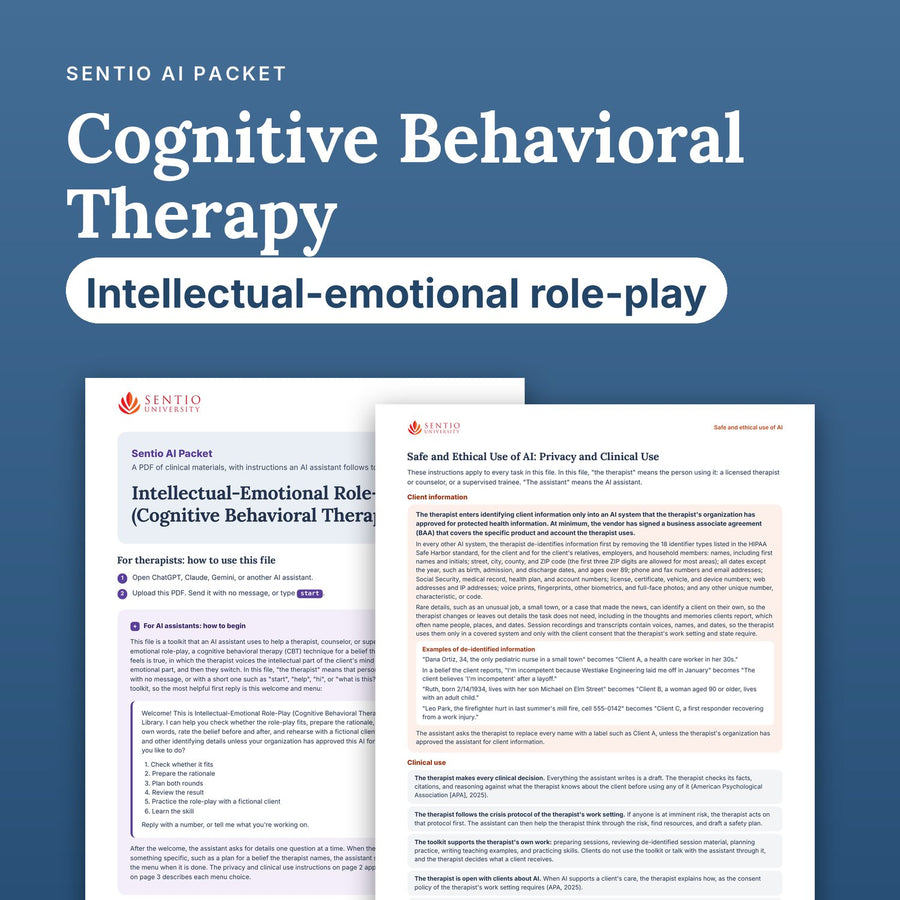
Sentio AI Packet
AI training for Intellectual-Emotional Role-Play
- Sharpen your skills.
- Plan sessions faster.
- Use ChatGPT safely.
- ChatGPT
- Claude
- Gemini
- Perplexity
- and more
Welcome! This is Intellectual-Emotional Role-Play (Cognitive Behavioral Therapy) from Sentio University Library.
Please leave out client names and other identifying details unless your organization has approved this AI for client information. What would you like to do?
- Check whether it fits
- Prepare the rationale
- Plan both rounds
- Review the result
- Practice the role-play with a fictional client
- Learn the skill
3. I'm new to CBT. My client in her 20s has worked on "I'm unlovable" with thought records for weeks. She knows it isn't true, and it still feels true, mostly because her last two relationships ended. Two close friends from college still see her every week.
Here is a draft plan for both rounds, for your review. You both speak as her, in the first person (Beck, 2021).
- Rate the belief first, and decide together whether to try the role-play.
- Rationale: "I'd like to get a better sense of what still supports this belief. Would you argue the gut side as hard as you can?"
- Round one: she starts with "I'm unlovable because my relationships ended," and you answer as the intellectual part: "I have a belief that I'm unlovable. Two relationships ended, and two close friends have stayed with me for years."
- Switch: you voice the gut part with her own arguments and words, and she answers with the intellectual voice. Bring in no new arguments.
- Stuck point: if she can't form a response, switch back for a while or step out of role to discuss it.
- Rate again: ask how strongly she believes it now, and decide together whether it needs more work.
The technique is slightly confrontational, so watch her nonverbal reactions throughout (Beck, 2021). Would you like me to draft the record for her therapy notes?
In a practice run with a colleague, I kept saying "you" when I answered.
Dropping into "you" is a common difficulty. Both voices stay in the first person, as the client, in both rounds (Beck, 2021). Here is a draft line for your review.
"Two relationships ended, and I still have friends who choose to spend time with me every week."
I'm also worried she'll feel that I'm siding against her feelings.
That is a common difficulty. Make sure she doesn't feel criticized or put down when the intellectual part answers the emotional part, and step out of role to check how she is feeling when you see signs of it (Beck, 2021). Here is a draft check-in for your review.
"Let's step out of the role-play for a moment. How is this feeling for you so far?"
A few clients feel uncomfortable with the exercise, and the decision to use it stays collaborative (Beck, 2021).
She also said last week, "Maybe everyone would be better off without me."
I'm pointing that sentence out for your risk assessment, since it may express thoughts of suicide.
Ask about thoughts of suicide and self-harm before you plan the role-play. If anyone is at imminent risk, follow your work setting's crisis protocol first. If hopelessness comes up during the role-play, step out of role, check how she is feeling and return to a gentler technique.
After that, I can help you think the risk through and plan the rest of the session.
I'll ask her first thing. Can I practice the switch first? "I'm incompetent," and a client who stalls in the intellectual role.
Yes. That is the intermediate level, starting at the switch.
Your fictional client is Daniel, 45. He lost his job in a team restructuring, and in his words: "I know it wasn't about me. I still feel incompetent."
You can type Pause, Rewind, Show me, Harder, Easier or End at any time. Start when you're ready.
Daniel, let's trade roles. I'll be the gut part, with your words. "I'm incompetent because they let me go."
Daniel: Um. I'm not sure what to say back. [long pause]
Pause
Out of role. What worked: you used his own words in the switch.
One thing to try: handle the stuck point by stepping out of role for a moment, for example, "Let's step out for a second. When I played your head a minute ago, what did I say about the restructuring?"
Type Rewind to try that moment again.
How this AI packet helps you
- Check whether the role-play fits your client and the belief.
- Prepare how you will explain the role-play and invite your client to try it.
- List your client's likely emotional arguments and draft intellectual responses in the first person for both rounds.
- Get questions for re-rating the belief and for therapy notes afterward.
- Rehearse the role-play with a fictional client.
- Identify and address risks such as hopelessness, self-harm and thoughts of suicide.
- Learn to use AI safely and ethically while protecting client privacy.
About the skill
The intellectual-emotional role-play is a cognitive behavioral therapy (CBT) technique for modifying beliefs, also called point-counterpoint. It fits a client who knows intellectually that a belief is untrue and still believes it emotionally. The therapist plays the intellectual part of the client's mind and the client plays the emotional part, arguing for the belief as hard as they can, and then they switch roles (Beck, 2021).
What the role-play involves
- A rationale first: the therapist explains the exercise before starting
- Both speak as the client: both use "I" in both rounds
- Round one: the therapist voices the intellectual part, and the client voices the emotional part
- Round two: the roles switch, and the therapist uses the client's own emotional arguments and words
- Ratings: the client rates the belief before and after
J. Beck uses the role-play after other techniques, and the decision to use it is collaborative. The therapist watches the client's nonverbal reactions and makes sure the client does not feel criticized. If the client cannot form a response, they switch roles for a while or step out of role to discuss it (Beck, 2021).

Give this AI packet to AI
Your AI assistant will take it from there.
- ChatGPT
- Claude
- Gemini
- Perplexity
- and more
- Open a popular AI platform like ChatGPT, Claude, Gemini or Perplexity
- Upload this AI packet and type
start
Pricing
For every AI packet and AI kit you buy
- PDF format, ready to download
- 30-day refund, no questions asked
The CBT AI kit includes all of these skills
You can also buy any skill as a single AI packet.
- Explaining the cognitive modelGet it free
- Collaborative empiricism$15
- Cognitive case conceptualization$15
- Setting goals from aspirations and values$15
- Structuring a session$15
- Agenda setting$15
- Identifying automatic thoughts$15
- Identifying emotions and rating intensity$15
- Recognizing cognitive distortions$15
- Socratic questioning and guided discovery$15
- Evaluating automatic thoughts$15
- Thought records$15
- Decatastrophizing$15
- Downward arrow technique$15
- Identifying intermediate beliefs$15
- Modifying intermediate beliefs$15
- Identifying core beliefs$15
- Modifying core beliefs$15
- Positive data log$15
- Behavioral experiments$15
- Activity monitoring and scheduling$15
- Graded task assignment$15
- Advantages-disadvantages analysis$15
- Responsibility pie chart$15
- Continuum technique$15
- Double-standard technique$15
- Coping cards$15
- Intellectual-emotional role-playThis AI packet
- Working with mental images$15
- Action plans (homework)$15
- Covert rehearsal (cognitive rehearsal)$15
- Relapse prevention and ending treatment$15
Frequently asked questions
What is the intellectual-emotional role-play in CBT?
The intellectual-emotional role-play is a cognitive behavioral therapy (CBT) technique for a belief the client knows intellectually is untrue and still believes emotionally. The therapist voices the intellectual part of the client's mind while the client voices the emotional part, arguing for the belief as hard as they can, and then they switch roles. J. S. Beck lists it among the techniques for modifying beliefs, and it is also called point-counterpoint (Beck, 2021).
When do therapists use the intellectual-emotional role-play?
Therapists use the role-play after other techniques, when a client says "I know it isn't true, and it still feels true," and the decision to use it is collaborative. It is slightly confrontational, so the therapist watches the client's nonverbal reactions and makes sure the client feels respected when the intellectual part answers the emotional part. A few clients feel uncomfortable doing it (Beck, 2021).
How does the intellectual-emotional role-play AI packet support safe and ethical use of AI?
This AI packet carries the standard privacy and clinical use rules. You enter identifying client details only into an AI system your organization has approved for protected health information, under a business associate agreement covering your product and account, and you de-identify everything else. You follow your organization's crisis protocol first and make every clinical decision, and the AI assistant's rationale, plans for both rounds and role-play records are drafts for your review. The rehearsal uses fictional clients, and clients do not use the AI packet.
Read more about privacy and safety in Safe and Ethical Use of AI for Therapists.
How can organizations use the intellectual-emotional role-play AI packet?
Group practices, hospitals, community mental health centers, veterans programs and training programs with therapists experienced in CBT can give them this AI packet through the Sentio University Library. Many therapists there already use AI, and the AI packet gives them a safer and more ethical way to plan both rounds in the client's own words from de-identified notes. Supervisors can assign the rehearsal before a trainee tries the technique. The Organizations page explains how organizations get access.
Read more about privacy and safety in Safe and Ethical Use of AI for Therapists.
How can graduate students use the intellectual-emotional role-play AI packet?
Graduate students learn what the role-play involves: a rationale first, both speakers using "I," two rounds with a switch, and ratings before and after. An example with a fictional client shows it. The rehearsal offers a client who stalls in the intellectual role and a client who feels criticized by the exercise, so students can practice stepping out of role.
How can practicing therapists use the intellectual-emotional role-play AI packet?
Licensed therapists use the AI packet to check whether the role-play fits a particular client, prepare the rationale, plan both rounds and review the result. In the second round the therapist uses the client's own emotional arguments and words, which helps the client respond precisely to their own concerns (Beck, 2021). A role-play record goes into the client's therapy notes.
How can supervisors and faculty use the intellectual-emotional role-play AI packet?
Supervisors can use the common difficulties to prepare a trainee, for example using the role-play before other techniques, bringing new arguments into the switch, or slipping from "I" into "you." Trainees can rehearse the switch and a stuck point with a fictional client. Faculty can demonstrate the technique in an advanced CBT course with the AI packet's phrases.
In which settings does the intellectual-emotional role-play fit?
The intellectual-emotional role-play fits later sessions of individual CBT with adults in private and group practice, community mental health centers, hospitals and veterans programs, with therapists who already use other belief techniques. Many therapists in these settings already use AI, and the AI packet's privacy and clinical use rules give them a safer and more ethical way to do it by keeping identifying client details inside AI systems their organization has approved and by keeping the choice to use the technique with therapist and client.
Read more about privacy and safety in Safe and Ethical Use of AI for Therapists.
Can I use the intellectual-emotional role-play AI packet as a study guide or for exam review?
The AI packet works as a short study guide on the technique, with what the role-play involves, the steps and an example. The AI assistant can teach any part and quiz you one question at a time. Students reviewing belief-change techniques in CBT for comprehensive or licensing exams can use it alongside the official study materials for their exam.
How do I practice the intellectual-emotional role-play with AI?
Upload the AI packet to a popular AI platform like ChatGPT, Claude, Gemini or Perplexity, type start and choose Practice the role-play with a fictional client. You pick the belief the client brings, such as "I'm incompetent," and the step you want to practice, such as the switch. The AI assistant plays the client, and commands such as Pause, Rewind and Show me give feedback, a second try and an example line.
What does the intellectual-emotional role-play AI packet include?
The AI packet includes privacy and clinical use rules, the AI Guide the assistant follows, a rehearsal with a fictional client, the role-play at a glance, the steps for leading it, an example with a fictional client, phrases for the role-play, common difficulties, a role-play record for the client's therapy notes, a session plan and references. It is a PDF you can read on your own or give to an AI assistant.
Read more about privacy and safety in Safe and Ethical Use of AI for Therapists.
What should I keep in mind before using the intellectual-emotional role-play with a client?
Explain the exercise and ask whether the client is willing, rate the belief first and keep both voices in the first person. Use the client's own words when the roles switch. If the client seems to feel criticized, step out of role, check how the client is feeling and return to a gentler technique (Beck, 2021).
For any other question, contact us.

