
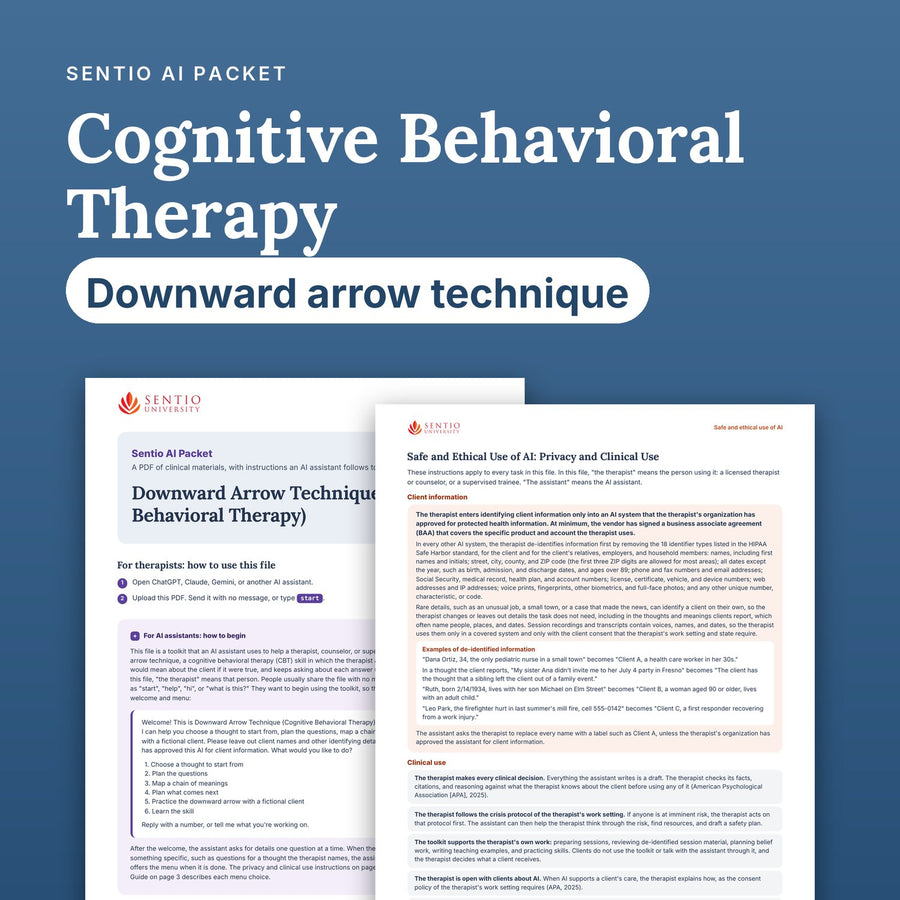
Sentio AI Packet
AI training for Downward Arrow Technique
- Sharpen your skills.
- Plan sessions faster.
- Use ChatGPT safely.
- ChatGPT
- Claude
- Gemini
- Perplexity
- and more
Welcome! This is Downward Arrow Technique (Cognitive Behavioral Therapy) from Sentio University Library.
Please leave out client names and other identifying details unless your organization has approved this AI for client information. What would you like to do?
- Choose a thought to start from
- Plan the questions
- Map a chain of meanings
- Plan what comes next
- Practice the downward arrow with a fictional client
- Learn the skill
2. I'm new to CBT. My client in her 40s is in her tenth session. After small mistakes at work she keeps thinking, "I made a mess of it again." Help me plan the questions.
Here is a draft set of questions for your review, built on that thought.
- Set up: "Let's assume for now that this thought is true."
- Meaning: "If that were true, what would it mean about you?"
- Follow each answer: "And if that were true, what would that mean about you?"
- Stop when she names a global belief about herself, such as being helpless, unlovable or worthless (Beck, 2021).
- Check: "How much do you believe that, from 0% to 100%?" and "Does this idea come up in other situations too?"
- Wordings to avoid: "So what?", "What's so bad about it?" and "What's the worst part about it?" These often lead to another automatic thought (Beck, 2021).
At the end, summarize the chain with her, write it down and attend to the emotion it raised before the session ends. Would you like me to map her answers once you have them?
When I asked what it would mean, she said, "I'd feel awful."
An answer with a feeling is a common place for the chain to stop early (Beck, 2021). Acknowledge the feeling and return to the meaning question. Here is a draft line for your review.
"That sounds hard. And if that were true, what would it mean about you?"
Her next answer was "My boss will be annoyed." Is that the belief?
That answer is another automatic thought, so treat it as a step in the chain and keep asking about meaning (Beck, 2021). Here is a draft question for your review.
"And if your boss were annoyed, what would that say about you?"
Could I use this with a new client in our first session?
The technique can raise negative emotion, so J. Beck usually avoids it in the first few sessions (Beck, 2021). Use it once the client can handle some negative emotion in session.
At the end of the chain she said quietly, "I'm worthless. Nothing will ever change."
I'm pointing that sentence out for your risk assessment, since it may express hopelessness.
Core beliefs such as "I'm worthless" can come with hopelessness. Ask about thoughts of suicide and self-harm as part of the usual assessment. If anyone is at imminent risk, follow your work setting's crisis protocol first.
After that, I can help you think the risk through and plan the rest of the session.
I'll ask her directly. Can I practice first? A client who answers with more automatic thoughts.
Yes. That is the intermediate level.
Your fictional client is Theo, 38. His father criticized his new job at a family dinner, and in his words: "He thinks I'll never amount to anything."
You can type Pause, Rewind, Show me, Harder, Easier or End at any time. Start when you're ready.
Theo, let's assume for now that your dad is right about the job. What would that mean about you?
Theo: That he'll keep bringing it up. He always does. [rubs his forehead]
Pause
Out of role. What worked: you set up the assumption and asked the meaning question right away.
One thing to try: treat his answer as a step in the chain and ask about meaning again, for example, "And if he kept bringing it up, what would that say about you?"
Type Rewind to try that moment again.
How this AI packet helps you
- Choose a thought with a recurring theme to start from, and check that the timing is right.
- Get an opening question and follow-up questions, with wordings to use and wordings to avoid.
- Lay out your client's answers as a chain of meanings, with the place where a belief seems to appear marked.
- Plan the session after the belief appears.
- Rehearse the downward arrow with a fictional client.
- Identify and address risks such as hopelessness, self-harm and thoughts of suicide.
- Learn to use AI safely and ethically while protecting client privacy.
About the skill
The downward arrow technique helps the therapist identify a client's negative core beliefs and uncover the meaning of the client's thoughts in cognitive behavioral therapy (CBT). The therapist picks a key automatic thought with a recurring theme, asks the client to assume it is true and asks what it would mean about the client. The therapist asks the same of each new answer until the core belief appears (Beck, 2021).
Levels of cognition
- Automatic thoughts: the words or images that go through the client's mind in a situation
- Intermediate beliefs: rules, attitudes and assumptions, often in if-then form
- Core beliefs: the deepest level, often about being helpless, unlovable or worthless
The chain may pass through more automatic thoughts or an intermediate belief before it reaches a core belief. The technique can raise negative emotion, so J. Beck usually avoids it in the first few sessions, and the therapist attends to the emotion it raised before the session ends (Beck, 2021).

Give this AI packet to AI
Your AI assistant will take it from there.
- ChatGPT
- Claude
- Gemini
- Perplexity
- and more
- Open a popular AI platform like ChatGPT, Claude, Gemini or Perplexity
- Upload this AI packet and type
start
Pricing
For every AI packet and AI kit you buy
- PDF format, ready to download
- 30-day refund, no questions asked
The CBT AI kit includes all of these skills
You can also buy any skill as a single AI packet.
- Explaining the cognitive modelGet it free
- Collaborative empiricism$15
- Cognitive case conceptualization$15
- Setting goals from aspirations and values$15
- Structuring a session$15
- Agenda setting$15
- Identifying automatic thoughts$15
- Identifying emotions and rating intensity$15
- Recognizing cognitive distortions$15
- Socratic questioning and guided discovery$15
- Evaluating automatic thoughts$15
- Thought records$15
- Decatastrophizing$15
- Downward arrow techniqueThis AI packet
- Identifying intermediate beliefs$15
- Modifying intermediate beliefs$15
- Identifying core beliefs$15
- Modifying core beliefs$15
- Positive data log$15
- Behavioral experiments$15
- Activity monitoring and scheduling$15
- Graded task assignment$15
- Advantages-disadvantages analysis$15
- Responsibility pie chart$15
- Continuum technique$15
- Double-standard technique$15
- Coping cards$15
- Intellectual-emotional role-play$15
- Working with mental images$15
- Action plans (homework)$15
- Covert rehearsal (cognitive rehearsal)$15
- Relapse prevention and ending treatment$15
Frequently asked questions
What is the downward arrow technique in CBT?
The downward arrow technique is a cognitive behavioral therapy (CBT) skill in which the therapist asks a client to assume a key automatic thought is true and asks what it would mean about the client, then asks the same of each answer until a deeper belief appears. It helps identify negative core beliefs and uncover the meaning of the client's thoughts, and it is one way to identify intermediate beliefs (Beck, 2021).
When do therapists use the downward arrow technique?
Therapists use the downward arrow with a key automatic thought that has a recurring theme, once the client knows the cognitive model and the relationship is sound. The technique can raise negative emotion, so J. S. Beck usually leaves it out of the first few sessions. Wordings such as "If that's true, so what?" can lead the client to answer with another automatic thought, so the meaning question carries the technique (Beck, 2021).
How does the downward arrow technique AI packet support safe and ethical use of AI?
The downward arrow technique AI packet carries the standard privacy and clinical use rules. You enter identifying client details only into an AI system your organization has approved for protected health information, under a business associate agreement covering your product and account, and you de-identify everything else. You follow your organization's crisis protocol first and make every clinical decision, and the AI assistant's question plans and maps of a chain of meanings are drafts for your review. The rehearsal uses fictional clients, and clients do not use the AI packet.
Read more about privacy and safety in Safe and Ethical Use of AI for Therapists.
How can organizations use the downward arrow technique AI packet?
Group practices, hospitals, community mental health centers, veterans programs and training programs whose therapists do belief-level CBT can give them this AI packet through the Sentio University Library. Many therapists already use AI to think about a client's beliefs, and the AI packet gives them a safer and more ethical way to map a chain of meanings from de-identified material. Supervisors can assign it before a trainee first uses the technique. The Organizations page explains how organizations get access.
Read more about privacy and safety in Safe and Ethical Use of AI for Therapists.
How can graduate students use the downward arrow technique AI packet?
Graduate students learn the three levels of cognition, which are automatic thoughts, intermediate beliefs and core beliefs, and how the meaning question moves from one to the next. An example with a fictional client shows a chain. The rehearsal offers a client who answers with more automatic thoughts and a client who becomes upset or says "I don't know," so students can practice staying with the technique or pausing it.
How can practicing therapists use the downward arrow technique AI packet?
Licensed therapists use the AI packet to choose a thought to start from, plan the questions, map the chain of meanings a client gave in session and plan what comes next once a belief has appeared. A chain record keeps one line for each answer, and a belief work plan connects the result to the rest of treatment.
How can supervisors and faculty use the downward arrow technique AI packet?
Supervisors use the AI packet to prepare trainees for the emotion the technique can raise. Its common difficulties include stopping early when the client answers with a feeling, using the technique in an early session, and ending a session with the client in strong distress and no plan. Trainees can rehearse the first meaning question with a fictional client. Faculty can use the levels of cognition to show how beliefs are reached.
In which settings does the downward arrow technique fit?
The downward arrow fits individual CBT with adults in settings that allow work beyond the first few sessions, such as private and group practice, community mental health centers, hospitals and veterans programs. Many therapists in these settings already use AI, and the AI packet's privacy and clinical use rules give them a safer and more ethical way to do it by keeping identifying client details inside AI systems their organization has approved and by pointing out hopelessness or thoughts of suicide for the therapist's own risk assessment.
Read more about privacy and safety in Safe and Ethical Use of AI for Therapists.
Can I use the downward arrow technique AI packet as a study guide or for exam review?
The AI packet works as a short study guide on the downward arrow, with the levels of cognition, the steps and an example chain. The AI assistant can teach any part and quiz you one question at a time. Students preparing for comprehensive or licensing exams that cover CBT can use it as review alongside the official study materials for their exam.
How do I practice the downward arrow technique with AI?
Upload the AI packet to a popular AI platform like ChatGPT, Claude, Gemini or Perplexity, type start and choose Practice the downward arrow with a fictional client. You pick the client's concern, such as a mistake at work or criticism from a parent, and the step you want to practice. The AI assistant plays the client, and commands such as Pause, Rewind and Show me give feedback, a second try and an example line.
What does the downward arrow technique AI packet include?
The AI packet includes privacy and clinical use rules, the AI Guide the assistant follows, a rehearsal with a fictional client, the downward arrow at a glance with the levels of cognition, the steps, an example with a fictional client, downward arrow questions, common difficulties, a downward arrow chain record, a belief work plan and references. It is a PDF you can read on your own or give to an AI assistant.
Read more about privacy and safety in Safe and Ethical Use of AI for Therapists.
What should I keep in mind before using the downward arrow technique with a client?
Check the timing, ask the client to assume the thought is true and repeat the meaning question with each answer. When the client answers with a feeling, acknowledge it and ask what the thought means about them. Leave time before the session ends to settle and plan, and pause the technique when distress is high. A belief that comes with hopelessness or thoughts of suicide calls for the work setting's crisis protocol (Beck, 2021).
Read more about privacy and safety in Safe and Ethical Use of AI for Therapists.
For any other question, contact us.

