
Sentio AI Packet
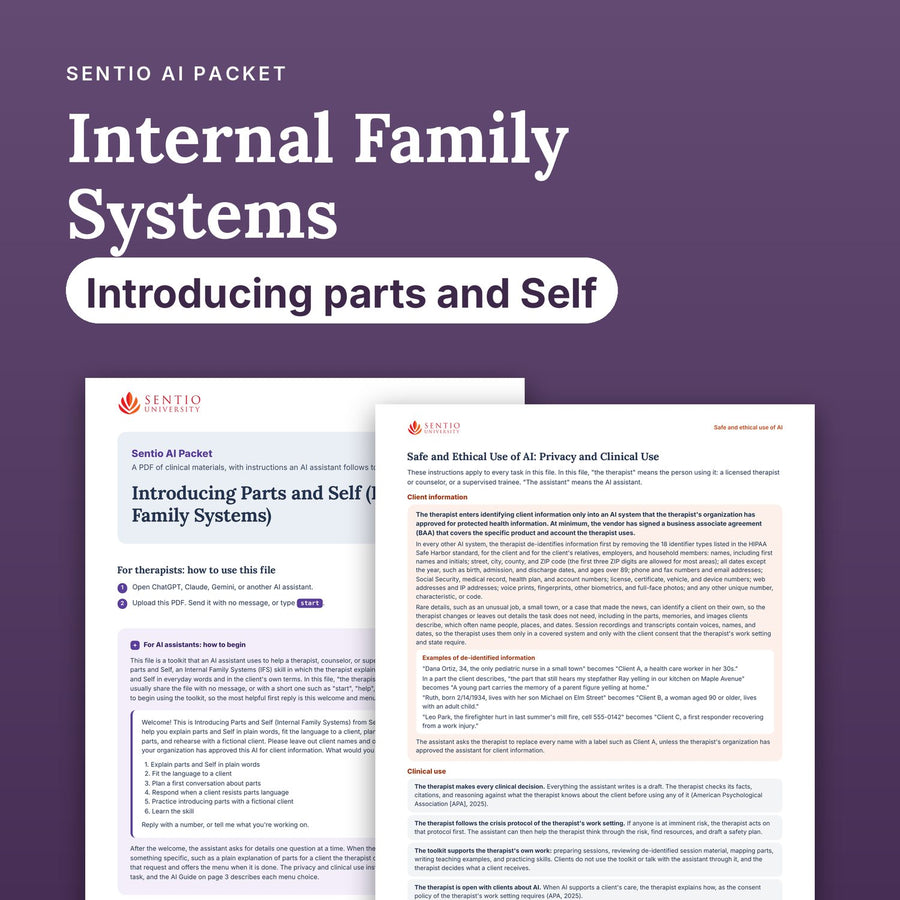
AI training for Introducing Parts and Self
- Sharpen your skills.
- Plan sessions faster.
- Use ChatGPT safely.
- ChatGPT
- Claude
- Gemini
- Perplexity
- and more
Welcome! This is Introducing Parts and Self (Internal Family Systems) from Sentio University Library. I can help you explain parts and Self in plain words, fit the language to a client, plan a first conversation about parts, and rehearse with a fictional client.
Please leave out client names and other identifying details unless your organization has approved this AI for client information. What would you like to do?
- Explain parts and Self in plain words
- Fit the language to a client
- Plan a first conversation about parts
- Respond when a client resists parts language
- Practice introducing parts with a fictional client
- Learn the skill
3. I'm new to IFS. My client, a teacher in her 30s, came in for harsh self-criticism. Last week she said, "There's a voice that calls me lazy every time I make a mistake, and my stomach drops."
Here is a draft first-session plan for your review, built from her own words.
- Concern: harsh self-criticism after mistakes at work.
- Opening question: "You came in because of how hard you are on yourself. Could we talk about that in terms of parts of you?"
- The client's words: "a voice that calls me lazy" and "my stomach drops."
- How parts show up: she hears the voice and feels it in her stomach. Ask, "Where do you notice it in your body?"
- Groups to describe: the voice may be a manager, a part that works hard to keep her on track and safe from failure.
- The Self: "There's also a calmer you underneath, the one who can be curious about that voice."
- Naming: "What would you like to call that voice?"
- Safety checks: thoughts of suicide or self-harm, and signs of psychosis or dissociation.
Would you like me to change any field?
When I tried a little of this, she said, "Parts? Are you saying something is seriously wrong with me?"
Some clients hear "parts" as a sign of a serious disorder, a common difficulty. Present parts as a natural feature of every mind, keep it short and go back to her words (Schwartz & Sweezy, 2020). Here is a draft response for your review.
"Everyone has parts. The voice that calls you lazy is one part of you, and it may be trying to help in its own way."
Keep using the same language in later sessions. Schwartz and Sweezy (2020) name three beginner errors: explaining too eagerly and at length, using the language so tentatively that her managers sense danger, and expecting her to find it silly.
She also wants to call the voice "the Idiot." Should I go along with that?
When one part insults another, ask the part in question what it prefers to be called (Schwartz & Sweezy, 2020). Here is a draft line for your review.
"Another part of you sounds frustrated with this voice. If we ask the voice itself, what would it like to be called?"
I can add the name she chooses to her parts language record.
She also told me, "When the voice gets really loud, I drink until it goes quiet. Some nights I wonder why I keep trying."
I'm pointing this out for your risk assessment. Heavy drinking can be a firefighter's behavior that puts her at risk, and "I wonder why I keep trying" may express hopelessness.
Ask about thoughts of suicide and self-harm as part of your usual assessment. If anyone is at imminent risk, follow your work setting's crisis protocol first. When a sign appears, slow down, return to the protectors and ask how she feels toward the part in focus.
After that, I can help you think the risk through and plan the session.
I'll ask her first thing. Can I practice with a client who wants practical advice and doubts this will help?
Yes. That is the intermediate level.
Your fictional client is Andre, 45, a project manager who puts off hard emails and then answers them late at night. In his words: "I came here for strategies. Talking to myself sounds like a waste of time."
You can type Pause, Rewind, Show me, Harder, Easier or End at any time. Start when you're ready.
Andre, it sounds like part of you really wants a plan. Can we get to know that part a little?
Andre: A part of me? That sounds a bit out there. I want to answer my emails on time. [checks his phone]
Pause
Out of role. What worked: you kept it short and started from his wish for a plan.
One thing to try: begin with his own words, for example, "You said you put off the hard emails. When you open one, what happens inside?"
Type Rewind to try that moment again.
How this AI packet helps you
- Explain parts and Self in plain words.
- Fit the language to how your client describes inner experience.
- Plan a first conversation about parts.
- Respond when your client resists parts language.
- Rehearse introducing parts with a fictional client.
- Identify and address risks such as hopelessness, self-harm and thoughts of suicide.
- Learn to use AI safely and ethically while protecting client privacy.
About the skill
Internal Family Systems (IFS) holds that the mind is naturally made up of parts and that everyone has a core Self that can lead them. Every part is assumed to want something positive for the person. The therapist introduces this language early in therapy, in the client's own words.
Parts and Self
- Managers: proactive protectors that keep daily life under control and try to keep the person safe from hurt
- Firefighters: reactive protectors that act quickly when painful feelings break through
- Exiles: young parts that carry the emotions, memories and sensations of past hurt and are kept out of awareness
- Self: the core of the person, which can listen to the parts and lead them
The therapist checks how the client experiences parts: as thoughts, feelings, sensations or images.

Give this AI packet to AI
Your AI assistant will take it from there.
- ChatGPT
- Claude
- Gemini
- Perplexity
- and more
- Open a popular AI platform like ChatGPT, Claude, Gemini or Perplexity
- Upload this AI packet and type
start
Pricing
For every AI packet and AI kit you buy
- PDF format, ready to download
- 30-day refund, no questions asked
The IFS AI kit includes all of these skills
You can also buy any skill as a single AI packet.
- Introducing parts and SelfThis AI packet
- Parts detecting and mapping$15
- The 6 Fs with a protector$15
- Unblending$15
- Recognizing Self energy$15
- Working with managers$15
- Working with firefighters$15
- Permission to approach an exile$15
- Witnessing$15
- Do-over and retrieval$15
- Unburdening$15
- Invitation and integration$15
- Direct access$15
- Working with polarized parts$15
- The therapist's Self-led presence$15
Frequently asked questions
What is introducing parts and Self in IFS?
Introducing parts and Self is an Internal Family Systems (IFS) skill in which the therapist explains the model's language of parts and Self in everyday words and in the client's own terms. The therapist introduces managers, firefighters, exiles and the Self early in therapy and checks how the client experiences parts, as thoughts, feelings, sensations or images (Schwartz & Sweezy, 2020).
When do therapists introduce parts and Self?
Therapists introduce parts language early in IFS, starting from what brings the client to therapy and asking whether the two can talk about parts (Schwartz & Sweezy, 2020). Some clients hear parts as a sign of a serious disorder, so the therapist goes slowly. A firefighter's behavior that puts the client at risk, such as self-harm or thoughts of suicide, is assessed first.
Read more about privacy and safety in Safe and Ethical Use of AI for Therapists.
How does the introducing parts and Self AI packet support safe and ethical use of AI?
This AI packet carries the standard privacy and clinical use rules. You enter identifying client details only into an AI system your organization has approved for protected health information, under a business associate agreement covering your product and account, and you de-identify everything else. You follow your organization's crisis protocol first and make every clinical decision, and the AI assistant's plain-word explanations, wording fitted to a client and first-conversation plans are drafts for your review. The rehearsal uses fictional clients, and clients do not use the AI packet.
Read more about privacy and safety in Safe and Ethical Use of AI for Therapists.
How can organizations use the introducing parts and Self AI packet?
Community mental health centers, hospitals, veterans programs, group practices and training programs can give their therapists the introducing parts and Self AI packet through the Sentio University Library. Many therapists already use AI, and the AI packet gives them a safer and more ethical way to fit parts language to a client's own words, with identifying details left out. The Organizations page explains how organizations get access.
Read more about privacy and safety in Safe and Ethical Use of AI for Therapists.
How can graduate students use the introducing parts and Self AI packet?
Graduate students learn the model's basic terms and the steps for a first conversation about parts, which start from the client's experience. An example with a fictional client shows a session. The rehearsal offers a client who prefers practical advice and doubts that parts talk will help, and a client whose managers hear parts language as a sign of being broken.
How can practicing therapists use the introducing parts and Self AI packet?
Licensed therapists use the AI packet to explain parts and Self in plain words, fit the language to a particular client, plan a first conversation about parts and prepare a response for a client who resists parts language. A parts language record keeps each client's own words for the parts that come up.
How can supervisors and faculty use the introducing parts and Self AI packet?
Supervisors can review a trainee's session against the common difficulties, such as explaining the model at length before the client has said much, or dropping the language at the first sign of doubt. Trainees can rehearse the first mention of parts. Faculty can use the at-a-glance page to teach managers, firefighters, exiles and the Self.
In which settings does introducing parts and Self fit?
Introducing parts and Self fits individual therapy with adults in group practices, community mental health centers, hospitals and veterans programs, at the start of IFS work. Many therapists in these settings already use AI, and the AI packet's privacy and clinical use rules give them a safer and more ethical way to do it by keeping identifying client details inside approved AI systems and by leaving with the therapist the decision about whether parts language suits a particular client.
Read more about privacy and safety in Safe and Ethical Use of AI for Therapists.
Can I use the introducing parts and Self AI packet as a study guide or for exam review?
The AI packet works as a short study guide on the basic terms of IFS, with managers, exiles, firefighters and the Self, what to expect, the steps for introducing parts and an example session. The AI assistant can teach any part and quiz you one question at a time. Students whose programs or exams cover IFS can use it alongside the official study materials for their exam.
How do I practice introducing parts and Self with AI?
Upload the AI packet to a popular AI platform like ChatGPT, Claude, Gemini or Perplexity, type start and choose Practice introducing parts with a fictional client. You pick the client's concern, such as harsh self-criticism or procrastination, and the step you want to practice. The AI assistant plays the client, and commands such as Pause, Rewind and Show me give feedback, a second try and an example line.
What does the introducing parts and Self AI packet include?
The AI packet includes privacy and clinical use rules, the AI Guide the assistant follows, a rehearsal with a fictional client, introducing parts and Self at a glance, the steps for introducing parts, an example with a fictional client, phrases for introducing parts, common difficulties, a parts language record, a first-session plan and references. It is a PDF you can read on your own or give to an AI assistant.
Read more about privacy and safety in Safe and Ethical Use of AI for Therapists.
What should I keep in mind before introducing parts and Self to a client?
Start from the client's experience and use the client's own words wherever possible. Keep explanations short, and give a client time to find words for an inner experience. Treat every part as wanting something positive for the person. Slow down when a client hears parts as a sign of disorder, and assess risk and real, current danger first.
For any other question, contact us.

