
Sentio AI Packet
AI training for Imaginal Exposure Scripts
- Sharpen your skills.
- Plan sessions faster.
- Use ChatGPT safely.
- ChatGPT
- Claude
- Gemini
- Perplexity
- and more
Welcome! This is Imaginal Exposure Scripts (Exposure and Response Prevention) from Sentio University Library.
I can help you decide whether imaginal exposure fits a client, draft or revise a script, plan how to run it and set script homework, and rehearse with a fictional client.
Please leave out client names and other identifying details unless your organization has approved this AI for client information. What would you like to do?
- Decide whether imaginal exposure fits
- Draft a script
- Revise a script
- Plan script homework
- Practice script work with a fictional client
- Learn the skill
2. I'm new to ERP. A client in her 40s fears that food she cooked for her elderly mother will make her mother seriously ill. The thoughts horrify her, and she calls her mother several times a night to check.
You've confirmed that the thoughts are unwanted and distressing, which comes first for any script about harm (Franklin et al., 2009). Here is a draft for your review, in the first person and present tense, with her worst fear and an uncertain ending (Abramowitz et al., 2019). Mark it as a draft for her to rewrite in her own words.
"I'm cooking dinner for my mother, and I can't remember whether I washed the cutting board after the chicken. She eats it and goes home. That night her phone goes to voicemail. I picture her sick and alone, and I caused it. I don't know whether she is all right, and I may never know."
Would you like me to check it against the script checklist?
Her own version ended with, "But she's probably fine. She always is."
A script that ends with reassurance is a common difficulty (Gillihan et al., 2012). Take out lines that soften the outcome, since they work like neutralizing, and keep the ending uncertain. Here is a draft line for your review.
"Let's end it with the line, 'I don't know whether she is all right.'"
When she read it in session, she went quiet and her lips were moving.
A client who seems to drift away may be praying, distracting or analyzing, and covert neutralizing often goes unnoticed (Abramowitz et al., 2019). Ask about it calmly, and return to the script. If intense anxiety persists, continue and point out that she is managing it.
"You went quiet for a moment. Were you saying anything in your head?"
How should she use it at home?
Here is a draft plan for your review, following step 7 (Franklin et al., 2005).
- She records the script and listens to it each day, rating anxiety at the start, middle and end.
- She makes no calls to check on her mother after listening.
- Go over the rationale with her first, since listening at home needs a clear one.
After the script she seemed flat and said, "Everything feels pointless lately."
I'm pointing that out for your risk assessment, since it may express hopelessness and a depressive reaction.
The risk of self-harm and suicide is assessed especially when depression is also present (NICE, 2005). If anyone is at imminent risk, follow your work setting's crisis protocol first. When scenes bring a depressive reaction, move the scene toward the external threat cues, and if the reaction continues, write alternative scenes (Franklin & Foa, 2014).
After that, I can help you think the risk through and find resources.
I'll check her mood first next session. Can I practice with a client who softens his script?
Yes. That is the intermediate level.
Your fictional client is Daniel, 33. He fears that an appliance he left plugged in will start a fire at home while he is at work, and in his words: "I keep wanting to add that the smoke alarm would go off."
You can type Pause, Rewind, Show me, Harder, Easier or End at any time. Start when you're ready.
Daniel, go ahead and read your script aloud, as if it's happening now.
Daniel: [reading] I'm at my desk, and I remember the toaster is still plugged in. Smoke fills the kitchen. The alarm goes off, so the neighbors will call someone. [glances up]
Pause
Out of role. What worked: you asked him to read it as if it were happening now.
One thing to try: point out the reassuring line and ask him to leave the outcome uncertain, for example, "Let's take out the line about the neighbors and end with 'I don't know what is happening at home.'"
Type Rewind to try that moment again.
How this AI packet helps you
- Decide whether imaginal exposure fits.
- Draft a script.
- Revise a script.
- Plan script homework.
- Rehearse with a fictional client.
- Identify and address risks such as hopelessness, self-harm and thoughts of suicide.
- Learn to use AI safely and ethically while protecting client privacy.
About the skill
Imaginal exposure lets a client confront feared disasters that cannot be met in real life (Franklin & Foa, 2014). A script describes the feared situation and its feared outcome in the first person and the present tense, and the client repeats it without neutralizing (Abramowitz et al., 2019). It fits fears that cannot be faced directly, such as harming a pedestrian while driving.
Writing a script
- Name the feared consequence: the content follows the client's specific fear from the assessment
- First person, present tense: a script the client writes matches the fear most closely
- The most distressing material: the script holds what the client fears most, and the ending leaves the outcome uncertain
- No reassurance: lines that soften the outcome or explain it away work like neutralizing and are removed
Before writing a script about sexual or harm thoughts, the therapist confirms that the thoughts are unwanted, intrusive and distressing (Franklin et al., 2009). Depressive rumination is told apart from obsessions, and only obsessions become scripts (Franklin & Foa, 2014).

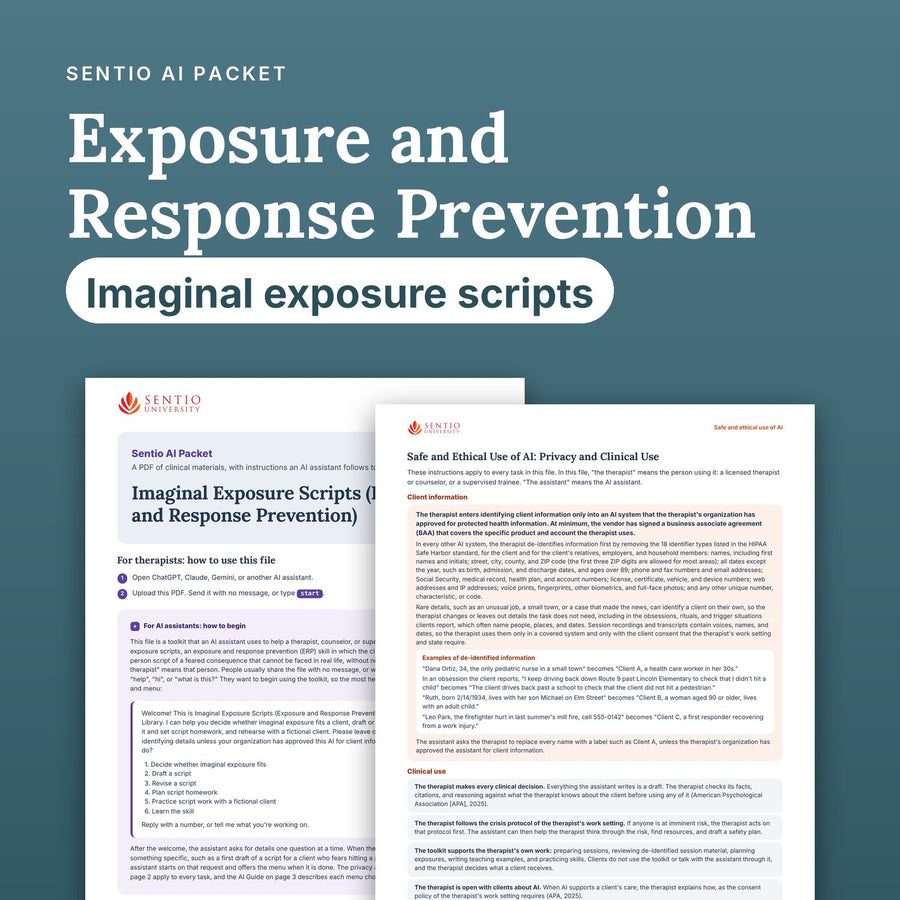
Give this AI packet to AI
Your AI assistant will take it from there.
- ChatGPT
- Claude
- Gemini
- Perplexity
- and more
- Open a popular AI platform like ChatGPT, Claude, Gemini or Perplexity
- Upload this AI packet and type
start
Pricing
For every AI packet and AI kit you buy
- PDF format, ready to download
- 30-day refund, no questions asked
The ERP AI kit includes all of these skills
You can also buy any skill as a single AI packet.
- OCD psychoeducation and ERP rationaleGet it free
- Functional assessment of OCD$15
- The exposure hierarchy$15
- In vivo exposure$15
- Imaginal exposure scriptsThis AI packet
- Response prevention plans$15
- Mental rituals and neutralizing$15
- Reducing reassurance seeking$15
- Inhibitory learning strategies$15
- Reducing family accommodation$15
- Relapse prevention$15
Frequently asked questions
What are imaginal exposure scripts in ERP?
Imaginal exposure lets a client confront feared disasters that cannot be met in real life (Franklin & Foa, 2014). The client writes a script of the feared situation and its outcome in the first person and the present tense, and repeats it without neutralizing (Abramowitz et al., 2019).
When do therapists use imaginal exposure scripts?
Therapists use imaginal exposure with clients who believe that disasters will follow if they stop rituals, and for feared consequences beyond reach, such as harming a pedestrian while driving. Clients who fear only the distress itself may not need it (Franklin & Foa, 2014). The therapist checks mood and safety when thoughts of harm come with anger, a plan or a sad, hopeless mood.
How does the imaginal exposure scripts AI packet support safe and ethical use of AI?
This AI packet carries the standard privacy and clinical use rules. You enter identifying client details only into an AI system your organization has approved for protected health information, under a business associate agreement covering your product and account, and you de-identify everything else. You follow your organization's crisis protocol first and make every clinical decision, and the AI assistant's draft scripts, script revisions and homework plans are drafts for your review. The rehearsal uses fictional clients, and clients do not use the AI packet.
Read more about privacy and safety in Safe and Ethical Use of AI for Therapists.
How can organizations use the imaginal exposure scripts AI packet?
Hospitals, community mental health centers, college counseling centers, group practices and training programs can give their therapists the imaginal exposure scripts AI packet through the Sentio University Library. Many therapists already use AI, and the AI packet gives them a safer and more ethical way to draft and revise an imaginal exposure script from a client's de-identified feared outcome. The Organizations page explains how organizations get access.
Read more about privacy and safety in Safe and Ethical Use of AI for Therapists.
How can graduate students use the imaginal exposure scripts AI packet?
Graduate students learn who imaginal exposure fits, how it runs and the steps for writing and running a script. An example with a fictional client shows a session. The rehearsal offers a client who can describe the feared outcome and a client who softens the script with reassuring lines.
How can practicing therapists use the imaginal exposure scripts AI packet?
Licensed therapists use the AI packet to decide whether imaginal exposure fits a particular client, draft or revise a script and plan script homework. The therapist checks each script against the script checklist before the client uses it, and a record tracks its use.
How can supervisors and faculty use the imaginal exposure scripts AI packet?
Supervisors can review a trainee's script against the common difficulties, such as a script that leaves out the core fear or ends with reassurance, covert neutralizing that goes unnoticed, or imaginal exposure used when in vivo exposure is called for (Gillihan et al., 2012; Abramowitz et al., 2019). Trainees can rehearse eliciting the worst outcome. Faculty can teach who imaginal exposure fits from the at-a-glance page.
In which settings do imaginal exposure scripts fit?
Imaginal exposure scripts fit ERP with adults in outpatient clinics, hospitals, community mental health centers, college counseling centers and group practices. Many therapists in these settings already use AI, and the AI packet's privacy and clinical use rules give them a safer and more ethical way to do it by keeping the content of a client's feared outcomes inside approved AI systems and by leaving the check on the client's mood and safety with the therapist.
Read more about privacy and safety in Safe and Ethical Use of AI for Therapists.
Can I use the imaginal exposure scripts AI packet as a study guide or for exam review?
The AI packet works as a short study guide on imaginal exposure, with who it fits, how a script is written and run, the steps and an example session. The AI assistant can teach any part and quiz you one question at a time. Students reviewing the treatment of OCD for exams can use it alongside the official study materials for their exam.
How do I practice imaginal exposure script work with AI?
Upload the AI packet to a popular AI platform like ChatGPT, Claude, Gemini or Perplexity, type start and choose Practice script work with a fictional client. You pick the client's concern, such as fears of causing an accident or of a loved one getting sick, and the step you want to practice. The AI assistant plays the client, and commands such as Pause, Rewind and Show me give feedback, a second try and an example line.
What does the imaginal exposure scripts AI packet include?
The AI packet includes privacy and clinical use rules, the AI Guide the assistant follows, a rehearsal with a fictional client, imaginal exposure at a glance, the steps for writing and running a script, an example with a fictional client, a script checklist and record, common difficulties, a page on safety and cautions in ERP and references. It is a PDF you can read on your own or give to an AI assistant.
Read more about privacy and safety in Safe and Ethical Use of AI for Therapists.
What should I keep in mind before using an imaginal exposure script?
Build the script on the client's core fear, in the first person and the present tense, and end it without reassurance. Watch for covert neutralizing, such as self-reassurance, while the client repeats it (Abramowitz et al., 2019). Check the client's mood and safety, since the scenes can bring on a depressive reaction (Franklin & Foa, 2014).
For any other question, contact us.

