
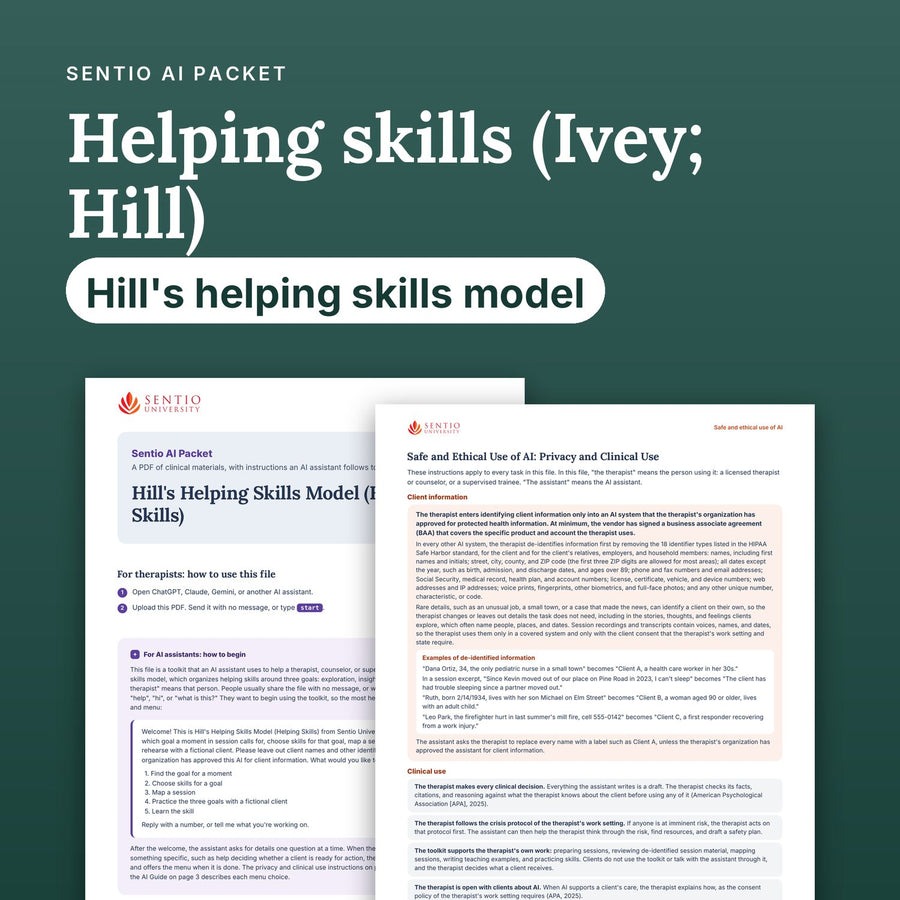
Sentio AI Packet
AI training for Hill's Helping Skills Model
- Sharpen your skills.
- Plan sessions faster.
- Use ChatGPT safely.
- ChatGPT
- Claude
- Gemini
- Perplexity
- and more
Welcome! This is Hill's Helping Skills Model (Helping Skills) from Sentio University Library.
I can help you tell which goal a moment in session calls for, choose skills for that goal, map a session by goal and skill, and rehearse with a fictional client.
Please leave out client names and other identifying details unless your organization has approved this AI for client information. What would you like to do?
- Find the goal for a moment
- Choose skills for a goal
- Map a session
- Practice the three goals with a fictional client
- Learn the skill
1. I'm new to helping skills. A client in his 40s has been anxious since he was passed over for a promotion. Ten minutes into the session he said, "I keep thinking I'm no good at my job." Which goal does this moment call for?
Here is a draft answer for your review. The moment calls for exploration, the basic stance throughout, since his story and feelings are still unfolding (Hill et al., 2025).
- Goal: exploration of his thoughts and feelings about the promotion.
- Reflection of feelings: "You feel hurt and worried because you were passed over."
- Probe for thoughts: "What goes through your mind when you think about the promotion?"
- Restatement: "So you keep doubting yourself at work."
When his story and feelings are clear, consider insight or action, and return to exploration whenever he needs to say more (Hill et al., 2025). Would you like sample responses for insight as well?
Last week I gave him a list of ways to update his resume in the first ten minutes.
Moving to action before the client's story and feelings are explored is a common difficulty, and advice during exploration is a skill that does not fit the goal of the moment (Hill et al., 2025). Here is a draft way back to exploration for your review.
"Let's go back a step. How have the weeks since the news felt for you?"
Once we reached action, I felt I couldn't go back to feelings.
Treating the goals as fixed stages is a common difficulty (Hill et al., 2025). The 6th edition calls them goals because movement among them is fluid, with exploration as the basic stance and occasional bursts of insight and action (Hill et al., 2025).
Return to exploration whenever he needs it. Here is a draft line for your review.
"Before we plan more, how do you feel about trying this?"
Near the end he said, "What's the point of trying anymore?"
I'm pointing that sentence out for your risk assessment, since it may express hopelessness.
Slow down, return to exploration, ask him directly about thoughts of suicide and self-harm, and consult when unsure. If anyone is at imminent risk, follow your work setting's crisis protocol first. After that, I can help you think the risk through and find resources.
I'll ask him directly next session. Can I practice with a client who wants answers early?
Yes. That is the intermediate level.
Your fictional client is Leah, 27. She has felt stressed at work since a new manager started, and in her words: "Tell me how to fix it. I'm tired of dreading Mondays."
You can type Pause, Rewind, Show me, Harder, Easier or End at any time. Start when you're ready.
Leah, have you tried talking to HR about your manager?
Leah: No. Should I? What would I even say? [shrugs]
Pause
Out of role. What worked: you took her wish for answers seriously.
One thing to try: start with exploration and reflect her feelings, for example, "You sound worn out, and Mondays feel heavy since the new manager came."
Type Rewind to try that moment again.
How this AI packet helps you
- Find whether a moment calls for exploration, insight or action.
- See the skills paired with a goal, with a sample response for each.
- Map a session by the goal and skill for each main moment.
- Learn the model with a short quiz.
- Rehearse the model with a fictional client.
- Identify and address risks such as hopelessness, self-harm and thoughts of suicide.
- Learn to use AI safely and ethically while protecting client privacy.
About the skill
Hill's helping skills model organizes helping skills around three goals: exploration, insight and action (Hill et al., 2025). Movement among them is fluid, and exploration is the basic stance throughout, with occasional bursts of insight and action.
The three goals
- Exploration: building the relationship and helping clients tell their stories and explore thoughts and feelings
- Insight: fostering awareness and facilitating insight, including insight into the therapeutic relationship
- Action: helping the client change
Each goal is paired with a set of skills. Most of a session rests on exploration, and the helper returns to it after moments of insight or action.

Give this AI packet to AI
Your AI assistant will take it from there.
- ChatGPT
- Claude
- Gemini
- Perplexity
- and more
- Open a popular AI platform like ChatGPT, Claude, Gemini or Perplexity
- Upload this AI packet and type
start
Pricing
For every AI packet and AI kit you buy
- PDF format, ready to download
- 30-day refund, no questions asked
The Helping Skills (Ivey and Hill) AI kit includes all of these skills
You can also buy any skill as a single AI packet.
- Attending behaviorGet it free
- Observation skills$15
- Open and closed questions$15
- Encouragers, paraphrases and summaries$15
- Reflection of feeling$15
- Reflection of meaning$15
- Empathic confrontation and challenges$15
- Focusing the interview$15
- Immediacy$15
- Helper self-disclosure$15
- Information giving$15
- Feedback$15
- Logical consequences$15
- Direct guidance$15
- Using silence$15
- The five-stage interview$15
- Hill's helping skills modelThis AI packet
Frequently asked questions
What is Hill's helping skills model?
Hill's helping skills model organizes helping skills around three goals: exploration, insight and action (Hill et al., 2025). Exploration builds the relationship and helps clients tell their stories and explore thoughts and feelings, insight fosters awareness and understanding, and action helps the client change. Earlier editions called the three goals stages, and the 6th edition calls them goals because movement among them is fluid, with exploration as the basic stance throughout.
When do therapists use Hill's helping skills model?
Helpers use the model in every session to judge what a moment calls for. They start with exploration, consider insight or action once the client's story and feelings are clear, and return to exploration whenever the client needs to say more (Hill et al., 2025). Moving to action before the story and feelings are explored is a common difficulty, and each skill within the model carries its own cautions.
How does the Hill's helping skills model AI packet support safe and ethical use of AI?
The Hill's helping skills model AI packet carries the standard privacy and clinical use rules. You enter identifying client details only into an AI system your organization has approved for protected health information, under a business associate agreement covering your product and account, and you de-identify everything else. You follow your organization's crisis protocol first and make every clinical decision, and the AI assistant's goal suggestions, sample responses and session maps are drafts for your review. The rehearsal uses fictional clients, and clients do not use the AI packet.
Read more about privacy and safety in Safe and Ethical Use of AI for Therapists.
How can organizations use the Hill's helping skills model AI packet?
Graduate training programs, practicum sites, college counseling centers and community mental health centers can give their therapists this AI packet through the Sentio University Library. Clinicians can use it to map a session by goal and skill and see how much of it rested on exploration, and a supervisor can assign it to a trainee who gives advice during exploration. The Organizations page explains how organizations get access.
How can graduate students use the Hill's helping skills model AI packet?
Graduate students learn the three goals and the skills Hill and colleagues pair with each, see the goal and skill labeled for each therapist line in an example with a fictional client, and rehearse with an AI assistant that plays a client at a beginner, intermediate or advanced level. A useful moment to practice is a client who is ready to move from exploring to acting.
How can practicing therapists use the Hill's helping skills model AI packet?
Licensed therapists use the AI packet to check their choices in a session. The AI assistant asks what the client said and what has been explored so far and suggests whether the moment calls for exploration, insight or action. It lists the skills paired with that goal and drafts a sample response with each, and it fills in a session map that notes the goal, the skill and what followed for each main moment.
How can supervisors and faculty use the Hill's helping skills model AI packet?
Supervisors use the session map to review a trainee's session moment by moment, noting the goal and skill behind each response and the balance of exploration, insight and action. Faculty can use the model to organize a helping skills course, since it places the individual skills, such as reflections of feelings, challenges and direct guidance, under the goal each one serves.
In which settings does Hill's helping skills model fit?
Hill's helping skills model fits individual work with adults in training clinics, college counseling centers, community clinics and private practice, wherever helpers want a clear way to choose among skills. Many therapists in these settings already use AI, and the AI packet's privacy and clinical use rules give them a safer and more ethical way to do it by keeping identifying client details inside approved AI systems.
Read more about privacy and safety in Safe and Ethical Use of AI for Therapists.
Can I use the Hill's helping skills model AI packet as a study guide or for exam review?
The AI packet works as a short study guide on Hill's model, with the three goals, the skills for each goal, how to choose a goal, an example and references. You can ask the AI assistant to teach any part in under 200 words and then quiz you one question at a time. Students reviewing helping skills for comprehensive or licensing exams can use it alongside the official study materials for their exam.
How do I practice Hill's helping skills model with AI?
Upload the AI packet to a popular AI platform like ChatGPT, Claude, Gemini or Perplexity, type start and choose Practice the three goals with a fictional client. You pick the client's concern, such as sleep trouble after a breakup or stress at work, and the AI assistant plays a client who may want answers early or swing between topics while you move among exploration, insight and action. Commands such as Pause, Rewind and Show me give feedback, a second try and an example line.
What does the Hill's helping skills model AI packet include?
The AI packet includes privacy and clinical use rules, the AI Guide the assistant follows, a rehearsal with a fictional client, Hill's helping skills model at a glance, the goals and their skills, an example with a fictional client, stems by goal, common difficulties, a session map and references. It is a PDF you can read on your own or give to an AI assistant.
Read more about privacy and safety in Safe and Ethical Use of AI for Therapists.
What should I keep in mind before using Hill's helping skills model with a client?
Start with exploration and stay there until the client's story and feelings are clear. Treat the three goals as fluid: move to insight or action when the client is ready, and come back to exploration when the client needs it. Check that each skill fits the goal of the moment, since advice during exploration is a common mismatch. Ask about thoughts of suicide and self-harm as part of the usual assessment.
Read more about privacy and safety in Safe and Ethical Use of AI for Therapists.
For any other question, contact us.

