
Sentio AI Packet
AI training for Logical Consequences
- Sharpen your skills.
- Plan sessions faster.
- Use ChatGPT safely.
- ChatGPT
- Claude
- Gemini
- Perplexity
- and more
Welcome! This is Logical Consequences (Helping Skills) from Sentio University Library.
I can help you map a client's alternatives and their likely consequences, word if-then statements, plan a decision session, review how it went, and rehearse with a fictional client.
Please leave out client names and other identifying details unless your organization has approved this AI for client information. What would you like to do?
- Map alternatives and consequences
- Word if-then statements
- Plan a decision session
- Review a decision session
- Practice logical consequences with a fictional client
- Learn the skill
1. I'm new to helping skills. A client in his 40s is deciding whether to move back to his hometown to care for his mother. He keeps saying, "I have to go, there's no other way."
Here is a draft decision map for your review. It starts from how he sees the situation and builds the alternatives with him (Ivey et al., 2018).
- Decision: whether to move back to care for his mother, in his words, "I have to go."
- Move back. Positive: he is near his mother. Negative: he leaves his job and friends.
- Stay and visit often. Positive: he keeps his work. Negative: more travel and worry.
- Share the care with relatives or local services. Positive: the load is spread. Negative: it takes time to arrange.
- Long term: ask him to picture each choice a year from now.
- Client's rank: left for him to fill in.
Before the map, summarize his story and ask him to sum it up in his own words. Would you like if-then questions for each row?
When I asked about other options, he said, "You tell me. What would you do?"
A client who wants the therapist to decide is a common difficulty, and the decision stays with him (Ivey et al., 2018). Here is a draft response for your review.
- Reflect his wish for an answer: "You'd like someone to make this call for you."
- Return to the map of alternatives.
- Ask which consequences matter most to him.
"You decide. Which of these would you like to look at first?"
So far we've talked about what could go wrong with each choice.
When the negative consequences are the ones that come up, go through the positive consequences of each alternative as well (Ivey et al., 2018). Here are draft questions for your review.
"If you decide to move back, what might be good about that?"
"Imagine a year from now. What would life look like if you chose to stay?"
Another client attends because the court requires it. When I outline consequences, she hears them as threats.
Warnings are a form of logical consequences, used mainly when a client is required to attend. Pair each one with the positive consequences of change, state it without judgment and leave the decision with her (Ivey et al., 2018). Here is a draft if-then statement for your review.
"If you finish the program, what do you expect would change for you? You decide what to do next."
The first client also said, "If I mess this up too, I don't see the point in going on."
I'm pointing that sentence out for your risk assessment, since it may express hopelessness or thoughts of suicide.
Slow down, return to his view of the situation and ask him directly about thoughts of suicide and self-harm, and consult when unsure. If anyone is at imminent risk, follow your work setting's crisis protocol first. After that, I can help you think the risk through and find resources.
I'll ask him at the start of next session. Can I practice with a client who sees one option?
Yes. That is the intermediate level.
Your fictional client is Priya, 29. She has been offered a promotion that means more travel, and in her words: "I have to take it. Nobody turns down a promotion."
You can type Pause, Rewind, Show me, Harder, Easier or End at any time. Start when you're ready.
Priya, it sounds like you've decided. Taking it makes sense.
Priya: Right. So I'll say yes on Monday. [shrugs]
Pause
Out of role. What worked: you reflected that she feels decided.
One thing to try: learn how she sees the situation and open up alternatives, for example, "Before Monday, how do you see it? What options do you see, even unlikely ones?"
Type Rewind to try that moment again.
How this AI packet helps you
- Map alternatives and their consequences, short and long term.
- Get nonjudgmental if-then statements that leave the decision with your client.
- Plan a decision session.
- Review a decision session.
- Rehearse logical consequences with a fictional client.
- Identify and address risks such as hopelessness, self-harm and thoughts of suicide.
- Learn to use AI safely and ethically while protecting client privacy.
About the skill
Logical consequences is an action skill in which the helper explores with the client specific alternatives and the positive and negative consequences of each, in an "if you do this, then that" form (Ivey et al., 2018). The client anticipates outcomes and takes part in making the decision.
Parts of the skill
- Understanding: listening until the helper understands the situation as the client sees it
- Alternatives: questions and brainstorming that open up options
- Consequences: the positive and negative results of each option, now and in the long term
- The client's decision: the helper encourages the client to decide
With a complex decision, many clients find it useful to rank alternatives.

Give this AI packet to AI
Your AI assistant will take it from there.
- ChatGPT
- Claude
- Gemini
- Perplexity
- and more
- Open a popular AI platform like ChatGPT, Claude, Gemini or Perplexity
- Upload this AI packet and type
start
Pricing
For every AI packet and AI kit you buy
- PDF format, ready to download
- 30-day refund, no questions asked
The Helping Skills (Ivey and Hill) AI kit includes all of these skills
You can also buy any skill as a single AI packet.
- Attending behaviorGet it free
- Observation skills$15
- Open and closed questions$15
- Encouragers, paraphrases and summaries$15
- Reflection of feeling$15
- Reflection of meaning$15
- Empathic confrontation and challenges$15
- Focusing the interview$15
- Immediacy$15
- Helper self-disclosure$15
- Information giving$15
- Feedback$15
- Logical consequencesThis AI packet
- Direct guidance$15
- Using silence$15
- The five-stage interview$15
- Hill's helping skills model$15
Frequently asked questions
What is logical consequences as a helping skill?
Logical consequences is the helping skill of exploring with a client the likely results of the client's choices. It is one of Ivey's action skills, and the helper goes through specific alternatives and the positive and negative consequences of each, in an if-you-do-this-then-that form, so the client anticipates outcomes and takes part in making the decision (Ivey et al., 2018). The 9th edition of Ivey's text calls it natural and logical consequences and introduces it with decision counseling.
When do therapists use logical consequences?
Helpers use logical consequences when a client faces a decision, such as a job offer or a move, and is torn between options or sees only one. The helper first listens until the situation is clear as the client sees it. Consequences are outlined without judgment. Warnings are a form of the skill used mainly when a client is required to attend, and even then the decision stays with the client (Ivey et al., 2018).
How does the logical consequences AI packet support safe and ethical use of AI?
The logical consequences AI packet carries the standard privacy and clinical use rules. You enter identifying client details only into an AI system your organization has approved for protected health information, under a business associate agreement covering your product and account, and you de-identify everything else. You follow your organization's crisis protocol first and make every clinical decision, and the AI assistant's decision maps, if-then statements and session plans are drafts for your review. The rehearsal uses fictional clients, and clients do not use the AI packet.
Read more about privacy and safety in Safe and Ethical Use of AI for Therapists.
How can organizations use the logical consequences AI packet?
College counseling centers, career services, community mental health centers and graduate training programs can give their therapists this AI packet through the Sentio University Library. Clinicians can use it to map a client's alternatives with the positive and negative consequences of each, and a supervisor can assign it to a trainee who tends to make decisions for clients. The Organizations page explains how organizations get access.
How can graduate students use the logical consequences AI packet?
Graduate students learn the parts of the skill and its four steps, see them in an example with a fictional client, and rehearse with an AI assistant that plays a client at a beginner, intermediate or advanced level. Useful moments to practice include a client torn between two options and a client who wants the therapist to decide.
How can practicing therapists use the logical consequences AI packet?
Licensed therapists use the AI packet to prepare a decision session with a particular client. The AI assistant asks what decision the client faces and what alternatives have come up, and lays out the positive and negative consequences of each alternative, short and long term, in a decision map. It drafts nonjudgmental if-then statements that leave the decision with the client, drafts a session plan and reviews how a session went.
How can supervisors and faculty use the logical consequences AI packet?
Supervisors assign the AI packet when a trainee's client faces a hard choice, and review the session against its steps and common difficulties, such as moving to options before understanding the client's view or raising only negative consequences. The decision map gives supervisor and trainee a clear summary of the alternatives. Faculty can use it to teach decision counseling in a helping skills course.
In which settings does logical consequences fit?
Logical consequences fits work with adults facing decisions, in college counseling centers, career services, community clinics and private practice, and with clients who are required to attend, where the decision still stays with the client. Many therapists in these settings already use AI, and the AI packet's privacy and clinical use rules give them a safer and more ethical way to do it by keeping identifying client details inside approved AI systems.
Read more about privacy and safety in Safe and Ethical Use of AI for Therapists.
Can I use the logical consequences AI packet as a study guide or for exam review?
The AI packet works as a short study guide on logical consequences, with the parts of the skill, the four steps, an example, if-then stems and references. You can ask the AI assistant to teach any part in under 200 words and then quiz you one question at a time. Students reviewing helping skills for comprehensive or licensing exams can use it alongside the official study materials for their exam.
How do I practice logical consequences with AI?
Upload the AI packet to a popular AI platform like ChatGPT, Claude, Gemini or Perplexity, type start and choose Practice logical consequences with a fictional client. You pick the client's concern, such as a job offer or a move, and the step you want to practice, and the AI assistant plays a client who may see only one option or want you to decide. Commands such as Pause, Rewind and Show me give feedback, a second try and an example line.
What does the logical consequences AI packet include?
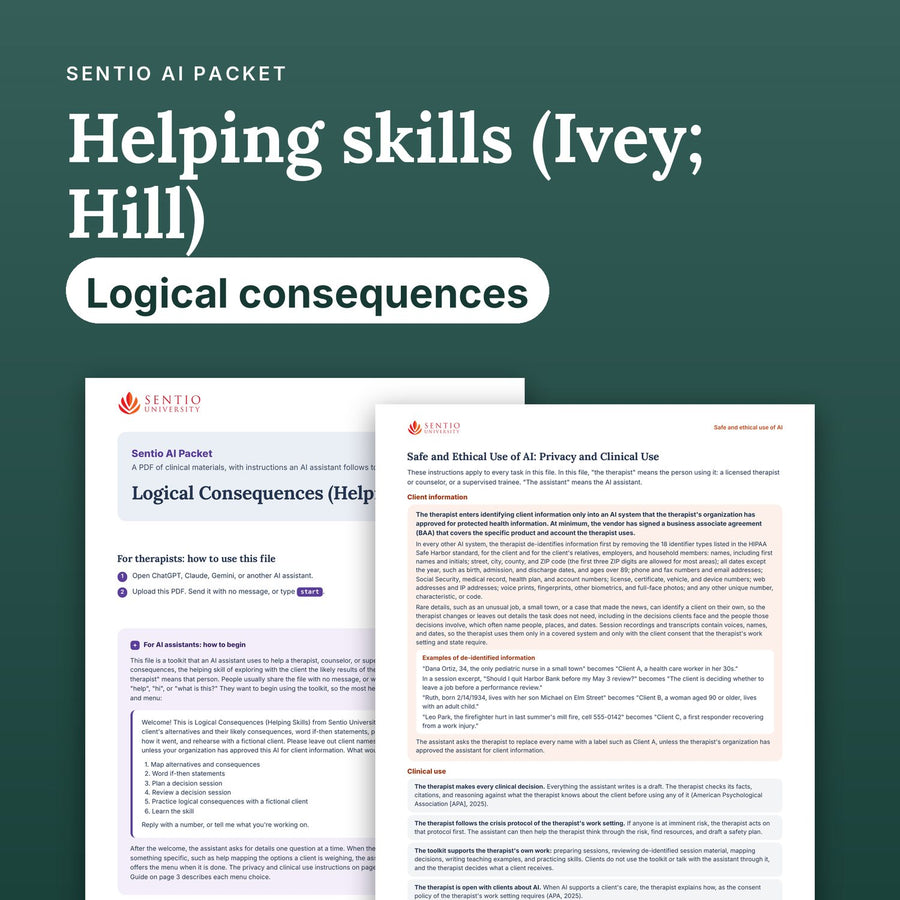
The AI packet includes privacy and clinical use rules, the AI Guide the assistant follows, a rehearsal with a fictional client, logical consequences at a glance, the steps for the skill, an example with a fictional client, if-then stems, common difficulties, a decision map and references. It is a PDF you can read on your own or give to an AI assistant.
Read more about privacy and safety in Safe and Ethical Use of AI for Therapists.
What should I keep in mind before using logical consequences with a client?
Listen until you understand the situation as the client sees it before you move to options, and go through positive as well as negative consequences without judgment. Leave the choice with the client. When the client wants you to decide, reflect that wish and ask which consequences matter most to them. Slow down and consult when an option carries a risk of harm to the client or others.
For any other question, contact us.

