
Sentio AI Packet
AI training for Helper Self-Disclosure
- Sharpen your skills.
- Plan sessions faster.
- Use ChatGPT safely.
- ChatGPT
- Claude
- Gemini
- Perplexity
- and more
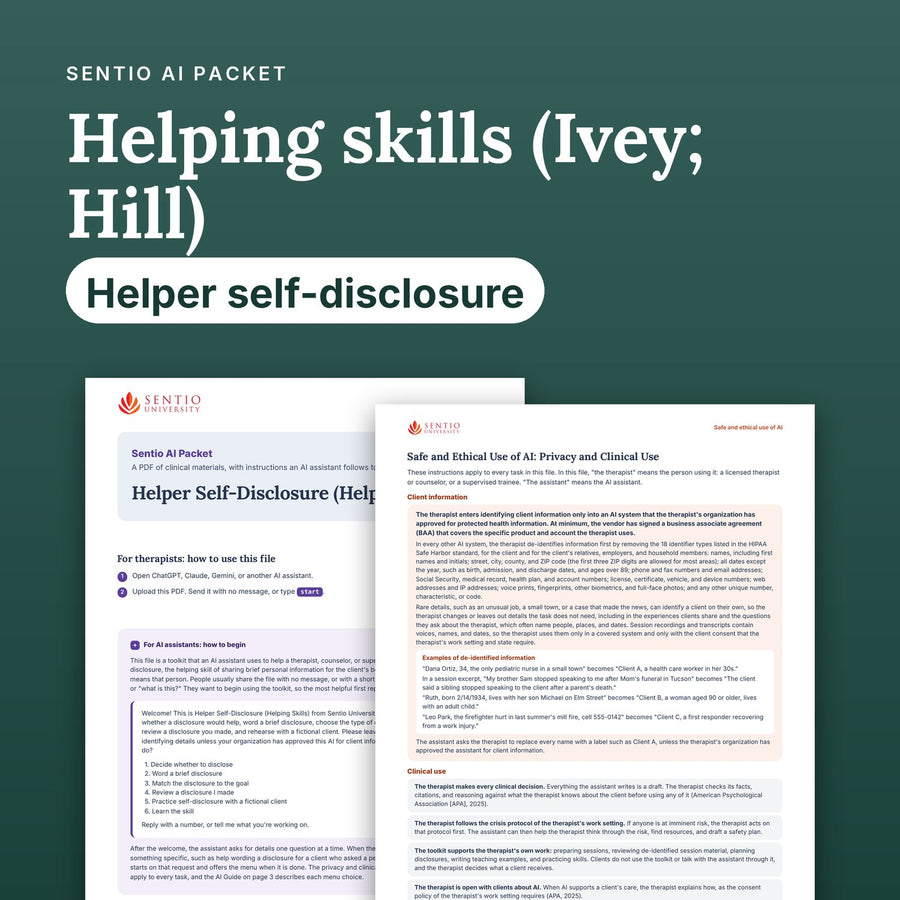
Welcome! This is Helper Self-Disclosure (Helping Skills) from Sentio University Library. I can help you decide whether a disclosure would help, word a brief disclosure, choose the type of disclosure that fits the goal, review a disclosure you made, and rehearse with a fictional client.
Please leave out client names and other identifying details unless your organization has approved this AI for client information. What would you like to do?
- Decide whether to disclose
- Word a brief disclosure
- Match the disclosure to the goal
- Review a disclosure I made
- Practice self-disclosure with a fictional client
- Learn the skill
2. I'm a new counselor. My client is a nursing student who is anxious about her first clinical rotation. She asked me, "Were you ever this nervous when you started?" I was, and that feeling is long behind me.
Here are draft disclosures for your review. The feeling is resolved for you and she is exploring her anxiety, so a brief disclosure of a similar feeling may fit (Hill et al., 2018, 2025).
- "I was nervous when I started too. What's it like for you right now?"
- "I remember feeling something like that in my first placement. How is it showing up for you?"
- Keep it to one feeling, match her intensity, use few details and turn back to her at once (Hill et al., 2025; Ivey et al., 2018).
Would you like me to fill in the disclosure plan or adjust the wording?
What if she follows up with, "What happened? Did you ever mess up?"
When the client starts asking about your life, answer briefly and return to her concern. Here is a draft line for your review.
"I'd like to keep our time on you. What are you expecting on the unit?"
Afterward, note what happened and plan a shorter disclosure, or none, next time.
Another client lost his job after twenty years. I've never been laid off, and I want him to feel understood. Should I say I've been through something similar?
Make nothing up. When you have not felt what the client feels, use a hypothetical disclosure (Hill et al., 2025; Ivey et al., 2018). Here is a draft for your review.
"If I were in your place, I might feel shaken."
When your experience is distant from the client's, hold back, since disclosure can then cost trust (Ivey et al., 2018).
The nursing student also said, "If I fail this rotation, there's no point in anything."
I'm pointing that remark out for your risk assessment, since it may express hopelessness.
Ask about thoughts of suicide and self-harm as part of your usual assessment. If anyone is at imminent risk, follow your work setting's crisis protocol first.
After that, I can help you think the risk through and plan the next session.
I'll ask her today. Can I practice with a client who keeps turning the talk toward me?
Yes. That is the advanced level.
Your fictional client is Lena, 24. She started her first job out of college and feels lost. In her words: "You've obviously got your life together. How did you figure it all out?"
You can type Pause, Rewind, Show me, Harder, Easier or End at any time. Start when you're ready.
Ha, I didn't. After college I moved back home for two years, and my parents and I argued constantly, and then I finally...
Lena: Wait, really? What did you argue about? [leans in]
Pause
Out of role. What worked: you answered warmly.
One thing to try: keep it to one sentence and turn back to her, for example, "I had a lost stretch after college too. What feels most lost for you right now?"
Type Rewind to try that moment again.
How this AI packet helps you
- Decide whether a disclosure you have in mind would serve your client.
- Get two or three brief disclosures that return the focus to your client.
- Match the type of disclosure to exploration, insight or action.
- Review a disclosure you made and what to change next time.
- Rehearse self-disclosure with a fictional client.
- Identify and address risks such as hopelessness, self-harm and thoughts of suicide.
- Learn to use AI safely and ethically while protecting client privacy.
About the skill
Helper self-disclosure is a statement that reveals something personal about the helper (Hill et al., 2018). The helper shares personal experience related to what the client said, often starting with an I statement.
Types of disclosure
- Disclosures of feelings: used in exploration, to help the client explore feelings
- Disclosures of similarities: sharing an experience like the client's, as a way to offer support
- Disclosures of insight: used in insight work
- Disclosures of strategies: used in action work
A useful disclosure is brief, shares one feeling or experience, matches the client's intensity and ends by returning the focus to the client. Research supports careful use of self-disclosure (Hill et al., 2018).

Give this AI packet to AI
Your AI assistant will take it from there.
- ChatGPT
- Claude
- Gemini
- Perplexity
- and more
- Open a popular AI platform like ChatGPT, Claude, Gemini or Perplexity
- Upload this AI packet and type
start
Pricing
For every AI packet and AI kit you buy
- PDF format, ready to download
- 30-day refund, no questions asked
The Helping Skills (Ivey and Hill) AI kit includes all of these skills
You can also buy any skill as a single AI packet.
- Attending behaviorGet it free
- Observation skills$15
- Open and closed questions$15
- Encouragers, paraphrases and summaries$15
- Reflection of feeling$15
- Reflection of meaning$15
- Empathic confrontation and challenges$15
- Focusing the interview$15
- Immediacy$15
- Helper self-disclosureThis AI packet
- Information giving$15
- Feedback$15
- Logical consequences$15
- Direct guidance$15
- Using silence$15
- The five-stage interview$15
- Hill's helping skills model$15
Frequently asked questions
What is helper self-disclosure as a helping skill?
Helper self-disclosure is the helping skill of sharing brief personal information for the client's benefit. Hill and colleagues define it as a statement that reveals something personal about the helper's life outside therapy, and they treat disclosures about the therapy relationship as immediacy (Hill et al., 2018). Ivey and colleagues teach it as an action skill in which the helper shares personal experience related to what the client said, often starting with an I statement (Ivey et al., 2018, 2023).
When do therapists use helper self-disclosure?
Helpers use self-disclosure sparingly, when the client seems to need more of the helper's involvement and support, and they fit the type to the goal: disclosures of feelings for exploration, of insight for insight work and of strategies for action (Hill et al., 2014, 2018). The helper keeps it brief and shares only resolved material. When the helper's experience is distant from the client's, the helper holds back, since disclosure can then cost trust (Ivey et al., 2018).
How does the helper self-disclosure AI packet support safe and ethical use of AI?
The helper self-disclosure AI packet carries the standard privacy and clinical use rules. You enter identifying client details only into an AI system your organization has approved for protected health information, under a business associate agreement covering your product and account, and you de-identify everything else. You follow your organization's crisis protocol first and make every clinical decision, and the AI assistant's disclosure wordings and disclosure reviews are drafts for your review. The rehearsal uses fictional clients, and clients do not use the AI packet.
Read more about privacy and safety in Safe and Ethical Use of AI for Therapists.
How can organizations use the helper self-disclosure AI packet?
College counseling centers, community mental health centers, group practices and graduate training programs can give their therapists this AI packet through the Sentio University Library. Clinicians can use it to check whether a planned disclosure serves the client and to word it briefly, and a supervisor can assign it after a trainee's disclosure runs long or shifts the focus to the trainee. The Organizations page explains how organizations get access.
How can graduate students use the helper self-disclosure AI packet?
Graduate students learn the types of disclosure and the steps from checking the purpose to returning the focus, see them in an example with a fictional client, and rehearse with an AI assistant that plays a client at a beginner, intermediate or advanced level. A useful moment to practice is a client who asks whether the therapist has been through the same thing.
How can practicing therapists use the helper self-disclosure AI packet?
Licensed therapists use the AI packet to think through a disclosure before or after a session. The AI assistant asks what the client said, what you are thinking of sharing and what you hope it will do for the client, and says plainly whether the disclosure seems to serve the client. It drafts two or three short disclosures in I language that return the focus to the client, and it reviews a disclosure you made and suggests one change.
How can supervisors and faculty use the helper self-disclosure AI packet?
Supervisors assign the AI packet when a trainee asks whether to answer a client's personal question, and review disclosures against its steps and common difficulties, such as disclosing to meet the helper's own needs or sharing unresolved material. The disclosure plan records the purpose, the type and the question that returns the focus to the client. Faculty can use Hill's and Ivey's definitions of the skill in a helping skills course.
In which settings does helper self-disclosure fit?
Helper self-disclosure fits individual work with adults in college counseling centers, community clinics, private practice and training clinics, wherever a brief disclosure would support the client. Many therapists in these settings already use AI, and the AI packet's privacy and clinical use rules give them a safer and more ethical way to do it by keeping identifying client details inside approved AI systems.
Read more about privacy and safety in Safe and Ethical Use of AI for Therapists.
Can I use the helper self-disclosure AI packet as a study guide or for exam review?
The AI packet works as a short study guide on helper self-disclosure, with the types of disclosure, what the authors advise, the steps, an example and references. You can ask the AI assistant to teach any part in under 200 words and then quiz you one question at a time. Students reviewing helping skills for comprehensive or licensing exams can use it alongside the official study materials for their exam.
How do I practice helper self-disclosure with AI?
Upload the AI packet to a popular AI platform like ChatGPT, Claude, Gemini or Perplexity, type start and choose Practice self-disclosure with a fictional client. You pick the client's concern, such as stress in a first job or doubts about school, and the step you want to practice, and the AI assistant plays a client who may ask about your life or keep turning the talk toward you. Commands such as Pause, Rewind and Show me give feedback, a second try and an example line.
What does the helper self-disclosure AI packet include?
The AI packet includes privacy and clinical use rules, the AI Guide the assistant follows, a rehearsal with a fictional client, self-disclosure at a glance, the steps for self-disclosure, an example with a fictional client, disclosure stems, common difficulties, a disclosure plan and review, and references. It is a PDF you can read on your own or give to an AI assistant.
Read more about privacy and safety in Safe and Ethical Use of AI for Therapists.
What should I keep in mind before using helper self-disclosure with a client?
Ask yourself whether the disclosure serves the client's needs, and share only material you have resolved that does not leave you too vulnerable. Keep it to one feeling or experience, match the client's intensity and turn back to the client at once. Make nothing up, and use a hypothetical disclosure when you have not felt what the client feels (Hill et al., 2025). When the session drifts toward your story, answer briefly and return to the client's concern.
For any other question, contact us.

