
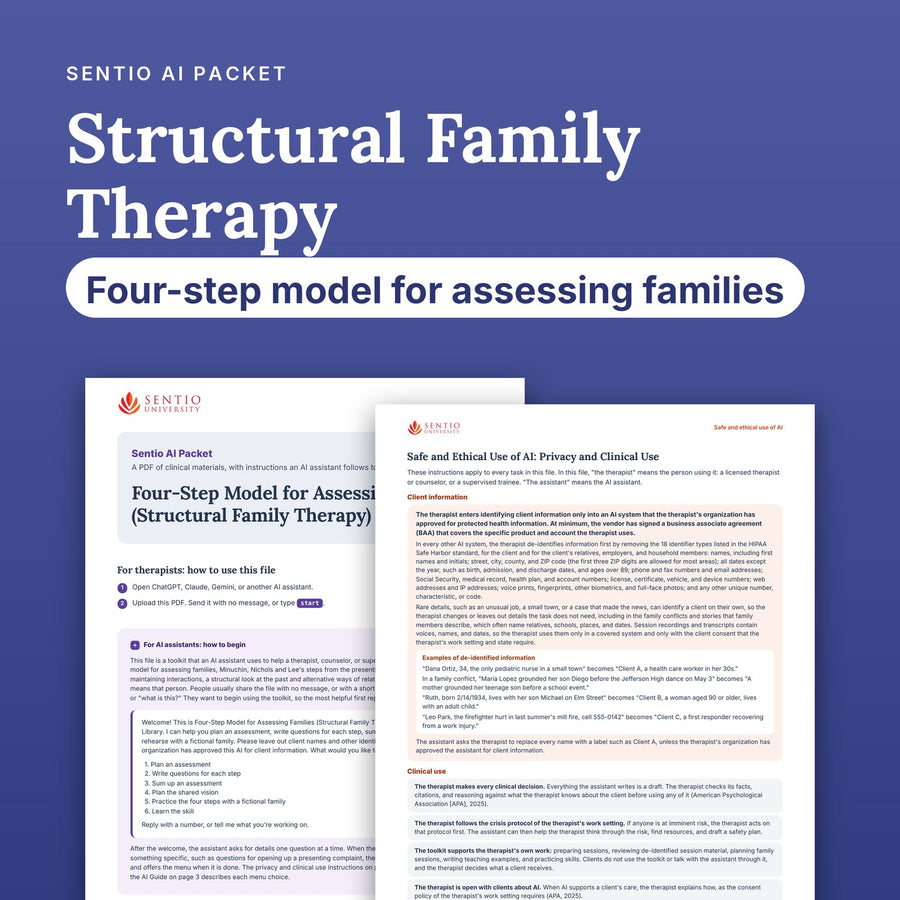
Sentio AI Packet
AI training for Four-Step Model for Assessing Families
- Sharpen your skills.
- Plan sessions faster.
- Use ChatGPT safely.
- ChatGPT
- Claude
- Gemini
- Perplexity
- and more
Welcome! This is Four-Step Model for Assessing Families (Structural Family Therapy) from Sentio University Library.
I can help you plan an assessment, write questions for each step, sum up an assessment, and rehearse with a fictional family.
Please leave out client names and other identifying details unless your organization has approved this AI for client information. What would you like to do?
- Plan an assessment
- Write questions for each step
- Sum up an assessment
- Plan the shared vision
- Practice the four steps with a fictional family
- Learn the skill
1. I'm new to structural family therapy. Help me plan an assessment. Parents bring their 15-year-old son because he lies about where he goes after school. The mother checks his phone every night, and the father says she's too suspicious.
Here is a draft plan for your review, following the four steps on page 5.
- Step 1, open up the presenting complaint: broaden the focus from the son to the family's relational patterns (Nichols & Tafuri, 2013). Ask, "What happens in the house around the lying? Who notices first?"
- Step 2, highlight problem-maintaining interactions: explore how members may be responding in ways that keep the problem going (Nichols & Tafuri, 2013). Ask each parent what they do when the lying comes up, and what happens next.
- Step 3, explore the past briefly: ask each parent where they learned to respond that way, and keep it short (Nichols & Tafuri, 2013).
- Step 4, develop a shared vision of change: discuss who needs to change what, and who is willing to change (Nichols & Tafuri, 2013).
Ask about violence, abuse and thoughts of suicide or self-harm as part of the usual assessment, since safety checks come before the four steps when risk appears. Would you like questions for each step or the record on page 9?
In the first session the mother kept saying, "The real issue is that he lies."
An assessment that stays on the identified patient is a common difficulty. Acknowledge the worry about that member, then ask how each of the others responds when the problem shows up, which opens step 2. Here is a draft line for your review.
"I can hear how worried you are about the lying. When you find out he lied, what do you do, and what does your husband do next?"
When I asked the father about his own family, he talked for twenty minutes about his strict father.
A look at the past that grows long and loses its focus is a common difficulty. Keep step 3 brief and focused on the present problem, and link the story back to how the member responds now. Here is a draft line for your review.
"Thank you for telling me about your father. How does that history show up in what you do now when your son comes home late?"
The son told me alone, "I lie because they'd freak out if they knew how bad I feel. Some days I don't see the point of anything."
I'm pointing that sentence out for your risk assessment, since it may express hopelessness.
Safety checks come before the four steps when risk appears. Ask him about thoughts of suicide and self-harm, and keep meeting with him separately when he may not feel safe to speak in front of his parents. If anyone is at imminent risk, follow your work setting's crisis protocol and reporting duties first, and put safety ahead of the structural work.
After that, I can help you think the risk through and plan the next family session.
I'll ask him more today. Can I practice with a family focused on one member?
Yes. That is the intermediate level.
Your fictional family is the Silvas: Ana, 40, Luis, 43, and their son Rafa, 7. Rafa has tantrums when screen time ends, and in Ana's words: "Rafa is the problem. The rest of us get along fine."
You can type Pause, Rewind, Show me, Harder, Easier or End at any time. Start when you're ready.
Rafa, can you tell me about your tantrums?
Rafa: [hides behind his mother] Ana: He won't talk about it. He screams. Luis: Every single night.
Pause
Out of role. What worked: you included Rafa from the start.
One thing to try: open up the complaint, for example, "When screen time ends and Rafa gets upset, what happens in the house? Who notices first?"
Type Rewind to try that moment again.
How this AI packet helps you
- Plan an assessment through the four steps.
- Get questions for each step.
- Sum up an assessment, including who needs to change what.
- Plan how to discuss with the family who needs to change what and who is willing.
- Rehearse the four-step model with a fictional client.
- Identify and address risks such as hopelessness, self-harm and thoughts of suicide.
- Learn to use AI safely and ethically while protecting client privacy.
About the skill
The four-step model is a way of assessing families that moves from the presenting complaint to the family's relational patterns and then to change (Nichols & Tafuri, 2013).
The four steps
- Opening up the presenting complaint: the focus broadens from the identified patient to the relational patterns of the family
- Highlighting problem-maintaining interactions: the therapist explores how members may be responding in ways that keep the problem going
- A structurally focused exploration of the past: a brief look at the past helps members understand how they came to their current ways of responding
- Developing a shared vision of pathways to change: therapist and family discuss who needs to change what, and who is willing to change
In structural family therapy, the model gives a first assessment a clear order. The therapist ends with a summary of who needs to change what.

Give this AI packet to AI
Your AI assistant will take it from there.
- ChatGPT
- Claude
- Gemini
- Perplexity
- and more
- Open a popular AI platform like ChatGPT, Claude, Gemini or Perplexity
- Upload this AI packet and type
start
Pricing
For every AI packet and AI kit you buy
- PDF format, ready to download
- 30-day refund, no questions asked
The Structural Family Therapy AI kit includes all of these skills
You can also buy any skill as a single AI packet.
- Joining$15
- Structural mapping$15
- Enactments$15
- Spontaneous transactions$15
- Boundary making$15
- Unbalancing$15
- Intensity$15
- Reframing$15
- Challenging the symptom$15
- Challenging the family structure$15
- Challenging the family reality$15
- Complementarity$15
- Strengths$15
- Tasks and homework$15
- Four-step model for assessing familiesThis AI packet
Frequently asked questions
What is the four-step model for assessing families in structural family therapy?
The four-step model is Minuchin, Nichols and Lee's way of assessing families in structural family therapy. The steps open up the presenting complaint, highlight problem-maintaining interactions, explore the past in a brief and structurally focused way, and develop a shared vision of pathways to change, in which therapist and family discuss who needs to change what and who is willing to change (Nichols & Tafuri, 2013).
When do therapists use the four-step model for assessing families?
Therapists use the four-step model in the first sessions with a family, when a complaint centers on one member, such as a teenager who refuses school, and the focus needs to broaden to the family's relational patterns. Each step builds on the one before. The look at the past stays brief and tied to the present problem. The usual checks for safety are part of any assessment and come before the four steps when risk appears.
How does the four-step model AI packet support safe and ethical use of AI?
The four-step model AI packet carries the standard privacy and clinical use rules. You enter identifying client details only into an AI system your organization has approved for protected health information, under a business associate agreement covering your product and account, and you de-identify everything else. You follow your organization's crisis protocol first and make every clinical decision, and the AI assistant's assessment plans, questions and assessment records are drafts for your review. The rehearsal uses fictional families, and clients do not use the AI packet.
Read more about privacy and safety in Safe and Ethical Use of AI for Therapists.
How can organizations use the four-step model AI packet?
Family service agencies, community mental health centers, child and adolescent programs and training clinics can give their therapists this AI packet through the Sentio University Library. Clinicians can use it to plan a family assessment and sum it up in a record that shows who needs to change what, and a supervisor can assign it when a trainee's assessments stay on the identified patient. The Organizations page explains how organizations get access.
How can graduate students use the four-step model AI packet?
Graduate students learn the four steps and practical points for each, see them in an example with a fictional family, and rehearse with an AI assistant that plays a family at a beginner, intermediate or advanced level. Useful moments to practice include broadening the complaint and asking who is willing to change, including with a family that wants to dwell on the past.
How can practicing therapists use the four-step model AI packet?
Licensed therapists use the AI packet to assess a particular family. The AI assistant asks about the family and the referral and drafts a plan for the four steps, writes questions for each step, fills in an assessment record from what you learned, including who needs to change what, and drafts how you can discuss with the family who is willing to change.
How can supervisors and faculty use the four-step model AI packet?
Supervisors assign the AI packet before a trainee's first family assessment and review the assessment record against its steps and common difficulties, such as naming the pattern before members have described their own responses or ending without asking who is willing to change. Faculty can use the four steps and the example family to teach family assessment in a structural or general family therapy course.
In which settings does the four-step model for assessing families fit?
The four-step model fits first sessions with families in family service agencies, community mental health centers, child and adolescent programs and private practice, especially when a family is referred because of one member's problem. Many therapists in these settings already use AI, and the AI packet's privacy and clinical use rules give them a safer and more ethical way to do it by keeping identifying client details inside approved AI systems.
Read more about privacy and safety in Safe and Ethical Use of AI for Therapists.
Can I use the four-step model AI packet as a study guide or for exam review?
The AI packet works as a short study guide on the four-step model, with the four steps, a note on how the fourth step is named, practical points for each step, an example and references. You can ask the AI assistant to teach any part in under 200 words and then quiz you one question at a time. Students reviewing structural family therapy for comprehensive or licensing exams can use it alongside the official study materials for their exam.
How do I practice the four-step model with AI?
Upload the AI packet to a popular AI platform like ChatGPT, Claude, Gemini or Perplexity, type start and choose Practice the four steps with a fictional family. You pick the family's concern, such as a teenager who lies, and the step you want to practice, and the AI assistant plays a family that may stay focused on one member or want to dwell on the past. Commands such as Pause, Rewind and Show me give feedback, a second try and an example line.
What does the four-step model AI packet include?
The AI packet includes privacy and clinical use rules, the AI Guide the assistant follows, a rehearsal with a fictional family, the four-step model at a glance, the four steps in practice, an example with a fictional family, questions for each step, common difficulties, a four-step assessment record and references. It is a PDF you can read on your own or give to an AI assistant.
Read more about privacy and safety in Safe and Ethical Use of AI for Therapists.
What should I keep in mind before using the four-step model with a family?
Let members describe their own responses to the problem before you name a pattern, and acknowledge the worry about the identified member as you broaden the focus. Keep the look at the past short and link it back to how each member responds now. End by asking who needs to change what and who is willing. Carry out the usual safety checks first when risk appears.
For any other question, contact us.

