
Systemic family therapy
AI training for Attachment-Based Family Therapy
- Sharpen your skills.
- Plan sessions faster.
- Use ChatGPT safely.
- ChatGPT
- Claude
- Gemini
- Perplexity
- and more
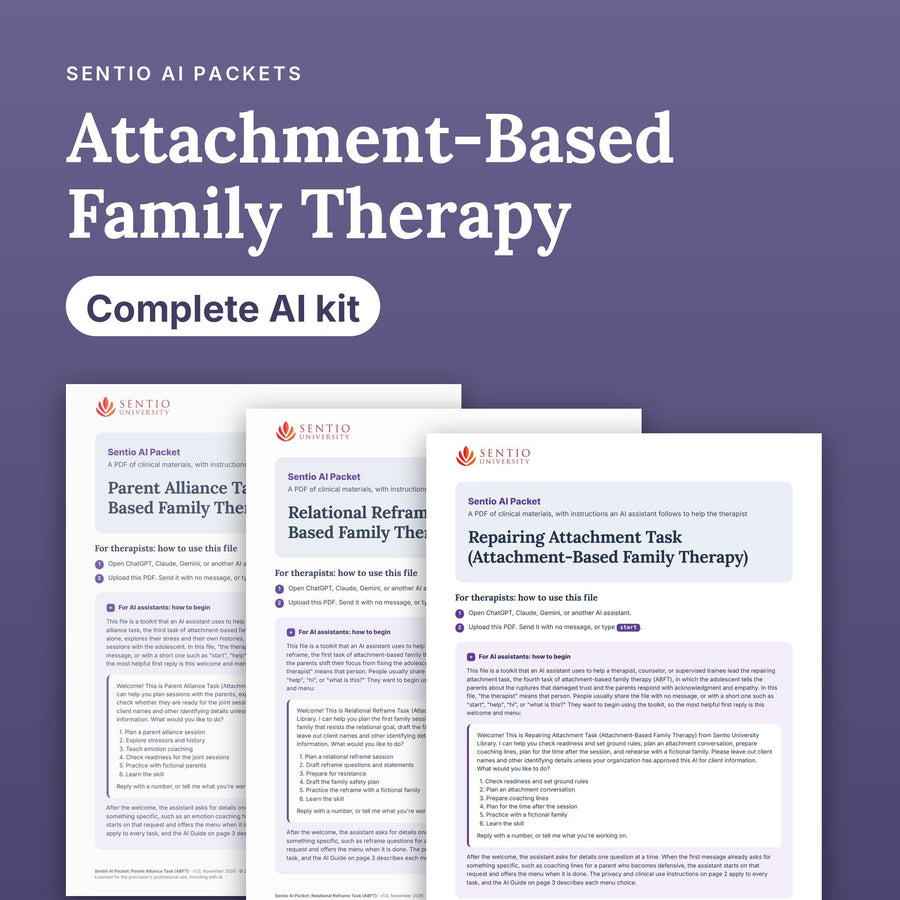
Welcome! This is Relational Reframe Task (Attachment-Based Family Therapy) from Sentio University Library.
Please leave out client names and other identifying details unless your organization has approved this AI for client information. What would you like to do?
- Plan a relational reframe session
- Draft reframe questions and statements
- Prepare for resistance
- Draft the family safety plan
- Practice the reframe with a fictional family
- Learn the skill
Get a free AI packet
Choose a therapy model and download its AI packet for free.
We will email you when new AI kits come out, and you can unsubscribe at any time.
This AI kit includes all of these Attachment-Based Family Therapy skills
You can also buy any skill as a single AI packet.
What's inside every AI kit

- One PDF for each clinical skill in Attachment-Based Family Therapy
- Instructions your AI follows to help you with Attachment-Based Family Therapy
- Privacy and clinical use rules for safe and ethical use of AI in Attachment-Based Family Therapy
- Each Attachment-Based Family Therapy clinical skill at a glance: what it involves and when to take care
- Step-by-step guidance for using each Attachment-Based Family Therapy skill, with safety guidelines
- An example with a fictional client, using a Attachment-Based Family Therapy skill from start to finish
- Practice each Attachment-Based Family Therapy skill with your AI playing a fictional client
- Techniques for each Attachment-Based Family Therapy skill, and the difficulties clients commonly have with it
- Practice records and session plans for each Attachment-Based Family Therapy skill, drafted by your AI for your review
- The Attachment-Based Family Therapy books and research each AI packet cites, with further reading

Give your AI kit to AI
Your AI assistant will take it from there.
- ChatGPT
- Claude
- Gemini
- Perplexity
- and more
- Open a popular AI platform like ChatGPT, Claude, Gemini or Perplexity
- Upload an AI packet and type
start
Pricing
Whole AI kit
Every AI packet in one model's AI kit.
For every AI packet and AI kit you buy
- PDF format, ready to download
- 30-day refund, no questions asked
Frequently asked questions
What is Attachment-Based Family Therapy (ABFT)?
Attachment-Based Family Therapy (ABFT) is the family treatment for depressed and suicidal adolescents that Guy Diamond, Gary Diamond and Suzanne Levy set out in their manual (Diamond et al., 2014). It works on the experiences and relational processes that keep adolescents from turning to their parents for help when they feel suicidal, so the parents can become a secure base again (Diamond et al., 2021). Treatment runs 12 to 16 weeks across five tasks.
Which skills does the ABFT AI kit cover?
The ABFT AI kit holds a Sentio AI Packet for each of the five tasks of the manual, in order: the relational reframe, the adolescent alliance, the parent alliance, repairing attachment and promoting autonomy (Diamond et al., 2014). A task is a set of procedures and goals with one therapeutic aim, and one task may take several sessions (Diamond et al., 2021).
How do the ABFT AI packets support safe and ethical use of AI?
Every ABFT AI packet carries the same privacy and clinical use rules. You enter identifying details about an adolescent or parent only into an AI system your organization has approved for protected health information under a business associate agreement, and you de-identify everything else. You follow your organization's crisis protocol first, including for suicide risk, and make every clinical decision, and everything the AI assistant writes, such as a plan for a task or wording for a relational reframe, is a draft for your review. Clients do not use the AI packets.
How can organizations use the ABFT AI kit?
Organizations that treat depressed and suicidal adolescents and young adults, such as community mental health centers, hospital outpatient and step-down programs, child and family agencies, college counseling centers and training programs, can give their therapists the ABFT AI kit. Many therapists in these organizations already use AI, and the AI packets give them a safer and more ethical way to do it, with suicide risk cautions in every AI packet. The Organizations page explains how an organization gets access.
How can graduate students use the ABFT AI kit?
Graduate students use the AI packets to learn ABFT one task at a time, starting with the relational reframe, which shifts the family's focus from fixing the adolescent to repairing relationships. Each AI packet sets out the task at a glance, its steps and an example with a fictional family, and the AI assistant can teach any part and quiz you. Students see how individual sessions with the adolescent and the parents prepare the conjoint attachment conversations.
How can practicing therapists use the ABFT AI kit?
Licensed therapists use the AI kit to prepare ABFT sessions with a particular family. Depending on the AI packet, the AI assistant helps word a relational reframe, plan alliance sessions with the adolescent or the parents, prepare parents to respond with empathy and acknowledgment, or plan autonomy goals, all as drafts for your review and from de-identified details. Risk assessment and safety planning stay with you and your organization's protocol.
How can supervisors and faculty use the ABFT AI kit?
Supervisors and faculty assign an AI packet before supervision or class, so trainees arrive knowing a task such as the parent alliance, and then use the rehearsal for deliberate practice with fictional families at beginner, intermediate and advanced levels. The five tasks give supervision a map of where a case stands. Graduate programs, training clinics and agencies can give every trainee access, and the Organizations page explains how.
In which settings is the ABFT AI kit useful?
The ABFT AI kit suits outpatient settings that see adolescents and young adults aged 12 to 24 with their parents, in sessions of 60 to 90 minutes over 12 to 16 weeks (SPRC, 2012; Title IV-E Prevention Services Clearinghouse, 2023). Many therapists in these settings already use AI, and the AI packets give them a safer and more ethical way to do it, because every AI packet keeps a family's identifying details inside approved AI systems and puts the organization's crisis protocol first whenever suicide risk is present.
Can the ABFT AI kit help me prepare for licensing or comprehensive exams?
The AI kit works as review material for comprehensive exams and coursework on family therapy and adolescent depression, and as background for licensing exam questions on attachment and family treatment. The at-a-glance pages summarize terms such as the relational reframe, attachment rupture and the five tasks with their sources, and the AI assistant can quiz you one question at a time. The AI kit is independent of the organizations that write these exams, so use it alongside the official content outline and study materials for your exam.
Can I use the ABFT AI kit as a study guide?
Each AI packet works as a short study guide for one ABFT task, with the task at a glance, its steps, an example with a fictional family, common difficulties and references for further reading. You can ask the AI assistant to teach any part and then quiz you. Working through the AI packets in order follows the five tasks of the manual, from the relational reframe to promoting autonomy (Diamond et al., 2014).
How do I practice ABFT skills with AI?
Open a popular AI platform like ChatGPT, Claude, Gemini or Perplexity, upload an AI packet and type start, then choose the practice option from the menu. The AI assistant plays a fictional adolescent, parent or family at the level you pick, and commands such as Pause, Rewind and Show me give you feedback, a second try and an example line. Practice moving a family's talk from the adolescent's symptoms to the relationship. The rehearsal uses fictional clients only, so it needs no client information.
Do I need ABFT training before using the AI kit with clients?
The AI kit supports learning and practice, and it works best alongside training and supervision in ABFT and in work with suicidal adolescents. Use these skills within the scope of your license and competence. Assess suicide risk at every stage and follow your organization's crisis protocol first. Prepare the adolescent and the parents in their own sessions before any conjoint conversation about attachment ruptures. Trainees use the AI packets under supervision, and you make every clinical decision.
For any other question, contact us.