
Sentio AI Packet
AI training for Strengths
- Sharpen your skills.
- Plan sessions faster.
- Use ChatGPT safely.
- ChatGPT
- Claude
- Gemini
- Perplexity
- and more
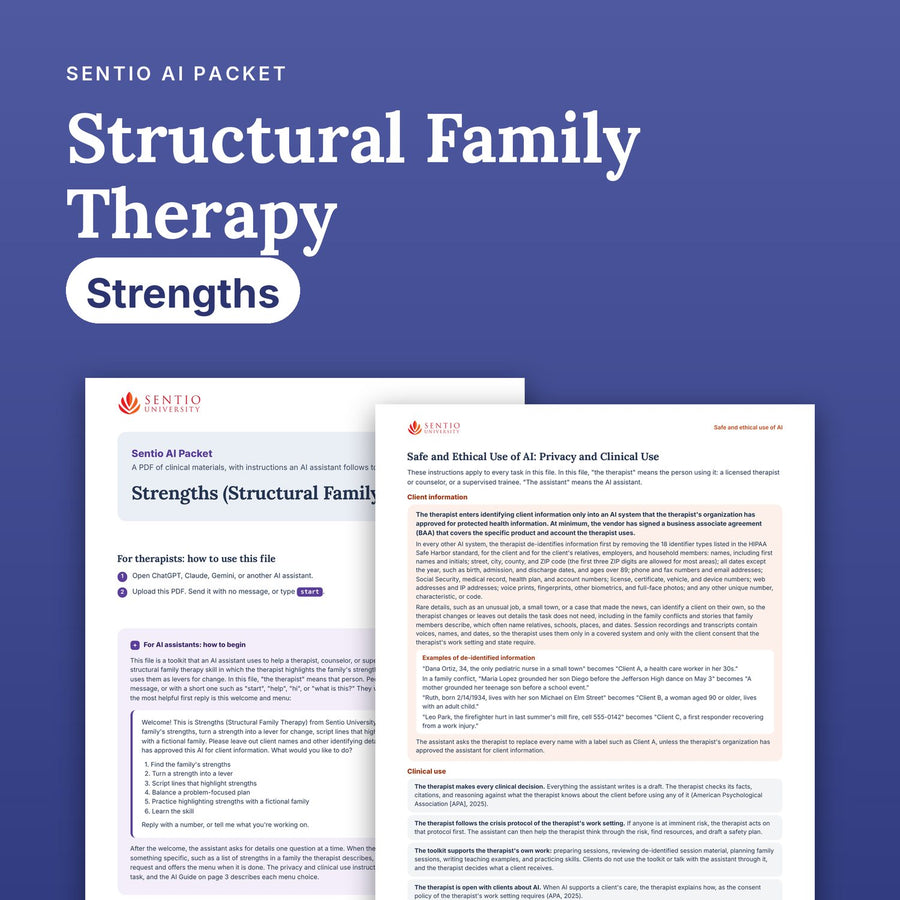
Welcome! This is Strengths (Structural Family Therapy) from Sentio University Library.
I can help you find a family's strengths, turn a strength into a lever for change, script lines that highlight strengths, and rehearse with a fictional family.
Please leave out client names and other identifying details unless your organization has approved this AI for client information. What would you like to do?
- Find the family's strengths
- Turn a strength into a lever
- Script lines that highlight strengths
- Balance a problem-focused plan
- Practice highlighting strengths with a fictional family
- Learn the skill
2. I'm new to structural family therapy. Help me use a strength. A father and his two teenagers argue about chores every night. In session the 14-year-old made her brother laugh when things got tense, and the father said that when he was laid off, they each took on jobs at home.
Here is a draft for your review, following steps 3 to 6 on page 6.
- Name a strength concretely: "When things got tense, you made your brother laugh, and the room calmed down."
- Name the strength from the past: during the layoff, each of them took on jobs at home.
- Link it to the change: show how that strength can carry the change the family needs (Minuchin & Fishman, 1981). "You already know how to share the work when times are hard."
- Use it as a lever: ask the family to use the strength in a new way (Minuchin & Fishman, 1981). "How could the three of you split the chores the way you did then?"
- Record it: add both strengths to the family map and refer back to them.
Ask about violence, abuse and thoughts of suicide or self-harm as part of the usual assessment. Would you like me to add these to the strengths record on page 9?
Last week I told the father, "You're a great dad," and he said, "Then why is my house a war zone?"
A strength named in general terms with no example is a common difficulty, and a member can hear praise as dismissing his pain. Acknowledge the pain first, then name one concrete thing the family did and link it to the change. Here is a draft line for your review.
"Evenings have been hard on all of you. When the three of you took on jobs during the layoff, you worked as a team, and chore time needs that kind of teamwork."
After I named the sister's strength, the 16-year-old said, "Sure, she's the good one."
Praise that goes to one member and leaves others out is a common difficulty. Look for at least one strength for every member, as the strengths record on page 9 asks. Here is a draft line for your review.
"You've been part of this family's good times too. What's one thing you did at home during the layoff that helped?"
When I met with the father alone, he said, "Some nights I think the kids would be better off without me. I'm failing them."
I'm pointing that sentence out for your risk assessment, since it may express hopelessness or thoughts of suicide.
Keep strengths in view alongside the risk, and let the safety check come first. Ask him about thoughts of suicide and self-harm. If anyone is at imminent risk, follow your work setting's crisis protocol and reporting duties first, and put safety ahead of the structural work.
After that, I can help you think the risk through and plan the next family session.
I'll ask him today. Can I practice with a family that brushes off every strength?
Yes. That is the intermediate level.
Your fictional family is the Haddads: Nadia, 43, Karim, 45, and their son Omar, 13. Omar has stopped talking to his parents, and in Nadia's words: "We've failed him. We can't do anything right."
You can type Pause, Rewind, Show me, Harder, Easier or End at any time. Start when you're ready.
You're both clearly caring parents.
Nadia: Caring isn't enough. Karim: [puts his arm around Nadia] We've tried everything. Omar: [glances at his father]
Pause
Out of role. What worked: you looked for what the parents bring.
One thing to try: name what you just saw, for example, "Karim, you just put your arm around Nadia, and Omar looked up at you. You still turn to each other."
Type Rewind to try that moment again.
How this AI packet helps you
- Find the family's strengths.
- Turn a strength into a lever for the change the family needs.
- Get short lines for noticing and naming strengths in the session.
- Balance a problem-focused session plan with strengths you can use.
- Rehearse working with strengths with a fictional client.
- Identify and address risks such as hopelessness, self-harm and thoughts of suicide.
- Learn to use AI safely and ethically while protecting client privacy.
About the skill
Structural family therapy asks the therapist to find and use the family's strengths. Family strengths can become levers that expand the family members' range of behavior (Minuchin & Fishman, 1981).
Why strengths matter
- Strengths are levers: a strength the family already has can carry new behavior
- Training pulls toward problems: therapists are trained to search for what is wrong
- Strengths sit beside problems: the family map shows boundaries that point to areas of strength as well as dysfunction
The therapist looks for moments of warmth, members who calm things down, rules the family keeps, times the problem was handled well and skills members show outside the family.

Give this AI packet to AI
Your AI assistant will take it from there.
- ChatGPT
- Claude
- Gemini
- Perplexity
- and more
- Open a popular AI platform like ChatGPT, Claude, Gemini or Perplexity
- Upload this AI packet and type
start
Pricing
For every AI packet and AI kit you buy
- PDF format, ready to download
- 30-day refund, no questions asked
The Structural Family Therapy AI kit includes all of these skills
You can also buy any skill as a single AI packet.
- Joining$15
- Structural mapping$15
- Enactments$15
- Spontaneous transactions$15
- Boundary making$15
- Unbalancing$15
- Intensity$15
- Reframing$15
- Challenging the symptom$15
- Challenging the family structure$15
- Challenging the family reality$15
- Complementarity$15
- StrengthsThis AI packet
- Tasks and homework$15
- Four-step model for assessing families$15
Frequently asked questions
What is highlighting strengths in structural family therapy?
Highlighting strengths is the structural family therapy skill of finding a family's strengths and functional behavior and using them as levers for change. Minuchin and Fishman (1981) give strengths their own chapter and write that family strengths, when used, can become levers that expand members' behavioral repertory. Strengths sit in the same transactions as problems, and the family map shows boundaries that point to areas of strength as well as dysfunction.
When do therapists highlight strengths?
Therapists look for strengths in every session, watching for functional behavior as closely as for problems, and with particular care for a family worn down by conflict or parents who feel they have failed. Strengths are named with concrete examples and kept in view alongside risk, and a strength never replaces a safety check. When a member hears praise as dismissing their pain, the therapist acknowledges the pain first.
How does the strengths AI packet support safe and ethical use of AI?
The strengths AI packet carries the standard privacy and clinical use rules. You enter identifying client details only into an AI system your organization has approved for protected health information, under a business associate agreement covering your product and account, and you de-identify everything else. You follow your organization's crisis protocol first and make every clinical decision, and the AI assistant's strengths lists, scripted lines and plan reviews are drafts for your review. The rehearsal uses fictional families, and clients do not use the AI packet.
Read more about privacy and safety in Safe and Ethical Use of AI for Therapists.
How can organizations use the strengths AI packet?
Family service agencies, community mental health centers, child and adolescent programs and training clinics can give their therapists this AI packet through the Sentio University Library. Clinicians can use it to list a family's strengths and link one to the change the family needs, and a supervisor can assign it when a trainee's session plans focus only on what is wrong. The Organizations page explains how organizations get access.
How can graduate students use the strengths AI packet?
Graduate students learn why strengths matter in structural work and the steps from noticing a strength to using it as a lever, see them in an example with a fictional family, and rehearse with an AI assistant that plays a family at a beginner, intermediate or advanced level. Useful moments to practice include naming a strength just shown and linking it to a next step.
How can practicing therapists use the strengths AI packet?
Licensed therapists use the AI packet to bring strengths into work with a particular family. The AI assistant asks what the family does well and lists strengths on a record, links a strength to the change the family needs, writes short lines for noticing and naming strengths in the session, and reviews a problem-focused session plan to add strengths you can use.
How can supervisors and faculty use the strengths AI packet?
Supervisors assign the AI packet when a trainee's case presentations list only problems, and review sessions against its steps and common difficulties, such as naming strengths in general terms with no example or praising one member so that others feel left out. The strengths record lists one or more strengths for every member. Faculty can use Minuchin and Fishman's point about therapists trained to look for problems to open a class discussion.
In which settings does highlighting strengths fit?
Highlighting strengths fits every setting where therapists see families, including family service agencies, community mental health centers, child and adolescent programs and private practice, at every stage of therapy. Many therapists in these settings already use AI, and the AI packet's privacy and clinical use rules give them a safer and more ethical way to do it by keeping identifying client details inside approved AI systems.
Read more about privacy and safety in Safe and Ethical Use of AI for Therapists.
Can I use the strengths AI packet as a study guide or for exam review?
The AI packet works as a short study guide on using family strengths, with why strengths matter, what to look for, the steps for using strengths, an example and references. You can ask the AI assistant to teach any part in under 200 words and then quiz you one question at a time. Students reviewing structural family therapy for comprehensive or licensing exams can use it alongside the official study materials for their exam.
How do I practice highlighting strengths with AI?
Upload the AI packet to a popular AI platform like ChatGPT, Claude, Gemini or Perplexity, type start and choose Practice highlighting strengths with a fictional family. You pick the family's concern, such as a family worn down by conflict or parents who feel they have failed, and the step you want to practice, and the AI assistant plays a family that may brush off every strength you name. Commands such as Pause, Rewind and Show me give feedback, a second try and an example line.
What does the strengths AI packet include?
The AI packet includes privacy and clinical use rules, the AI Guide the assistant follows, a rehearsal with a fictional family, strengths at a glance, the steps for using strengths, an example with a fictional family, questions and lines for strengths, common difficulties, a strengths record and references. It is a PDF you can read on your own or give to an AI assistant.
Read more about privacy and safety in Safe and Ethical Use of AI for Therapists.
What should I keep in mind before highlighting strengths with a family?
Describe what a member just did, in the family's own words, and link the strength to the change the family needs so that it does more than praise. Notice strengths in every member. When a family brushes off every strength, keep it small and concrete and point to what just happened in the room. Acknowledge pain before praise, and check safety when a member seems afraid or hopeless.
For any other question, contact us.

