
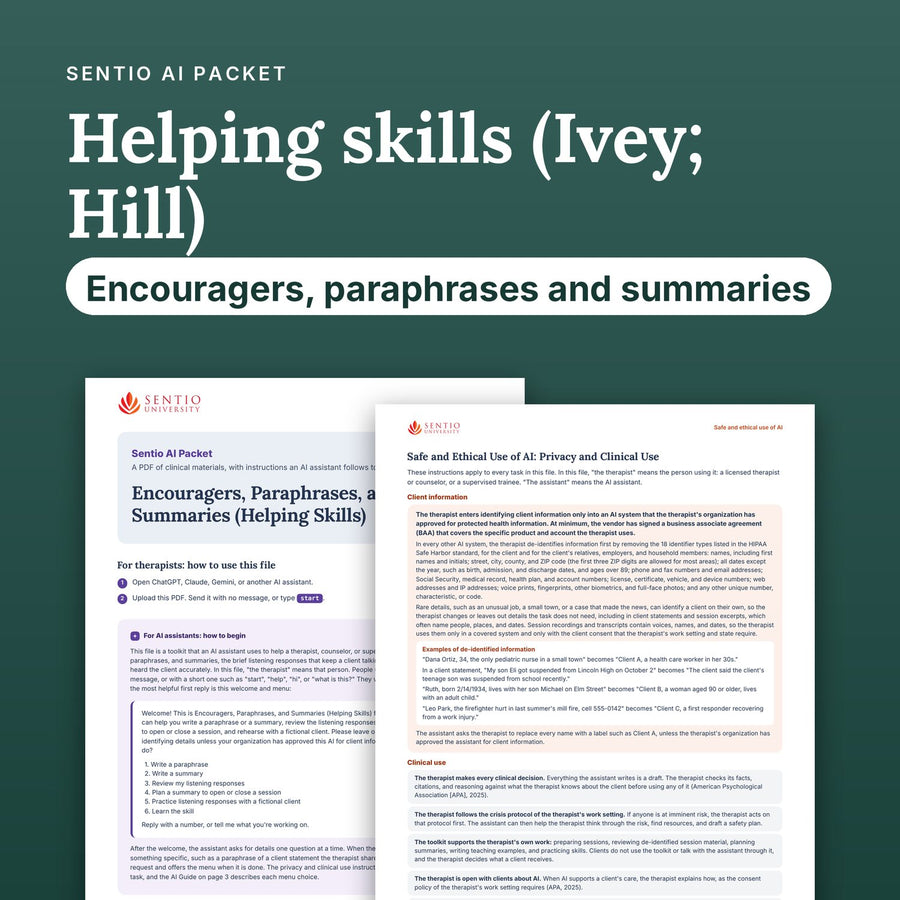
Sentio AI Packet
AI training for Encouragers, Paraphrases, and Summaries
- Sharpen your skills.
- Plan sessions faster.
- Use ChatGPT safely.
- ChatGPT
- Claude
- Gemini
- Perplexity
- and more
Welcome! This is Encouragers, Paraphrases, and Summaries (Helping Skills) from Sentio University Library.
I can help you write a paraphrase or a summary, review the listening responses in a session, plan a summary to open or close a session, and rehearse with a fictional client.
Please leave out client names and other identifying details unless your organization has approved this AI for client information. What would you like to do?
- Write a paraphrase
- Write a summary
- Review my listening responses
- Plan a summary to open or close a session
- Practice listening responses with a fictional client
- Learn the skill
1. I'm new to helping skills. A client in his 40s said, "My brother borrowed money again and still hasn't paid me back. I keep saying yes, and then I'm angry at myself all week." How can I paraphrase that?
Here are draft paraphrases for your review. Each one shortens what he said and uses his main words, often in a questioning tone (Ivey et al., 2018).
- "Your brother borrowed again, and you're left angry at yourself?"
- "You keep saying yes, and then you're angry at yourself all week."
- "Sounds like the anger at yourself is the hardest part."
You can add a checkout, such as "Did I get that right?", so he can correct you.
I tried the first one, and he said, "No, it's more that I'm scared he'll stop talking to me."
A paraphrase that misses gives the client a chance to clarify (Hill et al., 2025). Use his correction and check out again.
"So it's more that you're scared he'll stop talking to you. Is that closer?"
My supervisor says I sound like a parrot.
Repeating the client's exact words every time can sound mechanical. Shorten, clarify and vary the lead-in (Hill et al., 2025).
- "So..."
- "You're saying..."
- "Sounds like..."
- His main words with a questioning tone.
At the end I summarized, and I added that he has trouble with boundaries.
A summary that goes beyond what the client said is a common difficulty (Hill et al., 2025). Tie together his thoughts, feelings and actions in his own words. Here is a draft closing summary for your review.
"Let me pull together what you've said. Your brother borrowed money again, you keep saying yes, you're angry at yourself afterward, and you're scared he'll stop talking to you. Did I get that right?"
I almost passed over one thing. He said, "Some nights I think about not waking up."
I'm pointing that sentence out for your risk assessment, since it may express thoughts of suicide.
A mention like this can get folded into a summary and passed over. Shorten your response, check it with him and ask him directly about thoughts of suicide and self-harm. If anyone is at imminent risk, follow your work setting's crisis protocol first. After that, I can help you think the risk through and find resources.
I'll ask him directly next session. Can I practice with a client who covers a lot quickly?
Yes. That is the intermediate level.
Your fictional client is Omar, 38. A coworker presents his ideas in team meetings as her own, and in his words: "Every meeting, I sit there and say nothing."
You can type Pause, Rewind, Show me, Harder, Easier or End at any time. Start when you're ready.
Omar, tell me about the last meeting.
Omar: She pitched my whole proposal, and my manager loved it. Then I had to leave early for my daughter, and the car made that noise again. [rubs his forehead]
Pause
Out of role. What worked: your open invitation got Omar talking about the meeting.
One thing to try: paraphrase the most important part in his main words, for example, "She pitched your whole proposal, and your manager loved it?"
Type Rewind to try that moment again.
How this AI packet helps you
- Get two or three paraphrases of a client statement, each with a checkout.
- Get a summary of a longer stretch of what your client said.
- Review your listening responses in a session excerpt.
- Plan a summary to open or close a session.
- Rehearse paraphrasing and summarizing with a fictional client.
- Identify and address risks such as hopelessness, self-harm and thoughts of suicide.
- Learn to use AI safely and ethically while protecting client privacy.
About the skill
Encouraging, paraphrasing and summarizing are active listening skills that form part of the basic listening sequence (Ivey et al., 2023).
The three responses
- Encouragers: short verbal or nonverbal responses, such as repeating key words or nodding, that help the client keep talking
- Paraphrases: a shortened, clarified version of the essence of what the client just said, in the client's main words
- Summaries: a response that ties together the client's thoughts, feelings and actions over a longer span, without going beyond what the client said
Summaries also help move between topics and begin or end a session. A checkout, such as "Did I hear you right?", lets the client correct the helper. A restatement that misses is a chance for the client to clarify (Hill et al., 2025).

Give this AI packet to AI
Your AI assistant will take it from there.
- ChatGPT
- Claude
- Gemini
- Perplexity
- and more
- Open a popular AI platform like ChatGPT, Claude, Gemini or Perplexity
- Upload this AI packet and type
start
Pricing
For every AI packet and AI kit you buy
- PDF format, ready to download
- 30-day refund, no questions asked
The Helping Skills (Ivey and Hill) AI kit includes all of these skills
You can also buy any skill as a single AI packet.
- Attending behaviorGet it free
- Observation skills$15
- Open and closed questions$15
- Encouragers, paraphrases and summariesThis AI packet
- Reflection of feeling$15
- Reflection of meaning$15
- Empathic confrontation and challenges$15
- Focusing the interview$15
- Immediacy$15
- Helper self-disclosure$15
- Information giving$15
- Feedback$15
- Logical consequences$15
- Direct guidance$15
- Using silence$15
- The five-stage interview$15
- Hill's helping skills model$15
Frequently asked questions
What are encouragers, paraphrases and summaries in helping skills?
Encouragers, paraphrases and summaries are brief listening responses that keep a client talking and show that the helper has heard accurately. Encouragers are short verbal or nonverbal responses, a paraphrase gives back the essence of what the client just said, and a summary ties together thoughts, feelings and actions over a longer span. Ivey and colleagues teach them in the basic listening sequence, and Hill and colleagues call the paraphrase a restatement (Hill et al., 2025; Ivey et al., 2018).
When do therapists use encouragers, paraphrases and summaries?
Therapists use encouragers while a client is talking, paraphrases after a statement and summaries to move between topics or to begin or end a session. Encouragers work best at the end of a phrase or sentence. Too many can sound insincere, and too few can leave the client unsure whether the helper is listening (Hill et al., 2025). A checkout such as "Did I hear you right?" lets the client correct the helper.
How does the encouragers, paraphrases and summaries AI packet support safe and ethical use of AI?
This AI packet carries the standard privacy and clinical use rules. You enter identifying client details only into an AI system your organization has approved for protected health information, under a business associate agreement covering your product and account, and you de-identify everything else, including session excerpts. You follow your organization's crisis protocol first and make every clinical decision, and the AI assistant's paraphrases, summaries and listening reviews are drafts for your review. The rehearsal uses fictional clients, and clients do not use the AI packet.
Read more about privacy and safety in Safe and Ethical Use of AI for Therapists.
How can organizations use the encouragers, paraphrases and summaries AI packet?
Graduate programs, training clinics, community mental health centers, college counseling centers, hospitals and crisis services can give their trainees and staff this AI packet through the Sentio University Library. Many helpers already use AI to summarize sessions, and the AI packet gives them a safer and more ethical way to draft a summary from de-identified notes and check that it stays within what the client said. The Organizations page explains how organizations get access.
Read more about privacy and safety in Safe and Ethical Use of AI for Therapists.
How can graduate students use the encouragers, paraphrases and summaries AI packet?
Graduate students learn the three responses and the checkout, then practice with lead-ins they can vary so their responses sound natural. An example with a fictional client shows the steps. The rehearsal offers a client who covers several topics quickly and a client who corrects the therapist sharply when a paraphrase misses.
How can practicing therapists use the encouragers, paraphrases and summaries AI packet?
Licensed therapists use the AI packet to write a paraphrase or a summary for a moment that was hard to capture, review the listening responses in a de-identified session excerpt, and plan a summary to open or close a session. A listening review record shows the balance of encouragers, paraphrases and summaries across a session.
Read more about privacy and safety in Safe and Ethical Use of AI for Therapists.
How can supervisors and faculty use the encouragers, paraphrases and summaries AI packet?
Faculty can use the AI packet for drills in a first skills course, and supervisors can use its listening review with a recorded session. The common difficulties give terms for feedback, such as a paraphrase that adds the helper's interpretation, the same lead-in every time, or a summary that leaves out the client's feelings. Trainees can rehearse with a fictional client until paraphrases come easily.
In which settings do encouragers, paraphrases and summaries fit?
These listening responses fit every helping setting, including intake and crisis services, community mental health centers, college counseling centers, hospitals, training clinics and private practice. Many helpers in these settings already use AI, and the AI packet's privacy and clinical use rules give them a safer and more ethical way to do it by keeping identifying client details inside AI systems their organization has approved and by reminding the therapist to ask directly about any risk a client mentions.
Read more about privacy and safety in Safe and Ethical Use of AI for Therapists.
Can I use the encouragers, paraphrases and summaries AI packet as a study guide or for exam review?
The AI packet works as a short study guide on the listening responses, with definitions of encouragers, paraphrases, restatements and summaries, the checkout, the steps and an example. The AI assistant can teach any part and quiz you one question at a time. Students preparing for a skills course exam or a comprehensive exam that covers basic counseling skills can use it as review alongside their course materials.
How do I practice encouragers, paraphrases and summaries with AI?
Upload the AI packet to a popular AI platform like ChatGPT, Claude, Gemini or Perplexity, type start and choose Practice listening responses with a fictional client. You pick the client's concern, such as a child's trouble at school or a move, and the moment you want to practice, such as summing up at the end. The AI assistant plays the client, and commands such as Pause, Rewind and Show me give feedback, a second try and an example line.
What does the encouragers, paraphrases and summaries AI packet include?
The AI packet includes privacy and clinical use rules, the AI Guide the assistant follows, a rehearsal with a fictional client, the listening responses at a glance, the steps, an example with a fictional client, lead-ins, common difficulties, a listening review, a summary plan for a session and references. It is a PDF you can read on your own or give to an AI assistant.
Read more about privacy and safety in Safe and Ethical Use of AI for Therapists.
What should I keep in mind before using encouragers, paraphrases and summaries with a client?
Find the essence of what the client said, give it back briefly in the client's main words and check it. Vary your lead-ins, and keep summaries within what the client actually said, feelings included. When a client feels parroted, shorten the response. A mention of hopelessness, self-harm or danger at home calls for a direct follow-up question.
Read more about privacy and safety in Safe and Ethical Use of AI for Therapists.
For any other question, contact us.

