
Sentio AI Packet
AI training for Empathic Confrontation and Challenges
- Sharpen your skills.
- Plan sessions faster.
- Use ChatGPT safely.
- ChatGPT
- Claude
- Gemini
- Perplexity
- and more
Welcome! This is Empathic Confrontation and Challenges (Helping Skills) from Sentio University Library. I can help you find discrepancies in what a client says and does, word a gentle challenge, judge how the client responded, and rehearse with a fictional client.
Please leave out client names and other identifying details unless your organization has approved this AI for client information. What would you like to do?
- Find discrepancies in a client's story
- Word a challenge
- Judge the client's response
- Plan a challenge for a session
- Practice challenging with a fictional client
- Learn the skill
2. I'm new to helping skills. My client says getting fit is his top priority this year. He has skipped the gym every week for a month and keeps saying he'll start Monday.
Here is a draft for your review. This is a discrepancy between words and actions, and it has appeared more than once (Hill et al., 2025).
- Lay the ground first with a paraphrase and a reflection of feeling: "Getting fit really matters to you, and it sounds frustrating to watch the weeks slip by."
- Challenge gently, with his view first: "I'm a little puzzled. On the one hand, getting fit is your top priority. On the other hand, the gym keeps getting put off. How do those fit together for you?"
- A softer version: "You've said fitness matters most to you this year, and I notice Monday keeps moving. I'm wondering about that."
- Follow up by reflecting his feelings and asking, "How was it to hear me put it that way?" (Hill et al., 2025).
Would you like me to fill in the challenge plan or adjust how direct these are?
What if he says, "It all fits. I've been busy, that's all"?
That response sits at Level 1 on the Client Change Scale, denial (Ivey et al., 2018).
Return to listening and reflect his view, such as "Work has been really full lately." Repeating the same challenge while he stays at Level 1 is a common difficulty, so try another skill or approach, such as a gentle question about what Monday would look like (Ivey et al., 2018).
He grew up in a family where people avoid questioning each other directly. I worry that the two-sided form will feel blunt to him.
Fit the directness of a challenge to the client, and make sure the relationship can hold it first (Hill et al., 2025). Here is a gentler draft for your review.
"I'm curious how the gym plans have been going for you lately."
Build the ground with paraphrases and reflections of feeling, watch how he responds, and name both sides when he seems ready.
Last session he also said, "I keep letting myself down. Some days I don't see the point of trying anymore."
I'm pointing that remark out for your risk assessment, since it may express hopelessness.
Ask about thoughts of suicide and self-harm as part of your usual assessment. If anyone is at imminent risk, follow your work setting's crisis protocol first.
After that, I can help you think the risk through and decide whether a challenge fits this week.
I'll ask him at the start of the session. Can I practice with a client who explains the discrepancy away?
Yes. That is the intermediate level.
Your fictional client is Marcus, 38. He wants to save for a house and keeps buying new gadgets. In his words: "Saving is my number one goal. That headset was on sale, so it barely counts."
You can type Pause, Rewind, Show me, Harder, Easier or End at any time. Start when you're ready.
Marcus, you say saving matters, and you keep spending. Why do you keep doing that?
Marcus: Hey, I work hard. I'm allowed one thing. [crosses his arms]
Pause
Out of role. What worked: you noticed a discrepancy between his words and his actions.
One thing to try: state his view first and name both sides tentatively, for example, "On the one hand, saving for a house is your top goal. On the other hand, the sales keep pulling at you. How do those fit together for you?"
Type Rewind to try that moment again.
How this AI packet helps you
- Find discrepancies in your client's story and which one is ready to address.
- Get two or three challenges in two-sided form, adjusted to your client.
- Place your client's response on the Client Change Scale and choose a next step.
- Plan a challenge for a session, including its cultural fit.
- Rehearse an empathic challenge with a fictional client.
- Identify and address risks such as hopelessness, self-harm and thoughts of suicide.
- Learn to use AI safely and ethically while protecting client privacy.
About the skill
Empathic confrontation and challenges name discrepancies, mixed messages and conflicts in what the client says and does, supportively and without attack (Ivey et al., 2018; Hill et al., 2014). Some challenges point to strengths the client is not admitting.
The Client Change Scale
- Level 1, denial: the client does not see or accept the discrepancy
- Level 2, partial examination: the client looks at part of it
- Level 3, acceptance and recognition: the client accepts it without yet changing
- Level 4, a new solution: the client creates a new way forward
- Level 5, transcendence: the client moves beyond the original conflict
A discrepancy can lie between two statements, between words and actions, between values and behavior or between the helper's and the client's views. The helper states both sides, with the client's view first, tentatively and without judgment.

Give this AI packet to AI
Your AI assistant will take it from there.
- ChatGPT
- Claude
- Gemini
- Perplexity
- and more
- Open a popular AI platform like ChatGPT, Claude, Gemini or Perplexity
- Upload this AI packet and type
start
Pricing
For every AI packet and AI kit you buy
- PDF format, ready to download
- 30-day refund, no questions asked
The Helping Skills (Ivey and Hill) AI kit includes all of these skills
You can also buy any skill as a single AI packet.
- Attending behaviorGet it free
- Observation skills$15
- Open and closed questions$15
- Encouragers, paraphrases and summaries$15
- Reflection of feeling$15
- Reflection of meaning$15
- Empathic confrontation and challengesThis AI packet
- Focusing the interview$15
- Immediacy$15
- Helper self-disclosure$15
- Information giving$15
- Feedback$15
- Logical consequences$15
- Direct guidance$15
- Using silence$15
- The five-stage interview$15
- Hill's helping skills model$15
Frequently asked questions
What are empathic confrontation and challenges in helping skills?
Empathic confrontation and challenges are the helping skill of supportively naming discrepancies, mixed messages and conflicts in what a client says and does. Ivey calls it empathic confrontation, and Hill calls it challenges and places it among the insight skills. Challenges can also point to strengths a client is leaving unacknowledged (Hill et al., 2025). Ivey's Client Change Scale helps the helper judge how the client responded (Ivey et al., 2018).
When do therapists use empathic confrontation and challenges?
Therapists challenge once a trusting relationship is in place and a discrepancy has shown up more than once, for example between a client's words and actions or between values and behavior. A challenge needs a gentle manner, and its directness is fitted to the client and the client's culture (Hill et al., 2025). A discrepancy that involves substance use, self-harm or danger at home calls for a direct risk assessment.
Read more about privacy and safety in Safe and Ethical Use of AI for Therapists.
How does the empathic confrontation and challenges AI packet support safe and ethical use of AI?
This AI packet carries the standard privacy and clinical use rules. You enter identifying client details only into an AI system your organization has approved for protected health information, under a business associate agreement covering your product and account, and you de-identify everything else. You follow your organization's crisis protocol first and make every clinical decision, and the AI assistant's lists of discrepancies, challenge wordings and challenge plans are drafts for your review. The rehearsal uses fictional clients, and clients do not use the AI packet.
Read more about privacy and safety in Safe and Ethical Use of AI for Therapists.
How can organizations use the empathic confrontation and challenges AI packet?
Substance use programs, community mental health centers, hospitals, college counseling centers, veterans programs, training clinics and graduate programs can give their staff and trainees this AI packet through the Sentio University Library. Many helpers already use AI, and the AI packet gives them a safer and more ethical way to prepare a gentle challenge from de-identified notes. Supervisors can assign the rehearsal before a trainee challenges a client. The Organizations page explains how organizations get access.
Read more about privacy and safety in Safe and Ethical Use of AI for Therapists.
How can graduate students use the empathic confrontation and challenges AI packet?
Graduate students learn the kinds of discrepancy, the steps and the five levels of the Client Change Scale, from denial to transcendence. An example with a fictional client shows a gentle challenge. The rehearsal offers a client who explains the discrepancy away and a client who feels attacked by a direct challenge.
How can practicing therapists use the empathic confrontation and challenges AI packet?
Licensed therapists use the AI packet to find discrepancies in a particular client's story, word a challenge that states both sides with the client's view first, judge the client's response on the Client Change Scale and plan a challenge for a coming session. A challenge review records how the client responded and what to do next.
How can supervisors and faculty use the empathic confrontation and challenges AI packet?
Supervisors can use the common difficulties in review, for example a challenge that comes before the relationship can hold it, one that rests on a single instance, or a therapist who moves on without asking how the challenge felt. Trainees can rehearse naming a discrepancy for the first time. Faculty can teach Ivey's and Hill's versions of the skill side by side from the at-a-glance page.
In which settings do empathic confrontation and challenges fit?
The skill fits settings where clients feel two ways about change or say one thing and do another, including substance use programs, community mental health centers, college counseling centers, hospitals and private practice. Many helpers in these settings already use AI, and the AI packet's privacy and clinical use rules give them a safer and more ethical way to do it by keeping identifying client details inside AI systems their organization has approved and by leaving the timing and manner of every challenge with the therapist.
Read more about privacy and safety in Safe and Ethical Use of AI for Therapists.
Can I use the empathic confrontation and challenges AI packet as a study guide or for exam review?
The AI packet works as a short study guide on confrontation and challenges, with the kinds of discrepancy, the Client Change Scale, the steps and an example. The AI assistant can teach any part and quiz you one question at a time. Students preparing for a skills course exam or a comprehensive exam that covers basic counseling skills can use it as review alongside their course materials.
How do I practice empathic confrontation and challenges with AI?
Upload the AI packet to a popular AI platform like ChatGPT, Claude, Gemini or Perplexity, type start and choose Practice challenging with a fictional client. You pick the client's concern, such as drinking the client calls under control or a goal the client keeps putting off, and the moment you want to practice. The AI assistant plays the client, and commands such as Pause, Rewind and Show me give feedback, a second try and an example line.
What does the empathic confrontation and challenges AI packet include?
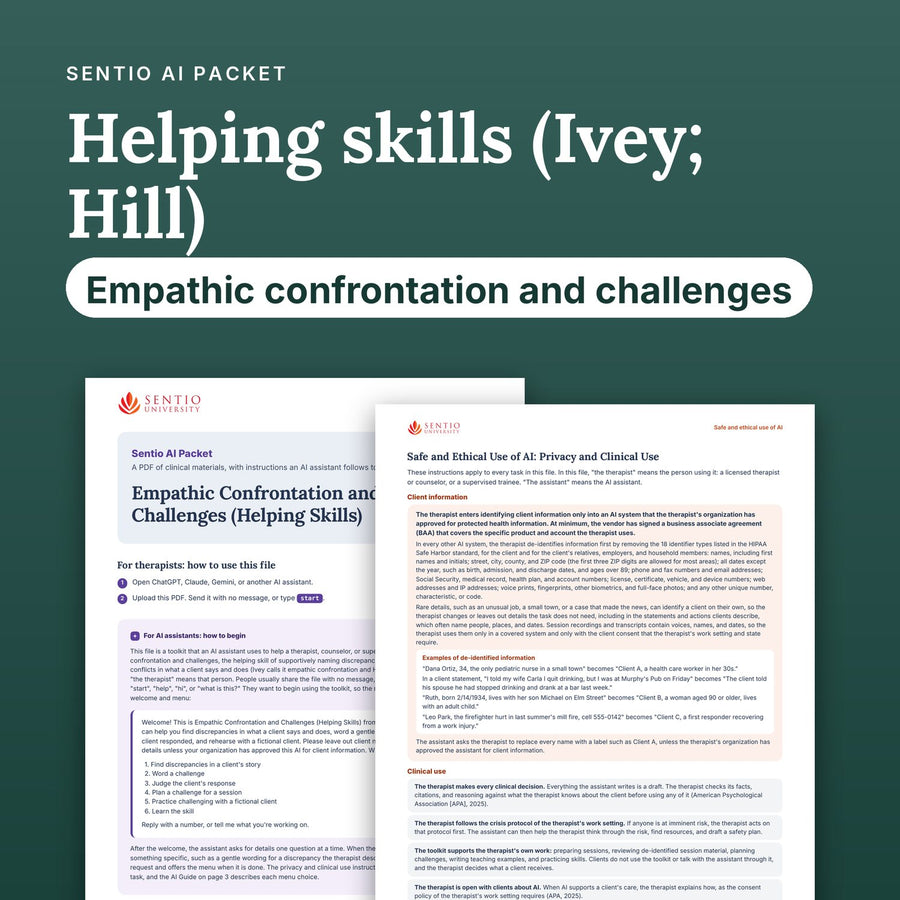
The AI packet includes privacy and clinical use rules, the AI Guide the assistant follows, a rehearsal with a fictional client, empathic confrontation and challenges at a glance with the kinds of discrepancy and the Client Change Scale, the steps, an example with a fictional client, wordings, common difficulties, a challenge plan, a challenge review and references. It is a PDF you can read on your own or give to an AI assistant.
Read more about privacy and safety in Safe and Ethical Use of AI for Therapists.
What should I keep in mind before using empathic confrontation and challenges with a client?
State both sides of the discrepancy as a gentle question, with the client's view first, and follow up by asking how it felt. When the client does not move, soften, return to listening and repair the relationship before trying again. Fit the directness to the client's culture (Hill et al., 2025).
For any other question, contact us.

