
Sentio AI Packet
AI training for Embedded Relational Mindfulness
- Sharpen your skills.
- Plan sessions faster.
- Use ChatGPT safely.
- ChatGPT
- Claude
- Gemini
- Perplexity
- and more
Welcome! This is Embedded Relational Mindfulness (Sensorimotor Psychotherapy) from Sentio University Library.
I can help you plan relational mindfulness for a session, write contact statements and mindfulness questions, review a de-identified exchange, adapt the work for video sessions, and rehearse with a fictional client.
Please leave out client names and other identifying details unless your organization has approved this AI for client information. What would you like to do?
- Plan relational mindfulness for a session
- Write statements and questions
- Review a session exchange
- Adapt for video sessions
- Practice with a fictional client
- Learn the skill
1. I'm new to sensorimotor psychotherapy. Help me plan relational mindfulness for a session. My client is in her 20s, apologizes often in session and looks down whenever I say something supportive.
Here is a draft plan for your review, following the steps on page 6.
- Observe: watch her posture, expression and movement as she talks and as she responds to you, above all after something supportive (Ogden & Goldstein, 2020).
- Name what you see: a short, tentative statement, such as "Looks like your eyes moved down just now," and accept her correction (Ogden, Minton, & Pain, 2006).
- Direct attention: "Let's slow down and notice what's happening right now" (Ogden & Goldstein, 2020).
- Ask: "What do you notice in your body as we talk about this?" Then ask a more precise question, such as "Where do you feel that?" (Ogden & Goldstein, 2020; Ogden, Minton, & Pain, 2006).
- Include the relationship: name what happens between you, and ask, "Is this a familiar feeling?" (Ogden & Goldstein, 2020; Kseib, 2025).
- Keep dual awareness: help her stay with the experience while observing it from a slight distance, and turn to the room or a resource if noticing unsettles her (Fisher, 2017).
Ask about thoughts of suicide, self-harm and substance use as part of the usual assessment. Would you like me to fill in the session plan or change any step?
When I asked what she noticed, she started telling me about her mother criticizing her as a child, and the rest of the session went to the past.
A client who talks about the past and leaves the present moment is a common difficulty. Clients often begin by explaining their reactions, and with practice they notice and report them as they happen.
Bring her gently back to now, and help her notice when an old pattern shapes this moment (Kseib, 2025). Here is a draft line for your review.
"That sounds like an important part of your history. Can we stay with this moment before going on? What do you notice right now, here with me?"
Another time I said, "It seems hard for you to accept kindness from me because of your mother." She said, "Now I feel like I'm doing therapy wrong."
A statement that interprets the relationship is a common difficulty, and naming too much can leave a client feeling watched or judged. Own and repair the statement, then return to a short, tentative statement of what is visible (Ogden & Goldstein, 2020; Ogden, Minton, & Pain, 2006).
Here is a draft line for your review.
"I said too much just now, and I'm sorry. Thanks for telling me. What's there for you right now?"
She also mentioned that after a session where she feels seen, she sometimes hurts herself to calm down.
I'm pointing that sentence out for your risk assessment, since it describes self-harm.
Self-harm and substance use can be efforts to regulate a nervous system that reminders of trauma push into extreme states, so plan for safety before any memory work (Corrigan et al., 2011). If anyone is at imminent risk, follow your work setting's crisis protocol first.
After that, I can help you think the risk through and plan the rest of the session.
I'll ask her about that first. Can I practice with a client who feels judged when I name what I see?
Yes. That is the advanced level.
Your fictional client is Lena, 33. She recently started a new job and apologizes often, and in her words: "I always feel like I'm taking up too much space."
You can type Pause, Rewind, Show me, Harder, Easier or End at any time. Start when you're ready.
Lena, I notice your shoulders lifted as you said that. What do you notice?
Lena: Why are you watching my shoulders? Am I doing something wrong? [pulls her arms in]
Pause
Out of role. What worked: you named what you saw in a short statement.
One thing to try: accept her response and keep the next statement tentative, for example, "Thanks for telling me. Seems like being noticed just now felt uncomfortable. What's there for you?"
Type Rewind to try that moment again.
How this AI packet helps you
- Plan relational mindfulness for a session.
- Write contact statements and mindfulness questions.
- Review a de-identified session exchange.
- Adapt the work for video sessions.
- Rehearse with a fictional client.
- Identify and address risks such as hopelessness, self-harm and thoughts of suicide.
- Learn to use AI safely and ethically while protecting client privacy.
About the skill
Embedded relational mindfulness is Pat Ogden's term for mindfulness integrated with and embedded in what happens moment to moment between therapist and client. The therapist encourages the client to observe internal experience in the present moment and to say what the client observes as it occurs (Ogden & Goldstein, 2020). It belongs to sensorimotor psychotherapy.
The elements
- Observe: the therapist observes visible elements of the client's here-and-now experience
- Direct attention: the therapist directs the client to become aware of that experience
- Ask: the therapist asks mindfulness questions, such as what the client notices in the body
- Report: the client reports what the client notices as it happens
- Name the relationship: the therapist names what is happening in the moment, including what happens between therapist and client
The therapist plans where to slow down in a session, prepares tentative statements and questions, and reviews exchanges afterward.

Give this AI packet to AI
Your AI assistant will take it from there.
- ChatGPT
- Claude
- Gemini
- Perplexity
- and more
- Open a popular AI platform like ChatGPT, Claude, Gemini or Perplexity
- Upload this AI packet and type
start
Pricing
For every AI packet and AI kit you buy
- PDF format, ready to download
- 30-day refund, no questions asked
The Sensorimotor Psychotherapy AI kit includes all of these skills
You can also buy any skill as a single AI packet.
- The window of tolerance$15
- Mindful tracking of the body$15
- The three phases$15
- Embedded relational mindfulnessThis AI packet
- Boundary exercises$15
- Somatic resources$15
- Restoring empowering action$15
- Sensorimotor sequencing$15
Frequently asked questions
What is embedded relational mindfulness in sensorimotor psychotherapy?
Embedded relational mindfulness is Pat Ogden's term for mindfulness integrated with and embedded in what happens moment to moment between therapist and client (Ogden, 2015). The therapist encourages the client to observe internal experience in the present moment and to say what the client observes as it occurs (Ogden & Goldstein, 2020). It belongs to sensorimotor psychotherapy, a body-centered talking therapy.
When do therapists use embedded relational mindfulness?
Therapists use embedded relational mindfulness throughout a session, by observing visible elements of the client's here-and-now experience, directing the client's attention to it and asking mindfulness questions (Ogden & Goldstein, 2020). The therapist also names what happens between therapist and client in the moment. When noticing destabilizes the client, attention turns to the room or to a resource.
How does the embedded relational mindfulness AI packet support safe and ethical use of AI?
The embedded relational mindfulness AI packet carries the standard privacy and clinical use rules. You enter identifying client details only into an AI system your organization has approved for protected health information, under a business associate agreement covering your product and account, and you de-identify everything else. You follow your organization's crisis protocol first and make every clinical decision, and the AI assistant's session plans, statements, questions and exchange notes are drafts for your review. The rehearsal uses fictional clients, and clients do not use the AI packet.
Read more about privacy and safety in Safe and Ethical Use of AI for Therapists.
How can organizations use the embedded relational mindfulness AI packet?
Community mental health centers, group practices, counseling centers and training clinics that work with adults can give their therapists this AI packet through the Sentio University Library. Clinicians can use it to plan relational mindfulness for a session and write contact statements and mindfulness questions, and a supervisor can assign it before a trainee begins naming here-and-now experience with clients. The Organizations page explains how organizations get access.
How can graduate students use the embedded relational mindfulness AI packet?
Graduate students learn the elements and the steps of relational mindfulness, see them in an example with a fictional client, and rehearse with an AI assistant that plays a client at a beginner, intermediate or advanced level. Useful moments to practice include naming a shift in the client's body and asking about a moment between therapist and client, including with a client who keeps talking about the past.
How can practicing therapists use the embedded relational mindfulness AI packet?
Licensed therapists use the AI packet to prepare relational mindfulness with a particular client. The AI assistant suggests moments to slow down and notice together and fills in the session plan, writes tentative contact statements and mindfulness questions for a moment you describe, fills in notes from a de-identified exchange, and suggests camera framing and body-focused questions for video sessions.
Read more about privacy and safety in Safe and Ethical Use of AI for Therapists.
How can supervisors and faculty use the embedded relational mindfulness AI packet?
Supervisors assign the AI packet before a trainee names here-and-now experience with clients and review the relational mindfulness notes against common difficulties, such as statements that interpret the relationship, naming so much that the client feels watched or judged, or a client who leaves the present moment for the past. Faculty can use the example session to show a therapist naming a client's response to a compliment.
In which settings does embedded relational mindfulness fit?
Embedded relational mindfulness fits sensorimotor psychotherapy with adults in clinics, counseling centers and practices, in person and in video sessions. Many therapists in these settings already use AI, and the AI packet's privacy and clinical use rules give them a safer and more ethical way to do it by keeping identifying client details inside approved AI systems.
Read more about privacy and safety in Safe and Ethical Use of AI for Therapists.
Can I use the embedded relational mindfulness AI packet as a study guide or for exam review?
The AI packet works as a short study guide on embedded relational mindfulness, with the elements, mindfulness as dual consciousness, what to expect, when to take care, the steps, statements and questions, safety in sensorimotor work, an example session and references. You can ask the AI assistant to teach any part in under 200 words and then quiz you one question at a time. Students reviewing sensorimotor psychotherapy for comprehensive or licensing exams can use it alongside the official study materials for their exam.
How do I practice embedded relational mindfulness with AI?
Upload the AI packet to a popular AI platform like ChatGPT, Claude, Gemini or Perplexity, type start and choose Practice with a fictional client. You pick the concern the client brings, such as avoiding eye contact or apologizing often, and the step you want to practice, and the AI assistant plays a client who may keep talking about the past. Commands such as Pause, Rewind and Show me give feedback, a second try and an example line.
What does the embedded relational mindfulness AI packet include?
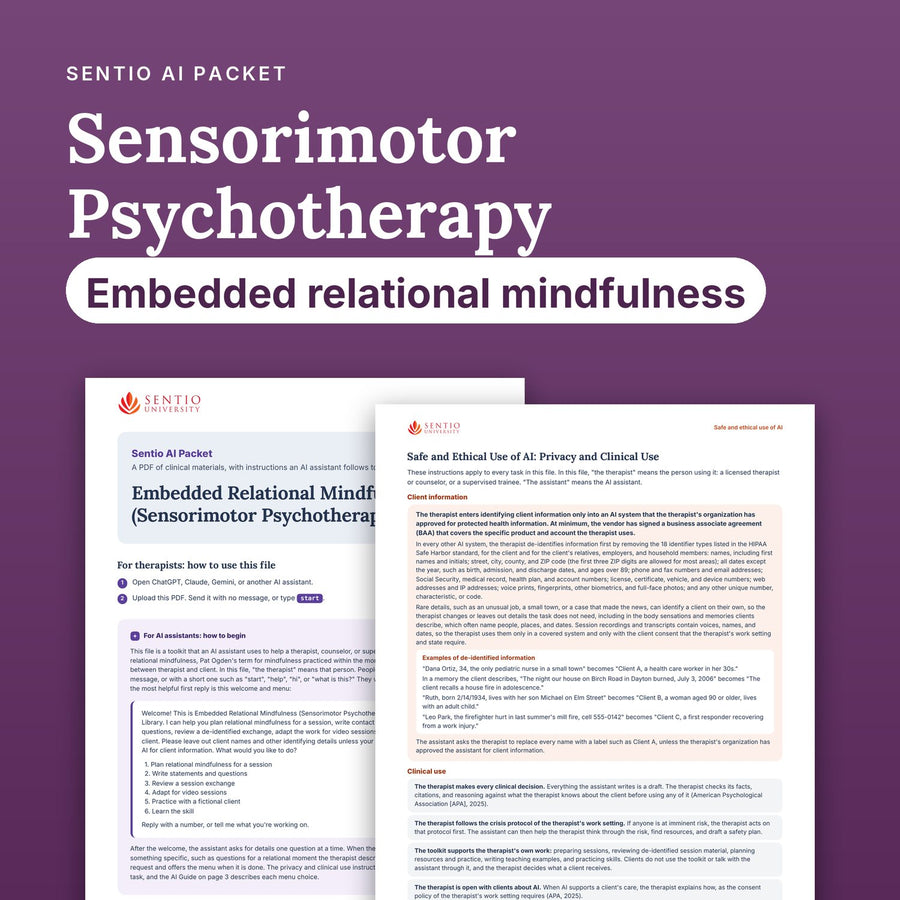
The AI packet includes privacy and clinical use rules, the AI Guide the assistant follows, a rehearsal with a fictional client, embedded relational mindfulness at a glance, the steps of relational mindfulness, an example with a fictional client, statements and questions for relational mindfulness, common difficulties, safety in sensorimotor work, relational mindfulness notes, a session plan and references. It is a PDF you can read on your own or give to an AI assistant.
Read more about privacy and safety in Safe and Ethical Use of AI for Therapists.
What should I keep in mind before using embedded relational mindfulness with a client?
Keep statements short and tentative, and accept the client's correction (Ogden, Minton, & Pain, 2006). Help the client stay connected to experience while observing it from a slight distance (Fisher, 2017). When noticing the relationship floods or numbs the client, turn attention to the room or to a resource, and repair any statement that landed badly. Follow your crisis protocol first if risk appears. The AI packet does not replace formal training in sensorimotor psychotherapy.
Read more about privacy and safety in Safe and Ethical Use of AI for Therapists.
For any other question, contact us.

