
Sentio AI Packet
AI training for Restoring Empowering Action
- Sharpen your skills.
- Plan sessions faster.
- Use ChatGPT safely.
- ChatGPT
- Claude
- Gemini
- Perplexity
- and more
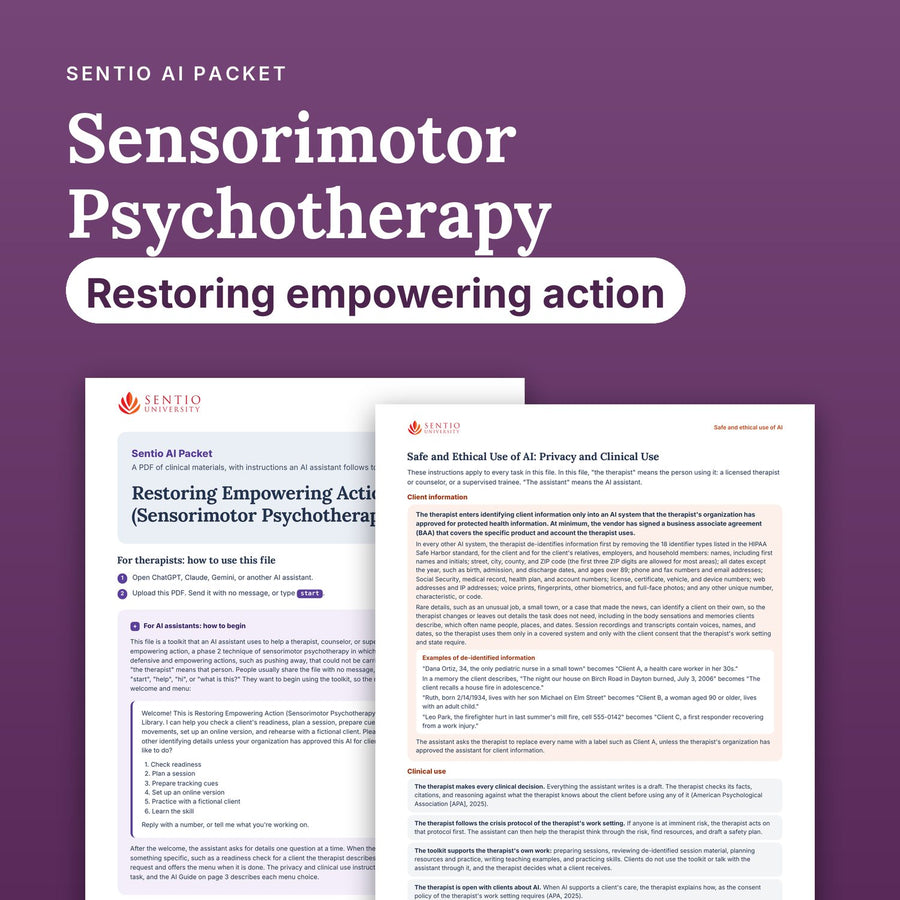
Welcome! This is Restoring Empowering Action (Sensorimotor Psychotherapy) from Sentio University Library.
I can help you check a client's readiness, plan a session, prepare cues for tracking preparatory movements, set up an online version, and rehearse with a fictional client.
Please leave out client names and other identifying details unless your organization has approved this AI for client information. What would you like to do?
- Check readiness
- Plan a session
- Prepare tracking cues
- Set up an online version
- Practice with a fictional client
- Learn the skill
2. I'm new to sensorimotor psychotherapy. Help me plan a session. My client is in her 40s and froze when she was pinned in her car after an accident, and her phase 1 resources are in place.
Here is a draft plan for your review, following the steps on page 6.
- Check readiness and resources: confirm the alliance, her phase 1 goals and that she can bring arousal back into the window, and name the resources she will return to (Ogden, Minton, & Pain, 2006).
- Evoke a sliver: invite one small piece of the memory, such as the moment she noticed she was stuck, slowly and mindfully (Ogden, Minton, & Pain, 2006).
- Track and make contact: watch for immobilizing defenses and for small preparatory movements, such as a hand starting to make a fist (Ogden, Minton, & Pain, 2006).
- Set the story aside: invite her to leave the narrative for now and stay with the movement (Ogden, Minton, & Pain, 2006).
- Carry out the action slowly: she pushes against a pillow you hold, directing the pressure and position (Ogden, Minton, & Pain, 2006).
- Integrate and settle: ask what she notices after the action and help arousal settle into the window (Ogden, Minton, & Pain, 2006).
Ask about thoughts of suicide, self-harm and substance use, and plan for safety before any memory work. Would you like me to fill in the session plan or change any step?
When we tried a small piece, she went into the whole accident, the sounds, the ambulance, everything.
A memory told in full is a common difficulty. The story's job is to bring the nonverbal parts of the memory into present awareness, and mindfulness questions keep dual awareness and prevent reliving (Ogden, Minton, & Pain, 2006).
Here is a draft line for your review.
"Let's leave the story for a moment. Can you feel your feet here in this room? What do you notice in your arms right now?"
When her hands started to push, she shoved the pillow hard and started sobbing.
A rushed action that turns into a release of emotion is a common difficulty. The method aims at resolution, and the developers discourage abreaction and regression (Ogden, Minton, & Pain, 2006).
Here is a draft next step for your review.
- Slow the action: "Push as slowly as you like, and tell me where to hold the pillow."
- Return to dual awareness: "Can you feel your feet here in this room as you notice that?"
- If she floods, stop the memory work and return to her phase 1 resources (Ogden, Minton, & Pain, 2006).
Afterward she said, "Some nights I wish the accident had finished me."
I'm pointing that sentence out for your risk assessment, since it may express thoughts of suicide.
Ask about thoughts of suicide before any further memory work, and plan for safety first. If anyone is at imminent risk, follow your work setting's crisis protocol first.
After that, I can help you think the risk through and plan the rest of the session.
I'll ask her about that first. Can I practice with a client who keeps returning to the story?
Yes. That is the intermediate level.
Your fictional client is Omar, 29. He froze when a stranger grabbed his arm on a train years ago, and in his words: "I keep replaying it and asking myself why I stood there."
You can type Pause, Rewind, Show me, Harder, Easier or End at any time. Start when you're ready.
Omar, let's take only the moment his hand touched your arm, and keep your feet on the floor here. What do you notice?
Omar: My arm feels stuck, like it did then. And the doors were closing, and everyone was staring. [left arm starts to pull in]
Pause
Out of role. What worked: you kept the memory to one small moment.
One thing to try: name the movement and set the story aside, for example, "Seems like your arm wants to do something. Let's leave the story for a moment and stay with your arm."
Type Rewind to try that moment again.
How this AI packet helps you
- Check a client's readiness for this work.
- Plan a session.
- Prepare the tracking cues to watch for.
- Set up a version for video sessions.
- Rehearse with a fictional client.
- Identify and address risks such as hopelessness, self-harm and thoughts of suicide.
- Learn to use AI safely and ethically while protecting client privacy.
About the skill
In phase 2 of sensorimotor psychotherapy, a body-centered talking therapy developed by Pat Ogden, the therapist helps the client complete defensive actions that could not be carried out during the trauma. The developers call these acts of triumph, a term from Janet (Ogden, Minton, & Pain, 2006).
Readiness conditions
- An established alliance: memory work starts only after an adequate alliance has formed
- Phase 1 goals met: the client has resources that work
- Arousal comes back: the client can return arousal to the window of tolerance
- A plan to return: work that destabilizes the client goes back to phase 1 resources
The client evokes only a sliver of the memory, slowly and mindfully, and the therapist tracks the preparatory movements that show a defensive action beginning.

Give this AI packet to AI
Your AI assistant will take it from there.
- ChatGPT
- Claude
- Gemini
- Perplexity
- and more
- Open a popular AI platform like ChatGPT, Claude, Gemini or Perplexity
- Upload this AI packet and type
start
Pricing
For every AI packet and AI kit you buy
- PDF format, ready to download
- 30-day refund, no questions asked
The Sensorimotor Psychotherapy AI kit includes all of these skills
You can also buy any skill as a single AI packet.
- The window of tolerance$15
- Mindful tracking of the body$15
- The three phases$15
- Embedded relational mindfulness$15
- Boundary exercises$15
- Somatic resources$15
- Restoring empowering actionThis AI packet
- Sensorimotor sequencing$15
Frequently asked questions
What is restoring empowering action in sensorimotor psychotherapy?
Restoring empowering action is a phase 2 technique of sensorimotor psychotherapy in which the client mindfully completes defensive and empowering actions, such as pushing away, that could not be carried out during a trauma. The developers call these acts of triumph, a term from Janet (Ogden, Minton, & Pain, 2006). The client evokes only a sliver of the memory, slowly and mindfully.
When do therapists use restoring empowering action?
Therapists use restoring empowering action in phase 2, only after an adequate alliance has formed, the phase 1 goals are met and the client can return arousal to the window of tolerance (Ogden, Minton, & Pain, 2006). Work that destabilizes the client goes back to phase 1 resources. The therapist plans for safety before any memory work.
How does the restoring empowering action AI packet support safe and ethical use of AI?
The restoring empowering action AI packet carries the standard privacy and clinical use rules. You enter identifying client details only into an AI system your organization has approved for protected health information, under a business associate agreement covering your product and account, and you de-identify everything else. You follow your organization's crisis protocol first and make every clinical decision, and the AI assistant's readiness summaries, session plans and tracking cues are drafts for your review. The rehearsal uses fictional clients, and clients do not use the AI packet.
Read more about privacy and safety in Safe and Ethical Use of AI for Therapists.
How can organizations use the restoring empowering action AI packet?
Community mental health centers, group practices, counseling centers and training clinics that work with adults can give their therapists this AI packet through the Sentio University Library. Clinicians can use it to check a client's readiness and plan a session, and a supervisor can assign it before a trainee begins phase 2 work with a client. The Organizations page explains how organizations get access.
How can graduate students use the restoring empowering action AI packet?
Graduate students learn the readiness conditions, the principles of the work and its steps, see them in an example with a fictional client, and rehearse with an AI assistant that plays a client at a beginner, intermediate or advanced level. Useful moments to practice include noticing a hand starting to move and slowing an action down, including with a client who keeps returning to the story.
How can practicing therapists use the restoring empowering action AI packet?
Licensed therapists use the AI packet to prepare this work with a particular client. The AI assistant goes through the readiness conditions and summarizes which are met, drafts a session plan with the small piece of memory to start with, the resources to return to and the object to use, lists preparatory movements to watch for with contact statements and questions, and adapts the plan for a video session.
How can supervisors and faculty use the restoring empowering action AI packet?
Supervisors assign the AI packet before a trainee begins phase 2 work and review the session plan against common difficulties, such as starting before the readiness conditions are met, a memory told in full, an action that is rushed, or leading questions. Faculty can use the example session to show a therapist tracking a preparatory movement and setting the story aside.
In which settings does restoring empowering action fit?
Restoring empowering action fits sensorimotor psychotherapy with adults in clinics, counseling centers and practices, in phase 2, in person or by video, once the readiness conditions are met. Many therapists in these settings already use AI, and the AI packet's privacy and clinical use rules give them a safer and more ethical way to do it by keeping identifying client details inside approved AI systems.
Read more about privacy and safety in Safe and Ethical Use of AI for Therapists.
Can I use the restoring empowering action AI packet as a study guide or for exam review?
The AI packet works as a short study guide on restoring empowering action, with the readiness conditions, the principles of the work, when to take care, the steps, cues, statements and questions, safety in sensorimotor work, an example session and references. You can ask the AI assistant to teach any part in under 200 words and then quiz you one question at a time. Students reviewing sensorimotor psychotherapy for comprehensive or licensing exams can use it alongside the official study materials for their exam.
How do I practice restoring empowering action with AI?
Upload the AI packet to a popular AI platform like ChatGPT, Claude, Gemini or Perplexity, type start and choose Practice with a fictional client. You pick the concern the client brings, such as being pinned in an accident, and the step you want to practice, and the AI assistant plays a client who may keep returning to the story. Commands such as Pause, Rewind and Show me give feedback, a second try and an example line.
What does the restoring empowering action AI packet include?
The AI packet includes privacy and clinical use rules, the AI Guide the assistant follows, a rehearsal with a fictional client, restoring empowering action at a glance, the steps of the work, an example with a fictional client, cues, statements and questions, common difficulties, safety in sensorimotor work, a session plan, session notes and references. It is a PDF you can read on your own or give to an AI assistant.
Read more about privacy and safety in Safe and Ethical Use of AI for Therapists.
What should I keep in mind before using restoring empowering action with a client?
Memory work is inherently destabilizing, and moving fast or giving priority to retrieving memories is a major error (Ogden, Minton, & Pain, 2006). Avoid leading questions, and neither confirm nor dispute memories that emerge. Stop and return to phase 1 resources when the client freezes, floods or dissociates. Follow your crisis protocol first if risk appears. The AI packet does not replace formal training in sensorimotor psychotherapy.
Read more about privacy and safety in Safe and Ethical Use of AI for Therapists.
For any other question, contact us.

