
Sentio AI Packet
AI training for The Three Phases
- Sharpen your skills.
- Plan sessions faster.
- Use ChatGPT safely.
- ChatGPT
- Claude
- Gemini
- Perplexity
- and more
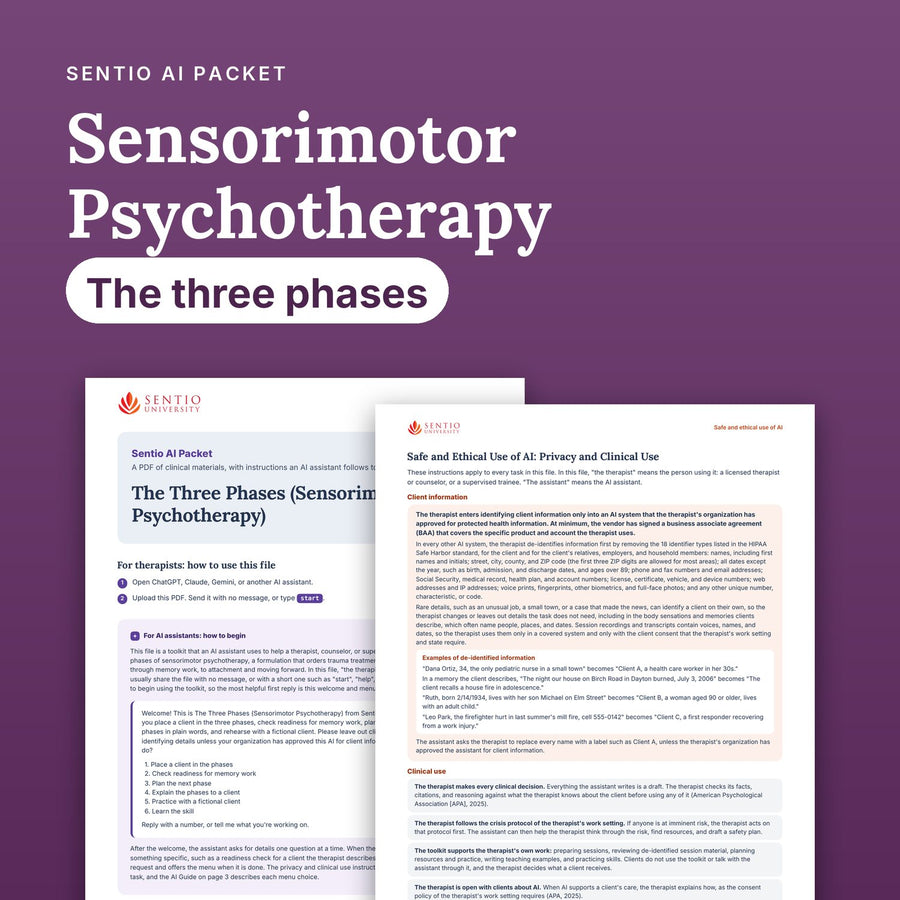
Welcome! This is The Three Phases (Sensorimotor Psychotherapy) from Sentio University Library.
I can help you place a client in the three phases, check readiness for memory work, plan the next phase, explain the phases in plain words, and rehearse with a fictional client.
Please leave out client names and other identifying details unless your organization has approved this AI for client information. What would you like to do?
- Place a client in the phases
- Check readiness for memory work
- Plan the next phase
- Explain the phases to a client
- Practice with a fictional client
- Learn the skill
2. I'm new to sensorimotor psychotherapy. Help me check whether my client is ready for memory work. She's in her 40s, was robbed at work two years ago, and after several weeks of resource work she says she wants to talk about it.
Here is a draft readiness check for your review, following step 3 on page 6. I'll go through each point with you one at a time.
- Alliance: is your working relationship established (Ogden, Minton, & Pain, 2006)?
- Phase 1 goals: does she recognize the first body signs of hyperarousal and hypoarousal, with steadying self-care such as regular sleep and eating in place (Ogden, Minton, & Pain, 2006)?
- Coming back: can she bring arousal back into the window after a reminder, using her somatic resources (Ogden, Minton, & Pain, 2006)?
- When all three are met: plan one small sliver of memory with dual awareness of past and present (Ogden, Minton, & Pain, 2006; Fisher, 2017).
- Signs to return to phase 1: going blank or far away, or a pounding heart that stays high.
Ask about thoughts of suicide, self-harm and substance use as part of the usual assessment, and check again before memory work. Would you like me to fill in the phase plan or change any step?
She says she wants to go through the whole robbery next session, every detail from start to finish, to get it over with.
A client who wants to tell the whole story at once is common. Detailed, scene-by-scene retelling can retraumatize, and Fisher favors acknowledging the past without exploring its details (Fisher, 2017).
Acknowledge her wish, explain that resources make memory work safer and link the small pieces to her own goal. Here is a draft line for your review.
"I hear how much you want this behind you. We'll take a small piece at a time and keep one foot here in the room, so you stay steady while we work."
We tried a small piece last week, and she went blank for several minutes. I feel like I failed her.
Seeing a return to phase 1 as failure is a common difficulty. The phases tend to occur in a spiral, and a client destabilized by memory work returns to phase 1 resources before going on (Ogden, Minton, & Pain, 2006).
Here is a draft next step for your review.
- Go back to the resources she already uses until she comes back into the window reliably.
- Check at each review which phase fits her now (Ogden, Minton, & Pain, 2006).
- Plan the next sliver smaller, with one foot in the room.
Some clients gain most from ongoing phase 1 resources (Ogden, Minton, & Pain, 2006).
She also said, "Sometimes I think everyone would be better off without me."
I'm pointing that sentence out for your risk assessment, since it may express thoughts of suicide.
Check for thoughts of suicide, self-harm and substance use before any further memory work, and plan for safety first. If anyone is at imminent risk, follow your work setting's crisis protocol first.
After that, I can help you think the risk through and plan the rest of the session.
I'll ask her about that first. Can I practice with a client who is impatient to talk about what happened?
Yes. That is the intermediate level.
Your fictional client is Marcus, 38. A break-in at his home last year leaves him on edge at night, and in his words: "I want to tell you the whole thing and be done with it."
You can type Pause, Rewind, Show me, Harder, Easier or End at any time. Start when you're ready.
Marcus, I hear how much you want to be done with it. Before the story, can we spend some time on what helps you settle at night?
Marcus: We've been doing the settling stuff for weeks. Can we start with the night it happened? [leans forward, taps his foot]
Pause
Out of role. What worked: you acknowledged his wish before setting the pace.
One thing to try: link phase 1 to his own goal, for example, "Building ways to settle at night is the step that makes the story safer to tell."
Type Rewind to try that moment again.
How this AI packet helps you
- Place a client in the three phases.
- Check readiness for memory work.
- Plan goals and sessions for the next phase.
- Explain the phases to a client.
- Rehearse with a fictional client.
- Identify and address risks such as hopelessness, self-harm and thoughts of suicide.
- Learn to use AI safely and ethically while protecting client privacy.
About the skill
Sensorimotor psychotherapy, a body-centered talking therapy developed by Pat Ogden, orders trauma treatment in three phases. They follow Janet's phases of symptom reduction and stabilization, treatment of traumatic memory, and personality integration and rehabilitation (Ogden, Minton, & Pain, 2006).
The phases
- Phase 1, developing resources: the client learns to recognize the first body signs of hyperarousal and hypoarousal and uses somatic resources to bring arousal back into the window of tolerance
- Phase 2, memory: the client works with small slivers of memory with dual awareness of past and present and completes or regulates the defensive responses that could not be carried out during the trauma
- Phase 3, moving forward: the client takes up the tasks of adult development
The phases are conceived in sequence and tend to occur in a spiral, and a client destabilized by memory work in phase 2 returns to phase 1.

Give this AI packet to AI
Your AI assistant will take it from there.
- ChatGPT
- Claude
- Gemini
- Perplexity
- and more
- Open a popular AI platform like ChatGPT, Claude, Gemini or Perplexity
- Upload this AI packet and type
start
Pricing
For every AI packet and AI kit you buy
- PDF format, ready to download
- 30-day refund, no questions asked
The Sensorimotor Psychotherapy AI kit includes all of these skills
You can also buy any skill as a single AI packet.
- The window of tolerance$15
- Mindful tracking of the body$15
- The three phasesThis AI packet
- Embedded relational mindfulness$15
- Boundary exercises$15
- Somatic resources$15
- Restoring empowering action$15
- Sensorimotor sequencing$15
Frequently asked questions
What are the three phases in sensorimotor psychotherapy?
The three phases are a sensorimotor psychotherapy formulation that orders trauma treatment from developing resources, through memory work, to attachment and moving forward. They follow Janet's phases of stabilization, treatment of traumatic memory and integration. The phases are conceived in sequence and tend to occur in a spiral, and a client destabilized by memory work in phase 2 returns to phase 1 (Ogden, Minton, & Pain, 2006).
When do therapists use the three phases?
Therapists use the three phases to plan trauma treatment from the first session on. Every treatment starts with phase 1, and memory work starts only when the alliance is established, the phase 1 goals are met and the client can bring arousal back into the window of tolerance (Ogden, Minton, & Pain, 2006). The therapist checks at each review which phase fits the client now.
How does the three phases AI packet support safe and ethical use of AI?
The three phases AI packet carries the standard privacy and clinical use rules. You enter identifying client details only into an AI system your organization has approved for protected health information, under a business associate agreement covering your product and account, and you de-identify everything else. You follow your organization's crisis protocol first and make every clinical decision, and the AI assistant's readiness summaries, phase plans and client explanations are drafts for your review. The rehearsal uses fictional clients, and clients do not use the AI packet.
Read more about privacy and safety in Safe and Ethical Use of AI for Therapists.
How can organizations use the three phases AI packet?
Community mental health centers, group practices, counseling centers and training clinics that work with adults can give their therapists this AI packet through the Sentio University Library. Clinicians can use it to place a client in the three phases and check readiness for memory work, and a supervisor can assign it before a trainee plans trauma treatment. The Organizations page explains how organizations get access.
How can graduate students use the three phases AI packet?
Graduate students learn the phases and the steps for working through them, see them in an example with a fictional client, and rehearse with an AI assistant that plays a client at a beginner, intermediate or advanced level. Useful moments to practice include explaining phase 1 and saying not yet to memory work, including with a client who is impatient to talk about what happened.
How can practicing therapists use the three phases AI packet?
Licensed therapists use the AI packet to plan treatment phases with a particular client. The AI assistant places the client in a phase and fills in the phase plan, goes through the readiness questions for memory work and summarizes which are met, drafts goals and session ideas for the current or next phase with signs that call for a return to phase 1, and drafts a plain explanation of the phases.
How can supervisors and faculty use the three phases AI packet?
Supervisors assign the AI packet before a trainee plans trauma treatment and review the phase plan against common difficulties, such as memory work that starts before the readiness conditions are met, a story told in full detail, or a return to phase 1 seen as failure. Faculty can use the example session to show a therapist checking readiness for memory work with the client.
In which settings do the three phases fit?
The three phases fit sensorimotor psychotherapy with adults in clinics, counseling centers and practices, across the whole course of trauma treatment. Many therapists in these settings already use AI, and the AI packet's privacy and clinical use rules give them a safer and more ethical way to do it by keeping identifying client details inside approved AI systems.
Read more about privacy and safety in Safe and Ethical Use of AI for Therapists.
Can I use the three phases AI packet as a study guide or for exam review?
The AI packet works as a short study guide on the three phases, with the phases, what to expect, when to take care, the steps, phrases for explaining the phases, safety in sensorimotor work, an example session and references. You can ask the AI assistant to teach any part in under 200 words and then quiz you one question at a time. Students reviewing sensorimotor psychotherapy for comprehensive or licensing exams can use it alongside the official study materials for their exam.
How do I practice the three phases with AI?
Upload the AI packet to a popular AI platform like ChatGPT, Claude, Gemini or Perplexity, type start and choose Practice with a fictional client. You pick the concern the client brings, such as wanting to tell the whole story at once, and the step you want to practice, and the AI assistant plays a client who may be impatient to talk about what happened. Commands such as Pause, Rewind and Show me give feedback, a second try and an example line.
What does the three phases AI packet include?
The AI packet includes privacy and clinical use rules, the AI Guide the assistant follows, a rehearsal with a fictional client, the three phases at a glance, the steps for working through the phases, an example with a fictional client, phrases for explaining the phases, common difficulties, safety in sensorimotor work, a phase plan and references. It is a PDF you can read on your own or give to an AI assistant.
Read more about privacy and safety in Safe and Ethical Use of AI for Therapists.
What should I keep in mind before using the three phases with a client?
Start memory work only when the readiness conditions are met, and return to phase 1 resources when it destabilizes the client (Ogden, Minton, & Pain, 2006). Detailed, scene-by-scene retelling can retraumatize (Fisher, 2017). Clients whose instability remains the main problem gain most from ongoing phase 1 resources. Follow your crisis protocol first if risk appears. The AI packet does not replace formal training in sensorimotor psychotherapy.
Read more about privacy and safety in Safe and Ethical Use of AI for Therapists.
For any other question, contact us.

