
Sentio AI Packet
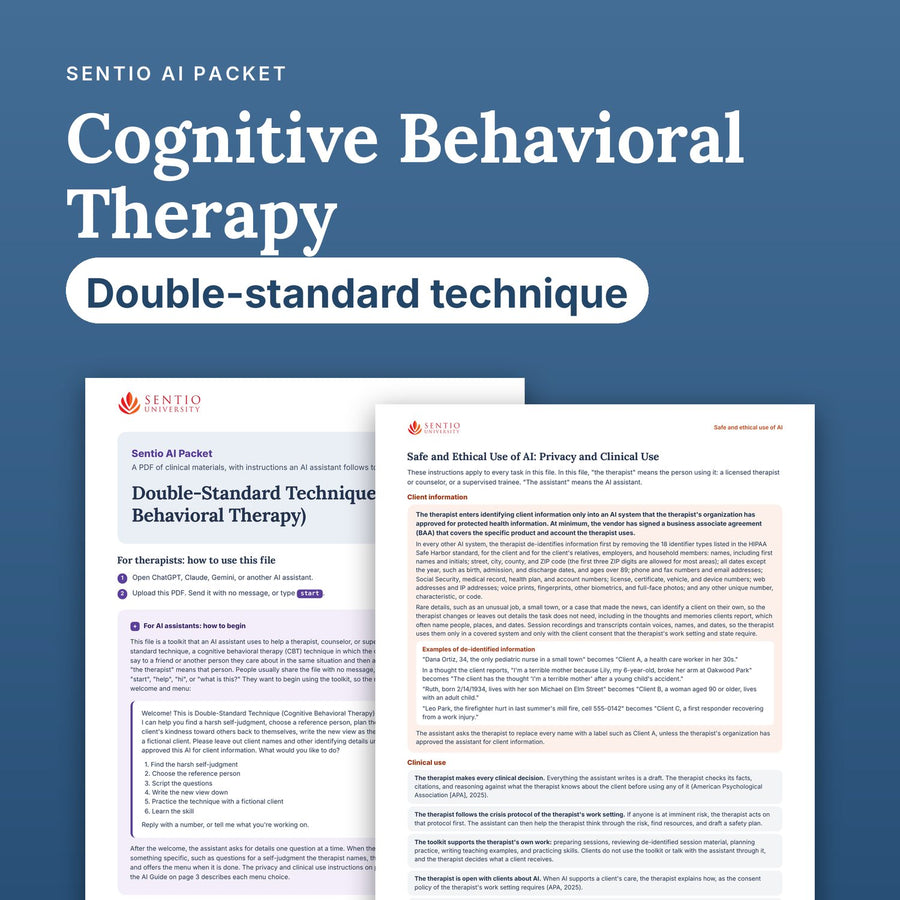
AI training for Double-Standard Technique
- Sharpen your skills.
- Plan sessions faster.
- Use ChatGPT safely.
- ChatGPT
- Claude
- Gemini
- Perplexity
- and more
Welcome! This is Double-Standard Technique (Cognitive Behavioral Therapy) from Sentio University Library.
Please leave out client names and other identifying details unless your organization has approved this AI for client information. What would you like to do?
- Find the harsh self-judgment
- Choose the reference person
- Script the questions
- Write the new view down
- Practice the technique with a fictional client
- Learn the skill
3. I'm new to CBT. My client in his 40s was passed over for a promotion and keeps saying, "I'm a failure." He speaks warmly about his younger brother, who lost a job last year.
Here is a draft set of questions for your review, in the order you would ask them.
- Hear the self-judgment: "Missing that promotion has been painful, and your mind keeps telling you that you're a failure."
- Choose the person: "You mentioned your brother lost a job last year. Think of him in particular."
- Ask about him: "How did he see himself then? What did you say to him?"
- Turn it back: "Could that be true for you too?"
- Test the difference: "Is there something about your brother that makes the kinder view true for him and not for you?"
- Write it down: invite him to write the new view as a therapy note and to read it when the self-judgment returns.
The technique works best after strong empathy, so stay with his distress before you bring in his brother (Beck, 2021). Would you like me to fill in the session plan?
When I tried step 4 last week, he said, "It's different for me. I should have known better."
Holding himself to a higher standard is a common difficulty. Step 5 tests that difference directly and lets him find the inconsistency himself (Beck, 2021). Here is a draft question for your review.
"Is there something about your situation that makes the kinder view true for your brother and not for you?"
If the gap stays, a closer reference person can help, such as a child he feels close to, imagined grown up and in the same situation (Beck, 2021).
I'm also worried he'll hear this as me telling him not to feel bad.
That is a common difficulty. Start from empathy for his distress, and bring in his brother once he feels understood (Beck, 2021). Here is a draft line for your review.
"This has hit you hard, and it makes sense that it hurts. Could we look at it together from another angle?"
When the new view starts to land, ask him to put it in his own words and write it down, so it stays with him between sessions (Beck, 2021).
He also said, "I hate myself, and I'm tired of trying."
I'm pointing that sentence out for your risk assessment, since it may express self-hatred and hopelessness.
Self-hatred calls for a careful risk assessment, and the technique fits a client who judges others more kindly than himself. Ask about thoughts of suicide and self-harm, and if anyone is at imminent risk, follow your work setting's crisis protocol first.
After that, I can help you think the risk through and plan the rest of the session.
I'll ask him at the start of the session. Can I practice first? Guilt about parenting, and a client who says she is different.
Yes. That is the intermediate level.
Your fictional client is Grace, 38. Her daughter's grades dropped this term, and in her words: "I'm a terrible parent. I should have seen it coming."
You can type Pause, Rewind, Show me, Harder, Easier or End at any time. Start when you're ready.
Grace, if your best friend's son had a hard term at school, what would you tell her?
Grace: I'd tell her it happens and she's a good mom. It's different for me. I'm supposed to be on top of things. [shakes her head]
Pause
Out of role. What worked: you chose a specific person she cares about.
One thing to try: start with empathy for her worry, then ask about her friend, for example, "You've been carrying a lot of worry about her this term. If your friend's son had the same term, what would you tell her?"
Type Rewind to try that moment again.
How this AI packet helps you
- Pin down the harsh self-judgment and check whether your client judges others more kindly.
- Choose a reference person your client feels compassion for, such as a close friend, a relative or a child.
- Get the questions in the order you will ask them.
- Draft therapy notes in your client's words, with a plan for reading them.
- Rehearse the technique with a fictional client.
- Identify and address risks such as hopelessness, self-harm and thoughts of suicide.
- Learn to use AI safely and ethically while protecting client privacy.
About the skill
People often judge themselves more harshly than they would judge a dear friend with the same problem. In the double-standard technique, a cognitive behavioral therapy (CBT) skill, the therapist asks what the client would say to another person in the same situation. When clients consider other people's circumstances, they often gain psychological distance from their own beliefs and see an inconsistency (Beck, 2021).
Choosing the reference person
- A dear friend: someone the client would comfort in the same situation
- Someone in a similar spot: a person the client knows who faces the same problem
- A child the client feels close to: the client's own child or grandchild, sometimes imagined grown up
The therapist reflects the client's distress first, asks what the client would say to the other person and asks whether that could be true for the client too. The client writes the new view down and reads it when the self-judgment returns. The technique needs a client who does judge others more kindly than themselves, and self-hatred calls for a careful risk assessment.

Give this AI packet to AI
Your AI assistant will take it from there.
- ChatGPT
- Claude
- Gemini
- Perplexity
- and more
- Open a popular AI platform like ChatGPT, Claude, Gemini or Perplexity
- Upload this AI packet and type
start
Pricing
For every AI packet and AI kit you buy
- PDF format, ready to download
- 30-day refund, no questions asked
The CBT AI kit includes all of these skills
You can also buy any skill as a single AI packet.
- Explaining the cognitive modelGet it free
- Collaborative empiricism$15
- Cognitive case conceptualization$15
- Setting goals from aspirations and values$15
- Structuring a session$15
- Agenda setting$15
- Identifying automatic thoughts$15
- Identifying emotions and rating intensity$15
- Recognizing cognitive distortions$15
- Socratic questioning and guided discovery$15
- Evaluating automatic thoughts$15
- Thought records$15
- Decatastrophizing$15
- Downward arrow technique$15
- Identifying intermediate beliefs$15
- Modifying intermediate beliefs$15
- Identifying core beliefs$15
- Modifying core beliefs$15
- Positive data log$15
- Behavioral experiments$15
- Activity monitoring and scheduling$15
- Graded task assignment$15
- Advantages-disadvantages analysis$15
- Responsibility pie chart$15
- Continuum technique$15
- Double-standard techniqueThis AI packet
- Coping cards$15
- Intellectual-emotional role-play$15
- Working with mental images$15
- Action plans (homework)$15
- Covert rehearsal (cognitive rehearsal)$15
- Relapse prevention and ending treatment$15
Frequently asked questions
What is the double-standard technique in CBT?
The double-standard technique is a cognitive behavioral therapy (CBT) technique in which the client considers what they would say to a friend or another person they care about in the same situation, and then applies it to themselves. People often judge themselves more harshly than they would judge a dear friend. J. S. Beck uses other people as a reference point, which gives clients distance from their own beliefs (Beck, 2021).
When do therapists use the double-standard technique?
Therapists use the technique when a client voices a harsh self-judgment, such as "I'm weak for needing help," and it works best after strong empathy. It needs a client who judges others more kindly than themselves, so it is a poor fit for the rare client who is equally harsh toward other people. Self-hatred calls for a careful risk assessment.
How does the double-standard technique AI packet support safe and ethical use of AI?
The double-standard technique AI packet carries the standard privacy and clinical use rules. You enter identifying client details only into an AI system your organization has approved for protected health information, under a business associate agreement covering your product and account, and you de-identify everything else, including the reference person. You follow your organization's crisis protocol first and make every clinical decision, and the AI assistant's question scripts and therapy notes are drafts for your review. The rehearsal uses fictional clients, and clients do not use the AI packet.
Read more about privacy and safety in Safe and Ethical Use of AI for Therapists.
How can organizations use the double-standard technique AI packet?
College counseling centers, hospitals, community mental health centers, veterans programs, group practices and training programs can give their therapists the double-standard technique AI packet through the Sentio University Library. Many therapists there already use AI, and the AI packet gives them a safer and more ethical way to script the questions for a self-critical client. The Organizations page explains how organizations get access.
Read more about privacy and safety in Safe and Ethical Use of AI for Therapists.
How can graduate students use the double-standard technique AI packet?
Graduate students learn how to choose a reference person, such as a dear friend, someone in a similar spot or a child the client feels close to, and the steps for turning the client's kindness toward others back to themselves. The rehearsal offers a client who says they are different from everyone else and a client who is harsh toward others as well.
How can practicing therapists use the double-standard technique AI packet?
Licensed therapists use the AI packet to find the harsh self-judgment in a particular client's words, choose the reference person, script the questions and write the new view down as therapy notes the client can reread. A double-standard record gives the client prompts for the next time the self-judgment shows up.
How can supervisors and faculty use the double-standard technique AI packet?
Supervisors can use the common difficulties to review a trainee's timing, for example using the technique before showing empathy or choosing a vague reference person. Trainees can rehearse the moment of asking "Could that be true for you too?" Faculty can use the AI packet to show how distancing questions work and where the technique came from, since David Burns named it and credits Maxie Maultsby.
In which settings does the double-standard technique fit?
The double-standard technique fits individual CBT with self-critical adults in college counseling centers, private and group practice, community mental health centers, hospitals and veterans programs. Many therapists in these settings already use AI, and the AI packet's privacy and clinical use rules give them a safer and more ethical way to do it by keeping identifying client details inside AI systems their organization has approved and by pointing out self-hatred or hopelessness for the therapist's own risk assessment.
Read more about privacy and safety in Safe and Ethical Use of AI for Therapists.
Can I use the double-standard technique AI packet as a study guide or for exam review?
The AI packet works as a short study guide on the double-standard technique, with its rationale, the choice of reference person, the steps and an example. The AI assistant can teach any part and quiz you one question at a time. Students preparing for comprehensive or licensing exams that cover CBT can use it as review alongside the official study materials for their exam.
How do I practice the double-standard technique with AI?
Upload the AI packet to a popular AI platform like ChatGPT, Claude, Gemini or Perplexity, type start and choose Practice the technique with a fictional client. You pick the self-judgment the client brings, such as "I'm a terrible parent," and the step you want to practice. The AI assistant plays the client, and commands such as Pause, Rewind and Show me give feedback, a second try and an example line.
What does the double-standard technique AI packet include?
The AI packet includes privacy and clinical use rules, the AI Guide the assistant follows, a rehearsal with a fictional client, the double-standard technique at a glance with guidance on choosing the reference person, the steps, an example with a fictional client, questions for the double standard, common difficulties, a double-standard record for the client, a session plan and references. It is a PDF you can read on your own or give to an AI assistant.
Read more about privacy and safety in Safe and Ethical Use of AI for Therapists.
What should I keep in mind before using the double-standard technique with a client?
Show empathy first and ask about a specific person before turning the question back to the client. When the client insists they are different, ask what makes the difference and test it. Write the kinder view down so it stays available. A situation that involves real, ongoing danger to the client or a child needs safety planning by the therapist.
For any other question, contact us.

