
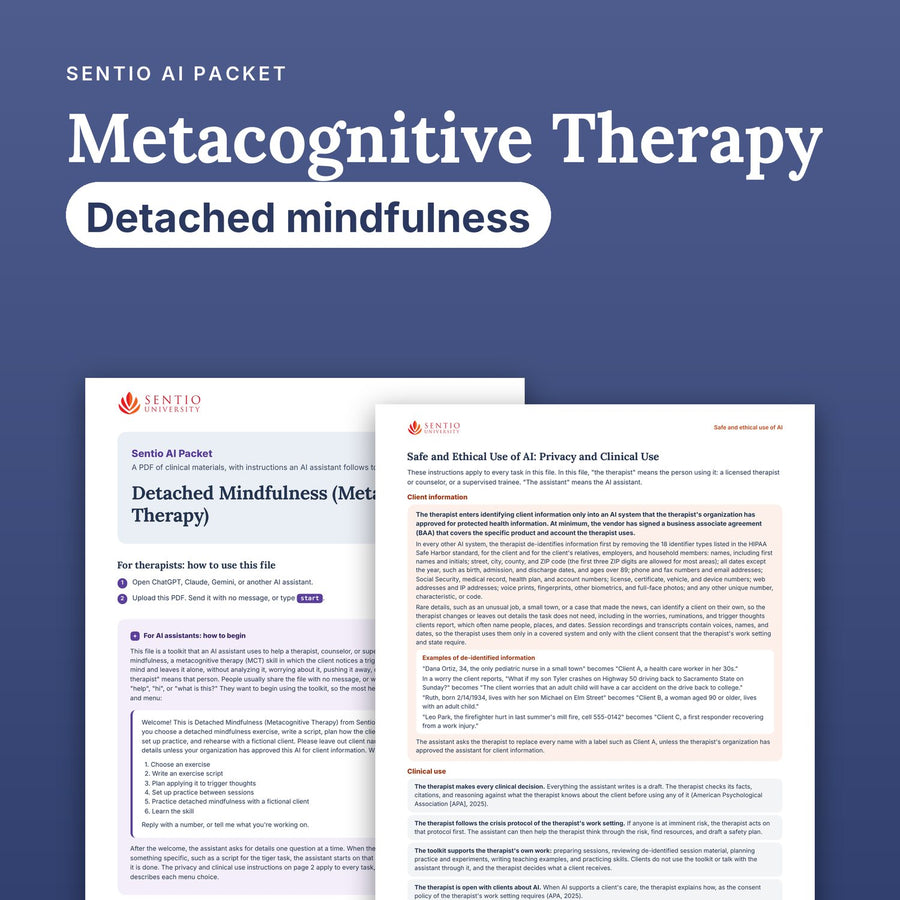
Sentio AI Packet
AI training for Detached Mindfulness
- Sharpen your skills.
- Plan sessions faster.
- Use ChatGPT safely.
- ChatGPT
- Claude
- Gemini
- Perplexity
- and more
Welcome! This is Detached Mindfulness (Metacognitive Therapy) from Sentio University Library.
I can help you choose a detached mindfulness exercise, write a script, plan how the client applies it to trigger thoughts, set up practice, and rehearse with a fictional client.
Please leave out client names and other identifying details unless your organization has approved this AI for client information. What would you like to do?
- Choose an exercise
- Write an exercise script
- Plan applying it to trigger thoughts
- Set up practice between sessions
- Practice detached mindfulness with a fictional client
- Learn the skill
3. I'm new to metacognitive therapy. My client worries about her health, and a thought like "What if this headache is something serious?" starts hours of worry.
Here is a draft plan for your review, built on that trigger thought.
- Find the triggers: list with her the thoughts that start the worry, beginning with "What if this headache is something serious?"
- What she does: notice the thought as an event in the mind and let it be, with no analyzing, worrying, pushing it away or acting on it.
- Apply it in session: bring the thought to mind and ask her to notice it and step back from it (Normann & Morina, 2018).
- Between sessions: apply it to each trigger, and save any worrying for a later postponement period (Wells, 2009).
- Review: check how often she applied it, aiming for about 75% of triggers, and what this showed about control of worry (Wells, 2009).
Ask about hopelessness and thoughts of suicide as part of the usual assessment. Would you like me to adapt the practice record for her?
She says she's already doing it. When the thought comes, she shoves it out of her head.
Pushing thoughts away and calling it detachment is a common difficulty (Wells, 2009). Detached mindfulness leaves the thought in place, with no suppression and no engagement.
Here is a draft next step for your review.
- Run the suppression-countersuppression experiment: for 3 minutes she tries to suppress a thought of a blue giraffe, then for 3 minutes she passively watches any such thoughts.
- Ask what she noticed in each half, and link what happened to her headache thought.
Last session I asked her to picture her thoughts written on clouds and floating away.
Images such as clouds work as a metaphor alone, since imagining thoughts printed on clouds changes the thoughts (Wells, 2009). The tiger task gives her an image to watch as it moves on its own.
"Picture a tiger. Leave it free to do what it does, and watch it."
She also said, "If it is something serious, maybe it would be easier to be gone."
I'm pointing that sentence out for your risk assessment, since it may express thoughts of suicide.
Respond early when thoughts of suicide or self-harm come up in the worry. If anyone is at imminent risk, follow your work setting's crisis protocol first.
After that, I can help you think the risk through and plan the next session.
I'll assess that first. Can I practice too? A client who keeps analyzing the thoughts.
Yes. That is the intermediate level.
Your fictional client is Daniel, 38. He goes over the end of a relationship most nights, and in his words: "I keep asking myself what I did wrong."
You can type Pause, Rewind, Show me, Harder, Easier or End at any time. Start when you're ready.
Daniel, bring up the thought "What did I do wrong?" Notice it, and let it sit there.
Daniel: Okay, it's there. Well, it was probably when I forgot her birthday, or maybe before that. [rubs his eyes]
Pause
Out of role. What worked: your instruction was clear and simple.
One thing to try: name what his mind is doing and invite him to watch, for example, "Your mind has started answering the thought. See whether you can notice the thought and let it sit there while you watch."
Type Rewind to try that moment again.
How this AI packet helps you
- Choose a detached mindfulness exercise.
- Write an exercise script.
- Plan applying it to trigger thoughts.
- Set up practice between sessions.
- Rehearse the exercise with a fictional client.
- Identify and address risks such as hopelessness, self-harm and thoughts of suicide.
- Learn to use AI safely and ethically while protecting client privacy.
About the skill
Detached mindfulness is a state in which a person is aware of thoughts and observes them without entering full rumination or elaborate appraisal (Wells, 2000). In therapy the client becomes aware of trigger thoughts and steps back from them.
What detached mindfulness involves
- Know about thinking: the client understands that thoughts are events in the mind
- Monitor and control: the client notices thoughts as they come and chooses how to respond
- Suspend processing: the client leaves the thought unanalyzed and unworried
- Stand apart: the client relates to the thought from a decentered place
The therapist chooses an exercise, leads it from a short script and plans how the client will apply it to trigger thoughts between sessions.

Give this AI packet to AI
Your AI assistant will take it from there.
- ChatGPT
- Claude
- Gemini
- Perplexity
- and more
- Open a popular AI platform like ChatGPT, Claude, Gemini or Perplexity
- Upload this AI packet and type
start
Pricing
For every AI packet and AI kit you buy
- PDF format, ready to download
- 30-day refund, no questions asked
The Metacognitive Therapy AI kit includes all of these skills
You can also buy any skill as a single AI packet.
Frequently asked questions
What is detached mindfulness in metacognitive therapy?
Detached mindfulness is a state in which a person is aware of thoughts and observes them without entering full rumination or elaborate appraisal (Wells, 2000). In metacognitive therapy (MCT) the client becomes aware of trigger thoughts and steps back from them, disengaging any further coping or worry in reaction to them, in sessions and between them (Normann & Morina, 2018). Wells (2005) describes ten techniques for reaching the state quickly.
When do therapists use detached mindfulness?
Therapists teach detached mindfulness in session with brief exercises and have the client apply it to trigger thoughts between sessions, usually together with worry or rumination postponement (Wells, 2009). Detached mindfulness leaves the thought in place: the client neither suppresses it nor engages with it. Images such as thoughts printed on clouds are used as a metaphor only, since imagining them changes the thoughts (Wells, 2009).
How does the detached mindfulness AI packet support safe and ethical use of AI?
The detached mindfulness AI packet carries the standard privacy and clinical use rules. You enter identifying client details only into an AI system your organization has approved for protected health information, under a business associate agreement covering your product and account, and you de-identify everything else. You follow your organization's crisis protocol first and make every clinical decision, and the AI assistant's exercise scripts, plans for trigger thoughts and practice plans are drafts for your review. The rehearsal uses fictional clients, and clients do not use the AI packet.
Read more about privacy and safety in Safe and Ethical Use of AI for Therapists.
How can organizations use the detached mindfulness AI packet?
Hospitals, community mental health centers, military and veterans programs, college counseling centers, group practices and training programs can give their therapists the detached mindfulness AI packet through the Sentio University Library. Many therapists already use AI, and the AI packet gives them a safer and more ethical way to choose an exercise and write an exercise script. The Organizations page explains how organizations get access.
Read more about privacy and safety in Safe and Ethical Use of AI for Therapists.
How can graduate students use the detached mindfulness AI packet?
Graduate students learn what detached mindfulness involves and eight steps, from explaining the idea to reviewing the practice. An example with a fictional client shows a session. The rehearsal offers a client who takes to the exercises quickly and a client who keeps analyzing the thoughts or trying to suppress them.
How can practicing therapists use the detached mindfulness AI packet?
Licensed therapists use the AI packet to choose an exercise, write an exercise script, plan applying it to trigger thoughts and set up practice between sessions. The AI packet includes ten detached mindfulness techniques (Wells, 2005, 2009), a detached mindfulness record for the client to fill in between sessions and a session plan.
How can supervisors and faculty use the detached mindfulness AI packet?
Supervisors can review a trainee's teaching against the common difficulties, such as a client who pushes thoughts away and calls it detachment (Wells, 2009), a client who analyzes or answers the thought while watching it (Wells, 2000), or practice that stays in session (Normann & Morina, 2018). Trainees can rehearse leading the tiger task. Faculty can teach what detached mindfulness involves from the at-a-glance page.
In which settings does detached mindfulness fit?
Detached mindfulness fits settings that treat anxiety and depression, including outpatient clinics, community mental health centers, college counseling centers, hospitals and military and veterans programs. Many therapists in these settings already use AI, and the AI packet's privacy and clinical use rules give them a safer and more ethical way to do it by keeping a client's trigger thoughts and practice records inside approved AI systems and by leaving the choice of exercise with the therapist.
Read more about privacy and safety in Safe and Ethical Use of AI for Therapists.
Can I use the detached mindfulness AI packet as a study guide or for exam review?
The AI packet works as a short study guide on detached mindfulness, with what it involves, the ten techniques, the steps and an example session. The AI assistant can teach any part and quiz you one question at a time. Students reviewing cognitive and behavioral treatments for anxiety and depression for exams can use it alongside the official study materials for their exam.
How do I practice detached mindfulness with AI?
Upload the AI packet to a popular AI platform like ChatGPT, Claude, Gemini or Perplexity, type start and choose Practice detached mindfulness with a fictional client. You pick the concern the client brings, such as worry about health or intrusive doubts, and the step you want to practice. The AI assistant plays the client, and commands such as Pause, Rewind and Show me give feedback, a second try and an example line.
What does the detached mindfulness AI packet include?
The AI packet includes privacy and clinical use rules, the AI Guide the assistant follows, a rehearsal with a fictional client, detached mindfulness at a glance, eight steps for teaching it, an example with a fictional client, ten detached mindfulness techniques, common difficulties, a detached mindfulness record, a session plan and references. It is a PDF you can read on your own or give to an AI assistant.
Read more about privacy and safety in Safe and Ethical Use of AI for Therapists.
What should I keep in mind before using detached mindfulness with a client?
Check that the client leaves the thought in place and neither suppresses it nor engages with it, and use images such as clouds as a metaphor only (Wells, 2009). Have the client apply the skill to their own trigger thoughts. When a worry concerns a real, current danger, plan for safety, and when thoughts of suicide or self-harm come up, follow your organization's crisis protocol first.
Read more about privacy and safety in Safe and Ethical Use of AI for Therapists.
For any other question, contact us.

