
Sentio AI Packet
AI training for The Cognitive Attentional Syndrome
- Sharpen your skills.
- Plan sessions faster.
- Use ChatGPT safely.
- ChatGPT
- Claude
- Gemini
- Perplexity
- and more
Welcome! This is The Cognitive Attentional Syndrome (Metacognitive Therapy) from Sentio University Library.
I can help you map a client's worry or rumination from a recent episode, find the beliefs about thinking that keep it going, plan how to share the formulation, and rehearse with a fictional client.
Please leave out client names and other identifying details unless your organization has approved this AI for client information. What would you like to do?
- Map a recent episode
- Find the beliefs about thinking
- Plan socialization to the model
- Draft the formulation summary
- Practice formulation with a fictional client
- Learn the skill
1. I'm new to metacognitive therapy. My client worries most evenings about her mother's health. On Tuesday her mother missed a phone call, and my client worried for three hours.
Here is a draft set of questions for your review, built on Tuesday evening. Ask them one at a time.
- Trigger: "When your mother missed the call, what was the first thought that set it off?" In generalized anxiety it is usually a "what if" thought.
- Worry and feelings: "What did your mind do next, and how did you feel as it went on?"
- Worry about worry: "What could have happened if the worry had gone on and on?" Her answer shows her beliefs about uncontrollability and danger.
- Coping and control: "What did you do to cope? Did you call anyone, check or push the thoughts away?"
- Positive beliefs: "Does worrying help you in any way?"
I can fill in the formulation record with her answers. Would you like me to change any question?
In our last session she kept asking me whether her mother really is getting sicker, and we spent twenty minutes on that.
Sessions spent weighing whether the worries are realistic are a common difficulty (Wells, 2008). MCT leaves the content of the worry unchallenged and works on the beliefs about worrying and on the coping that follows.
Here is a draft line for your review.
"Let's look at Tuesday evening together, from the first thought to what you did to cope with it."
Then return to the questions for that one episode.
She says, "I can't switch it off." I'd like to start by showing her that worrying doesn't help her mother.
Starting on positive beliefs before she believes worry can be controlled is a common difficulty (Wells, 2000, 2009). The formulation sets the order of treatment: beliefs about uncontrollability first, then danger, then positive beliefs.
"I can't switch it off" is a belief about uncontrollability, so it comes first. Keep asking about positive beliefs in later sessions, since they often come out late (Wells, 2000).
Near the end she said, "Some nights I think there's no point to any of it."
I'm pointing that sentence out for your risk assessment, since it may express hopelessness.
Ask about thoughts of suicide and self-harm as part of the usual assessment, and respond early when hopelessness comes up in the worry or rumination. If anyone is at imminent risk, follow your work setting's crisis protocol first.
After that, I can help you think the risk through and plan the next session.
I'll ask her about it this week. Can I practice first? A client who talks about what the worries say and struggles to describe the process.
Yes. That is the intermediate level.
Your fictional client is Marcus, 52. He worries about money most nights, and in his words: "Bills could pile up any time, and then where would we be?"
You can type Pause, Rewind, Show me, Harder, Easier or End at any time. Start when you're ready.
Marcus, think of the last time the money worry really got going. When was it?
Marcus: It's every night. The rent could go up, my car's old, anything could happen. [rubs his forehead]
Pause
Out of role. What worked: you asked about one recent episode.
One thing to try: bring him back to one evening and ask for the first thought, for example, "Let's take last night. What was the first thought that set it off?"
Type Rewind to try that moment again.
How this AI packet helps you
- Map a recent episode of worry or rumination.
- Find the client's beliefs about thinking.
- Plan socialization to the model.
- Draft the formulation summary.
- Rehearse formulation with a fictional client.
- Identify and address risks such as hopelessness, self-harm and thoughts of suicide.
- Learn to use AI safely and ethically while protecting client privacy.
About the skill
In metacognitive therapy, the cognitive attentional syndrome (CAS) is the set of strategies a person uses to deal with distressing thoughts and feelings.
What the CAS involves
- Worry and rumination: long chains of "what if" or "why" thinking about a trigger thought (Normann & Morina, 2018)
- Threat monitoring: watching for signs of danger (Wells, 2000)
- Thought control: trying to suppress or push away thoughts (Normann & Morina, 2018)
- Avoidance and reassurance seeking: ways of coping that the client uses against distressing thoughts and feelings (Normann & Morina, 2018)
The therapist maps one recent episode with the client, sorts the client's beliefs about thinking into positive and negative ones and shares the formulation in plain words.

Give this AI packet to AI
Your AI assistant will take it from there.
- ChatGPT
- Claude
- Gemini
- Perplexity
- and more
- Open a popular AI platform like ChatGPT, Claude, Gemini or Perplexity
- Upload this AI packet and type
start
Pricing
For every AI packet and AI kit you buy
- PDF format, ready to download
- 30-day refund, no questions asked
The Metacognitive Therapy AI kit includes all of these skills
You can also buy any skill as a single AI packet.
- The cognitive attentional syndromeThis AI packet
- Attention Training Technique$15
- Detached mindfulness$15
- Worry and rumination postponement$15
- Challenging beliefs about uncontrollability and danger$15
- Challenging positive metacognitive beliefs$15
- Situational attentional refocusing$15
Frequently asked questions
What is the cognitive attentional syndrome in metacognitive therapy?
The cognitive attentional syndrome (CAS) is the set of strategies a person uses to deal with distressing thoughts and feelings: worry, rumination, threat monitoring, thought control strategies, avoidance and reassurance seeking. Negative thoughts and feelings pass on their own, and responding to them with CAS activity can extend distress (Normann & Morina, 2018). Metacognitive therapy (MCT) maps the CAS with the client at the start of treatment and works on the beliefs that keep it going (Wells, 2008).
When do therapists build a cognitive attentional syndrome formulation?
Therapists build the formulation at the start of MCT, from one recent episode, and it sets the order of treatment, with beliefs about uncontrollability first. Wells (2000) asks clinicians to stay flexible about the order while keeping its logic. New coping strategies come last so that they do not become behaviors that keep the beliefs from being tested (Wells, 2000).
How does the cognitive attentional syndrome AI packet support safe and ethical use of AI?
The cognitive attentional syndrome AI packet carries the standard privacy and clinical use rules. You enter identifying client details only into an AI system your organization has approved for protected health information, under a business associate agreement covering your product and account, and you de-identify everything else. You follow your organization's crisis protocol first and make every clinical decision, and the AI assistant's episode maps, formulation summaries and socialization plans are drafts for your review. The rehearsal uses fictional clients, and clients do not use the AI packet.
Read more about privacy and safety in Safe and Ethical Use of AI for Therapists.
How can organizations use the cognitive attentional syndrome AI packet?
Hospitals, community mental health centers, military and veterans programs, college counseling centers, group practices and training programs can give their therapists the cognitive attentional syndrome AI packet through the Sentio University Library. Many therapists already use AI, and the AI packet gives them a safer and more ethical way to map a de-identified recent episode and draft the formulation summary. The Organizations page explains how organizations get access.
Read more about privacy and safety in Safe and Ethical Use of AI for Therapists.
How can graduate students use the cognitive attentional syndrome AI packet?
Graduate students learn what the CAS involves, the beliefs that keep it going and eight steps, from gathering measures to socializing the client to the model. An example with a fictional client shows a session. The rehearsal offers a client who recalls a recent episode in detail and a client who talks about what the worries say and struggles to describe the process.
How can practicing therapists use the cognitive attentional syndrome AI packet?
Licensed therapists use the AI packet to map a recent episode, find the beliefs about thinking, plan socialization to the model and draft the formulation summary. The AI packet includes questions for the formulation, a CAS formulation record to fill in from one recent episode and a socialization plan.
How can supervisors and faculty use the cognitive attentional syndrome AI packet?
Supervisors can review a trainee's formulation against the common difficulties, such as building it from a general description of the worry, spending sessions weighing whether the worries are realistic (Wells, 2008), or missing positive beliefs that come out late (Wells, 2000). Trainees can rehearse drawing out a positive belief or running the suppression experiment. Faculty can teach what the CAS involves from the at-a-glance page.
In which settings does the cognitive attentional syndrome formulation fit?
The cognitive attentional syndrome formulation fits settings that treat anxiety and depression, including outpatient clinics, community mental health centers, college counseling centers, hospitals and military and veterans programs. Many therapists in these settings already use AI, and the AI packet's privacy and clinical use rules give them a safer and more ethical way to do it by keeping a client's worry episodes and beliefs inside approved AI systems and by leaving the formulation with the therapist.
Read more about privacy and safety in Safe and Ethical Use of AI for Therapists.
Can I use the cognitive attentional syndrome AI packet as a study guide or for exam review?
The AI packet works as a short study guide on the cognitive attentional syndrome, with the parts of the CAS, the beliefs that keep it going, the steps and an example session. The AI assistant can teach any part and quiz you one question at a time. Students reviewing cognitive and behavioral treatments for anxiety and depression for exams can use it alongside the official study materials for their exam.
How do I practice the cognitive attentional syndrome formulation with AI?
Upload the AI packet to a popular AI platform like ChatGPT, Claude, Gemini or Perplexity, type start and choose Practice formulation with a fictional client. You pick the concern the client brings, such as worry about a family member's health or rumination about a failure at work, and the step you want to practice. The AI assistant plays the client, and commands such as Pause, Rewind and Show me give feedback, a second try and an example line.
What does the cognitive attentional syndrome AI packet include?
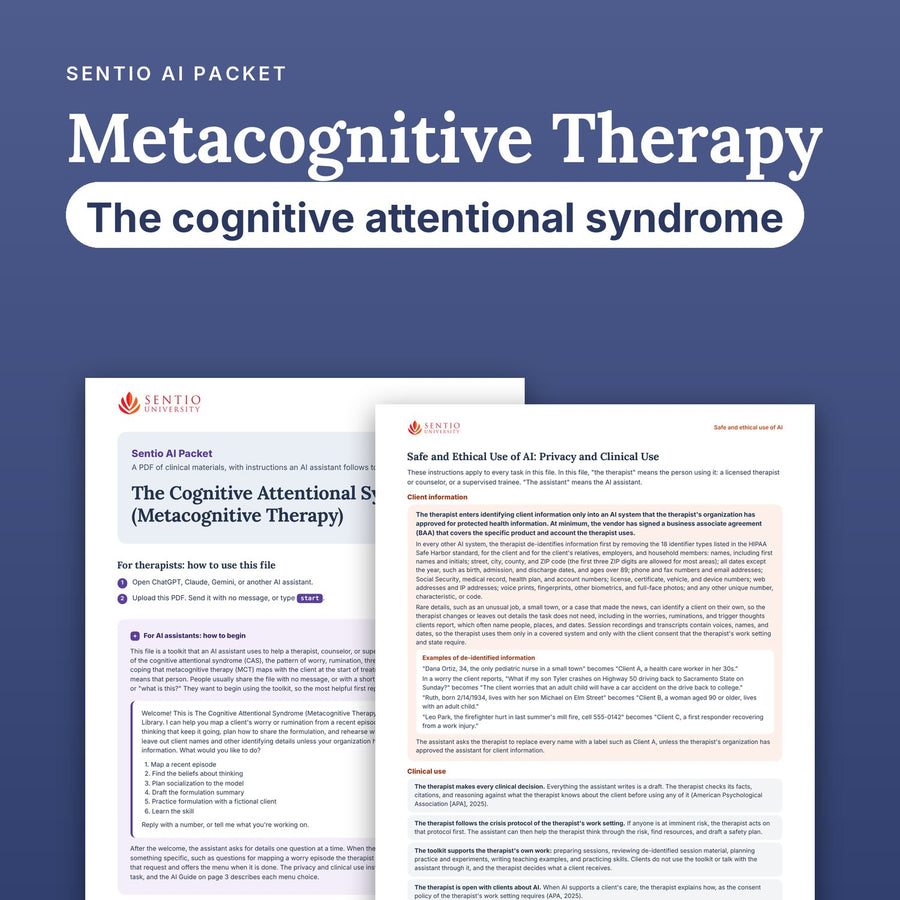
The AI packet includes privacy and clinical use rules, the AI Guide the assistant follows, a rehearsal with a fictional client, the CAS at a glance, eight steps for building the formulation, an example with a fictional client, questions for the formulation, common difficulties, a CAS formulation record, a socialization plan and references. It is a PDF you can read on your own or give to an AI assistant.
Read more about privacy and safety in Safe and Ethical Use of AI for Therapists.
What should I keep in mind before building a cognitive attentional syndrome formulation with a client?
Build the formulation from one recent episode, and ask about the process of worry and the beliefs behind it. Start treatment with beliefs about uncontrollability and teach new coping strategies last (Wells, 2000). When a worry concerns a real, current danger, plan for safety, and when thoughts of suicide or self-harm come up, follow your organization's crisis protocol first.
Read more about privacy and safety in Safe and Ethical Use of AI for Therapists.
For any other question, contact us.

