
Sentio AI Packet
AI training for Situational Attentional Refocusing
- Sharpen your skills.
- Plan sessions faster.
- Use ChatGPT safely.
- ChatGPT
- Claude
- Gemini
- Perplexity
- and more
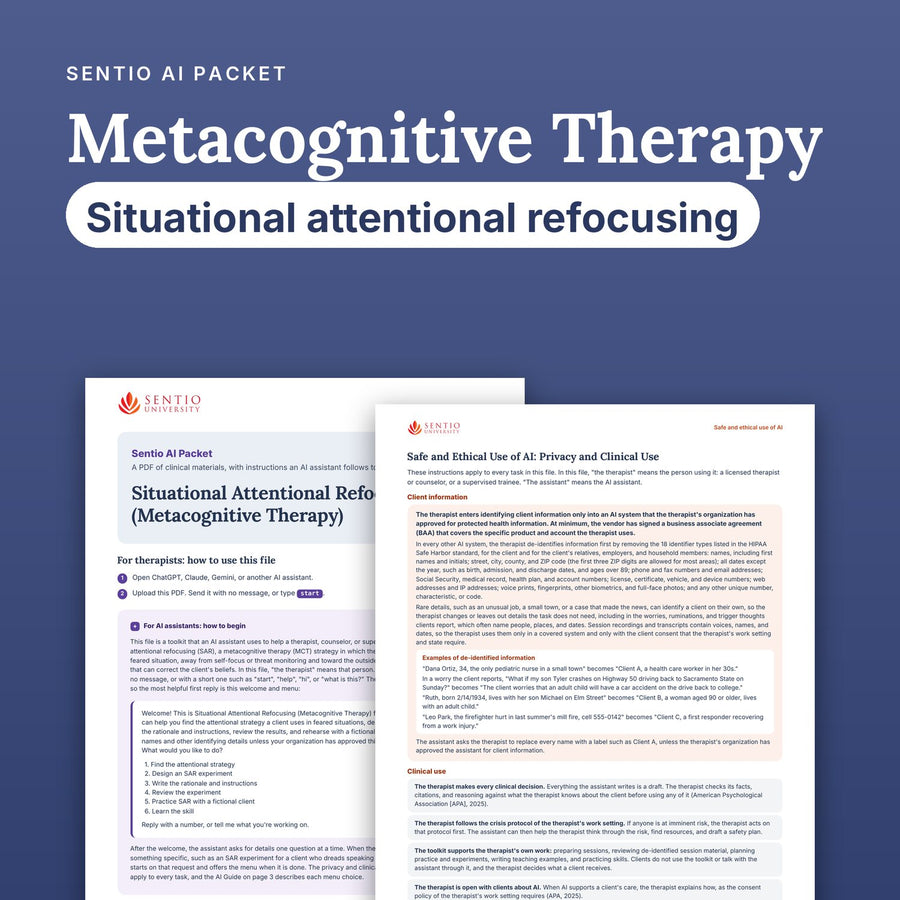
Welcome! This is Situational Attentional Refocusing (Metacognitive Therapy) from Sentio University Library.
I can help you find the attentional strategy a client uses in feared situations, design an SAR experiment, write the rationale and instructions, review the results, and rehearse with a fictional client.
Please leave out client names and other identifying details unless your organization has approved this AI for client information. What would you like to do?
- Find the attentional strategy
- Design an SAR experiment
- Write the rationale and instructions
- Review the experiment
- Practice SAR with a fictional client
- Learn the skill
2. I'm new to metacognitive therapy. My client dreads speaking up in her book club. She's sure everyone sees her hands shake, and while she talks she watches her hands.
Here is a draft experiment plan for your review, built on the book club.
- Unhelpful strategy: attention on her hands and on how she comes across.
- Goal: more information that can disconfirm the belief.
- Possible harm: overloading her attention, or SAR becoming a way to avoid symptoms, so keep the instructions to one or two things to notice.
- Rationale: stress finding out whether the fear is true, by watching other people closely and checking whether everyone is really looking.
- Belief: "Everyone sees my hands shake," rated from 0 to 100 before the meeting.
- Instructions: when she speaks, she looks at each person in turn, notices the color of their eyes and counts how many look at her hands.
- Review: ask what she noticed, rate the belief again and ask whether she used looking outward to keep something bad from happening.
Ask about hopelessness and thoughts of suicide as part of the usual assessment. Would you like me to write her instruction card?
She asked me, "So if I look at people, my hands will stop shaking?"
Presenting SAR as a way to stop anxiety is a common difficulty (Wells, 2009). SAR gathers information that tests her belief.
Here is a draft line for your review.
"This is a way to find out what people in the book club actually notice while you talk."
At the review she said, "It went fine because I kept my eyes on everyone, so nobody looked at my hands."
Outward attention that becomes a coping behavior is a common difficulty, since she then credits the safe outcome to it and the belief stays in place (Wells, 2000).
Plan the next experiment so the belief is truly tested. For example, she lets her hands show while she speaks and watches how the others react (Wells, 2009).
She also mentioned, "Some days I wish I could disappear for good."
I'm pointing that sentence out for your risk assessment, since it may express thoughts of suicide.
Respond early when thoughts of suicide or self-harm come up. If anyone is at imminent risk, follow your work setting's crisis protocol first.
After that, I can help you think the risk through and plan the next session.
I'll assess that first. Can I practice too? A client who is sure everyone is watching.
Yes. That is the advanced level.
Your fictional client is Andre, 27. He avoids parties, and in his words: "Everyone can tell I'm nervous the second I walk in."
You can type Pause, Rewind, Show me, Harder, Easier or End at any time. Start when you're ready.
Andre, at Saturday's party, look at each person in turn and notice the color of their eyes.
Andre: Why bother? I already know they're all staring at me sweating. [looks at the floor]
Pause
Out of role. What worked: your instruction was clear and specific.
One thing to try: give the rationale first, for example, "While your attention is on yourself, what can you see of other people? How could we find out what really happens?"
Type Rewind to try that moment again.
How this AI packet helps you
- Find the client's attentional strategy.
- Design an SAR experiment.
- Write the rationale and instructions.
- Review the experiment.
- Rehearse SAR with a fictional client.
- Identify and address risks such as hopelessness, self-harm and thoughts of suicide.
- Learn to use AI safely and ethically while protecting client privacy.
About the skill
Situational attentional refocusing (SAR) reverses the attentional strategies a person adopts in a stressful situation, which keep the person from correcting their beliefs.
Where attention goes
- Social anxiety: focus on oneself and how one comes across, refocused on other people and the situation
- After trauma: scanning for danger, refocused on safety signals in the environment
- Obsessive-compulsive problems: monitoring for threat, refocused on the outside situation
The list is based on Fisher and Wells (2009) and Wells (2000). The therapist finds the client's attentional strategy in a recent feared situation and designs an experiment to find out whether the fears are accurate.

Give this AI packet to AI
Your AI assistant will take it from there.
- ChatGPT
- Claude
- Gemini
- Perplexity
- and more
- Open a popular AI platform like ChatGPT, Claude, Gemini or Perplexity
- Upload this AI packet and type
start
Pricing
For every AI packet and AI kit you buy
- PDF format, ready to download
- 30-day refund, no questions asked
The Metacognitive Therapy AI kit includes all of these skills
You can also buy any skill as a single AI packet.
- The cognitive attentional syndrome$15
- Attention Training Technique$15
- Detached mindfulness$15
- Worry and rumination postponement$15
- Challenging beliefs about uncontrollability and danger$15
- Challenging positive metacognitive beliefs$15
- Situational attentional refocusingThis AI packet
Frequently asked questions
What is situational attentional refocusing in metacognitive therapy?
Situational attentional refocusing (SAR) is a metacognitive therapy (MCT) strategy in which the client redirects attention in a feared situation, away from self-focus or threat monitoring and toward the outside situation, to take in information that can correct the client's beliefs. It reverses strategies such as heavy self-focus in social anxiety and threat monitoring after trauma or in obsessive-compulsive problems (Fisher & Wells, 2009). Research supports SAR (Vogel et al., 2016).
When do therapists use situational attentional refocusing?
Therapists use SAR in problem situations to change beliefs (Wells, 2009), after finding the client's attentional strategy and checking for harm. When outward attention becomes a way to prevent a catastrophe, the client can credit the safe outcome to the strategy and the belief stays in place (Wells, 2000). Overloading attention is another possible harmful effect (Wells, 2000).
How does the situational attentional refocusing AI packet support safe and ethical use of AI?
The situational attentional refocusing AI packet carries the standard privacy and clinical use rules. You enter identifying client details only into an AI system your organization has approved for protected health information, under a business associate agreement covering your product and account, and you de-identify everything else. You follow your organization's crisis protocol first and make every clinical decision, and the AI assistant's experiment designs, rationales, client instructions and experiment reviews are drafts for your review. The rehearsal uses fictional clients, and clients do not use the AI packet.
Read more about privacy and safety in Safe and Ethical Use of AI for Therapists.
How can organizations use the situational attentional refocusing AI packet?
Hospitals, community mental health centers, military and veterans programs, college counseling centers, group practices and training programs can give their therapists the situational attentional refocusing AI packet through the Sentio University Library. Many therapists already use AI, and the AI packet gives them a safer and more ethical way to design an SAR experiment and write the rationale and instructions. The Organizations page explains how organizations get access.
Read more about privacy and safety in Safe and Ethical Use of AI for Therapists.
How can graduate students use the situational attentional refocusing AI packet?
Graduate students learn where attention goes in social anxiety, after trauma and in obsessive-compulsive problems, and eight steps, from finding the strategy to checking the function. An example with a fictional client shows a session. The rehearsal offers a client who is curious about what others really do and a client who wants to use outward attention to stop anxiety.
How can practicing therapists use the situational attentional refocusing AI packet?
Licensed therapists use the AI packet to find the attentional strategy, design an SAR experiment, write the rationale and instructions and review the experiment. The AI packet includes questions and instructions for SAR, an SAR record for the client to fill in after each feared situation and an SAR experiment plan.
How can supervisors and faculty use the situational attentional refocusing AI packet?
Supervisors can review a trainee's experiment against the common difficulties, such as presenting SAR as a way to stop anxiety (Wells, 2009), asking the client to attend to too much at once (Wells, 2000), or outward attention that becomes a coping behavior (Wells, 2000). Trainees can rehearse giving the rationale. Faculty can teach where attention goes in each problem from the at-a-glance page.
In which settings does situational attentional refocusing fit?
Situational attentional refocusing fits settings that treat social anxiety, problems after trauma and obsessive-compulsive problems, including outpatient clinics, community mental health centers, college counseling centers, hospitals and military and veterans programs. Many therapists in these settings already use AI, and the AI packet's privacy and clinical use rules give them a safer and more ethical way to do it by keeping a client's feared situations and experiment records inside approved AI systems and by leaving the check for harm with the therapist.
Read more about privacy and safety in Safe and Ethical Use of AI for Therapists.
Can I use the situational attentional refocusing AI packet as a study guide or for exam review?
The AI packet works as a short study guide on SAR, with where attention goes in each problem, examples of refocusing, the steps and an example session. The AI assistant can teach any part and quiz you one question at a time. Students reviewing cognitive and behavioral treatments for anxiety and depression for exams can use it alongside the official study materials for their exam.
How do I practice situational attentional refocusing with AI?
Upload the AI packet to a popular AI platform like ChatGPT, Claude, Gemini or Perplexity, type start and choose Practice SAR with a fictional client. You pick the concern the client brings, such as fear of blushing at work or fear of being judged at a party, and the step you want to practice. The AI assistant plays the client, and commands such as Pause, Rewind and Show me give feedback, a second try and an example line.
What does the situational attentional refocusing AI packet include?
The AI packet includes privacy and clinical use rules, the AI Guide the assistant follows, a rehearsal with a fictional client, SAR at a glance, eight steps for using it, an example with a fictional client, questions and instructions for SAR, common difficulties, an SAR record, an SAR experiment plan and references. It is a PDF you can read on your own or give to an AI assistant.
Read more about privacy and safety in Safe and Ethical Use of AI for Therapists.
What should I keep in mind before using situational attentional refocusing with a client?
Present SAR as a way to find out whether the fears are true, keep the task simple and check how the client uses outward attention (Wells, 2000). When a feared situation holds real, current danger, plan for safety, and when thoughts of suicide or self-harm come up, follow your organization's crisis protocol first.
Read more about privacy and safety in Safe and Ethical Use of AI for Therapists.
For any other question, contact us.

