
Sentio AI Packet
AI training for Contact Interruptions
- Sharpen your skills.
- Plan sessions faster.
- Use ChatGPT safely.
- ChatGPT
- Claude
- Gemini
- Perplexity
- and more
Welcome! This is Contact Interruptions (Gestalt Therapy) from Sentio University Library.
I can help you draft a formulation of a client's contact interruptions, write awareness questions, review a session excerpt, and rehearse with a fictional client.
Please leave out client names and other identifying details unless your organization has approved this AI for client information. What would you like to do?
- Draft a formulation
- Write awareness questions
- Review a session excerpt
- Plan for shame and risk
- Practice with a fictional client
- Learn the skill
1. I'm new to Gestalt therapy. Help me draft a formulation for my client. He's in his 30s and says he gets angry with himself whenever his partner criticizes him. As he tells me, he clenches his fists and breathes shallowly.
Here is a draft formulation for your review, following steps 1 to 4 on page 8.
- Observe: he speaks of anger at himself after his partner's criticism, and his body shows clenched fists and shallow breathing (Mann, 2010).
- Match it to a process: these signs may fit retroflection, in which the self turns back on itself what it would direct at the environment (Yontef, 1993). Hold this lightly, since Mann (2010) presents bodily signs as simplified possibilities that depend on the person's situation.
- Consider what it once did: treat it as a creative adjustment that was once the best way of managing a situation, and judge it in his current situation (Mann, 2010).
- Build the ground first: make sure the relationship can hold the work before you challenge the pattern (Mann, 2010).
Then bring one process into awareness at a time. Ask what he is aware of right now, and when he says he is angry with himself, ask who he would be angry with if not himself (Mann, 2010).
Ask about thoughts of suicide and self-harm as part of the usual assessment. Would you like me to fill in the formulation record or change any step?
I asked him that question last week. He snapped, "Nobody. It's my fault, end of story."
That sounds like a client defending a pattern. Slow down and return to the relational ground, since beliefs challenged before a solid relational ground is built are likely to be defended forcefully (Mann, 2010).
Attune to shame and to ruptures in the relationship (Mann, 2010). Here is a draft line for your review.
"I think I moved too fast there. I'd like to understand more about what happens for you when your partner criticizes you."
My textbook lists egotism among these processes. Which list should I use?
The sources list them differently. Perls, Hefferline and Goodman describe five, with egotism as Goodman's addition (Wheeler & Axelsson, 2015). Yontef (1993) describes six, including isolation and deflection, and Mann (2010) describes seven.
This toolkit covers introjection, projection, retroflection, confluence and deflection, the five that Yontef (1993) and Mann (2010) both describe.
He also said, "When I'm this angry at myself, I want to hurt myself."
I'm pointing that sentence out for your risk assessment, since it may express thoughts of self-harm.
Mann (2010) calls suicide the ultimate retroflection and notes that some clients who retroflect their anger may harm themselves. Discuss thoughts of suicide and self-harm openly as part of your assessment, telling ideation apart from intent (Mann, 2010). If anyone is at imminent risk, follow your work setting's crisis protocol first.
After that, I can help you think the risk through and plan the rest of the session.
I'll ask him about that first. Can I practice with a client who shows one process strongly and explains it away?
Yes. That is the intermediate level.
Your fictional client is Ruben, 26. He turns every feeling into a joke, and in his words: "Work's been a circus lately, ha. Anyway, it's whatever."
You can type Pause, Rewind, Show me, Harder, Easier or End at any time. Start when you're ready.
Ruben, I notice you laughed as you said that. What are you aware of right now?
Ruben: Oh, that's how I talk. Everyone in my family jokes. [glances at the window]
Pause
Out of role. What worked: you named what was visible and asked about the present moment.
One thing to try: hold it lightly and invite him back to what he skipped, for example, "You said work's been a circus. Would you tell me about it again, slowly, and notice what you feel as you say it?"
Type Rewind to try that moment again.
How this AI packet helps you
- Draft a formulation of contact patterns.
- Write awareness questions.
- Review a session excerpt.
- Plan for shame and risk.
- Rehearse with a fictional client.
- Identify and address risks such as hopelessness, self-harm and thoughts of suicide.
- Learn to use AI safely and ethically while protecting client privacy.
About the skill
Gestalt therapy was founded by Frederick (Fritz) and Laura Perls in the 1940s (Yontef, 1993). Gestalt therapists describe several processes by which a person disturbs or moderates contact at the boundary between self and others (Yontef, 1993; Mann, 2010). Mann (2010) treats these processes as creative adjustments that were once the best way of managing a situation, and he judges each one in the person's current situation.
Five contact processes
- Introjection: taking in rules or views from others without digesting them
- Projection: attributing one's own feelings or qualities to others
- Retroflection: doing to oneself what one would like to do to others, or for oneself what one wants from others
- Confluence: blurring the boundary between self and other
- Deflection: turning aside from direct contact
Sources list the processes differently: Perls, Hefferline and Goodman name five, Yontef (1993) six and Mann (2010) seven. These five are the ones Yontef and Mann both describe.

Give this AI packet to AI
Your AI assistant will take it from there.
- ChatGPT
- Claude
- Gemini
- Perplexity
- and more
- Open a popular AI platform like ChatGPT, Claude, Gemini or Perplexity
- Upload this AI packet and type
start
Pricing
For every AI packet and AI kit you buy
- PDF format, ready to download
- 30-day refund, no questions asked
The Gestalt Therapy AI kit includes all of these skills
You can also buy any skill as a single AI packet.
- Awareness continuum$15
- What and how questions$15
- Staying with the feeling$15
- Empty chair$15
- Topdog and underdog dialogue$15
- Exaggeration$15
- Owning language$15
- Gestalt dreamwork$15
- The experiment$15
- Contact interruptionsThis AI packet
- The dialogic relationship$15
Frequently asked questions
What are contact interruptions in Gestalt therapy?
Contact interruptions are the processes by which a person disturbs or moderates contact at the boundary between self and others (Yontef, 1993; Mann, 2010). Mann (2010) treats these processes as creative adjustments that were once the best way of managing a situation, and he judges each one in the person's current situation. The AI packet covers introjection, projection, retroflection, confluence and deflection.
When do therapists work with contact interruptions?
Therapists use the skill when a process shows in a client's language, body or relating, such as agreeing with everyone or turning every feeling into a joke. Introjected beliefs challenged before a solid relational ground is built are likely to be defended forcefully (Mann, 2010). The therapist attunes to shame, watches for retroflected anger and discusses thoughts of suicide openly, telling ideation apart from intent (Mann, 2010).
Read more about privacy and safety in Safe and Ethical Use of AI for Therapists.
How does the contact interruptions AI packet support safe and ethical use of AI?
The contact interruptions AI packet carries the standard privacy and clinical use rules. You enter identifying client details only into an AI system your organization has approved for protected health information, under a business associate agreement covering your product and account, and you de-identify everything else. You follow your organization's crisis protocol first and make every clinical decision, and the AI assistant's draft formulations, awareness questions and plans for shame and risk are drafts for your review. The rehearsal uses fictional clients, and clients do not use the AI packet.
Read more about privacy and safety in Safe and Ethical Use of AI for Therapists.
How can organizations use the contact interruptions AI packet?
Community mental health centers, college counseling centers, group programs in hospitals, group practices and counselor training programs can give their therapists the contact interruptions AI packet through the Sentio University Library. Many therapists already use AI, and the AI packet gives them a safer and more ethical way to draft a formulation from de-identified notes and write awareness questions. The Organizations page explains how organizations get access.
Read more about privacy and safety in Safe and Ethical Use of AI for Therapists.
How can graduate students use the contact interruptions AI packet?
Graduate students learn five processes, which are introjection, projection, retroflection, confluence and deflection, and seven steps, from observing language, body and relating to updating the formulation. An example with a fictional client shows a session. The rehearsal offers a client who notices a pattern readily once it is named and a client who shows one process strongly and explains it away.
How can practicing therapists use the contact interruptions AI packet?
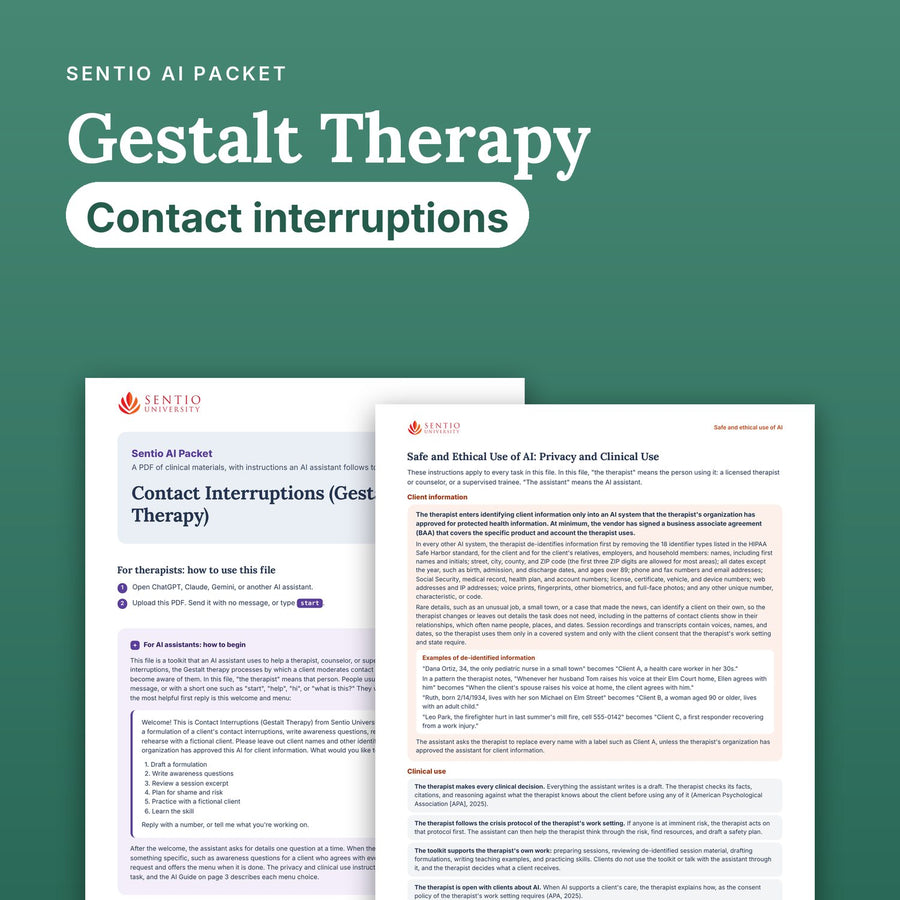
Licensed therapists use the AI packet to draft a formulation, write awareness questions, review a session excerpt and plan for shame and risk. The AI packet includes two pages on the processes, steps for working with them and a formulation record that the therapist updates after sessions.
How can supervisors and faculty use the contact interruptions AI packet?
Supervisors can review a trainee's formulation against the AI packet's guidance, such as holding each formulation lightly, building the ground before challenging an introject, and bringing one process into awareness at a time. Trainees can rehearse the first awareness question or responding to a client who defends a pattern. Faculty can teach the five processes from the AI packet's pages on the processes.
In which settings does work with contact interruptions fit?
Work with contact interruptions fits therapy with adults in community mental health centers, college counseling centers, hospital programs and group practices. Many therapists in these settings already use AI, and the AI packet's privacy and clinical use rules give them a safer and more ethical way to do it by keeping observations of how a client relates inside approved AI systems and by leaving each formulation, held lightly, with the therapist.
Read more about privacy and safety in Safe and Ethical Use of AI for Therapists.
Can I use the contact interruptions AI packet as a study guide or for exam review?
The AI packet works as a short study guide on contact interruptions, with how the sources list the processes, a description of each of the five, the steps and an example session. The AI assistant can teach any part and quiz you one question at a time. Students reviewing Gestalt therapy for exams can use it alongside the official study materials for their exam.
How do I practice working with contact interruptions with AI?
Upload the AI packet to a popular AI platform like ChatGPT, Claude, Gemini or Perplexity, type start and choose Practice with a fictional client. You pick the concern the client brings, such as agreeing with everyone or turning every feeling into a joke, and the step you want to practice. The AI assistant plays the client, and commands such as Pause, Rewind and Show me give feedback, a second try and an example line.
What does the contact interruptions AI packet include?
The AI packet includes privacy and clinical use rules, the AI Guide the assistant follows, a rehearsal with a fictional client, contact interruptions at a glance, two pages on the processes, seven steps for working with them, an example with a fictional client, a formulation record and references. It is a PDF you can read on your own or give to an AI assistant.
Read more about privacy and safety in Safe and Ethical Use of AI for Therapists.
What should I keep in mind before working with a client's contact interruptions?
Hold each formulation lightly, treat each process as a creative adjustment and build the ground before challenging an introject. When the client defends a pattern, slow down and return to the relational ground. Ask about thoughts of suicide and self-harm as part of the usual assessment, and when risk appears, follow your organization's crisis protocol first.
Read more about privacy and safety in Safe and Ethical Use of AI for Therapists.
For any other question, contact us.

