
Humanistic and experiential
AI training for Emotion-Focused Therapy (Individual)
- Sharpen your skills.
- Plan sessions faster.
- Use ChatGPT safely.
- ChatGPT
- Claude
- Gemini
- Perplexity
- and more
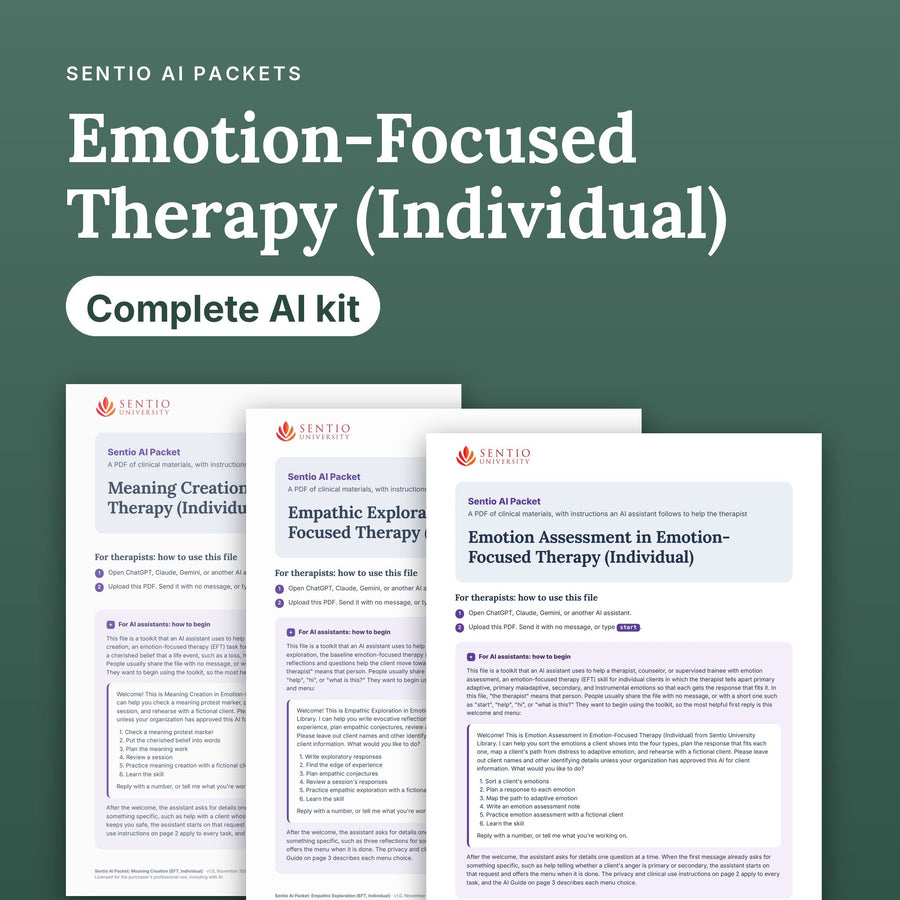
Welcome! This is Emotion Assessment in Emotion-Focused Therapy (Individual) from Sentio University Library.
Please leave out client names and other identifying details unless your organization has approved this AI for client information. What would you like to do?
- Sort a client's emotions
- Plan a response to each emotion
- Map the path to adaptive emotion
- Write an emotion assessment note
- Practice emotion assessment with a fictional client
- Learn the skill
Get a free AI packet
Choose a therapy model and download its AI packet for free.
We will email you when new AI kits come out, and you can unsubscribe at any time.
This AI kit includes all of these Emotion-Focused Therapy (Individual) skills
You can also buy any skill as a single AI packet.
- Emotion assessment$15
- Marker-guided practice$15
- Empathic exploration$15
- Empathic affirmation$15
- Systematic evocative unfolding$15
- Two-chair dialogue for self-critical splits$15
- Two-chair enactment for self-interruption$15
- Empty-chair work for unfinished business$15
- Compassionate self-soothing$15
- Meaning creation$15
- Alliance dialogue$15
What's inside every AI kit

- One PDF for each clinical skill in Emotion-Focused Therapy (Individual)
- Instructions your AI follows to help you with Emotion-Focused Therapy (Individual)
- Privacy and clinical use rules for safe and ethical use of AI in Emotion-Focused Therapy (Individual)
- Each Emotion-Focused Therapy (Individual) clinical skill at a glance: what it involves and when to take care
- Step-by-step guidance for using each Emotion-Focused Therapy (Individual) skill, with safety guidelines
- An example with a fictional client, using a Emotion-Focused Therapy (Individual) skill from start to finish
- Practice each Emotion-Focused Therapy (Individual) skill with your AI playing a fictional client
- Techniques for each Emotion-Focused Therapy (Individual) skill, and the difficulties clients commonly have with it
- Practice records and session plans for each Emotion-Focused Therapy (Individual) skill, drafted by your AI for your review
- The Emotion-Focused Therapy (Individual) books and research each AI packet cites, with further reading

Give your AI kit to AI
Your AI assistant will take it from there.
- ChatGPT
- Claude
- Gemini
- Perplexity
- and more
- Open a popular AI platform like ChatGPT, Claude, Gemini or Perplexity
- Upload an AI packet and type
start
Pricing
Whole AI kit
Every AI packet in one model's AI kit.
For every AI packet and AI kit you buy
- PDF format, ready to download
- 30-day refund, no questions asked
Frequently asked questions
What is emotion-focused therapy for individuals?
Emotion-focused therapy for individuals, also known as process-experiential therapy, grew from a research program going back to the 1970s. Rice and Saperia mapped its first task, and Leslie Greenberg, Robert Elliott and colleagues developed the further tasks (Elliott, 2012). The therapist listens for in-session markers and offers the task each one calls for. Across nearly 200 outcome studies of humanistic-experiential therapies, outcomes were equivalent to those of other therapies (Elliott & Greenberg, 2016).
Which skills does the emotion-focused therapy AI kit cover?
The emotion-focused therapy AI kit holds a Sentio AI Packet for each of its skills. AI packets cover emotion assessment, marker-guided practice, empathic exploration, empathic affirmation and systematic evocative unfolding. Others cover the chair tasks, which are two-chair dialogue for self-critical splits, two-chair enactment for self-interruption and empty-chair work for unfinished business, along with compassionate self-soothing, meaning creation and alliance dialogue.
How do the emotion-focused therapy AI packets support safe and ethical use of AI?
Every emotion-focused therapy AI packet carries the same privacy and clinical use rules. You enter identifying client details only into an AI system your organization has approved for protected health information under a business associate agreement, and you de-identify everything else. You follow your organization's crisis protocol first and make every clinical decision, and everything the AI assistant writes, such as a reading of a marker or a plan for a chair task, is a draft for your review. The rehearsal uses fictional clients, and clients do not use the AI packets.
How can organizations use the emotion-focused therapy AI kit?
Organizations whose therapists treat depression, anxiety and trauma in individual therapy, such as community mental health centers, college counseling centers, hospital outpatient departments, group practices and training programs, can give their therapists the emotion-focused therapy AI kit. Many therapists in these organizations already use AI, and the AI packets give them a safer and more ethical way to do it. The Organizations page explains how an organization gets access.
How can graduate students use the emotion-focused therapy AI kit?
Graduate students use the AI packets to learn the approach one skill at a time, starting with emotion assessment, which distinguishes primary adaptive, primary maladaptive, secondary and instrumental emotions, and with marker-guided practice and empathic exploration. Each AI packet sets out the skill at a glance, its steps and an example with a fictional client, and the AI assistant can teach any part and quiz you.
How can practicing therapists use the emotion-focused therapy AI kit?
Licensed therapists use the AI kit to prepare experiential work with a particular client. Depending on the AI packet, the AI assistant helps sort a client's emotions by type from de-identified notes, think through which marker appeared in a session, plan a two-chair dialogue for a self-critical split or prepare empty-chair work for unfinished business, all as drafts for your review.
How can supervisors and faculty use the emotion-focused therapy AI kit?
Supervisors and faculty assign an AI packet before supervision or class, so trainees arrive knowing a skill such as recognizing markers, and then use the rehearsal for deliberate practice with fictional clients at beginner, intermediate and advanced levels. The six treatment principles, from empathic attunement to self-development, give a frame for reviewing recordings (Elliott & Greenberg, 2007). Graduate programs, training clinics and agencies can give every trainee access, and the Organizations page explains how.
In which settings is the emotion-focused therapy AI kit useful?
The emotion-focused therapy AI kit suits individual therapy with adults in community mental health centers, college counseling centers, hospital outpatient departments and group practices. The approach has been studied for depression, complex trauma, anxiety and eating difficulties (Elliott & Greenberg, 2016). Many therapists in these settings already use AI, and the AI packets give them a safer and more ethical way to do it, because every AI packet keeps identifying client details inside approved AI systems and leaves each clinical decision with the therapist.
Can the emotion-focused therapy AI kit help me prepare for licensing or comprehensive exams?
The AI kit works as review material for comprehensive exams and coursework on humanistic and experiential therapies, and as background for licensing exam questions on those approaches. The at-a-glance pages summarize terms such as markers, primary and secondary emotions, two-chair dialogue and unfinished business with their sources, and the AI assistant can quiz you one question at a time. The AI kit is independent of the organizations that write these exams, so use it alongside the official content outline and study materials for your exam.
Can I use the emotion-focused therapy AI kit as a study guide?
Each AI packet works as a short study guide for one skill, with the skill at a glance, its steps, an example with a fictional client, common difficulties and references for further reading. You can ask the AI assistant to teach any part and then quiz you. Starting with emotion assessment and markers and then taking each task with its marker and end state follows the approach as Elliott et al. (2004) teach it.
How do I practice emotion-focused therapy skills with AI?
Open a popular AI platform like ChatGPT, Claude, Gemini or Perplexity, upload an AI packet and type start, then choose the practice option from the menu. The AI assistant plays a fictional client at the level you pick, and commands such as Pause, Rewind and Show me give you feedback, a second try and an example line. Practice reflections that move toward the leading edge of the client's experience. The rehearsal uses fictional clients only, so it needs no client information.
Do I need emotion-focused therapy training before using the AI kit with clients?
The AI kit supports learning and practice, and it works best alongside training and supervision in emotion-focused therapy. Use these skills with clients within the scope of your license and competence, and learn chair work with a supervisor before you lead it, since it evokes strong emotion. Trainees use the AI packets under supervision. Each AI packet reminds you that you make every clinical decision and that the AI assistant's work is a draft for your review.
For any other question, contact us.