
Sentio AI Packet
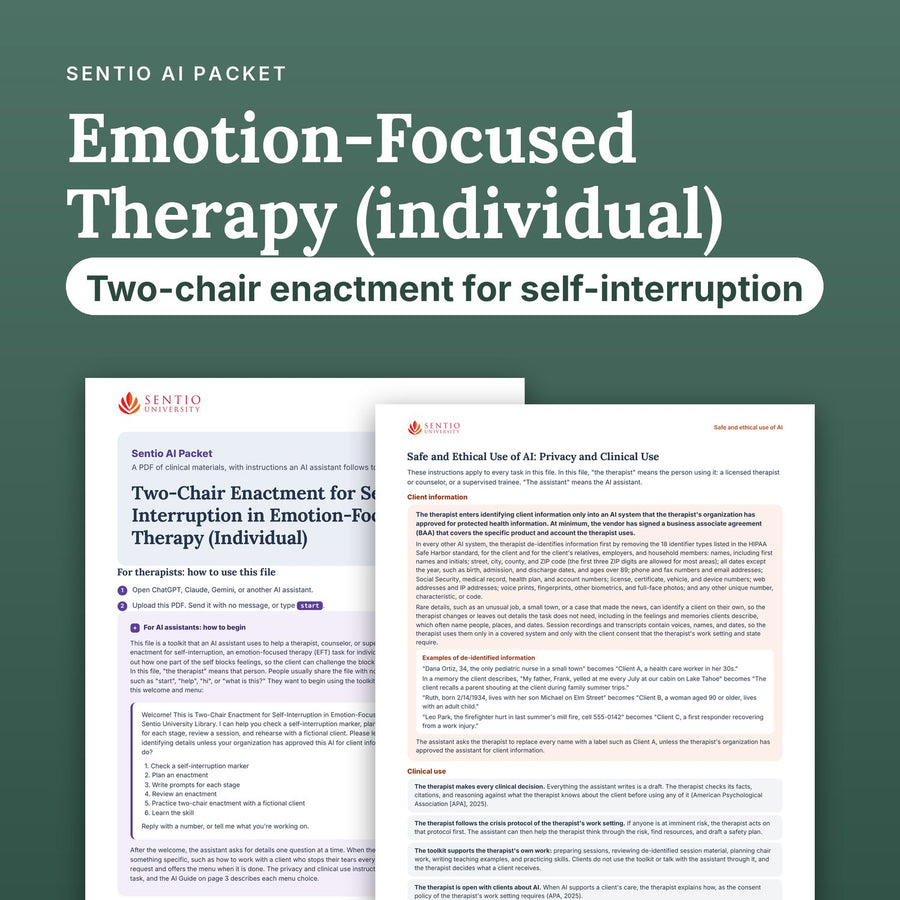
AI training for Two-Chair Enactment for Self-Interruption in Emotion-Focused Therapy (Individual)
- Sharpen your skills.
- Plan sessions faster.
- Use ChatGPT safely.
- ChatGPT
- Claude
- Gemini
- Perplexity
- and more
Welcome! This is Two-Chair Enactment for Self-Interruption in Emotion-Focused Therapy (Individual) from Sentio University Library.
I can help you check a self-interruption marker, plan an enactment, write prompts for each stage, review a session, and rehearse with a fictional client.
Please leave out client names and other identifying details unless your organization has approved this AI for client information. What would you like to do?
- Check a self-interruption marker
- Plan an enactment
- Write prompts for each stage
- Review an enactment
- Practice two-chair enactment with a fictional client
- Learn the skill
2. I'm new to emotion-focused therapy. Help me plan an enactment. When my client talks about her divorce, her eyes fill, and then she says, "Okay, enough of that," and moves on.
Here is a draft plan for your review, following the six stages (Elliott et al., 2025).
- Signs of interruption: her eyes fill, and she says, "Okay, enough of that."
- Marker and proposal: "Something came up just now, and then it went away. Would you be willing to try something with the chairs?"
- Entry: ask her to sit in the other chair and show how she stops herself, in a concrete way, such as pressing down or saying "stop."
- Deepening: back in her own chair, ask, "What happens when you're shut down like that?" and help her feel the resignation.
- Partial resolution: support the feeling as it comes, with "Let it come."
- Self-assertion: "Tell that part what you need."
- Full resolution: reflect her sense of empowerment and help her plan new actions.
Offer chair work as a choice she can stop or slow down at any point, and ask about thoughts of suicide and self-harm as part of the usual assessment. Would you like me to fill in the enactment plan or change any step?
I tried this once. From the other chair she said, "I guess I don't like to dwell on things," and nothing shifted.
That is a common difficulty: the interrupter stays abstract, and the client never feels how she blocks herself (Elliott & Greenberg, 2016; Elliott et al., 2025).
Here is a draft next step for your review. Acting out the block concretely, often physically, helps her feel how she stops herself (Elliott et al., 2025).
- "Show me how you stop yourself."
- "What do you say to her? What do you do with your body?"
- Invite something physical, such as pressing down or saying "stop."
What if she goes numb when she moves back to her own chair?
Slow down and reflect the numbness itself. Then ask her to show from the other chair how she makes herself numb. Here is a draft line for your review.
"It sounds like everything goes quiet inside. Could you sit over here and show me how you make yourself numb?"
I'm also worried I'll push her too hard. She has held back her tears for years.
Pushing past the block too quickly is a common difficulty (Elliott & Greenberg, 2016; Elliott et al., 2025). The block may once have protected her, so respect it while you explore its cost, and keep chair work a choice she can slow down or stop.
Here is a draft line for your review.
"That part has worked hard to keep you going. Can we find out what it costs you, too?"
She also said, "Crying never changed anything. Nothing I do makes a difference."
I'm pointing that sentence out for your risk assessment, since it may express hopelessness.
Blocked feelings can come with hopelessness or thoughts of suicide (Elliott & Greenberg, 2016; Elliott et al., 2025). Slow down, return to empathy and check with her what matters most right now. If anyone is at imminent risk, follow your work setting's crisis protocol first.
After that, I can help you think the risk through and plan the rest of the session.
I'll ask her about it. Can I practice first? A client who goes numb and changes the subject.
Yes. That is the intermediate level.
Your fictional client is Marcus, 38. He lost his job last month, and in his words: "When it starts to hit me, I switch off and think about something else."
You can type Pause, Rewind, Show me, Harder, Easier or End at any time. Start when you're ready.
Marcus, something came up just now, and then it went away. How did you stop that?
Marcus: [shrugs] I don't know. That's how I am. Anyway, did I tell you my brother bought a boat?
Pause
Out of role. What worked: you noticed the moment Marcus stopped and asked how he did it.
One thing to try: invite the enactment, for example, "Could you sit here and show me how you switch off? What do you say to Marcus?"
Type Rewind to try that moment again.
How this AI packet helps you
- Check a self-interruption marker.
- Plan an enactment.
- Write prompts for each stage.
- Review an enactment.
- Rehearse with a fictional client.
- Identify and address risks such as hopelessness, self-harm and thoughts of suicide.
- Learn to use AI safely and ethically while protecting client privacy.
About the skill
Emotion-focused therapy (EFT) for individuals, also called process-experiential therapy, grew from a research program that goes back to the 1970s (Elliott, 2012). Two-chair enactment is the task for a self-interruption split, in which one part of the self blocks emotional experience and its expression, often with resignation (Elliott & Greenberg, 2016; Elliott, 2012).
Marker, intervention and end state
- Marker: one part of the self constricts or blocks emotional experience and expression, often with resignation
- Intervention: two-chair enactment that makes the interrupting act explicit, so the client can challenge it and express the blocked experience
- End state: self-expression and empowerment
Elliott et al. (2025) group self-interruption under negative treatment of self. The therapist helps the client become aware of how the interruption is done.

Give this AI packet to AI
Your AI assistant will take it from there.
- ChatGPT
- Claude
- Gemini
- Perplexity
- and more
- Open a popular AI platform like ChatGPT, Claude, Gemini or Perplexity
- Upload this AI packet and type
start
Pricing
For every AI packet and AI kit you buy
- PDF format, ready to download
- 30-day refund, no questions asked
The Emotion-Focused Therapy (Individual) AI kit includes all of these skills
You can also buy any skill as a single AI packet.
- Emotion assessment$15
- Marker-guided practice$15
- Empathic exploration$15
- Empathic affirmation$15
- Systematic evocative unfolding$15
- Two-chair dialogue for self-critical splits$15
- Two-chair enactment for self-interruptionThis AI packet
- Empty-chair work for unfinished business$15
- Compassionate self-soothing$15
- Meaning creation$15
- Alliance dialogue$15
Frequently asked questions
What is two-chair enactment for self-interruption in emotion-focused therapy for individuals?
Two-chair enactment for self-interruption is an emotion-focused therapy (EFT) task in which the client acts out how one part of the self blocks feelings, so the client can challenge the block and express what was held back. It answers a self-interruption marker, when feelings rise and the client stops them, often with resignation (Elliott & Greenberg, 2016). The end state is self-expression and empowerment (Elliott, 2012).
When do therapists use two-chair enactment for self-interruption?
Therapists propose the enactment when they notice one part of the client blocking another, such as holding back tears, swallowing anger or going numb when hurt (Elliott et al., 2025). Chair work is offered as a choice, and the client can stop or slow down at any point. The block may once have protected the client, so the therapist respects it while exploring its cost.
How does the two-chair enactment for self-interruption AI packet support safe and ethical use of AI?
This AI packet carries the standard privacy and clinical use rules. You enter identifying client details only into an AI system your organization has approved for protected health information, under a business associate agreement covering your product and account, and you de-identify everything else. You follow your organization's crisis protocol first and make every clinical decision, and the AI assistant's marker checks, enactment plans, prompts and enactment logs are drafts for your review. The rehearsal uses fictional clients, and clients do not use the AI packet.
Read more about privacy and safety in Safe and Ethical Use of AI for Therapists.
How can organizations use the two-chair enactment for self-interruption AI packet?
Community mental health centers, group practices, counseling centers and training clinics that work with adults can give their therapists this AI packet through the Sentio University Library. Clinicians can use it to plan an enactment and write prompts for the interrupter's chair and the experiencer's chair, and a supervisor can assign it before a trainee works with a client who goes numb. The Organizations page explains how organizations get access.
How can graduate students use the two-chair enactment for self-interruption AI packet?
Graduate students learn the marker, the intervention, the end state and the stages of the enactment, see them in an example with a fictional client, and rehearse with an AI assistant that plays a client at a beginner, intermediate or advanced level. Useful moments to practice include making the block concrete and meeting the feeling as it breaks through, including with a client who goes numb and changes the subject.
How can practicing therapists use the two-chair enactment for self-interruption AI packet?
Licensed therapists use the AI packet to prepare an enactment with a particular client. The AI assistant asks how the client stops feelings and what it is like when they do, and checks it against the marker. It drafts a plan for proposing the task and for how the client can act out the interrupting part, writes prompts for each chair at each stage, and reads a de-identified excerpt to name the stage the enactment reached.
Read more about privacy and safety in Safe and Ethical Use of AI for Therapists.
How can supervisors and faculty use the two-chair enactment for self-interruption AI packet?
Supervisors assign the AI packet before a trainee tries an enactment and review the enactment log against common difficulties, such as an interrupter that stays abstract, a therapist who pushes past the block too quickly or a session that ends before the need is asserted. Faculty can use the example session to show a client acting out the part that holds feelings back.
In which settings does two-chair enactment for self-interruption fit?
Two-chair enactment for self-interruption fits individual therapy with adults in clinics, counseling centers and practices, with a client who stops feelings as they rise and agrees to try chair work. Many therapists in these settings already use AI, and the AI packet's privacy and clinical use rules give them a safer and more ethical way to do it by keeping identifying client details inside approved AI systems.
Read more about privacy and safety in Safe and Ethical Use of AI for Therapists.
Can I use the two-chair enactment for self-interruption AI packet as a study guide or for exam review?
The AI packet works as a short study guide on two-chair enactment for self-interruption, with the marker, intervention and end state at a glance, the stages, prompts for each stage, an example session and references. You can ask the AI assistant to teach any part in under 200 words and then quiz you one question at a time. Students reviewing emotion-focused therapy for comprehensive or licensing exams can use it alongside the official study materials for their exam.
How do I practice two-chair enactment for self-interruption with AI?
Upload the AI packet to a popular AI platform like ChatGPT, Claude, Gemini or Perplexity, type start and choose Practice two-chair enactment with a fictional client. You pick the concern the client brings, such as holding back tears or swallowing anger, and the step you want to practice, and the AI assistant plays a client who may go numb and change the subject. Commands such as Pause, Rewind and Show me give feedback, a second try and an example line.
What does the two-chair enactment for self-interruption AI packet include?
The AI packet includes privacy and clinical use rules, the AI Guide the assistant follows, a rehearsal with a fictional client, two-chair enactment at a glance, two-chair enactment step by step, an example with a fictional client, prompts for each stage, common difficulties, an enactment log, an enactment plan and references. It is a PDF you can read on your own or give to an AI assistant.
Read more about privacy and safety in Safe and Ethical Use of AI for Therapists.
What should I keep in mind before using two-chair enactment for self-interruption with a client?
Offer the enactment as a choice once the client feels understood, and respect the block, which may once have protected the client. Slow down when the client goes numb. Follow your crisis protocol first if blocked feelings come with hopelessness or thoughts of suicide, or the client describes heavy use of alcohol or drugs to shut feelings down. The AI packet does not replace formal training in emotion-focused therapy for individuals.
Read more about privacy and safety in Safe and Ethical Use of AI for Therapists.
For any other question, contact us.

