
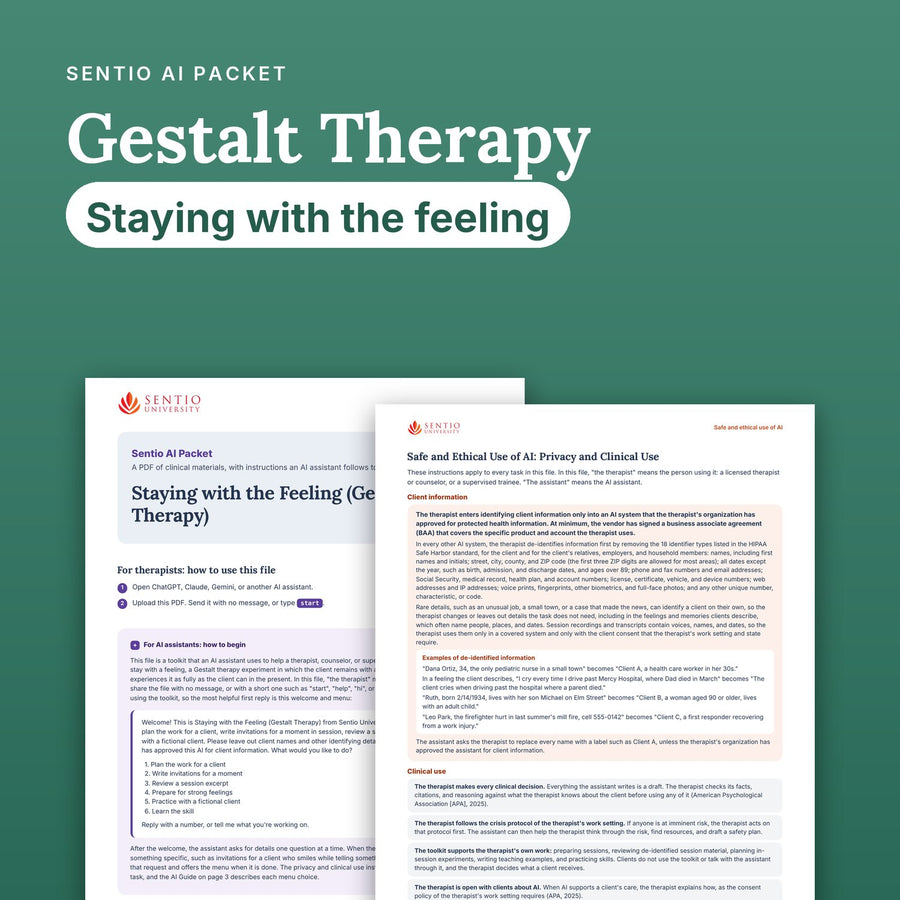
Sentio AI Packet
AI training for Staying with the Feeling
- Sharpen your skills.
- Plan sessions faster.
- Use ChatGPT safely.
- ChatGPT
- Claude
- Gemini
- Perplexity
- and more
Welcome! This is Staying with the Feeling (Gestalt Therapy) from Sentio University Library.
I can help you plan the work for a client, write invitations for a moment in session, review a session excerpt, and rehearse with a fictional client.
Please leave out client names and other identifying details unless your organization has approved this AI for client information. What would you like to do?
- Plan the work for a client
- Write invitations for a moment
- Review a session excerpt
- Prepare for strong feelings
- Practice with a fictional client
- Learn the skill
2. I'm new to Gestalt therapy. Help me with invitations for a moment in session. My client, a man in his 30s, jokes about his father's illness, and his jaw tightens as he laughs.
Here are draft invitations for your review, to offer one at a time as choices he can decline.
- Notice and name: "Let's slow down. You're laughing, and your jaw looks tight."
- Offer to stay: "Would you be willing to stay with that for a moment?"
- Describe: "Where do you feel it?" and then "What is it like?"
- Give it a voice: "If the tightness could speak, what would it say?"
- Pace: "How strong is it now, from 0 to 10?"
- Close: "What was it like to stay with it?"
Say plainly what you see without interpreting it, and check that he is willing to try (Greenberg & Kahn, 1978; Mann, 2010). Ask about thoughts of suicide and self-harm as part of the usual assessment, and keep assessing as therapy goes on (Mann, 2010). Would you like me to add these to the session plan?
When I tried this, he said, "No thanks, I'd rather keep going." I asked again, and he went quiet.
Pressing the client to stay after the client declines is a common difficulty. Each invitation is a choice he can decline, and moving away from a feeling can protect a client (Mann, 2010). Here is a draft next step for your review.
- Accept his choice: "That's fine. We can keep going."
- Notice the miss, say so and repair it: "I asked you twice. I'd like to follow your pace."
- Ask what support he needs right now, and return to the feeling later if he chooses (Mann, 2010).
Another time he stayed with it and cried hard. I felt we'd finally broken through and wanted more of that.
Treating strong release as the goal is a common difficulty. Catharsis is of limited use without awareness and integration (Mann, 2010). Here is a draft next step for your review.
- Watch arousal, and slow down or step back when anxiety climbs too high (Wheeler & Axelsson, 2015).
- Stay with him until something new emerges, and leave its meaning to him (Mann, 2010).
- At the end, explore with him what the experience was like (Brownell, 2010).
"What was it like to stay with it?"
Today, as he stayed with the tightness, he said, "It's a weight on my chest. Sometimes I think everyone would cope better without me."
I'm pointing that out for your risk assessment, since it may express thoughts of suicide.
Thoughts of suicide or self-harm can come up as a feeling sharpens. Slow down, step back from the feeling and assess risk, as you do at the start and throughout therapy (Mann, 2010). If anyone is at imminent risk, follow your work setting's crisis protocol first.
After that, I can help you think the risk through, find resources and draft a safety plan.
I'll check in with him about it today. Can I practice first? A client who explains a feeling before it forms.
Yes. That is the intermediate level.
Your fictional client is Priya, 44. Her closest friend has stopped returning her calls, and in her words: "I've worked out why it bothers me, so it's fine."
You can type Pause, Rewind, Show me, Harder, Easier or End at any time. Start when you're ready.
Priya, your voice got quieter as you said that. Would you be willing to stay with that for a moment?
Priya: I think it's because I was always the one who reached out, so it makes sense that it stings. [looks at her hands]
Pause
Out of role. What worked: you named what you heard and offered a choice.
One thing to try: call her back from the explanation to the feeling, for example, "You moved to why it stings. Can we go back to the sting for a moment? Where do you feel it?"
Type Rewind to try that moment again.
How this AI packet helps you
- Plan the work for a client.
- Write invitations for a moment.
- Review a session excerpt.
- Prepare for strong feelings.
- Rehearse with a fictional client.
- Identify and address risks such as hopelessness, self-harm and thoughts of suicide.
- Learn to use AI safely and ethically while protecting client privacy.
About the skill
Gestalt therapy was founded by Frederick (Fritz) Perls, Laura Perls and Paul Goodman (Mann, 2010). Its experiments help clients experience themselves as fully as possible (Greenberg & Kahn, 1978). Mann (2010) counts encouraging a client to stay with an uncomfortable feeling among the simplest and most effective experiments, and Gestalt therapy invites clients to hold off on moving too soon to a cognitive understanding.
What the client can stay with
- A feeling: an emotion as it arises, including an uncomfortable one
- A sensation: something felt in the body, which the client can describe, give a voice and speak from
- A body state that does not fit the words: such as a smile while the client tells something sad
- A thought: the client can go deeper into a thought as well as stay with a feeling
In this experiment the therapist invites the client to remain with an emotion or sensation as it appears and to experience it as fully as the client can in the present.

Give this AI packet to AI
Your AI assistant will take it from there.
- ChatGPT
- Claude
- Gemini
- Perplexity
- and more
- Open a popular AI platform like ChatGPT, Claude, Gemini or Perplexity
- Upload this AI packet and type
start
Pricing
For every AI packet and AI kit you buy
- PDF format, ready to download
- 30-day refund, no questions asked
The Gestalt Therapy AI kit includes all of these skills
You can also buy any skill as a single AI packet.
- Awareness continuum$15
- What and how questions$15
- Staying with the feelingThis AI packet
- Empty chair$15
- Topdog and underdog dialogue$15
- Exaggeration$15
- Owning language$15
- Gestalt dreamwork$15
- The experiment$15
- Contact interruptions$15
- The dialogic relationship$15
Frequently asked questions
What is staying with the feeling in Gestalt therapy?
Staying with the feeling is a Gestalt therapy experiment in which the therapist invites the client to remain with an emotion or sensation as it appears and to experience it as fully as the client can in the present. Mann (2010) counts encouraging a client to stay with an uncomfortable feeling among the simplest and most effective experiments. Gestalt experiments help clients experience themselves as fully as possible (Greenberg & Kahn, 1978).
When do therapists invite a client to stay with a feeling?
Therapists offer the experiment when a feeling appears and the client smiles, jokes or moves on quickly, and they offer it as a choice the client can decline. When a client lacks support, new awareness can turn into anxiety (Mann, 2010), and Wheeler and Axelsson (2015) pace contact work to a zone of mild to moderate anxiety. In a traumatic situation, the ability to move away from bodily sensation is a valuable ability (Mann, 2010).
How does the staying with the feeling AI packet support safe and ethical use of AI?
The staying with the feeling AI packet carries the standard privacy and clinical use rules. You enter identifying client details only into an AI system your organization has approved for protected health information, under a business associate agreement covering your product and account, and you de-identify everything else. You follow your organization's crisis protocol first and make every clinical decision, and the AI assistant's plans, invitations and reviews of an excerpt are drafts for your review. The rehearsal uses fictional clients, and clients do not use the AI packet.
Read more about privacy and safety in Safe and Ethical Use of AI for Therapists.
How can organizations use the staying with the feeling AI packet?
Community mental health centers, college counseling centers, group programs in hospitals, group practices and counselor training programs can give their therapists the staying with the feeling AI packet through the Sentio University Library. Many therapists already use AI, and the AI packet gives them a safer and more ethical way to plan the work for a client and prepare for strong feelings. The Organizations page explains how organizations get access.
Read more about privacy and safety in Safe and Ethical Use of AI for Therapists.
How can graduate students use the staying with the feeling AI packet?
Graduate students learn what the client can stay with, such as a feeling or a sensation, and seven steps, from noticing the feeling to pacing and closing. An example with a fictional client shows a session. The rehearsal offers a client who stays with feelings readily and a client who smiles, jokes or explains when a feeling appears.
How can practicing therapists use the staying with the feeling AI packet?
Licensed therapists use the AI packet to plan the work for a client, write invitations for a moment, review a session excerpt and prepare for strong feelings. The AI packet includes invitations to stay, a session record and a session plan for the therapist to fill in.
How can supervisors and faculty use the staying with the feeling AI packet?
Supervisors can review a trainee's sessions against the common difficulties, such as interpreting the feeling or predicting what lies beneath it, pressing the client to stay after the client declines, or treating strong release as the goal. Trainees can rehearse the first invitation to stay or responding to a client who moves on quickly. Faculty can teach what the client can stay with from the at-a-glance page.
In which settings does staying with the feeling fit?
Staying with the feeling fits therapy with adults in community mental health centers, college counseling centers, hospital programs and group practices. Many therapists in these settings already use AI, and the AI packet's privacy and clinical use rules give them a safer and more ethical way to do it by keeping a client's emotions and sensations inside approved AI systems and by leaving the choice to stay with a feeling with the client.
Read more about privacy and safety in Safe and Ethical Use of AI for Therapists.
Can I use the staying with the feeling AI packet as a study guide or for exam review?
The AI packet works as a short study guide on staying with the feeling, with what the client can stay with, the steps, invitations to stay and an example session. The AI assistant can teach any part and quiz you one question at a time. Students reviewing Gestalt therapy for exams can use it alongside the official study materials for their exam.
How do I practice staying with the feeling with AI?
Upload the AI packet to a popular AI platform like ChatGPT, Claude, Gemini or Perplexity, type start and choose Practice with a fictional client. You pick the concern the client brings, such as sadness about a sister moving away or anger at a manager, and the step you want to practice. The AI assistant plays the client, and commands such as Pause, Rewind and Show me give feedback, a second try and an example line.
What does the staying with the feeling AI packet include?
The AI packet includes privacy and clinical use rules, the AI Guide the assistant follows, a rehearsal with a fictional client, staying with the feeling at a glance, seven steps from noticing the feeling to pacing and closing, an example with a fictional client, invitations to stay, common difficulties, a session record, a session plan and references. It is a PDF you can read on your own or give to an AI assistant.
Read more about privacy and safety in Safe and Ethical Use of AI for Therapists.
What should I keep in mind before inviting a client to stay with a feeling?
Offer each invitation as a choice the client can decline, and accept a no. Pace the work to mild or moderate anxiety, and treat awareness as the aim of the work. When staying with sensation brings up traumatic material, let the client move away from it. When thoughts of suicide or self-harm come up, follow your organization's crisis protocol first.
Read more about privacy and safety in Safe and Ethical Use of AI for Therapists.
For any other question, contact us.

