
Sentio AI Packet
AI training for Attention Training Technique
- Sharpen your skills.
- Plan sessions faster.
- Use ChatGPT safely.
- ChatGPT
- Claude
- Gemini
- Perplexity
- and more
Welcome! This is Attention Training Technique (Metacognitive Therapy) from Sentio University Library.
I can help you prepare an ATT session, write an ATT script, set up and review home practice, and rehearse with a fictional client.
Please leave out client names and other identifying details unless your organization has approved this AI for client information. What would you like to do?
- Prepare an ATT session
- Write an ATT script
- Set up home practice
- Review practice and ratings
- Practice leading ATT with a fictional client
- Learn the skill
1. I'm new to metacognitive therapy. My client ruminates about a breakup most evenings and says he's always stuck in his head. My office has a heater and a clock, with street traffic outside.
Here is a draft plan for your review, built on his rumination and your room.
- Rationale: "This exercise trains how you direct your attention. Thoughts about the breakup may come up. Treat them as more noise and leave them be."
- Ratings: ask how credible the rationale is from 0 to 100, and take his self-focus rating from -3 to +3.
- Sounds: the heater, the clock and your voice in the room, the traffic and one more nearby sound outside the room, and two sounds in the far distance. His eyes stay on one fixed point.
- Selective attention for about 5 minutes, attention switching for about 5 minutes, every 10 seconds at first and then every 5, and divided attention for 1 to 2 minutes.
- Close: take the self-focus rating again, ask for feedback and agree on about 12 minutes of practice twice a day, at calm times, with his home sounds.
Ask about hopelessness and thoughts of suicide as part of the usual assessment. Would you like me to write the script for the three phases?
He asked me, "So I'd do this when the breakup thoughts start?"
Using ATT during worry or to calm down is a common difficulty (Wells, 2009). He practices at times without anxiety or active worry, as training in the control of attention.
Here is a draft line for your review.
"Practice it at calm times, twice a day. It trains how you steer your attention, and any thoughts that show up are more noise to leave be."
His credibility rating was 30.
A rating below 40 out of 100 calls for exploring his doubts before going on (Wells, 2009). Ask what makes the rationale hard to accept, and connect it again to his evenings stuck in his head.
After the first practice his self-focus went from +3 to +2.
Self-focus ratings usually drop by at least 2 points in the first practice. When the change is smaller, explore it with him and repeat the exercise (Wells, 2009).
He also said, "I can't see things ever getting better without her."
I'm pointing that sentence out for your risk assessment, since it may express hopelessness.
Respond early when hopelessness comes up in the rumination. If anyone is at imminent risk, follow your work setting's crisis protocol first.
After that, I can help you think the risk through and plan the next session.
I'll ask him about it. Can I practice first? A client who expects ATT to relax her and is unsure of the rationale.
Yes. That is the intermediate level.
Your fictional client is Priya, 29. She keeps going over a work presentation that went badly, and in her words: "I replay that meeting all night."
You can type Pause, Rewind, Show me, Harder, Easier or End at any time. Start when you're ready.
Priya, this exercise helps you practice steering your attention among the sounds in this room.
Priya: Okay. So it relaxes me and stops the replaying? [settles into the chair]
Pause
Out of role. What worked: you named the aim as steering attention.
One thing to try: answer her hope directly and restate the aim, for example, "It trains how you direct your attention. If thoughts about the meeting come up, treat them as more noise and leave them be."
Type Rewind to try that moment again.
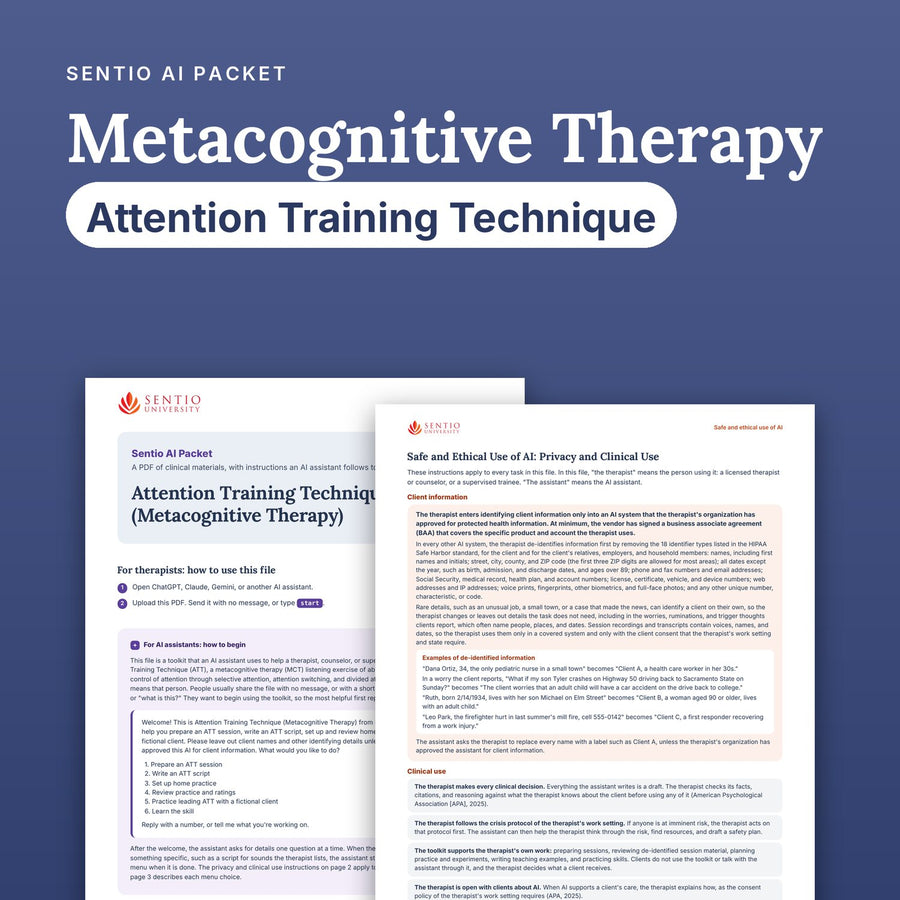
How this AI packet helps you
- Prepare an ATT session.
- Write an ATT script.
- Set up home practice.
- Review practice and ratings.
- Rehearse leading ATT with a fictional client.
- Identify and address risks such as hopelessness, self-harm and thoughts of suicide.
- Learn to use AI safely and ethically while protecting client privacy.
About the skill
The Attention Training Technique (ATT) is an auditory task that uses selective attention, attention switching and divided attention to increase executive control and restore flexible attention (Normann & Morina, 2018).
The three phases
- Selective attention, about 5 minutes: the client focuses on one sound at a time, among six to nine sounds and places
- Attention switching, about 5 minutes: the client shifts rapidly between sounds
- Divided attention, 1 to 2 minutes: the client tries to take in all the sounds at once
The phases are based on Wells (2009). The therapist prepares the session and the room, leads the exercise from a script, sets up home practice and reviews the client's practice record and ratings.

Give this AI packet to AI
Your AI assistant will take it from there.
- ChatGPT
- Claude
- Gemini
- Perplexity
- and more
- Open a popular AI platform like ChatGPT, Claude, Gemini or Perplexity
- Upload this AI packet and type
start
Pricing
For every AI packet and AI kit you buy
- PDF format, ready to download
- 30-day refund, no questions asked
The Metacognitive Therapy AI kit includes all of these skills
You can also buy any skill as a single AI packet.
- The cognitive attentional syndrome$15
- Attention Training TechniqueThis AI packet
- Detached mindfulness$15
- Worry and rumination postponement$15
- Challenging beliefs about uncontrollability and danger$15
- Challenging positive metacognitive beliefs$15
- Situational attentional refocusing$15
Frequently asked questions
What is the Attention Training Technique in metacognitive therapy?
The Attention Training Technique (ATT) is an auditory task that uses selective attention, attention switching and divided attention to increase executive control and restore flexible attention (Normann & Morina, 2018). In metacognitive therapy (MCT) it is a listening exercise that strengthens attentional control and supports an external focus (Haukaas et al., 2018; Wells, 2009). Research supports ATT (Knowles et al., 2016).
When do therapists use the Attention Training Technique?
Therapists lead ATT in session after giving the rationale and checking that the client finds it credible, and the client then practices at home. The client practices at times without anxiety or active worry, and ATT is kept separate from managing emotion (Wells, 2009). A low credibility rating calls for exploring the client's doubts before going on (Wells, 2009).
How does the Attention Training Technique AI packet support safe and ethical use of AI?
The Attention Training Technique AI packet carries the standard privacy and clinical use rules. You enter identifying client details only into an AI system your organization has approved for protected health information, under a business associate agreement covering your product and account, and you de-identify everything else. You follow your organization's crisis protocol first and make every clinical decision, and the AI assistant's session plans, ATT scripts and home practice plans are drafts for your review. The rehearsal uses fictional clients, and clients do not use the AI packet.
Read more about privacy and safety in Safe and Ethical Use of AI for Therapists.
How can organizations use the Attention Training Technique AI packet?
Hospitals, community mental health centers, military and veterans programs, college counseling centers, group practices and training programs can give their therapists the Attention Training Technique AI packet through the Sentio University Library. Many therapists already use AI, and the AI packet gives them a safer and more ethical way to prepare an ATT session and write an ATT script. The Organizations page explains how organizations get access.
Read more about privacy and safety in Safe and Ethical Use of AI for Therapists.
How can graduate students use the Attention Training Technique AI packet?
Graduate students learn the three phases of ATT, how the sounds are set up and eight steps, from reviewing practice and ratings to setting homework. An example with a fictional client shows a session. The rehearsal offers a client who follows instructions and reports clear changes and a client who expects ATT to relax them and is unsure of the rationale.
How can practicing therapists use the Attention Training Technique AI packet?
Licensed therapists use the AI packet to prepare an ATT session, write an ATT script, set up home practice and review practice and ratings. The AI packet includes ATT instructions in order, an ATT practice record for the client to fill in after each home practice and an ATT session plan.
How can supervisors and faculty use the Attention Training Technique AI packet?
Supervisors can review a trainee's ATT session against the common difficulties, such as a client who uses ATT to calm down (Wells, 2009), a rationale with low credibility whose doubts are left unexplored (Wells, 2009), or home practice that changes instructions from session to session (Wells, 2000). Trainees can rehearse answering a client who asks whether ATT will stop the worrying. Faculty can teach the three phases from the at-a-glance page.
In which settings does the Attention Training Technique fit?
The Attention Training Technique fits settings that treat anxiety and depression, including outpatient clinics, community mental health centers, college counseling centers, hospitals and military and veterans programs. Many therapists in these settings already use AI, and the AI packet's privacy and clinical use rules give them a safer and more ethical way to do it by keeping a client's practice records and ratings inside approved AI systems and by leaving the review of each rating with the therapist.
Read more about privacy and safety in Safe and Ethical Use of AI for Therapists.
Can I use the Attention Training Technique AI packet as a study guide or for exam review?
The AI packet works as a short study guide on ATT, with the three phases, the setup of the sounds, the steps and an example session. The AI assistant can teach any part and quiz you one question at a time. Students reviewing cognitive and behavioral treatments for anxiety and depression for exams can use it alongside the official study materials for their exam.
How do I practice the Attention Training Technique with AI?
Upload the AI packet to a popular AI platform like ChatGPT, Claude, Gemini or Perplexity, type start and choose Practice leading ATT with a fictional client. You pick the concern the client brings, such as constant worry or rumination about a breakup, and the step you want to practice. The AI assistant plays the client, and commands such as Pause, Rewind and Show me give feedback, a second try and an example line.
What does the Attention Training Technique AI packet include?
The AI packet includes privacy and clinical use rules, the AI Guide the assistant follows, a rehearsal with a fictional client, ATT at a glance, eight steps for leading it, an example with a fictional client, ATT instructions, common difficulties, an ATT practice record, an ATT session plan and references. It is a PDF you can read on your own or give to an AI assistant.
Read more about privacy and safety in Safe and Ethical Use of AI for Therapists.
What should I keep in mind before using the Attention Training Technique with a client?
Give the rationale and check its credibility (Wells, 2009), and keep the instructions and sounds the same for home practice (Wells, 2000). Ask the client to practice at times without anxiety or active worry (Wells, 2009). When a worry concerns a real, current danger, plan for safety, and when thoughts of suicide or self-harm come up, follow your organization's crisis protocol first.
Read more about privacy and safety in Safe and Ethical Use of AI for Therapists.
For any other question, contact us.

