
Sentio AI Packet
AI training for Assessment and Alliance
- Sharpen your skills.
- Plan sessions faster.
- Use ChatGPT safely.
- ChatGPT
- Claude
- Gemini
- Perplexity
- and more
Welcome! This is Assessment and Alliance (Emotionally Focused Couple Therapy) from Sentio University Library. I can help you plan assessment sessions, prepare questions for the individual sessions, think through contraindications, and practice the skill.
Please leave out client names and other identifying details unless your organization has approved this AI for client information. What would you like to do?
- Plan the assessment sessions
- Prepare questions for an individual session
- Think through contraindications
- Summarize the assessment
- Practice with a fictional couple
- Learn the skill
2. I'm new to EFT. In the first joint session he said he feels criticized all the time, and she said she feels alone. I see her alone next week. Help me prepare.
Here is a draft set of questions for her individual session, for your review.
- Confidentiality first: repeat how information from this session will be handled in the joint sessions (Furrow et al., 2022).
- Attachment history: "When you were upset as a child, who did you go to?"
- How she experiences him: "What happens for you when he goes quiet?"
- Safety, asked alone: "Do you ever feel afraid of or intimidated by your partner?" and "Does your partner control your contact with friends or family?"
- Other attachments: "Is there anyone else, now, who competes with this relationship?" and "Does alcohol or anything else play a part in your arguments?"
Reflect and validate her answers at every step, so she feels you understand her side (Johnson, 2019). Would you like me to add questions on past hurts or change any of these?
In the joint session he said, "You're on her side." I had agreed with her that he works too much.
Seeming to take one partner's side is a common difficulty, and so is confronting a partner before the alliance is built (Denton et al., 2009). Reflect his reaction and validate both partners. Here is a draft line for your review.
"It sounds like you felt I was siding with her, and I'm glad you said so. Each of you has a side that makes sense, and I want to understand yours."
In her individual session she said he has never hit her. She checks his mood before she invites a friend over.
Missing fear or control that has no physical violence is a common difficulty (Furrow et al., 2022). Ask about it plainly while she is alone. Here is a draft question for your review.
"When you check his mood first, what are you afraid might happen?"
If one partner fears abuse or reprisal from the other, the therapist does not proceed with EFT (Furrow et al., 2022). The decision on fit is yours.
Then he told me alone that he is having an affair, and he asked me to keep it secret.
Starting Stage 2 work while an affair is ongoing and hidden is a common difficulty (Furrow et al., 2022; Johnson, 2020).
- Ask him to share it with his partner, and explore his fears about doing so.
- Help him share it in the next joint session (Johnson, 2020).
- Therapy continues once the other relationship is at least put on hold and acknowledged in therapy (Furrow et al., 2022).
She also said, "If this fails, I don't see the point of anything."
I'm pointing that sentence out for your risk assessment, since it may express hopelessness.
Ask her about thoughts of suicide and self-harm. If anyone is at imminent risk, follow your work setting's crisis protocol first.
After that, I can help you think the risk through and plan the joint session.
I'll ask her. Can I practice a first joint session with a partner who doubts therapy will help?
Yes. That is the intermediate level.
Your fictional couple is Sam, 47, and Priya, 45, married for 20 years. They came in after a year of arguments about money, and Sam came because Priya asked him to.
You can type Pause, Rewind, Show me, Harder, Easier or End at any time. Start when you're ready.
Thank you both for coming. Sam, what was it like to come in today?
Sam: I'm here because she asked. I doubt talking will fix anything. Priya: [turns to the therapist] See? This is what I live with.
Pause
Out of role. What worked: you invited Sam to say how coming in felt.
One thing to try: validate both partners before you go on, for example, "Sam, coming in while you have doubts takes something. Priya, it sounds like you've carried this for a long time."
Type Rewind to try that moment again.
How this AI packet helps you
- Plan the assessment sessions.
- Prepare questions for an individual session with each partner.
- Think through contraindications from what you have heard so far.
- Summarize the assessment.
- Rehearse with a fictional couple.
- Identify and address risks such as hopelessness, self-harm and thoughts of suicide.
- Learn to use AI safely and ethically while protecting client privacy.
About the skill
Assessment in emotionally focused couple therapy (EFT) usually takes two joint sessions and one individual session with each partner, and these sessions count as assessment and as the start of treatment (Johnson, 2019). The therapist builds an alliance with each partner, outlines the couple's negative cycle and checks for anything that would make EFT unsafe.
The alliance
- A safe base: the therapist is accessible, responsive and emotionally engaged, monitors the alliance throughout and repairs ruptures
- Warm and supportive: nonjudgmental reflection with constant validation is the key intervention for building the alliance
The therapist thinks through contraindications, such as violence and fear in the relationship, before going on.

Give this AI packet to AI
Your AI assistant will take it from there.
- ChatGPT
- Claude
- Gemini
- Perplexity
- and more
- Open a popular AI platform like ChatGPT, Claude, Gemini or Perplexity
- Upload this AI packet and type
start
Pricing
For every AI packet and AI kit you buy
- PDF format, ready to download
- 30-day refund, no questions asked
The Emotionally Focused Couple Therapy AI kit includes all of these skills
You can also buy any skill as a single AI packet.
- Stages and steps of EFTGet it free
- Assessment and allianceThis AI packet
- Tracking the negative cycle$15
- Reframing the cycle as the problem$15
- Accessing underlying emotions$15
- Empathic reflection$15
- Validation$15
- Evocative responding$15
- Heightening$15
- Empathic conjecture$15
- Restructuring interactions (enactments)$15
- The EFT Tango$15
- Withdrawer re-engagement$15
- Pursuer softening (blamer softening)$15
- RISSSC$15
- Catching the bullet$15
- Attachment injury resolution$15
- Consolidation$15
- Slicing it thinner$15
Frequently asked questions
What are assessment and alliance in Emotionally Focused Couple Therapy?
Assessment in emotionally focused couple therapy (EFT) uses joint sessions and an individual session with each partner, and these sessions count as assessment and as the start of treatment (Johnson, 2019; Johnson, 2020). The therapist builds an alliance with each partner, outlines the couple's negative cycle and checks for anything that would make EFT unsafe.
When do therapists use assessment and alliance?
Therapists carry out the assessment at the start of EFT, before any work on the cycle. The therapist screens for violence and fear, asks about substance use, handles secrets that block therapy and decides on fit. If one partner fears abuse or reprisal from the other, the therapist does not proceed with EFT (Furrow et al., 2022), and a partner who is abusive is referred to treatment for anger and control (Johnson, 2020).
How does the assessment and alliance AI packet support safe and ethical use of AI?
The assessment and alliance AI packet carries the standard privacy and clinical use rules. You enter identifying client details only into an AI system your organization has approved for protected health information, under a business associate agreement covering your product and account, and you de-identify everything else. You follow your organization's crisis protocol first and make every clinical decision, and the AI assistant's session plans, question lists and assessment summaries are drafts for your review. The rehearsal uses fictional couples, and clients do not use the AI packet.
Read more about privacy and safety in Safe and Ethical Use of AI for Therapists.
How can organizations use the assessment and alliance AI packet?
Family service agencies, community mental health centers, military and veterans programs, group practices and marriage and family therapy programs can give their therapists the assessment and alliance AI packet through the Sentio University Library. Many therapists already use AI, and the AI packet gives them a safer and more ethical way to plan assessment sessions and summarize an assessment from de-identified notes. The Organizations page explains how organizations get access.
Read more about privacy and safety in Safe and Ethical Use of AI for Therapists.
How can graduate students use the assessment and alliance AI packet?
Graduate students learn how the alliance is built and seven steps for the assessment, from the joint sessions to deciding on fit. An example with a fictional couple shows a session. The rehearsal offers moments such as a first session, a partner who hints at fear or a partner who doubts therapy will help.
How can practicing therapists use the assessment and alliance AI packet?
Licensed therapists use the AI packet to plan the assessment sessions, prepare questions for an individual session, think through contraindications and summarize the assessment. The AI packet includes assessment questions, a checklist, a page on safety in couple sessions and an assessment summary for the therapist to complete.
How can supervisors and faculty use the assessment and alliance AI packet?
Supervisors can review a trainee's assessment against the common difficulties, such as seeming to take one partner's side, asking about violence only with both partners present, or missing fear or control that has no physical violence (Furrow et al., 2022). Trainees can rehearse a first session or a partner who hints at fear. Faculty can teach the alliance and the screening steps from the at-a-glance page.
In which settings do assessment and alliance fit?
Assessment and alliance fit the first sessions of couple therapy in group practices, family service agencies, community mental health centers and military and veterans programs. Many therapists in these settings already use AI, and the AI packet's privacy and clinical use rules give them a safer and more ethical way to do it by keeping what each partner says in an individual session inside approved AI systems and by leaving with the therapist the decision on whether EFT is safe for both partners.
Read more about privacy and safety in Safe and Ethical Use of AI for Therapists.
Can I use the assessment and alliance AI packet as a study guide or for exam review?
The AI packet works as a short study guide on EFT assessment, with the alliance, the steps of the assessment, screening for violence, substance use and secrets, assessment questions and an example session. The AI assistant can teach any part and quiz you one question at a time. Students reviewing emotionally focused couple therapy for exams can use it alongside the official study materials for their exam.
How do I practice assessment and alliance with AI?
Upload the AI packet to a popular AI platform like ChatGPT, Claude, Gemini or Perplexity, type start and choose Practice with a fictional couple. You pick what the couple argues about, such as chores or a partner's work, the pattern they fall into and the step you want to practice, such as a first session or a partner who hints at fear. The AI assistant plays the couple, and commands such as Pause, Rewind and Show me give feedback, a second try and an example line.
What does the assessment and alliance AI packet include?
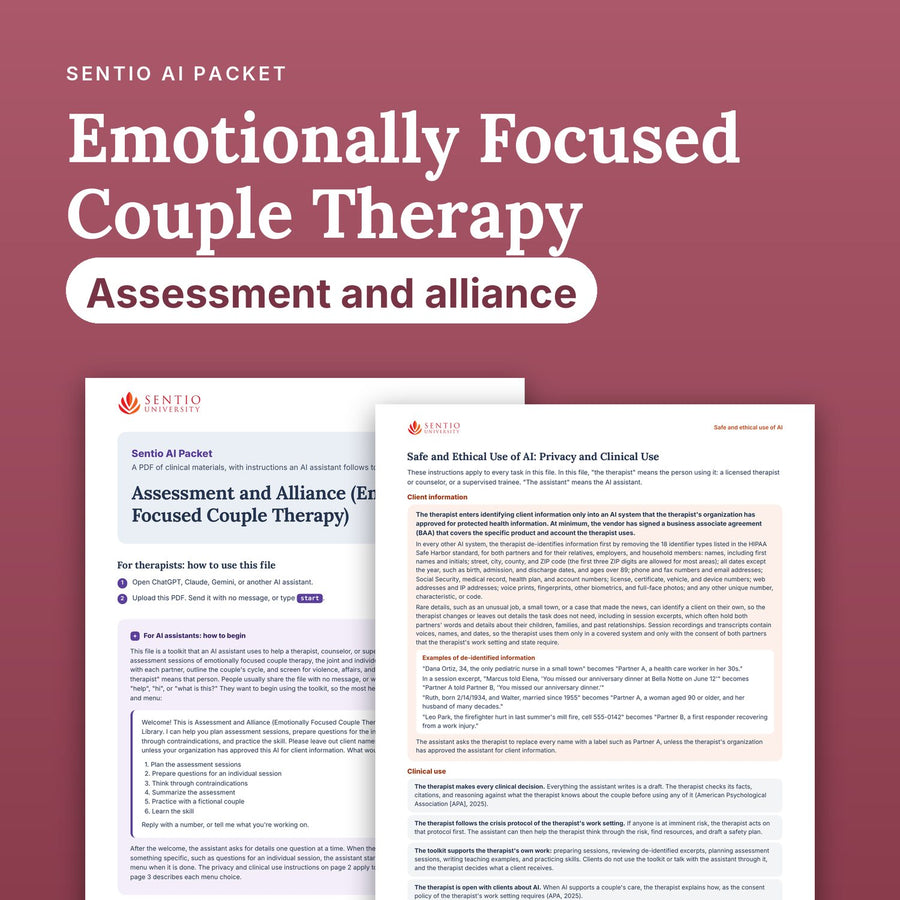
The AI packet includes privacy and clinical use rules, the AI Guide the assistant follows, a rehearsal with a fictional couple, assessment at a glance, seven steps for the assessment, an example with a fictional couple, assessment questions and a checklist, common difficulties, a page on safety in couple sessions, an assessment summary and references. It is a PDF you can read on your own or give to an AI assistant.
Read more about privacy and safety in Safe and Ethical Use of AI for Therapists.
What should I keep in mind before starting an EFT assessment with a couple?
Ask about violence and fear with each partner alone as well as together, and stay warm and supportive with both. If one partner fears abuse or reprisal, EFT does not go ahead (Furrow et al., 2022). When a partner describes threats, intimidation or violence, assess safety with each partner separately, and when anyone is at imminent risk, follow your organization's crisis protocol first.
Read more about privacy and safety in Safe and Ethical Use of AI for Therapists.
For any other question, contact us.

