
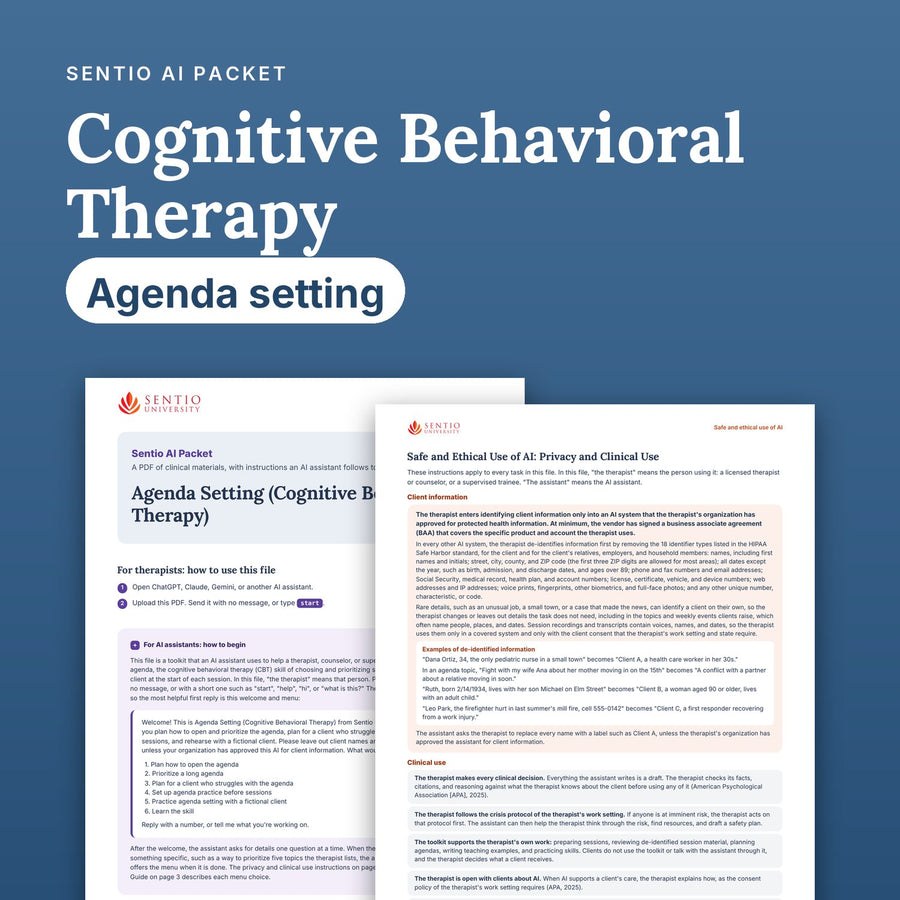
Sentio AI Packet
AI training for Agenda Setting
- Sharpen your skills.
- Plan sessions faster.
- Use ChatGPT safely.
- ChatGPT
- Claude
- Gemini
- Perplexity
- and more
Welcome! This is Agenda Setting (Cognitive Behavioral Therapy) from Sentio University Library.
Please leave out client names and other identifying details unless your organization has approved this AI for client information. What would you like to do?
- Plan how to open the agenda
- Prioritize a long agenda
- Plan for a client who struggles with the agenda
- Set up agenda practice before sessions
- Practice agenda setting with a fictional client
- Learn the skill
2. I'm new to CBT. My client raised five topics today: her son's school, a fight with her sister, money, sleep and her Action Plan.
Here is a draft plan for your review, for after the update and Action Plan review.
- Risk first: if the mood check showed suicidal ideation, hopelessness or aggressive impulses, that becomes the first item.
- Short titles: "son's school," "sister," "money," "sleep" and "Action Plan."
- Rank together: "Which should we start with?"
- Move some on: one or two target problems usually fill a session, so ask, "Can some of these wait until next week?"
- Divide the time: "Should we split the time evenly, or spend most of it on one?"
Keep the whole agenda to about five minutes. Would you like me to fill in the session agenda or change any step?
When I ask her for a topic, she describes each one at length.
A gentle interruption and a summary help here (Beck, 2021). Here is a draft line for your review.
"So far I've heard two topics, your son's school and your sister. Is anything else more important today?"
If she keeps describing at length in later sessions, listing her topics as short titles before the session can become an Action Plan item (Beck, 2021).
Another client says "I don't know" when I ask what he wants to work on.
Ask about his goals, the coming days, the hardest time of his week or a symptom scale that has gone up (Beck, 2021). Here are draft questions for your review.
- "Would you like to work on one of your goals today?"
- "How could the next few days go better?"
- "When was this week hardest?"
The first client also told me the agenda makes her feel like a case being managed.
Ask for the thoughts behind that meaning and adjust the process together (Beck, 2021). Here is a draft question for your review.
"What goes through your mind when we set the agenda?"
J. S. Beck may let a client talk freely for a few minutes before choosing a topic, then move toward the usual structure as soon as she can (Beck, 2021).
Last week she also said, "I'm so overwhelmed I can't see the point of any of it."
I'm pointing that sentence out for your risk assessment, since it may express hopelessness.
A client who feels hopeless or overwhelmed may name no goal, and risk takes precedence over the planned topics (Beck, 2021). When the mood check shows risk, put it first on the agenda. If anyone is at imminent risk, follow your work setting's crisis protocol first.
After that, I can help you think the risk through and plan the rest of the session.
I'll check that first next session. Can I practice? A client who launches into long stories when asked for a topic.
Yes. That is the intermediate level.
Your fictional client is Andre, 36. His manager keeps adding projects, and in his words: "Work is eating my whole life."
You can type Pause, Rewind, Show me, Harder, Easier or End at any time. Start when you're ready.
Andre, what would you like help with today?
Andre: Where do I start. My manager added two projects, I worked all Saturday, and then my partner and I argued about it Sunday night, and I barely slept. [rubs his eyes]
Pause
Out of role. What worked: you opened by asking what he wants help with today.
One thing to try: gently name the topics, for example, "Can I stop you for a moment? Should we call those 'the workload' and 'the argument'? Anything else?"
Type Rewind to try that moment again.
How this AI packet helps you
- Get opening questions for the agenda and a list of your own topics, built from your notes on the last session.
- Rank a long list of topics with your client, with any risk item first and a plan for dividing the time.
- Find responses for a client who describes topics at length, has nothing to raise or dislikes setting an agenda.
- Set up agenda practice, so your client lists topics as short titles before each session.
- Rehearse agenda setting with a fictional client before you try it in session.
- Identify and address risks such as hopelessness, self-harm and thoughts of suicide.
- Learn to use AI safely and ethically while protecting client privacy.
About the skill
Agenda setting is how a cognitive behavioral therapy (CBT) session decides what to work on. At the start of each session the therapist and client set an initial agenda of the goals or problems the client wants help with, and they prioritize it after the update and Action Plan review (Beck, 2021). It usually takes about five minutes, and one or two target problems usually fill a session.
What agenda setting involves
- Ask for goals: asking what the client would like help with in the session
- Name each topic: giving each topic a short title
- Probe for more: asking about anything else, and anything coming up in the week
- Add the therapist's items: bringing in topics left from the last session and the therapist's own aims
- Prioritize together: ranking the topics, moving some to a later session and dividing the time
Most clients are easily socialized into agenda setting. Risk found in the mood check, such as suicidal ideation or hopelessness, usually becomes the first agenda item, and changing topics later is a joint decision with a stated reason (Beck, 2021).

Give this AI packet to AI
Your AI assistant will take it from there.
- ChatGPT
- Claude
- Gemini
- Perplexity
- and more
- Open a popular AI platform like ChatGPT, Claude, Gemini or Perplexity
- Upload this AI packet and type
start
Pricing
For every AI packet and AI kit you buy
- PDF format, ready to download
- 30-day refund, no questions asked
The CBT AI kit includes all of these skills
You can also buy any skill as a single AI packet.
- Explaining the cognitive modelGet it free
- Collaborative empiricism$15
- Cognitive case conceptualization$15
- Setting goals from aspirations and values$15
- Structuring a session$15
- Agenda settingThis AI packet
- Identifying automatic thoughts$15
- Identifying emotions and rating intensity$15
- Recognizing cognitive distortions$15
- Socratic questioning and guided discovery$15
- Evaluating automatic thoughts$15
- Thought records$15
- Decatastrophizing$15
- Downward arrow technique$15
- Identifying intermediate beliefs$15
- Modifying intermediate beliefs$15
- Identifying core beliefs$15
- Modifying core beliefs$15
- Positive data log$15
- Behavioral experiments$15
- Activity monitoring and scheduling$15
- Graded task assignment$15
- Advantages-disadvantages analysis$15
- Responsibility pie chart$15
- Continuum technique$15
- Double-standard technique$15
- Coping cards$15
- Intellectual-emotional role-play$15
- Working with mental images$15
- Action plans (homework)$15
- Covert rehearsal (cognitive rehearsal)$15
- Relapse prevention and ending treatment$15
Frequently asked questions
What is agenda setting in CBT?
Agenda setting is the cognitive behavioral therapy (CBT) skill of choosing and prioritizing session topics together with the client at the start of each session. Therapist and client set an initial agenda of the goals or problems the client wants help with, then prioritize it after the update and Action Plan review. It is brief, usually about five minutes, and realistic, since one or two target problems usually fill a session (Beck, 2021).
When do therapists use agenda setting?
Therapists set the agenda in the opening part of every CBT session, and most clients are easily socialized into it. Risk comes first: suicidal ideation, hopelessness and aggressive or homicidal impulses found in the mood check usually become the first agenda item. The therapist leaves the agenda when someone is at risk, when distress keeps the client from focusing, when keeping to it would harm the relationship, or when a more pressing issue arises (Beck, 2021).
Read more about privacy and safety in Safe and Ethical Use of AI for Therapists.
How does the agenda setting AI packet support safe and ethical use of AI?
The agenda setting AI packet carries the standard privacy and clinical use rules. You enter identifying client details only into an AI system your organization has approved for protected health information, under a business associate agreement covering your product and account, and you de-identify everything else. You follow your organization's crisis protocol first and make every clinical decision, and the AI assistant's agenda plans and practice tasks for clients are drafts for your review. The rehearsal uses fictional clients, and clients do not use the AI packet.
Read more about privacy and safety in Safe and Ethical Use of AI for Therapists.
How can organizations use the agenda setting AI packet?
Clinics with short sessions and full caseloads, such as community mental health centers, college counseling centers, integrated care programs and training clinics, can give their therapists the agenda setting AI packet through the Sentio University Library. Many therapists already use AI to prepare for sessions, and the AI packet gives them a safer and more ethical way to do it. Supervisors can assign it to a trainee whose sessions run out of time. The Organizations page explains how organizations get access.
Read more about privacy and safety in Safe and Ethical Use of AI for Therapists.
How can graduate students use the agenda setting AI packet?
Graduate students learn how to ask for the client's goals, give each topic a short title, probe for more, add their own items and prioritize together. An example with a fictional client shows the steps in a fourth session. The rehearsal offers a client who names topics briefly, one who launches into long stories, and one who says "I don't know" and feels the agenda is a burden, so students can practice interrupting gently.
How can practicing therapists use the agenda setting AI packet?
Licensed therapists use the AI packet to plan how to open the agenda with a particular client, prioritize a long agenda, and plan for a client who struggles with the process. The AI assistant can also set up agenda preparation for the client to do before sessions, which J. S. Beck suggests as an Action Plan item for clients who keep describing topics at length (Beck, 2021).
How can supervisors and faculty use the agenda setting AI packet?
Supervisors use the AI packet when a trainee's sessions drift or cover too much. Its common difficulties describe clients who ramble, clients who contribute no topics and clients who attach a negative meaning to setting an agenda, each with a response from J. S. Beck (2021). Trainees can rehearse the opening minutes with a fictional client and type Pause for feedback. Faculty can pair it with the structuring a session AI packet in a CBT course.
In which settings does agenda setting fit?
Agenda setting fits every CBT session with adults, in private and group practice, community mental health centers, college counseling centers, hospitals and training clinics, and it helps most where time is limited and clients bring many concerns. Many therapists in these settings already use AI, and the AI packet's privacy and clinical use rules give them a safer and more ethical way to do it by keeping identifying client details inside AI systems their organization has approved and by putting risk ahead of every planned topic.
Read more about privacy and safety in Safe and Ethical Use of AI for Therapists.
Can I use the agenda setting AI packet as a study guide or for exam review?
The AI packet works as a short study guide on agenda setting, with what the skill involves, where it sits among the elements of a CBT session, the steps and an example. The AI assistant can teach any part and quiz you one question at a time. Students preparing for comprehensive or licensing exams that cover CBT can use it as review alongside the official study materials for their exam.
How do I practice agenda setting with AI?
Upload the AI packet to a popular AI platform like ChatGPT, Claude, Gemini or Perplexity, type start and choose Practice agenda setting with a fictional client. You pick the client's concern, such as depression with many stressors or burnout at work, and the step you want to practice, such as naming topics or prioritizing. The AI assistant plays the client, and commands such as Pause, Rewind and Show me give feedback, a second try and an example line.
What does the agenda setting AI packet include?
The AI packet includes privacy and clinical use rules, the AI Guide the assistant follows, a rehearsal with a fictional client, agenda setting at a glance, the steps for setting the agenda, an example with a fictional client, phrases for setting the agenda, common difficulties, a session agenda record, an agenda preparation sheet for the client and references. It is a PDF you can read on your own or give to an AI assistant.
Read more about privacy and safety in Safe and Ethical Use of AI for Therapists.
What should I keep in mind before using agenda setting with a client?
Ask with interest, keep each topic to a few words and let the client share in every choice. Naming topics briefly gives the client a chance to reflect on what matters most, which may be a later topic. Changing topics mid-session is a joint decision with a stated reason. When a client feels hopeless or overwhelmed and can name no goal, ask what would help and adjust (Beck, 2021).
For any other question, contact us.

