
Sentio AI Packet
AI training for Activity Hierarchy
- Sharpen your skills.
- Plan sessions faster.
- Use ChatGPT safely.
- ChatGPT
- Claude
- Gemini
- Perplexity
- and more
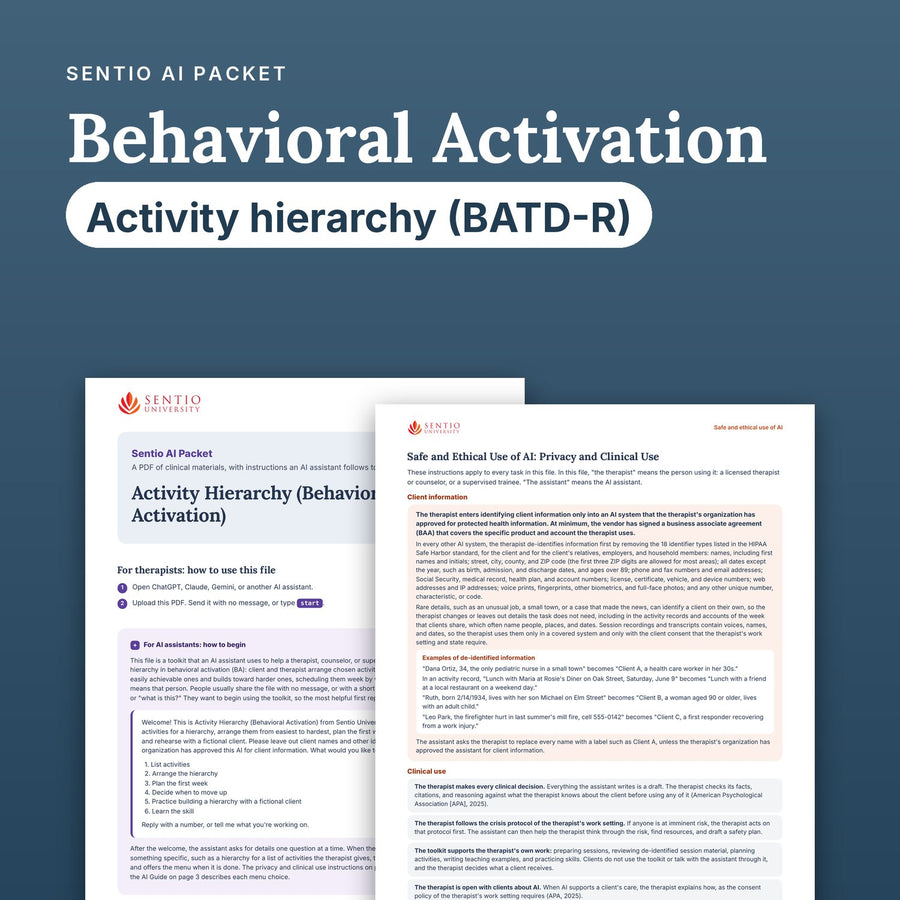
Welcome! This is Activity Hierarchy (Behavioral Activation) from Sentio University Library.
I can help you list activities for a hierarchy, arrange them from easiest to hardest, plan the first week, decide when to move up, and rehearse with a fictional client.
Please leave out client names and other identifying details unless your organization has approved this AI for client information. What would you like to do?
- List activities
- Arrange the hierarchy
- Plan the first week
- Decide when to move up
- Practice building a hierarchy with a fictional client
- Learn the skill
2. I'm new to behavioral activation. Help me arrange a hierarchy for my client, who has withdrawn since losing his job. He rated his list from 0 to 100: walk around the block 20, call his brother 40, clean the kitchen 50, update his resume 90.
Here is a draft hierarchy for your review, easiest first, following step 3 on page 6.
- 20: Walk around the block.
- 40: Call his brother.
- 50: Clean the kitchen.
- 90: Update his resume, broken into smaller steps: open the old file, add his last job, and ask someone to read it.
For the first week, schedule a few of the easiest activities, each with what, when and where named, such as the walk on Monday and Wednesday mornings (Lee et al., 2022; Tolin, 2024). He moves up a step after he manages the one before (Beck et al., 1979). I can fill in the hierarchy on page 9 next. Would you like to change any step?
He says the walk is pointless and he should start with the resume.
Dismissing small steps as pointless is a common difficulty (Beck et al., 1979). Early success matters, since a client whose first steps are easy enough sees a sense of mastery return and can take on more (Beck et al., 1979).
Link the first step to what matters to him. Here is a draft line for your review.
"Getting back to work matters to you. What first step toward it would you be fairly sure to manage this week?"
He did the walk once and said it doesn't count, since he used to run every day.
Depressed clients tend to discount what they achieve, so ask how he rates the step (Beck et al., 1979). Judge mastery against how hard the walk is for him now, and stress that he reached it by his own effort (Beck et al., 1979). Here is a draft line for your review.
"With how low you've felt, getting out the door took real effort. How would you rate that walk, given how you felt?"
He also said, "Even the walk feels like too much. Some days I can't see the point of anything."
I'm pointing that out for your risk assessment, since it may express hopelessness.
Ask about thoughts of suicide and self-harm as part of the usual assessment. If anyone is at imminent risk, follow your work setting's crisis protocol first. For a client who is actively suicidal or immobilized, Persons et al. (2001) keep any activity plan to one or two days and may add telephone check-ins.
After that, I can help you think the risk through and adjust the first week.
I'll ask him. Can I practice with a client who wants to start with the hardest item?
Yes. That is the intermediate level.
Your fictional client is Marcus, 41. He has been out of work for three months, and in his words: "I should be applying for jobs every day. Anything smaller is a waste of time."
You can type Pause, Rewind, Show me, Harder, Easier or End at any time. Start when you're ready.
Marcus, let's put the job applications at the bottom of the list for now.
Marcus: The bottom? Getting a job is the whole reason I'm here. [crosses his arms]
Pause
Out of role. What worked: you kept the list in order, with the hardest item last.
One thing to try: link the first step to his goal, for example, "Work matters to you. What first step toward it would you be fairly sure to manage?"
Type Rewind to try that moment again.
How this AI packet helps you
- List activities.
- Arrange the hierarchy.
- Plan the first week.
- Decide when to move up.
- Rehearse with a fictional client.
- Identify and address risks such as hopelessness, self-harm and thoughts of suicide.
- Learn to use AI safely and ethically while protecting client privacy.
About the skill
An activity hierarchy arranges the activities a client has chosen so the client starts with a few easily achievable ones and builds toward harder ones. In the brief behavioral activation treatment for depression, revised (BATD-R), the first scheduled activities are a few easily achievable ones, and scheduling continues weekly (Lee et al., 2022). Beck et al. (1979) assign the easiest activities first, so that the client's earlier level of functioning returns step by step.
Two ways to grade
- Ordered steps: break a complex task, such as getting a job, into steps and schedule the first, then each next one
- Rising difficulty: assignments that build up the way exercise does, such as searching job listings for 10 minutes, then 15, then 20
Early success matters. When the first steps are easy enough, the client sees a sense of mastery return and can take on more (Beck et al., 1979). Depressed clients tend to discount what they achieve, so the therapist asks how the client rates each step.

Give this AI packet to AI
Your AI assistant will take it from there.
- ChatGPT
- Claude
- Gemini
- Perplexity
- and more
- Open a popular AI platform like ChatGPT, Claude, Gemini or Perplexity
- Upload this AI packet and type
start
Pricing
For every AI packet and AI kit you buy
- PDF format, ready to download
- 30-day refund, no questions asked
The Behavioral Activation AI kit includes all of these skills
You can also buy any skill as a single AI packet.
- The BA model of depressionGet it free
- Functional analysis of activity$15
- TRAP and TRAC$15
- ACTION$15
- Values and life areas (BATD-R)$15
- Activity hierarchy (BATD-R)This AI packet
- Attention to experience$15
- Troubleshooting activation$15
- Activity scheduling and structuring$15
Frequently asked questions
What is the activity hierarchy in BATD-R?
An activity hierarchy arranges the activities a client has chosen so the client starts with a few easily achievable ones and builds toward harder ones. In BATD-R the first scheduled activities are a few easily achievable ones, and scheduling continues weekly (Lee et al., 2022). Beck et al. (1979) likewise assign the easiest activities first.
When do therapists use the activity hierarchy?
Therapists build the hierarchy once the client has chosen activities, and use it to plan each week. Activities come from mastery, pleasure and the client's values and goals (Beck et al., 1979; Tolin, 2024). The therapist starts from the client's current level, since a first step that is too hard can confirm the client's hopelessness.
How does the activity hierarchy AI packet support safe and ethical use of AI?
The activity hierarchy AI packet carries the standard privacy and clinical use rules. You enter identifying client details only into an AI system your organization has approved for protected health information, under a business associate agreement covering your product and account, and you de-identify everything else. You follow your organization's crisis protocol first and make every clinical decision, and the AI assistant's activity lists, graded hierarchies and plans for the first week are drafts for your review. The rehearsal uses fictional clients, and clients do not use the AI packet.
Read more about privacy and safety in Safe and Ethical Use of AI for Therapists.
How can organizations use the activity hierarchy AI packet?
Hospitals, community mental health centers, college counseling centers, military and veterans programs, group practices and training programs can give their therapists the activity hierarchy AI packet through the Sentio University Library. Many therapists already use AI, and the AI packet gives them a safer and more ethical way to arrange a client's chosen activities from easiest to hardest and to plan the first week. The Organizations page explains how organizations get access.
Read more about privacy and safety in Safe and Ethical Use of AI for Therapists.
How can graduate students use the activity hierarchy AI packet?
Graduate students learn where activities come from, how they are graded and the steps for building a hierarchy and moving up. An example with a fictional client shows a session. The rehearsal offers a client who lists activities readily and a client who wants to start with the hardest item.
How can practicing therapists use the activity hierarchy AI packet?
Licensed therapists use the AI packet to list activities with a particular client, arrange the hierarchy, plan the first week and decide when to move up. The client writes the activity hierarchy with the therapist, easiest first, and the AI packet adds a hierarchy plan.
How can supervisors and faculty use the activity hierarchy AI packet?
Supervisors can review a trainee's hierarchy against the common difficulties, such as a first step that is too hard, a large item that is not broken into steps, or a client who dismisses small steps as pointless (Beck et al., 1979). Trainees can rehearse with a client who says even the easiest step is too much. Faculty can teach how activities are graded from the at-a-glance page.
In which settings does the activity hierarchy fit?
The activity hierarchy fits treatment for depression with adults in hospitals, community mental health centers, college counseling centers, military and veterans programs and group practices. Many therapists in these settings already use AI, and the AI packet's privacy and clinical use rules give them a safer and more ethical way to do it by keeping identifying client details inside approved AI systems and by leaving the judgment about what a client can manage this week with the therapist and the client.
Read more about privacy and safety in Safe and Ethical Use of AI for Therapists.
Can I use the activity hierarchy AI packet as a study guide or for exam review?
The AI packet works as a short study guide on the activity hierarchy, with where activities come from, how they are graded, when to move up, the steps and an example session. The AI assistant can teach any part and quiz you one question at a time. Students reviewing behavioral treatments for exams can use it alongside the official study materials for their exam.
How do I practice building an activity hierarchy with AI?
Upload the AI packet to a popular AI platform like ChatGPT, Claude, Gemini or Perplexity, type start and choose Practice building a hierarchy with a fictional client. You pick the client's concern, such as withdrawal after leaving college or after a job loss, and the step you want to practice. The AI assistant plays the client, and commands such as Pause, Rewind and Show me give feedback, a second try and an example line.
What does the activity hierarchy AI packet include?
The AI packet includes privacy and clinical use rules, the AI Guide the assistant follows, a rehearsal with a fictional client, the activity hierarchy at a glance, the steps for building one, an example with a fictional client, questions for building a hierarchy, common difficulties, an activity hierarchy, a hierarchy plan and references. It is a PDF you can read on your own or give to an AI assistant.
Read more about privacy and safety in Safe and Ethical Use of AI for Therapists.
What should I keep in mind before building an activity hierarchy?
Ask specific questions, and let the client write the list (Beck et al., 1979). Break large items into steps, and make the first step one the client can achieve this week. Treat a missed step as information for the next plan. Follow your crisis protocol when hopelessness or thoughts of suicide come up.
Read more about privacy and safety in Safe and Ethical Use of AI for Therapists.
For any other question, contact us.

