
Sentio AI Packet
AI training for TRAP and TRAC
- Sharpen your skills.
- Plan sessions faster.
- Use ChatGPT safely.
- ChatGPT
- Claude
- Gemini
- Perplexity
- and more
Welcome! This is TRAP and TRAC (Behavioral Activation) from Sentio University Library.
I can help you find a client's TRAPs, build a TRAC for each, explain the acronyms to a client, set up practice between sessions, and rehearse with a fictional client.
Please leave out client names and other identifying details unless your organization has approved this AI for client information. What would you like to do?
- Find a client's TRAP
- Build a TRAC
- Explain TRAP and TRAC to a client
- Set up practice between sessions
- Practice TRAP and TRAC with a fictional client
- Learn the skill
2. I'm new to BA. Help me build a TRAC. When her sister calls, my client feels a wave of guilt, lets the call go to voicemail and spends the evening in bed.
Here is a draft for your review. The trigger and the response stay the same in the TRAP and the TRAC, since they will come again (Martell et al., 2022).
- Trigger: her sister's name on the phone screen.
- Response: a wave of guilt.
- Avoidance pattern: the call goes to voicemail and she goes to bed; brief relief, then a lower mood and a call still unanswered.
- Alternative coping, option 1: answer and talk for five minutes.
- Option 2: text back within an hour, such as "Saw your call. Can I ring you tomorrow at six?"
- Option 3: listen to the voicemail and call back the next evening.
Option 2 looks like the smallest first step. Ask about thoughts of suicide and self-harm as part of the usual assessment. Would you like me to fill in the TRAC plan?
Last week, when I first asked her for a trigger, she said, "Everything."
A vague trigger is a common difficulty. Pick one recent moment from her week, often from the activity record, and describe what happened, when and where (Martell et al., 2022). Here are draft questions for your review.
"What happened just before you felt that way? Where were you, and what did you see or hear?"
When I said "avoidance," she looked hurt and said, "So I'm doing it wrong."
Validate the relief that avoidance brings, and offer the acronyms as optional aids (Martell, 2009). Some clients find a simple question more useful. Here is a draft line for your review.
"Letting it ring gives you a break from that guilt, and that makes sense. When it happens again, what could you do that moves toward your sister, even a little?"
She then picked "visit my sister every weekend."
A first step that is too big for her current energy is a common difficulty. Choose one small, specific step, and build approach up through graded tasks (Martell et al., 2022; Dobson & Dobson, 2017).
Agree on when and where she will do it, such as one text to her sister on Thursday evening, and write it on the sheet.
Then she said, "My husband gets angry when I visit her, and I'm scared of what he'll do."
I'm pointing that out for your risk assessment, since it may signal risk from her partner.
Martell (2009) cautions against encouraging any activity that could expose a client living with domestic violence to greater harm from an abusive partner. If anyone is at imminent risk, follow your work setting's crisis protocol first.
After that, I can help you think the risk through and adjust the plan.
I'll ask her about it first. Can I practice with a client who says the avoidance is the only way to get through the day?
Yes. That is the intermediate level.
Your fictional client is Marcus, 31. He has stopped opening his mail since he lost his job, and in his words: "Leaving the envelopes on the counter is how I get through the day."
You can type Pause, Rewind, Show me, Harder, Easier or End at any time. Start when you're ready.
Marcus, it sounds like you're avoiding the mail. What could you do differently?
Marcus: I'm resting, that's all. If I open them, I'll panic. [crosses arms]
Pause
Out of role. What worked: you named a specific trigger, the mail on the counter.
One thing to try: validate the relief and ask about the response first, for example, "Leaving them there gives you a break. What do you feel when you see the pile?"
Type Rewind to try that moment again.
How this AI packet helps you
- Find a client's TRAP.
- Build a TRAC.
- Explain TRAP and TRAC to a client.
- Set up practice between sessions.
- Rehearse with a fictional client.
- Identify and address risks such as hopelessness, self-harm and thoughts of suicide.
- Learn to use AI safely and ethically while protecting client privacy.
About the skill
TRAP and TRAC help a client see avoidance as a pattern and choose another way to respond. A trigger brings a response, usually an emotional reaction, and the client then follows an avoidance pattern that escapes the feeling or situation (Martell et al., 2022). To get back on TRAC, the client keeps the same trigger and response and uses alternative coping, an approach behavior that counters the avoidance.
The letters
- T, trigger: an event or circumstance, such as a message, a task or a reminder of a loss
- R, response: the client's reaction, usually an emotion such as dread, sadness or shame
- AP, avoidance pattern: what the client does to escape, such as staying in bed or not answering the phone
- AC, alternative coping: an approach behavior the client chooses in its place
Avoidance brings brief relief, and over time it cuts the client off from rewards and from solving the problem behind the trigger (Martell et al., 2022). Martell (2009) describes the acronyms as optional aids for explaining avoidance to clients.

Give this AI packet to AI
Your AI assistant will take it from there.
- ChatGPT
- Claude
- Gemini
- Perplexity
- and more
- Open a popular AI platform like ChatGPT, Claude, Gemini or Perplexity
- Upload this AI packet and type
start
Pricing
For every AI packet and AI kit you buy
- PDF format, ready to download
- 30-day refund, no questions asked
The Behavioral Activation AI kit includes all of these skills
You can also buy any skill as a single AI packet.
Frequently asked questions
What are TRAP and TRAC in BA?
TRAP and TRAC are two acronyms in BA that help a client see avoidance as a pattern and choose another way to respond. TRAP stands for trigger, response, avoidance pattern, and TRAC stands for trigger, response, alternative coping, an approach behavior that counters the avoidance (Martell et al., 2022).
When do therapists use TRAP and TRAC?
Therapists use TRAP and TRAC when avoidance keeps a client stuck, starting from one specific moment in the client's week. The client keeps the same trigger and response and chooses alternative coping in place of the avoidance pattern. Martell (2009) describes the acronyms as optional aids for explaining avoidance to clients.
How does the TRAP and TRAC AI packet support safe and ethical use of AI?
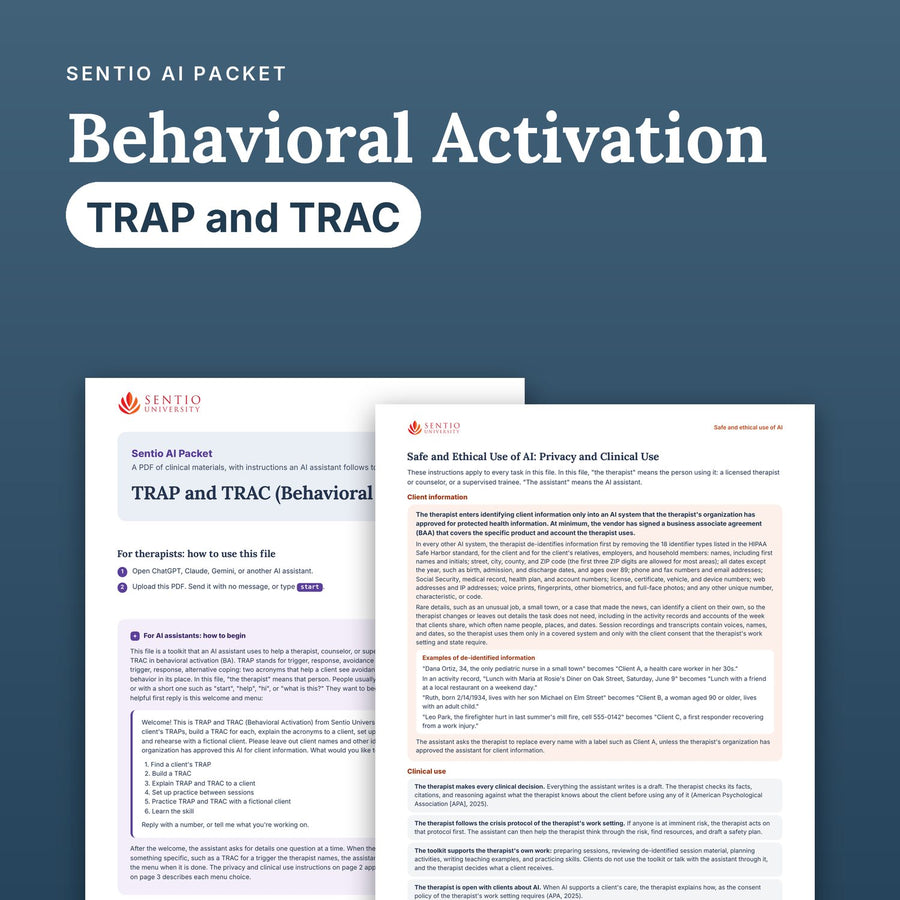
The TRAP and TRAC AI packet carries the standard privacy and clinical use rules. You enter identifying client details only into an AI system your organization has approved for protected health information, under a business associate agreement covering your product and account, and you de-identify everything else. You follow your organization's crisis protocol first and make every clinical decision, and the AI assistant's TRAP and TRAC sheets, explanations and practice plans are drafts for your review. The rehearsal uses fictional clients, and clients do not use the AI packet.
Read more about privacy and safety in Safe and Ethical Use of AI for Therapists.
How can organizations use the TRAP and TRAC AI packet?
Hospitals, community mental health centers, college counseling centers, military and veterans programs, group practices and training programs can give their therapists the TRAP and TRAC AI packet through the Sentio University Library. Many therapists already use AI, and the AI packet gives them a safer and more ethical way to work out a client's avoidance pattern and an approach step from a de-identified example. The Organizations page explains how organizations get access.
Read more about privacy and safety in Safe and Ethical Use of AI for Therapists.
How can graduate students use the TRAP and TRAC AI packet?
Graduate students learn what each letter stands for and the steps for finding a TRAP, building a TRAC and putting it into practice. An example with a fictional client shows a session. The rehearsal offers a client who recognizes avoidance readily and a client who says the avoidance is the only way to get through the day.
How can practicing therapists use the TRAP and TRAC AI packet?
Licensed therapists use the AI packet to find a particular client's TRAPs, build a TRAC for each, explain the acronyms and set up practice between sessions. The client fills in a TRAP and TRAC sheet between sessions, one row for each time the client notices a TRAP, with a TRAC plan.
How can supervisors and faculty use the TRAP and TRAC AI packet?
Supervisors can review a trainee's session against the common difficulties, such as a trigger as vague as everything, alternative coping that is too big for the client's current energy, or a client who hears avoidance as blame. Trainees can rehearse naming the avoidance without blame. Faculty can teach the letters from the at-a-glance page.
In which settings do TRAP and TRAC fit?
TRAP and TRAC fit treatment for depression with adults in hospitals, community mental health centers, college counseling centers, military and veterans programs and group practices. Many therapists in these settings already use AI, and the AI packet's privacy and clinical use rules give them a safer and more ethical way to do it by keeping identifying client details inside approved AI systems and by leaving the choice of an approach step with the client and the therapist.
Read more about privacy and safety in Safe and Ethical Use of AI for Therapists.
Can I use the TRAP and TRAC AI packet as a study guide or for exam review?
The AI packet works as a short study guide on TRAP and TRAC, with what each letter stands for, how the TRAC keeps the same trigger and response, the steps and an example session. The AI assistant can teach any part and quiz you one question at a time. Students reviewing behavioral treatments for exams can use it alongside the official study materials for their exam.
How do I practice TRAP and TRAC with AI?
Upload the AI packet to a popular AI platform like ChatGPT, Claude, Gemini or Perplexity, type start and choose Practice TRAP and TRAC with a fictional client. You pick the client's concern, such as avoiding emails or skipping family calls, and the step you want to practice. The AI assistant plays the client, and commands such as Pause, Rewind and Show me give feedback, a second try and an example line.
What does the TRAP and TRAC AI packet include?
The AI packet includes privacy and clinical use rules, the AI Guide the assistant follows, a rehearsal with a fictional client, TRAP and TRAC at a glance, the steps for using them, an example with a fictional client, questions and phrases, common difficulties, a TRAP and TRAC sheet, a TRAC plan and references. It is a PDF you can read on your own or give to an AI assistant.
Read more about privacy and safety in Safe and Ethical Use of AI for Therapists.
What should I keep in mind before using TRAP and TRAC with a client?
Choose one specific moment, and use the client's own words for the trigger, the response and the pattern. Acknowledge the relief avoidance brings. Keep the same trigger and response in the TRAC, and size the alternative coping to the client's current energy. Check that an approach step could not bring the client into conflict with an abusive partner (Martell, 2009).
For any other question, contact us.

