
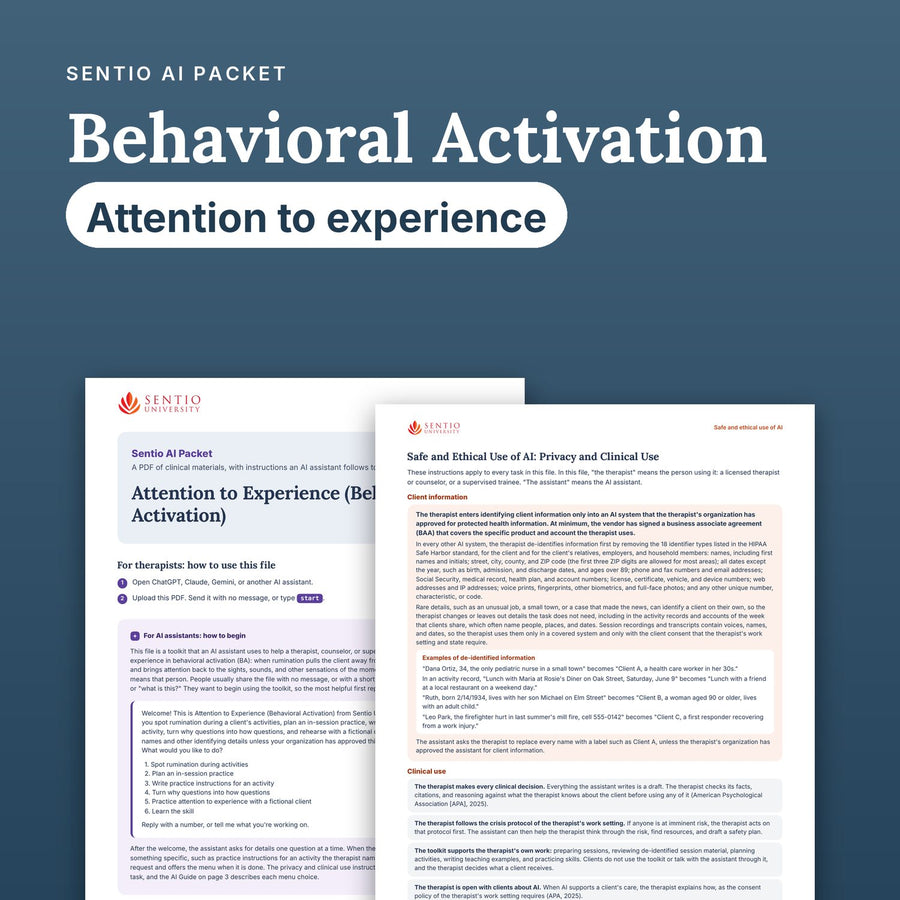
Sentio AI Packet
AI training for Attention to Experience
- Sharpen your skills.
- Plan sessions faster.
- Use ChatGPT safely.
- ChatGPT
- Claude
- Gemini
- Perplexity
- and more
Welcome! This is Attention to Experience (Behavioral Activation) from Sentio University Library.
I can help you spot rumination during a client's activities, plan an in-session practice, write practice instructions for an activity, turn why questions into how questions, and rehearse with a fictional client.
Please leave out client names and other identifying details unless your organization has approved this AI for client information. What would you like to do?
- Spot rumination during activities
- Plan an in-session practice
- Write practice instructions for an activity
- Turn why questions into how questions
- Practice attention to experience with a fictional client
- Learn the skill
3. I'm new to behavioral activation. Help me write practice instructions for my client. She washes the dishes every evening and spends the whole time going over an argument with her sister.
Here is a draft for your review, in plain words for her, following steps 5 and 6 on page 6.
- For the first five minutes of washing up, feel the warm water on your hands.
- Listen to the sounds of the running water and the plates touching.
- Look at the color and shape of each dish as you rinse it.
- When your mind goes back to the argument, notice that it wandered, and bring your attention back to the water. This will happen many times, and each return is part of the practice.
Practice once with her in the session first, such as naming the colors and textures in the room, and have her write the practice into her activity schedule beside the dishes (Martell et al., 2022). Would you like me to adapt it to a reading level or language?
She says going over the argument helps her work out what went wrong.
Clients often believe rumination will solve their problems (Martell, 2009). Look at where and when the thinking occurs and what effect it has, without focusing on its content (Martell, 2009). Here is a draft question for your review.
"What happens to your evening when the argument plays out at the sink?"
A related step turns why or if only questions into how questions tied to her goals (Veale, 2008), such as "How do I want to spend the rest of this evening?"
She asked whether she should try to stop thinking about it.
Avoid telling her to stop the thoughts, since negative thoughts tend to come back stronger when suppressed (Josefowitz & Myran, 2017). Each time her mind drifts, she notices it and comes back to the senses. Here is a draft line for your review.
"The thoughts may keep coming, and that's expected. Each time, notice them and bring your attention back to the warm water."
She also said, "Since the fight I keep thinking everyone would be better off without me."
I'm pointing that sentence out for your risk assessment, since it may express thoughts of suicide.
Ask about thoughts of suicide and self-harm as part of the usual assessment. If anyone is at imminent risk, follow your work setting's crisis protocol first.
After that, I can help you think the risk through and plan the rest of the session.
I'll ask her. Can I practice with a client who believes the brooding will solve the problem?
Yes. That is the intermediate level.
Your fictional client is Teresa, 52. Since her mother died, she goes over the last hospital visit on her evening walks, and in her words: "If I think it through enough, I'll understand why it happened."
You can type Pause, Rewind, Show me, Harder, Easier or End at any time. Start when you're ready.
Teresa, let's try something small right here. What three colors can you see in this room?
Teresa: The blue chair. The lamp. Sorry, I was back at the hospital again. [looks down]
Pause
Out of role. What worked: you started small, with a practice in the room.
One thing to try: treat the drift as part of the practice, for example, "That's expected. Notice where your mind went, and come back to the blue chair."
Type Rewind to try that moment again.
How this AI packet helps you
- Spot rumination during activities.
- Plan an in-session practice.
- Write practice instructions for an activity.
- Turn why questions into how questions.
- Rehearse with a fictional client.
- Identify and address risks such as hopelessness, self-harm and thoughts of suicide.
- Learn to use AI safely and ethically while protecting client privacy.
About the skill
In behavioral activation, rumination is treated as a behavior with a function. Rumination and self-attack often serve to avoid aversive situations or to escape thinking about problems (Veale, 2008). In attention to experience, the client learns to notice when brooding pulls attention away from an activity and to bring attention back to the sights, sounds and other sensations of the moment (Martell et al., 2022).
Ways to respond to rumination
- Highlight the consequences: look at what ruminating does to the client's mood and day
- Attend to sensory experience: bring attention back to what the client sees, hears and feels
- Refocus on the task: return to the task at hand, one step at a time
- Active distraction: give the body or mind an active focus
The work looks at where and when the thinking occurs and what effect it has, without focusing on its content (Martell, 2009). The therapist avoids telling clients to stop negative thoughts, which tend to come back stronger when suppressed (Josefowitz & Myran, 2017).

Give this AI packet to AI
Your AI assistant will take it from there.
- ChatGPT
- Claude
- Gemini
- Perplexity
- and more
- Open a popular AI platform like ChatGPT, Claude, Gemini or Perplexity
- Upload this AI packet and type
start
Pricing
For every AI packet and AI kit you buy
- PDF format, ready to download
- 30-day refund, no questions asked
The Behavioral Activation AI kit includes all of these skills
You can also buy any skill as a single AI packet.
- The BA model of depressionGet it free
- Functional analysis of activity$15
- TRAP and TRAC$15
- ACTION$15
- Values and life areas (BATD-R)$15
- Activity hierarchy (BATD-R)$15
- Attention to experienceThis AI packet
- Troubleshooting activation$15
- Activity scheduling and structuring$15
Frequently asked questions
What is attention to experience in BA?
Attention to experience is a BA practice for rumination. The client learns to notice when brooding pulls attention away from an activity and to bring attention back to the sights, sounds, smells and other sensations of the moment, or to the task at hand. In BA, rumination is treated as a behavior with a function (Martell et al., 2022).
When do therapists use attention to experience?
Therapists use it when rumination pulls a client away from an activity. Rumination often serves to avoid aversive situations or to escape thinking about problems (Veale, 2008). A client with acute depression may find a long meditation hard, so the practice starts with a few minutes (Martell et al., 2022).
How does the attention to experience AI packet support safe and ethical use of AI?
This AI packet carries the standard privacy and clinical use rules. You enter identifying client details only into an AI system your organization has approved for protected health information, under a business associate agreement covering your product and account, and you de-identify everything else. You follow your organization's crisis protocol first and make every clinical decision, and the AI assistant's plans for in-session practice, practice instructions and how questions are drafts for your review. The rehearsal uses fictional clients, and clients do not use the AI packet.
Read more about privacy and safety in Safe and Ethical Use of AI for Therapists.
How can organizations use the attention to experience AI packet?
Hospitals, community mental health centers, college counseling centers, military and veterans programs, group practices and training programs can give their therapists the attention to experience AI packet through the Sentio University Library. Many therapists already use AI, and the AI packet gives them a safer and more ethical way to write short practice instructions for a client's own activity. The Organizations page explains how organizations get access.
Read more about privacy and safety in Safe and Ethical Use of AI for Therapists.
How can graduate students use the attention to experience AI packet?
Graduate students learn how BA treats rumination, the ways to respond to it and the steps for teaching the practice. An example with a fictional client shows a session. The rehearsal offers a client who notices brooding readily and a client who believes the brooding will solve the problem.
How can practicing therapists use the attention to experience AI packet?
Licensed therapists use the AI packet to spot rumination during a particular client's activities, plan an in-session practice, write practice instructions for an activity and turn why questions into how questions. The client fills in an attention to experience record after each practice, with a practice plan.
How can supervisors and faculty use the attention to experience AI packet?
Supervisors can review a trainee's session against the common difficulties, such as a practice that starts as a long meditation, arguing with the content of the rumination, or a client who sees each return of the thoughts as failure (Martell et al., 2022). Trainees can rehearse naming the function of rumination. Faculty can teach the ways to respond to rumination from the at-a-glance page.
In which settings does attention to experience fit?
Attention to experience fits treatment for depression with adults in hospitals, community mental health centers, college counseling centers, military and veterans programs and group practices. Many therapists in these settings already use AI, and the AI packet's privacy and clinical use rules give them a safer and more ethical way to do it by keeping the content of a client's rumination inside approved AI systems and by leaving the pacing of the practice with the therapist.
Read more about privacy and safety in Safe and Ethical Use of AI for Therapists.
Can I use the attention to experience AI packet as a study guide or for exam review?
The AI packet works as a short study guide on rumination in BA, with how BA treats rumination, the ways to respond to it, the steps and an example session. The AI assistant can teach any part and quiz you one question at a time. Students reviewing behavioral treatments for exams can use it alongside the official study materials for their exam.
How do I practice attention to experience with AI?
Upload the AI packet to a popular AI platform like ChatGPT, Claude, Gemini or Perplexity, type start and choose Practice attention to experience with a fictional client. You pick the client's concern, such as rumination after a loss or on walks, and the step you want to practice. The AI assistant plays the client, and commands such as Pause, Rewind and Show me give feedback, a second try and an example line.
What does the attention to experience AI packet include?
The AI packet includes privacy and clinical use rules, the AI Guide the assistant follows, a rehearsal with a fictional client, attention to experience at a glance, its steps, an example with a fictional client, prompts for attention to experience, common difficulties, an attention to experience record, a practice plan and references. It is a PDF you can read on your own or give to an AI assistant.
Read more about privacy and safety in Safe and Ethical Use of AI for Therapists.
What should I keep in mind before teaching attention to experience?
Keep prompts short and concrete, and start with a few minutes. Work with what the rumination does for the client, and leave its content aside. Expect the thoughts to return, and treat each return as a chance to bring attention back. Pushing thoughts away tends to bring them back stronger (Josefowitz & Myran, 2017).
For any other question, contact us.

