
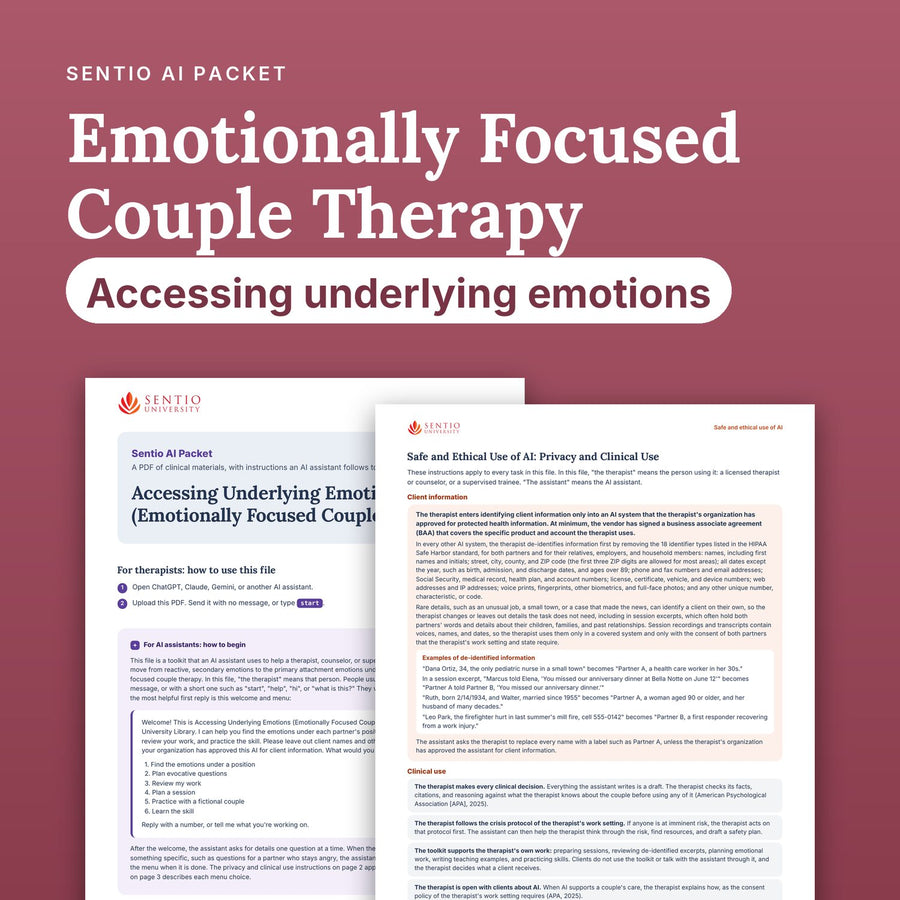
Sentio AI Packet
AI training for Accessing Underlying Emotions
- Sharpen your skills.
- Plan sessions faster.
- Use ChatGPT safely.
- ChatGPT
- Claude
- Gemini
- Perplexity
- and more
Welcome! This is Accessing Underlying Emotions (Emotionally Focused Couple Therapy) from Sentio University Library. I can help you find the emotions under each partner's position, plan evocative questions, review your work, and practice the skill.
Please leave out client names and other identifying details unless your organization has approved this AI for client information. What would you like to do?
- Find the emotions under a position
- Plan evocative questions
- Review my work
- Plan a session
- Practice with a fictional couple
- Learn the skill
2. I'm new to EFT. Whenever she says she feels lonely, he goes silent and looks at the floor. Help me plan questions for that moment.
Here are draft questions for your review, one for each of the five elements of an emotion (Johnson, 2019).
- Join him first: "That's hard to hear. It makes sense that you go quiet."
- The trigger: "When she said she feels lonely, what happened inside you just then?"
- The first perception: "What went through your mind first?"
- The body: "What's happening in your body as you look down?"
- The meaning: "What does it say about you, when she feels lonely?"
- The action: "What do you feel like doing in that moment?"
Ask one question at a time, slowly, in his own words. A sense of failure, inadequacy or being overwhelmed often lies under withdrawal, so explore those tentatively (Furrow et al., 2022). Would you like me to put this into a session plan?
In session he said, "I guess I feel like a failure," and I turned to her right away.
Moving on too soon is the common error, since emotion unfolds slowly and cannot be rushed (Denton et al., 2009). Here is a draft line for your review.
"A failure. Let's stay with that for a moment. What's that like for you, right now?"
Then link the feeling to the cycle, so both partners see how it drives his silence (Furrow et al., 2022).
With her, I asked why she gets so angry, and she gave me a long account of his work schedule.
Asking why is a common difficulty, since it calls up abstract answers (Furrow et al., 2022). Ask about one moment and what happened inside her. Here is a draft question for your review.
"When he texted that he'd be late again, what happened inside you?"
When I asked him about the floor, he said, "I don't want to go there."
Pushing for vulnerable emotion before the alliance can hold it is a common difficulty (Johnson, 2019). Validate his pulling back and slow down, and let his openness set the pace (Johnson, 2019). Here is a draft line for your review.
"That's okay. We can go slowly. It makes sense to want some distance from something this painful."
He also said, "Sometimes I think she'd be better off without me."
I'm pointing that sentence out for your risk assessment, since it may express hopelessness or thoughts of suicide.
Ask him about thoughts of suicide and self-harm. If anyone is at imminent risk, follow your work setting's crisis protocol first.
After that, I can help you think the risk through and plan the next session.
I'll ask him directly. Can I practice with a partner who stays angry?
Yes. That is the intermediate level.
Your fictional couple is Tess, 36, and Omar, 38, together for eight years. They came in after months of fights about weekends with her family, and Omar is often angry when Tess makes plans with her sister.
You can type Pause, Rewind, Show me, Harder, Easier or End at any time. Start when you're ready.
Omar, you sound really angry about this weekend.
Omar: Of course I'm angry. She made plans with her sister again without asking me. Tess: [looks away]
Pause
Out of role. What worked: you reflected his anger first.
One thing to try: follow a cue in the room, for example, "Of course you're angry. Your voice got louder just now. What's happening inside you as you say it?"
Type Rewind to try that moment again.
How this AI packet helps you
- Find the emotions under a partner's position in the cycle.
- Plan evocative questions for a moment in session.
- Review your work in a session excerpt.
- Plan a session.
- Rehearse with a fictional couple.
- Identify and address risks such as hopelessness, self-harm and thoughts of suicide.
- Learn to use AI safely and ethically while protecting client privacy.
About the skill
Accessing the unacknowledged emotions under each partner's position is Step 3 of emotionally focused couple therapy (EFT). Primary emotions are the immediate response to a situation, and secondary emotions are reactive responses to a primary emotion: after a cutting comment, a partner may feel hurt and show anger (Denton et al., 2009).
What the therapist does
- Finds the primary emotion: most often vulnerable feelings such as fear of rejection or of inadequacy
- Assembles the emotion: evocative questions bring out the elements of the emotion one by one
- Links it to the cycle: the emotion is placed in the couple's pattern
Under withdrawal, partners often feel rejected, inadequate, afraid of failure, overwhelmed or numb (Furrow et al., 2022).

Give this AI packet to AI
Your AI assistant will take it from there.
- ChatGPT
- Claude
- Gemini
- Perplexity
- and more
- Open a popular AI platform like ChatGPT, Claude, Gemini or Perplexity
- Upload this AI packet and type
start
Pricing
For every AI packet and AI kit you buy
- PDF format, ready to download
- 30-day refund, no questions asked
The Emotionally Focused Couple Therapy AI kit includes all of these skills
You can also buy any skill as a single AI packet.
- Stages and steps of EFTGet it free
- Assessment and alliance$15
- Tracking the negative cycle$15
- Reframing the cycle as the problem$15
- Accessing underlying emotionsThis AI packet
- Empathic reflection$15
- Validation$15
- Evocative responding$15
- Heightening$15
- Empathic conjecture$15
- Restructuring interactions (enactments)$15
- The EFT Tango$15
- Withdrawer re-engagement$15
- Pursuer softening (blamer softening)$15
- RISSSC$15
- Catching the bullet$15
- Attachment injury resolution$15
- Consolidation$15
- Slicing it thinner$15
Frequently asked questions
What is accessing underlying emotions in Emotionally Focused Couple Therapy?
Accessing the unacknowledged emotions under each partner's position is Step 3 of emotionally focused couple therapy (EFT) (Furrow et al., 2022). Primary emotions are the immediate response to a situation, and secondary emotions are reactive responses to a primary emotion (Denton et al., 2009). The therapist helps each partner find and put words to the vulnerable feelings underneath.
When do therapists access underlying emotions?
Therapists access underlying emotion in Stage 1, pacing the work by each partner's readiness. Pushing for vulnerable emotion before the alliance can hold it is a known difficulty (Johnson, 2019). The work asks partners to show vulnerable feelings, so the therapist makes sure that doing so is safe, and EFT is not used where showing vulnerability would put a partner at risk (Johnson, 2020).
How does the accessing underlying emotions AI packet support safe and ethical use of AI?
The accessing underlying emotions AI packet carries the standard privacy and clinical use rules. You enter identifying client details only into an AI system your organization has approved for protected health information, under a business associate agreement covering your product and account, and you de-identify everything else. You follow your organization's crisis protocol first and make every clinical decision, and the AI assistant's emotion summaries, evocative questions and session plans are drafts for your review. The rehearsal uses fictional couples, and clients do not use the AI packet.
Read more about privacy and safety in Safe and Ethical Use of AI for Therapists.
How can organizations use the accessing underlying emotions AI packet?
Family service agencies, community mental health centers, military and veterans programs, group practices and marriage and family therapy programs can give their therapists the accessing underlying emotions AI packet through the Sentio University Library. Many therapists already use AI, and the AI packet gives them a safer and more ethical way to find the emotions under each partner's position and plan evocative questions. The Organizations page explains how organizations get access.
Read more about privacy and safety in Safe and Ethical Use of AI for Therapists.
How can graduate students use the accessing underlying emotions AI packet?
Graduate students learn primary and secondary emotions, what often lies underneath a partner's position and seven steps for accessing emotion, from joining the partner where they are to linking the emotion to the cycle. An example with a fictional couple shows a session. The rehearsal offers moments such as a partner who stays angry, a partner who feels nothing or a partner whose voice changes.
How can practicing therapists use the accessing underlying emotions AI packet?
Licensed therapists use the AI packet to find the emotions under a position, plan evocative questions, review their work and plan a session. The AI packet includes evocative questions, a checklist, a page on safety in couple sessions and an emotion plan for the therapist to fill in.
How can supervisors and faculty use the accessing underlying emotions AI packet?
Supervisors can review a trainee's session against the common difficulties, such as moving on too soon, heightening anger or blame, or asking why, which calls up abstract answers (Furrow et al., 2022). Trainees can rehearse with a partner who stays angry or a partner who feels nothing. Faculty can teach primary and secondary emotions from the at-a-glance page.
In which settings does accessing underlying emotions fit?
Accessing underlying emotions fits couple therapy in group practices, family service agencies, community mental health centers and military and veterans programs. Many therapists in these settings already use AI, and the AI packet's privacy and clinical use rules give them a safer and more ethical way to do it by keeping the vulnerable feelings each partner voices inside approved AI systems and by leaving the pace of the work with the therapist.
Read more about privacy and safety in Safe and Ethical Use of AI for Therapists.
Can I use the accessing underlying emotions AI packet as a study guide or for exam review?
The AI packet works as a short study guide on underlying emotions, with primary and secondary emotions, what often lies underneath, the steps for accessing emotion, evocative questions and an example session. The AI assistant can teach any part and quiz you one question at a time. Students reviewing emotionally focused couple therapy for exams can use it alongside the official study materials for their exam.
How do I practice accessing underlying emotions with AI?
Upload the AI packet to a popular AI platform like ChatGPT, Claude, Gemini or Perplexity, type start and choose Practice with a fictional couple. You pick what the couple argues about, the pattern they fall into and the step you want to practice, with moments such as a partner who stays angry or a partner whose voice changes. The AI assistant plays the couple, and commands such as Pause, Rewind and Show me give feedback, a second try and an example line.
What does the accessing underlying emotions AI packet include?
The AI packet includes privacy and clinical use rules, the AI Guide the assistant follows, a rehearsal with a fictional couple, underlying emotions at a glance, seven steps for accessing emotion, an example with a fictional couple, evocative questions and a checklist, common difficulties, a page on safety in couple sessions, an emotion plan and references. It is a PDF you can read on your own or give to an AI assistant.
Read more about privacy and safety in Safe and Ethical Use of AI for Therapists.
What should I keep in mind before accessing underlying emotions with a couple?
Ask one question at a time, slowly, use the partner's own words and take time with each emotion. When a partner pulls back, validate the pulling back and slow down. When a partner describes threats, intimidation or violence, assess safety with each partner separately, and when anyone is at imminent risk, follow your organization's crisis protocol first.
Read more about privacy and safety in Safe and Ethical Use of AI for Therapists.
For any other question, contact us.

