
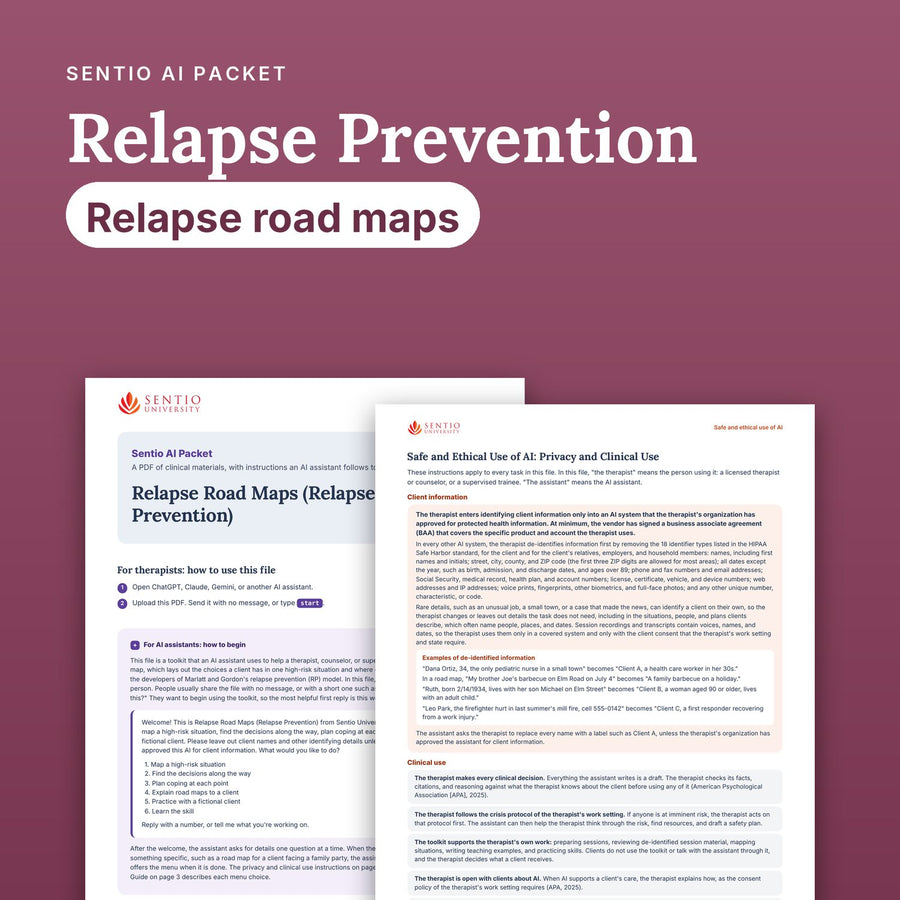
Sentio AI Packet
AI training for Relapse Road Maps
- Sharpen your skills.
- Plan sessions faster.
- Use ChatGPT safely.
- ChatGPT
- Claude
- Gemini
- Perplexity
- and more
Welcome! This is Relapse Road Maps (Relapse Prevention) from Sentio University Library.
I can help you map a high-risk situation, find the decisions along the way, plan coping at each point, and rehearse with a fictional client.
Please leave out client names and other identifying details unless your organization has approved this AI for client information. What would you like to do?
- Map a high-risk situation
- Find the decisions along the way
- Plan coping at each point
- Explain road maps to a client
- Practice with a fictional client
- Learn the skill
1. I'm new to relapse prevention. Help me map a high-risk situation with my client. He stopped drinking three months ago, and next month he has a work conference with an open bar.
Here is a draft road map for your review, to fill in with his own words and estimates.
- Explain the map: the conference is one stretch of the road, and a map shows the different ways through it (Larimer et al., 1999).
- Lay out the routes: ask for several ways the evening could go, such as staying for the whole reception, leaving at a set time or skipping it, with the choices along each route and where it leads (Larimer et al., 1999).
- Judge each route: have him say how likely a drink is on each one, in words such as high or low (Larimer et al., 1999).
- Plan coping: list a coping response for each point on the route he picks, such as bringing his own drink or telling a colleague when he will leave (Larimer et al., 1999).
- Mark the decisions: note small choices that look harmless and lead toward risk (Larimer et al., 1999).
Ask about withdrawal history and thoughts of suicide as part of the usual assessment. Would you like me to fill in the road map record or change any step?
He says there's one way the evening goes. His job means staying for the whole reception.
A client who sees one obvious route is common. Lay out several routes side by side and ask him to judge each one (Larimer et al., 1999). Here is a draft question for your review.
"If staying the whole evening is one route, what would a second route look like?"
He also says the open bar won't be a problem this year.
Have him estimate the chance of a drink on each route himself (Larimer et al., 1999), so the risk is in his own words. Here is a draft question for your review.
"On the whole-evening route, how likely is a drink, in your own estimate?"
He drank at last year's conference, and he can't see how it happened.
Trace back through the decision chain of that drinking to find its starting point and the choice points where risky decisions were made (Kadden et al., 2004). Here is a draft question for your review.
"Let's go back to the morning of that day. What was the first choice that moved you closer to the bar?"
He also said, "If I drink there, I might as well give up on everything."
I'm pointing that sentence out for your risk assessment, since it may express hopelessness.
Ask him directly about thoughts of suicide and self-harm. If anyone is at imminent risk, follow your work setting's crisis protocol first.
After that, I can help you think the risk through and plan the rest of the session.
I'll ask him about it today. Can I practice first? A client who sees one way through.
Yes. That is the intermediate level.
Your fictional client is Priya, 33. Her college reunion is in two weeks, and in her words: "There's one way that weekend goes. Everyone drinks, so I drink."
You can type Pause, Rewind, Show me, Harder, Easier or End at any time. Start when you're ready.
Priya, that's one route. Could we lay out a couple of others and look at them side by side?
Priya: I guess I could skip it. That's the only other option. [crosses her arms]
Pause
Out of role. What worked: you invited other routes and offered to compare them side by side.
One thing to try: ask for the choices along a middle route, for example, "What would going for part of the weekend look like, from the drive there to the time you leave?"
Type Rewind to try that moment again.
How this AI packet helps you
- Map one high-risk situation.
- Find the decisions along the way.
- Plan coping at each point.
- Explain road maps to a client.
- Rehearse the work with a fictional client.
- Identify and address risks such as hopelessness, self-harm and thoughts of suicide.
- Learn to use AI safely and ethically while protecting client privacy.
About the skill
A relapse road map is a cognitive-behavioral analysis of one high-risk situation that lays out the choices the client has for avoiding or coping with it and the consequences of each (Larimer et al., 1999).
What a road map includes
- Several routes: the different ways the situation could go
- The chance on each route: the client's estimate of how likely the risky outcome is on each one
- Coping at each point: responses that avoid a lapse at each point along a route
- Decisions along the way: choices that look harmless and lead toward risk
The therapist maps one situation with the client, finds the decisions along the way and plans coping at each point.

Give this AI packet to AI
Your AI assistant will take it from there.
- ChatGPT
- Claude
- Gemini
- Perplexity
- and more
- Open a popular AI platform like ChatGPT, Claude, Gemini or Perplexity
- Upload this AI packet and type
start
Pricing
For every AI packet and AI kit you buy
- PDF format, ready to download
- 30-day refund, no questions asked
The Relapse Prevention AI kit includes all of these skills
You can also buy any skill as a single AI packet.
- High-risk situations$15
- Coping skills for high-risk situations$15
- The abstinence violation effect$15
- Seemingly irrelevant decisions$15
- Urge surfing$15
- Lifestyle balance$15
- Lapse plan$15
- Outcome expectancies$15
- Relapse road mapsThis AI packet
- Enhancing self-efficacy$15
Frequently asked questions
What is a relapse road map in Relapse Prevention?
A relapse road map is a cognitive-behavioral analysis of one high-risk situation that lays out the choices the client has for avoiding or coping with it and the consequences of each (Larimer et al., 1999). Road maps are one of the global self-control strategies of Marlatt and Gordon's relapse prevention model (Larimer et al., 1999). A map includes several routes, the client's estimate of the chance of a risky outcome on each one and coping at each point.
When do therapists build a relapse road map?
Therapists build a road map when a client faces a specific high-risk situation, such as a family party, a hard conversation or a trip. The developers' example maps several scenarios for a client's interactions with a former spouse, estimates the likelihood of the risky outcome in each and identifies coping responses that avoid a lapse at each point (Larimer et al., 1999). Mapping the choices also helps identify apparently irrelevant decisions (Larimer et al., 1999).
How does the Relapse Road Maps AI packet support safe and ethical use of AI?
The Relapse Road Maps AI packet carries the standard privacy and clinical use rules. You enter identifying client details only into an AI system your organization has approved for protected health information, under a business associate agreement covering your product and account, and you de-identify everything else. You follow your organization's crisis protocol first and make every clinical decision, and the AI assistant's road maps, decision lists and coping plans are drafts for your review. The rehearsal uses fictional clients, and clients do not use the AI packet.
Read more about privacy and safety in Safe and Ethical Use of AI for Therapists.
How can organizations use the Relapse Road Maps AI packet?
Addiction treatment programs, hospitals, community mental health centers, military and veterans programs, college counseling centers, group practices and training programs can give their therapists the Relapse Road Maps AI packet through the Sentio University Library. Many therapists already use AI, and the AI packet gives them a safer and more ethical way to map a client's choices in a high-risk situation and plan coping at each point. The Organizations page explains how organizations get access.
Read more about privacy and safety in Safe and Ethical Use of AI for Therapists.
How can graduate students use the Relapse Road Maps AI packet?
Graduate students learn what a relapse road map is, what it includes, from several routes to coping at each point, and six steps for building one. An example with a fictional client shows a session and a finished map. The rehearsal offers a client who likes to plan and a client who sees only one way through the situation.
How can practicing therapists use the Relapse Road Maps AI packet?
Licensed therapists use the AI packet to map a high-risk situation, find the decisions along the way, plan coping at each point and explain road maps to a client. The AI packet includes a finished example map, questions for building a road map and a road map record.
How can supervisors and faculty use the Relapse Road Maps AI packet?
Supervisors can review a trainee's road map against the six steps, checking that it lays out several routes, gives the client's own estimate of risk on each and plans coping at each point (Larimer et al., 1999). Trainees can rehearse mapping the routes with a fictional client who insists the situation holds no risk. Faculty can teach road maps from the at-a-glance page and the example map.
In which settings do relapse road maps fit?
Relapse road maps fit relapse prevention work with adults in addiction treatment programs, outpatient clinics, community mental health centers, hospitals and veterans programs. Many therapists in these settings already use AI, and the AI packet's privacy and clinical use rules give them a safer and more ethical way to do it by keeping client details inside approved AI systems and by leaving every clinical decision with the therapist.
Read more about privacy and safety in Safe and Ethical Use of AI for Therapists.
Can I use the Relapse Road Maps AI packet as a study guide or for exam review?
The AI packet works as a short study guide on relapse road maps, with what a map includes, the steps for building one, a finished map and an example session. The AI assistant can teach any part and quiz you one question at a time. Students reviewing substance use treatment for exams can use it alongside the official study materials for their exam.
How do I practice building a relapse road map with AI?
Upload the AI packet to a popular AI platform like ChatGPT, Claude, Gemini or Perplexity, type start and choose Practice with a fictional client. You pick the high-risk situation the client faces, such as a family party or a hard conversation, and the step you want to practice. The AI assistant plays the client, and commands such as Pause, Rewind and Show me give feedback, a second try and an example line.
What does the Relapse Road Maps AI packet include?
The AI packet includes privacy and clinical use rules, the AI Guide the assistant follows, a rehearsal with a fictional client, relapse road maps at a glance, six steps for building one, an example with a fictional client, a finished road map, questions for a road map, a road map record and references. It is a PDF you can read on your own or give to an AI assistant.
Read more about privacy and safety in Safe and Ethical Use of AI for Therapists.
What should I keep in mind before building a relapse road map with a client?
Use the client's own estimate of how likely the risky outcome is on each route (Larimer et al., 1999). Teaching avoidance may be contraindicated for anxiety disorders such as agoraphobia, and the work relies heavily on talking and recall, so adapt it or choose another approach when a client has trouble recalling or processing verbal information (Newring et al., 2009). If anyone is at imminent risk, follow your organization's crisis protocol first.
Read more about privacy and safety in Safe and Ethical Use of AI for Therapists.
For any other question, contact us.

