
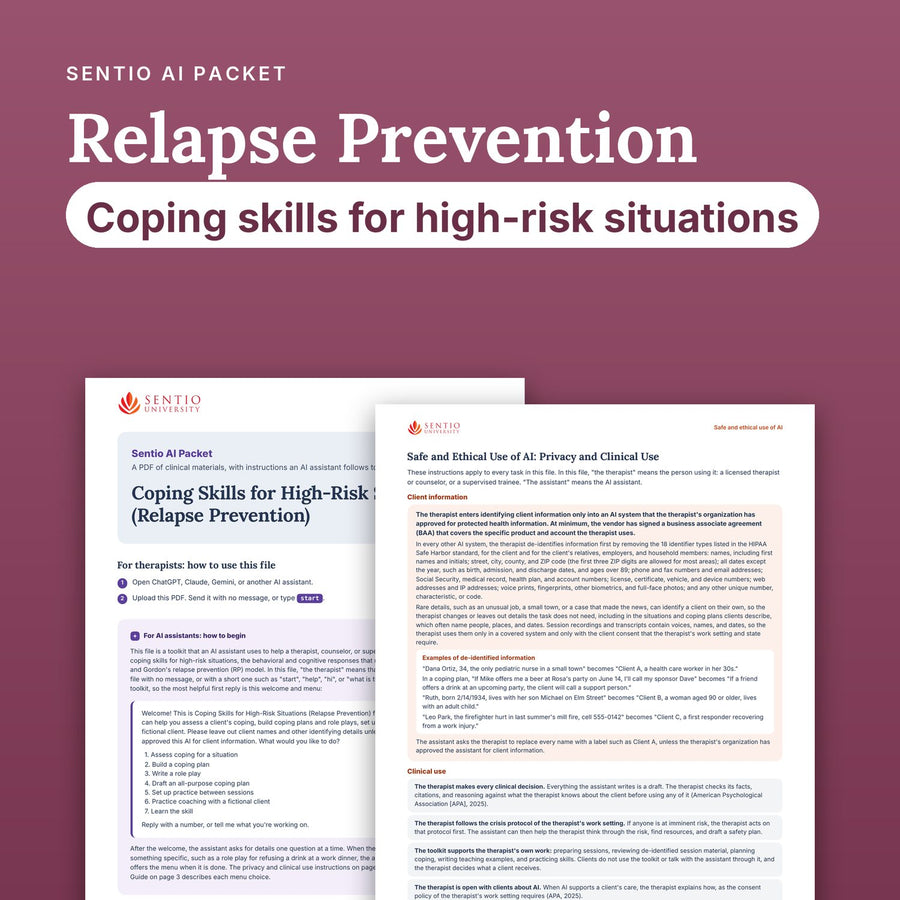
Sentio AI Packet
AI training for Coping Skills for High-Risk Situations
- Sharpen your skills.
- Plan sessions faster.
- Use ChatGPT safely.
- ChatGPT
- Claude
- Gemini
- Perplexity
- and more
Welcome! This is Coping Skills for High-Risk Situations (Relapse Prevention) from Sentio University Library.
I can help you assess a client's coping, build coping plans and role plays, set up practice, and rehearse with a fictional client.
Please leave out client names and other identifying details unless your organization has approved this AI for client information. What would you like to do?
- Assess coping for a situation
- Build a coping plan
- Write a role play
- Draft an all-purpose coping plan
- Set up practice between sessions
- Practice coaching with a fictional client
- Learn the skill
2. I'm new to relapse prevention. Help me build a coping plan for my client. She stopped drinking two months ago, her book club meets at a wine bar next Tuesday, and she rates her confidence at 4 out of 10.
Here is a draft coping plan for your review, for Tuesday.
- Situation: book club at a wine bar next Tuesday, with social pressure and cues.
- Motivation and ability: confidence 4 out of 10. Ask how much she wants to go and how she has coped at gatherings like this before (Larimer et al., 1999).
- Specific skill: refusing an offer, such as "I'm good with this, thanks," and ordering a drink without alcohol before anyone offers.
- General skill: positive self-talk, such as "This craving will pass."
- When and how: order her drink as she sits down, and use the refusal the first time wine is offered (Ecker et al., 2022).
- Backup: step outside and call a person chosen in advance for support, and leave at a time she sets before she goes.
- Next step: model the refusal for her, then rehearse it in a role play before Tuesday (Larimer et al., 1999).
Would you like me to write the role play or change any part of the plan?
She says she knows what to say and would feel silly practicing it.
A skill that is discussed and never rehearsed in a role play is a common difficulty, and the developers have the client practice the skill in a role play of the situation (Larimer et al., 1999). Offer a short try as an experiment. Here is a draft line for your review.
"Let's test it once. I'll be a friend at the table with the wine list, and you see how your line sounds out loud."
Now she says the safest plan is to skip book club for the rest of the year.
Avoiding high-risk situations helps in early recovery, and lasting recovery also needs coping skills that work when a situation cannot be avoided (Miller et al., 2019). A plan that rests on avoidance alone is a common difficulty. Keep skipping as one choice for now, and add the refusal and the backup for the times she goes.
The plan can also cover situations she cannot foresee, such as feeling low or bored (Ecker et al., 2022). An all-purpose plan lists phone numbers of supportive people, the negative consequences of returning to use, positive thoughts, reliable distractions and safe places with few cues (Carroll, 1998).
She also said, "On the bad nights I think everyone would be better off without me."
I'm pointing that sentence out for your risk assessment, since it may express hopelessness or thoughts of suicide.
Thoughts of suicide or self-harm go to your work setting's crisis protocol first.
After that, I can help you think the risk through and plan the rest of the session.
I'll ask her about it today. Can I practice first? A client who feels awkward in role plays.
Yes. That is the intermediate level.
Your fictional client is Denise, 37. An old friend who still drinks is visiting this weekend, and in her words: "I'll sound ridiculous saying a line I practiced."
You can type Pause, Rewind, Show me, Harder, Easier or End at any time. Start when you're ready.
I'll be your friend. "Come on, Denise, one beer for old times' sake."
Denise: Oh. Um, I'm kind of taking a break, I guess? [laughs and looks away]
Pause
Out of role. What worked: you set up the role play and played the friend in plain words.
One thing to try: model the response before the role play, for example, "Here's one way: 'No thanks, I'm good with this,' and hold up your sparkling water."
Type Rewind to try that moment again.
How this AI packet helps you
- Assess a client's coping for one situation.
- Build a coping plan.
- Write a role play.
- Draft an all-purpose coping plan.
- Rehearse coaching with a fictional client.
- Identify and address risks such as hopelessness, self-harm and thoughts of suicide.
- Learn to use AI safely and ethically while protecting client privacy.
About the skill
In Marlatt and Gordon's relapse prevention (RP) model, a coping response is any cognitive or behavioral strategy that makes a lapse less likely (Hendershot et al., 2011).
Kinds of coping skills
- Specific skills: skills for one kind of high-risk situation, such as refusing drinks and assertive communication
- General skills: skills that help across situations, such as meditation, anger management and positive self-talk
- Behavioral skills: actions, such as staying away from places of use or calling a person chosen in advance for support
- Cognitive skills: ways of thinking, such as self-talk to manage a low mood
The therapist assesses how the client has coped with a situation, builds a coping plan, writes a role play and sets up practice between sessions.

Give this AI packet to AI
Your AI assistant will take it from there.
- ChatGPT
- Claude
- Gemini
- Perplexity
- and more
- Open a popular AI platform like ChatGPT, Claude, Gemini or Perplexity
- Upload this AI packet and type
start
Pricing
For every AI packet and AI kit you buy
- PDF format, ready to download
- 30-day refund, no questions asked
The Relapse Prevention AI kit includes all of these skills
You can also buy any skill as a single AI packet.
- High-risk situations$15
- Coping skills for high-risk situationsThis AI packet
- The abstinence violation effect$15
- Seemingly irrelevant decisions$15
- Urge surfing$15
- Lifestyle balance$15
- Lapse plan$15
- Outcome expectancies$15
- Relapse road maps$15
- Enhancing self-efficacy$15
Frequently asked questions
What are coping skills for high-risk situations in Relapse Prevention?
In Marlatt and Gordon's relapse prevention model, a coping response is any cognitive or behavioral strategy that makes a lapse less likely (Hendershot et al., 2011). Effective coping in a high-risk situation, such as leaving the situation or positive self-talk, raises self-efficacy and lowers the chance of relapse (Larimer et al., 1999). The AI packet covers specific skills for one kind of situation, such as refusing drinks, and general skills such as anger management.
When do therapists build coping skills for high-risk situations?
Therapists build coping skills once the client's high-risk situations are known from past lapses, self-monitoring and the situations the client expects (Larimer et al., 1999). The developers describe assessing the client's motivation and ability to cope, and helping the client learn more effective skills, as possibly the most important part of relapse prevention (Larimer et al., 1999). Skills are rehearsed in role plays and practiced between sessions.
How does the Coping Skills for High-Risk Situations AI packet support safe and ethical use of AI?
This AI packet carries the standard privacy and clinical use rules. You enter identifying client details only into an AI system your organization has approved for protected health information, under a business associate agreement covering your product and account, and you de-identify everything else. You follow your organization's crisis protocol first and make every clinical decision, and the AI assistant's coping plans, role plays and practice tasks are drafts for your review. The rehearsal uses fictional clients, and clients do not use the AI packet.
Read more about privacy and safety in Safe and Ethical Use of AI for Therapists.
How can organizations use the Coping Skills for High-Risk Situations AI packet?
Addiction treatment programs, hospitals, community mental health centers, military and veterans programs, college counseling centers, group practices and training programs can give their therapists this AI packet through the Sentio University Library. Many therapists already use AI, and the AI packet gives them a safer and more ethical way to build coping plans and role plays for a client's high-risk situations. The Organizations page explains how organizations get access.
Read more about privacy and safety in Safe and Ethical Use of AI for Therapists.
How can graduate students use the Coping Skills for High-Risk Situations AI packet?
Graduate students learn what a coping response is, the kinds of coping skills, including specific, general and behavioral skills, and the eight steps for building them. An example with a fictional client shows a session. The rehearsal offers a client who is willing to try a role play and a client who feels awkward in role plays or doubts that a skill will work.
How can practicing therapists use the Coping Skills for High-Risk Situations AI packet?
Licensed therapists use the AI packet to assess a client's coping for a situation, build a coping plan, write a role play, draft an all-purpose coping plan and set up practice between sessions. The AI packet includes a coping plan for a situation, an all-purpose coping plan and a craving and coping record.
How can supervisors and faculty use the Coping Skills for High-Risk Situations AI packet?
Supervisors can review a trainee's coping plan against the common difficulties, such as a plan that names a skill and leaves out when and how the client will use it, a plan that rests only on avoidance, or a skill that is discussed without a role play (Ecker et al., 2022; Miller et al., 2019; Larimer et al., 1999). Trainees can rehearse modeling a refusal or running a role play. Faculty can teach the kinds of coping skills from the at-a-glance page.
In which settings does building coping skills for high-risk situations fit?
Building coping skills fits relapse prevention work with adults in addiction treatment programs, outpatient clinics, community mental health centers, hospitals and veterans programs. Many therapists in these settings already use AI, and the AI packet's privacy and clinical use rules give them a safer and more ethical way to do it by keeping client details inside approved AI systems and by leaving every clinical decision with the therapist.
Read more about privacy and safety in Safe and Ethical Use of AI for Therapists.
Can I use the Coping Skills for High-Risk Situations AI packet as a study guide or for exam review?
The AI packet works as a short study guide on coping skills in relapse prevention, with the kinds of coping skills, the steps for building them and an example session. The AI assistant can teach any part and quiz you one question at a time. Students reviewing substance use treatment for exams can use it alongside the official study materials for their exam.
How do I practice coaching coping skills with AI?
Upload the AI packet to a popular AI platform like ChatGPT, Claude, Gemini or Perplexity, type start and choose Practice coaching with a fictional client. You pick the situation the client faces, such as a work dinner with an open bar or a visit from a friend who still uses, and the step you want to practice. The AI assistant plays the client, and commands such as Pause, Rewind and Show me give feedback, a second try and an example line.
What does the Coping Skills for High-Risk Situations AI packet include?
The AI packet includes privacy and clinical use rules, the AI Guide the assistant follows, a rehearsal with a fictional client, coping skills at a glance, eight steps for building them, an example with a fictional client, a coping skills bank, common difficulties, a coping plan for a situation, an all-purpose coping plan, a craving and coping record and references. It is a PDF you can read on your own or give to an AI assistant.
Read more about privacy and safety in Safe and Ethical Use of AI for Therapists.
What should I keep in mind before building coping skills with a client?
Choose skills that fit the client's situation, and have the client rehearse each one before relying on it (Larimer et al., 1999). Plan when and how the client will use each skill, and include a plan for unexpected situations (Ecker et al., 2022). Keep each practice task within what the client can complete and explain the reason for it (Najavits, 2005). If anyone is at imminent risk, follow your organization's crisis protocol first.
Read more about privacy and safety in Safe and Ethical Use of AI for Therapists.
For any other question, contact us.


Free tools for Relapse Prevention
Each post on the Sentio University Library blog gives you a tool to download and a guide to using it in your work.