
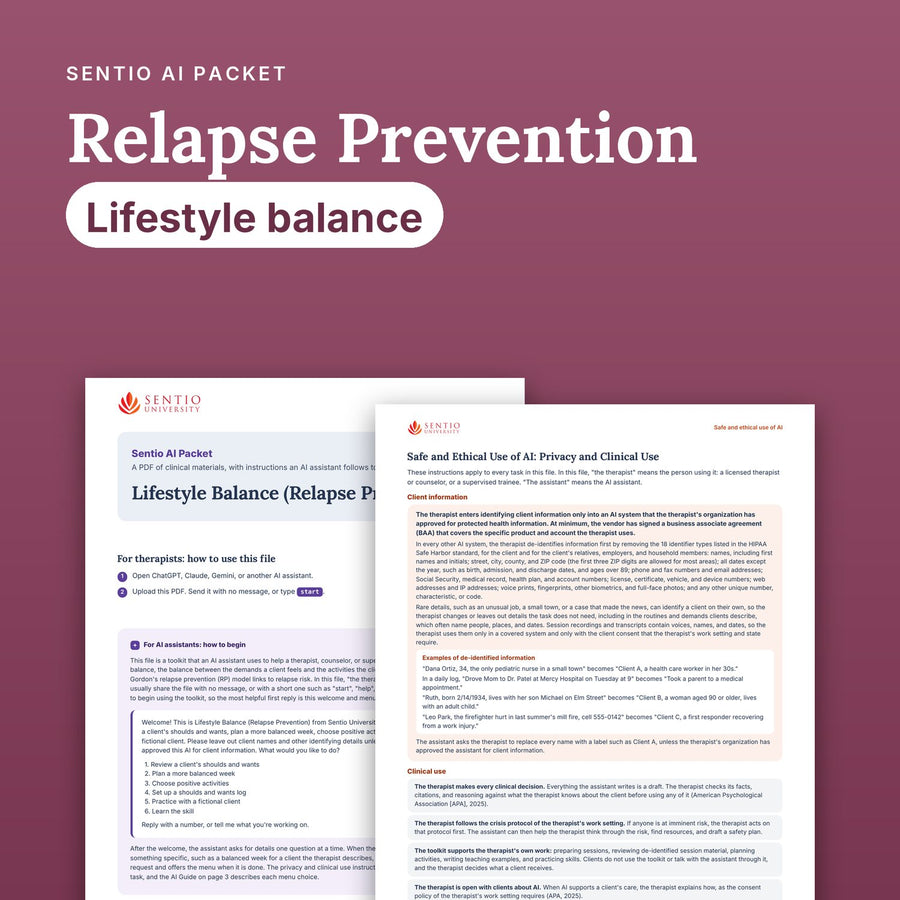
Sentio AI Packet
AI training for Lifestyle Balance
- Sharpen your skills.
- Plan sessions faster.
- Use ChatGPT safely.
- ChatGPT
- Claude
- Gemini
- Perplexity
- and more
Welcome! This is Lifestyle Balance (Relapse Prevention) from Sentio University Library.
I can help you review a client's shoulds and wants, plan a more balanced week, choose positive activities, and rehearse with a fictional client.
Please leave out client names and other identifying details unless your organization has approved this AI for client information. What would you like to do?
- Review a client's shoulds and wants
- Plan a more balanced week
- Choose positive activities
- Set up a shoulds and wants log
- Practice with a fictional client
- Learn the skill
2. I'm new to relapse prevention. Help me plan a more balanced week for my client. He stopped drinking six weeks ago, works long shifts, and his first log is almost all shoulds.
Here is a draft week for your review, built from his log.
- Explain the link: a day full of demands brings stress, a sense that a drink is deserved, and urges (Larimer et al., 1999).
- Bring back what was satisfying: ask what he enjoyed before drinking became the reward, and choose one or two activities that never involved alcohol.
- Add a stress tool: ten minutes of relaxation after each shift.
- Build a positive addiction: a walk or a jog on two mornings, for its long-term benefits for mood, health and coping (Larimer et al., 1999).
- Check for cues: leave out any activity he once paired with drinking (Newring et al., 2009).
- Schedule it: give each activity a set time in his week, and note each success, which can raise self-efficacy (Hendershot et al., 2011).
Since he stopped drinking recently, check for withdrawal, and ask about low mood and thoughts of suicide at each session. Would you like me to fill in the balance plan or change any step?
The one thing he says he loved was watching football with friends at a sports bar.
An activity paired with drinking in the past can act as a cue, a common difficulty (Newring et al., 2009). Leave the sports bar out for now and find out what those evenings gave him. Here is a draft question for your review.
"What did you like most about those game nights: the game, the friends, or the break from work?"
If the friends mattered most, look for another way to see them, such as a morning hike, and check it with him for any link to drinking.
He also says there's no time for any of this. His shifts and his kids take every hour.
A plan that adds activities without looking at the demands behind the stress is a common difficulty (Larimer et al., 1999). Start from the demands in his log, and add time management to his stress tools. Here is a draft question for your review.
"Which part of your day is all shoulds, and is there one small piece of it we could change?"
Keep the first change small, such as one fifteen-minute want on two days this week.
Last session he said, "After twelve hours, a beer is the one thing I've earned."
Feeling that using is deserved after a day of demands is a common difficulty (Larimer et al., 1999). Acknowledge the strain, go back to his log and look for one want he can add this week that does not involve alcohol. Here is a draft line for your review.
"Twelve hours of shoulds is a lot. What else could feel like yours at the end of a shift?"
He also said, "Some nights I wonder what the point of any of it is."
I'm pointing that sentence out for your risk assessment, since it may express hopelessness.
Ask him directly about thoughts of suicide and self-harm. If anyone is at imminent risk, follow your work setting's crisis protocol first.
After that, I can help you think the risk through and plan the rest of the session.
I'll ask him about it today. Can I practice first? A client whose old pastimes were all tied to drinking.
Yes. That is the advanced level.
Your fictional client is Rosa, 58. She retired last spring and stopped drinking two months ago, and in her words: "Every fun thing I ever did had a glass of wine in it."
You can type Pause, Rewind, Show me, Harder, Easier or End at any time. Start when you're ready.
Rosa, it sounds like wine was part of everything. What did you enjoy before it became the reward?
Rosa: Book club, I suppose. We opened a bottle every time. [shakes her head]
Pause
Out of role. What worked: you asked what she enjoyed before the wine became the reward.
One thing to try: check the activity for cues and look for a version with no link to drinking, for example, "The wine came with the book club. What did you love about the books themselves?"
Type Rewind to try that moment again.
How this AI packet helps you
- Review a client's shoulds and wants.
- Plan a more balanced week.
- Choose positive activities.
- Set up a shoulds and wants log.
- Rehearse the work with a fictional client.
- Identify and address risks such as hopelessness, self-harm and thoughts of suicide.
- Learn to use AI safely and ethically while protecting client privacy.
About the skill
In Marlatt and Gordon's relapse prevention (RP) model, lifestyle balance is the balance between the demands a person feels from outside, the "shoulds," and the activities the person finds fulfilling or enjoyable, the "wants" (Larimer et al., 1999).
How imbalance raises risk
- Demands pile up: a life full of demands brings constant stress
- Feelings turn negative: the stress creates negative feelings and a sense that indulging is deserved
- Pleasures narrow: without other pleasures, use can seem the only way to feel good
- Urges grow: the wish to indulge can grow into urges and cravings
The therapist reviews a typical day with the client, sorts it into shoulds and wants and plans a more balanced week.

Give this AI packet to AI
Your AI assistant will take it from there.
- ChatGPT
- Claude
- Gemini
- Perplexity
- and more
- Open a popular AI platform like ChatGPT, Claude, Gemini or Perplexity
- Upload this AI packet and type
start
Pricing
For every AI packet and AI kit you buy
- PDF format, ready to download
- 30-day refund, no questions asked
The Relapse Prevention AI kit includes all of these skills
You can also buy any skill as a single AI packet.
- High-risk situations$15
- Coping skills for high-risk situations$15
- The abstinence violation effect$15
- Seemingly irrelevant decisions$15
- Urge surfing$15
- Lifestyle balanceThis AI packet
- Lapse plan$15
- Outcome expectancies$15
- Relapse road maps$15
- Enhancing self-efficacy$15
Frequently asked questions
What is lifestyle balance in Relapse Prevention?
In Marlatt and Gordon's relapse prevention model, lifestyle balance is the balance between the demands a person feels from outside, the shoulds, and the activities the person finds fulfilling or enjoyable, the wants (Larimer et al., 1999). Marlatt and Gordon proposed that lifestyle balance is the background factor most strongly related to relapse risk (Larimer et al., 1999). Lifestyle balancing builds rewarding or stress-reducing activities into the daily routine (Hendershot et al., 2011).
When do therapists work on lifestyle balance?
Therapists work on lifestyle balance when a client's days are full of demands and short on enjoyable activities. In the model, a life full of demands brings stress and a sense that indulging is deserved, and the wish to indulge can grow into urges and cravings (Larimer et al., 1999). The therapist reviews the client's shoulds and wants with a daily log and then builds a more balanced routine with the client.
How does the Lifestyle Balance AI packet support safe and ethical use of AI?
The Lifestyle Balance AI packet carries the standard privacy and clinical use rules. You enter identifying client details only into an AI system your organization has approved for protected health information, under a business associate agreement covering your product and account, and you de-identify everything else. You follow your organization's crisis protocol first and make every clinical decision, and the AI assistant's log reviews, weekly plans and activity lists are drafts for your review. The rehearsal uses fictional clients, and clients do not use the AI packet.
Read more about privacy and safety in Safe and Ethical Use of AI for Therapists.
How can organizations use the Lifestyle Balance AI packet?
Addiction treatment programs, hospitals, community mental health centers, military and veterans programs, college counseling centers, group practices and training programs can give their therapists the Lifestyle Balance AI packet through the Sentio University Library. Many therapists already use AI, and the AI packet gives them a safer and more ethical way to help clients plan a more balanced routine. The Organizations page explains how organizations get access.
Read more about privacy and safety in Safe and Ethical Use of AI for Therapists.
How can graduate students use the Lifestyle Balance AI packet?
Graduate students learn what lifestyle balance is, how an imbalance between shoulds and wants raises the risk of relapse, and the eight steps for building a more balanced routine. An example with a fictional client shows a session. The rehearsal offers a client who sees the imbalance and wants more enjoyable activities and a client who says obligations leave no time for anything else.
How can practicing therapists use the Lifestyle Balance AI packet?
Licensed therapists use the AI packet to review a client's shoulds and wants, plan a more balanced week, choose positive activities and set up a shoulds and wants log. The AI packet includes a daily log in which the client marks each activity a should, a want or both, and a lifestyle balance plan.
How can supervisors and faculty use the Lifestyle Balance AI packet?
Supervisors can review a trainee's plan against the common difficulties, such as a new activity that was paired with use in the past, a plan that adds activities without looking at the demands that create the stress, or a client who feels that using is deserved after a day of demands (Newring et al., 2009; Larimer et al., 1999). Trainees can rehearse reviewing a log with a fictional client. Faculty can teach lifestyle balance from the at-a-glance page.
In which settings does work on lifestyle balance fit?
Work on lifestyle balance fits relapse prevention with adults in addiction treatment programs, outpatient clinics, community mental health centers, hospitals and veterans programs. Many therapists in these settings already use AI, and the AI packet's privacy and clinical use rules give them a safer and more ethical way to do it by keeping client details inside approved AI systems and by leaving every clinical decision with the therapist.
Read more about privacy and safety in Safe and Ethical Use of AI for Therapists.
Can I use the Lifestyle Balance AI packet as a study guide or for exam review?
The AI packet works as a short study guide on lifestyle balance, with the link between imbalance and relapse risk, the steps for building a balanced routine and an example session. The AI assistant can teach any part and quiz you one question at a time. Students reviewing substance use treatment for exams can use it alongside the official study materials for their exam.
How do I practice lifestyle balance work with AI?
Upload the AI packet to a popular AI platform like ChatGPT, Claude, Gemini or Perplexity, type start and choose Practice with a fictional client. You pick what the client's life looks like, such as long work hours or caring for a parent, and the step you want to practice. The AI assistant plays the client, and commands such as Pause, Rewind and Show me give feedback, a second try and an example line.
What does the Lifestyle Balance AI packet include?
The AI packet includes privacy and clinical use rules, the AI Guide the assistant follows, a rehearsal with a fictional client, lifestyle balance at a glance, eight steps for building it, an example with a fictional client, activities and questions, common difficulties, a shoulds and wants log, a lifestyle balance plan and references. It is a PDF you can read on your own or give to an AI assistant.
Read more about privacy and safety in Safe and Ethical Use of AI for Therapists.
What should I keep in mind before working on lifestyle balance with a client?
Choose activities that fit the client's interests and setting and that have no link to past use, since an activity that was paired with use can act as a cue (Newring et al., 2009). Look at the demands that create the stress along with the activities the plan adds (Larimer et al., 1999). If anyone is at imminent risk, follow your organization's crisis protocol first.
Read more about privacy and safety in Safe and Ethical Use of AI for Therapists.
For any other question, contact us.


Free tools for Relapse Prevention
Each post on the Sentio University Library blog gives you a tool to download and a guide to using it in your work.