
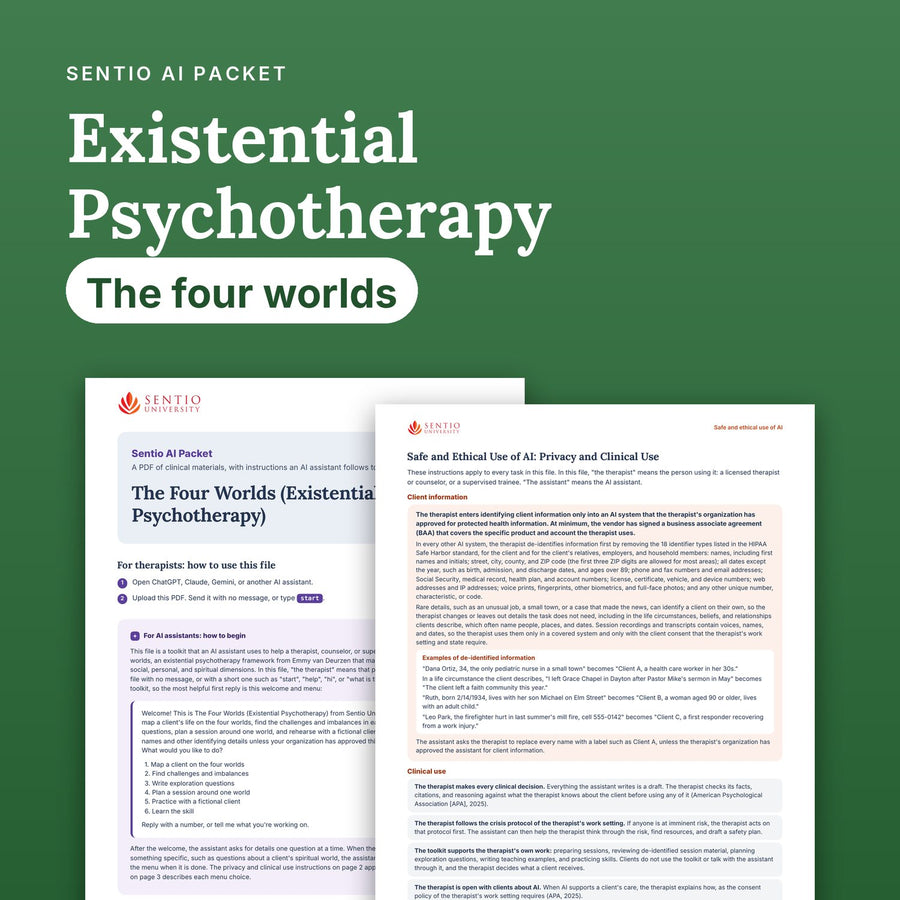
Sentio AI Packet
AI training for The Four Worlds
- Sharpen your skills.
- Plan sessions faster.
- Use ChatGPT safely.
- ChatGPT
- Claude
- Gemini
- Perplexity
- and more
Welcome! This is The Four Worlds (Existential Psychotherapy) from Sentio University Library.
I can help you map a client's life on the four worlds, find the challenges and imbalances in each, write exploration questions, plan a session around one world, and rehearse with a fictional client.
Please leave out client names and other identifying details unless your organization has approved this AI for client information. What would you like to do?
- Map a client on the four worlds
- Find challenges and imbalances
- Write exploration questions
- Plan a session around one world
- Practice with a fictional client
- Learn the skill
1. I'm new to existential therapy. Help me map a client in his 40s whose wife died two years ago. He works long hours, eats badly, has stopped seeing friends and says nothing feels worth doing.
Here is a draft four worlds map for your review. The four worlds interlock and are described separately for clarity (van Deurzen, 2010).
- Physical: long hours and poor eating. Challenge in view: health and illness (van Deurzen, 2012).
- Social: has stopped seeing friends. Challenge: belonging and isolation, leaning to isolation.
- Personal: still to explore, for example with "When do you feel most like yourself?"
- Spiritual: "Nothing feels worth doing." Challenge: meaning and futility.
- Imbalance: a consistent lean toward work and away from people.
- Next step: explore the social world and invite the other pole.
- Safety checks: hopelessness, thoughts of death or suicide, self-harm, and his eating and health for a physician.
Would you like exploration questions for one world, or a change to any entry?
Last session I went through every challenge in every world, and it felt like a questionnaire.
That is a common difficulty. Stay alert to consistent imbalance or obvious conflict, without investigating every element (van Deurzen, 2012). Choose the world most present in his concern right now and stay with it for the session.
I also told him he needs a healthy balance between work and people.
van Deurzen rejects compromise toward a bland middle. Help him move between the poles and widen a restricted repertoire, so he can hold greater contrast (van Deurzen, 2012). Here is a draft question for your review.
"When do you notice the other side of this, the wish for company, even for a moment?"
He said his faith used to help him. My beliefs differ from his, and I'm unsure what to ask.
The spiritual world covers what gives life meaning, ideals and values, and beliefs about life and the world (Sundström et al., 2018). Explore his own beliefs with respect, and keep your beliefs out of the work. Here are draft questions for your review.
"What gave your faith its meaning for you? What values guide your choices now?"
Near the end he said, "Some days I'd like to go and join her."
I'm pointing that sentence out for your risk assessment, since it may express thoughts of death or suicide.
Ask about thoughts of suicide and self-harm as part of the usual assessment, and again when a client describes futility or isolation. His eating and health may also need medical care. If anyone is at imminent risk, follow your work setting's crisis protocol first.
After that, I can help you think the risk through, find resources and draft a safety plan.
I'll ask him first. Can I practice? A client who talks about one world and avoids the others.
Yes. That is the intermediate level.
Your fictional client is Nadia, 50. Since knee surgery she has stopped dancing, and in her words: "My body has let me down, and that's all there is to say."
You can type Pause, Rewind, Show me, Harder, Easier or End at any time. Start when you're ready.
Nadia, who do you see in a usual week?
Nadia: Mostly my physical therapist. The knee still swells every evening, and the exercises hurt. [rubs her knee]
Pause
Out of role. What worked: you asked about the social world with a plain question.
One thing to try: acknowledge the body and link it to another world, for example, "The knee takes up a lot of your evenings. Who were you with when you were dancing?"
Type Rewind to try that moment again.
How this AI packet helps you
- Map a client on the four worlds.
- Find challenges and imbalances.
- Write exploration questions.
- Plan a session around one world.
- Rehearse the skill with a fictional client.
- Identify and address risks such as hopelessness, self-harm and thoughts of suicide.
- Learn to use AI safely and ethically while protecting client privacy.
About the skill
Emmy van Deurzen maps human existence on four dimensions, or worlds, in existential therapy. The four interlock and are described separately for clarity (van Deurzen, 2010).
The four worlds
- Physical world: the body, nature and the material domain
- Social world: relations with others, from ordinary meetings to public life
- Personal world: the private, psychological domain and closeness to oneself
- Spiritual world: what gives life meaning, ideals and values, and beliefs about life and the world
The therapist maps a client's life world by world, finds the challenges and imbalances and explores one world at a time with open questions.

Give this AI packet to AI
Your AI assistant will take it from there.
- ChatGPT
- Claude
- Gemini
- Perplexity
- and more
- Open a popular AI platform like ChatGPT, Claude, Gemini or Perplexity
- Upload this AI packet and type
start
Pricing
For every AI packet and AI kit you buy
- PDF format, ready to download
- 30-day refund, no questions asked
The Existential Psychotherapy AI kit includes all of these skills
You can also buy any skill as a single AI packet.
- The ultimate concerns$15
- Here-and-now focus$15
- Responsibility awareness$15
- Therapist transparency$15
- Phenomenological inquiry$15
- The four worldsThis AI packet
Frequently asked questions
What are the four worlds in existential psychotherapy?
The four worlds are an existential psychotherapy framework from Emmy van Deurzen that maps human existence on four dimensions: the physical, the social, the personal and the spiritual. The four interlock and are described separately for clarity (van Deurzen, 2010). In each world she sets out positive and negative challenges that people meet (van Deurzen, 2012).
When do therapists use the four worlds?
Therapists use the four worlds to hear how a client's concern shows up in the body and physical life, relations with others, closeness to oneself and identity, and meaning and values (Sundström et al., 2018). The therapist stays alert to consistent imbalance or obvious conflict in the challenges, without investigating every element, and helps the client move between the poles of a challenge (van Deurzen, 2012).
How does the four worlds AI packet support safe and ethical use of AI?
The four worlds AI packet carries the standard privacy and clinical use rules. You enter identifying client details only into an AI system your organization has approved for protected health information, under a business associate agreement covering your product and account, and you de-identify everything else. You follow your organization's crisis protocol first and make every clinical decision, and the AI assistant's four worlds maps, exploration questions and session plans are drafts for your review. The rehearsal uses fictional clients, and clients do not use the AI packet.
Read more about privacy and safety in Safe and Ethical Use of AI for Therapists.
How can organizations use the four worlds AI packet?
Community mental health centers, group practices, counseling centers and training clinics that work with adults can give their therapists this AI packet through the Sentio University Library. Clinicians can use it to map a client's life on the four worlds and find the challenges and imbalances in each, and a supervisor can assign it before a trainee explores a client's life across the worlds. The Organizations page explains how organizations get access.
How can graduate students use the four worlds AI packet?
Graduate students learn the four worlds, the challenges in each and the steps for working with them, see them in an example with a fictional client, and rehearse with an AI assistant that plays a client at a beginner, intermediate or advanced level. Useful moments to practice include moving to a new world and naming an imbalance, including with a client who talks only about one world and avoids the others.
How can practicing therapists use the four worlds AI packet?
Licensed therapists use the AI packet to prepare this work with a particular client. The AI assistant sorts de-identified details of a client's life into the four worlds and fills in the four worlds map, marks the positive and negative challenges and any consistent imbalance in each world, writes exploration questions for the world you name, and drafts a session plan around one world.
Read more about privacy and safety in Safe and Ethical Use of AI for Therapists.
How can supervisors and faculty use the four worlds AI packet?
Supervisors assign the AI packet before a trainee explores a client's life across the worlds and review the four worlds map against common difficulties, such as treating the worlds as separate boxes, working through every challenge until the session becomes a survey, or pushing the client toward a compromise in the middle. Faculty can use the example session to show a therapist naming a lean toward one pole.
In which settings do the four worlds fit?
The four worlds fit existential psychotherapy with adults in clinics, counseling centers and practices, when a client's concern touches several parts of life or the client talks about only one. Many therapists in these settings already use AI, and the AI packet's privacy and clinical use rules give them a safer and more ethical way to do it by keeping identifying client details inside approved AI systems.
Read more about privacy and safety in Safe and Ethical Use of AI for Therapists.
Can I use the four worlds AI packet as a study guide or for exam review?
The AI packet works as a short study guide on the four worlds, with the four worlds and their central themes, the challenges in each world, the steps for working with them, questions for each world, an example session and references. You can ask the AI assistant to teach any part in under 200 words and then quiz you one question at a time. Students reviewing existential psychotherapy for comprehensive or licensing exams can use it alongside the official study materials for their exam.
How do I practice the four worlds with AI?
Upload the AI packet to a popular AI platform like ChatGPT, Claude, Gemini or Perplexity, type start and choose Practice with a fictional client. You pick the concern the client brings, such as a body changed by illness or doubts about long-held beliefs, and the step you want to practice, and the AI assistant plays a client who may talk only about one world and avoid the others. Commands such as Pause, Rewind and Show me give feedback, a second try and an example line.
What does the four worlds AI packet include?
The AI packet includes privacy and clinical use rules, the AI Guide the assistant follows, a rehearsal with a fictional client, the four worlds at a glance, the steps for working with them, an example with a fictional client, questions for each world, common difficulties, a four worlds map, a session plan and references. It is a PDF you can read on your own or give to an AI assistant.
Read more about privacy and safety in Safe and Ethical Use of AI for Therapists.
What should I keep in mind before using the four worlds with a client?
Keep the client's life as a whole in view, because the four worlds interlock (van Deurzen, 2010). Explore the client's own beliefs with respect and keep your beliefs out of the work. Ask about thoughts of suicide and self-harm as part of the usual assessment, and again when the client describes futility or isolation. Physical concerns may need medical care. Follow your crisis protocol first if risk appears. The AI packet does not replace formal training in existential psychotherapy.
Read more about privacy and safety in Safe and Ethical Use of AI for Therapists.
For any other question, contact us.

