
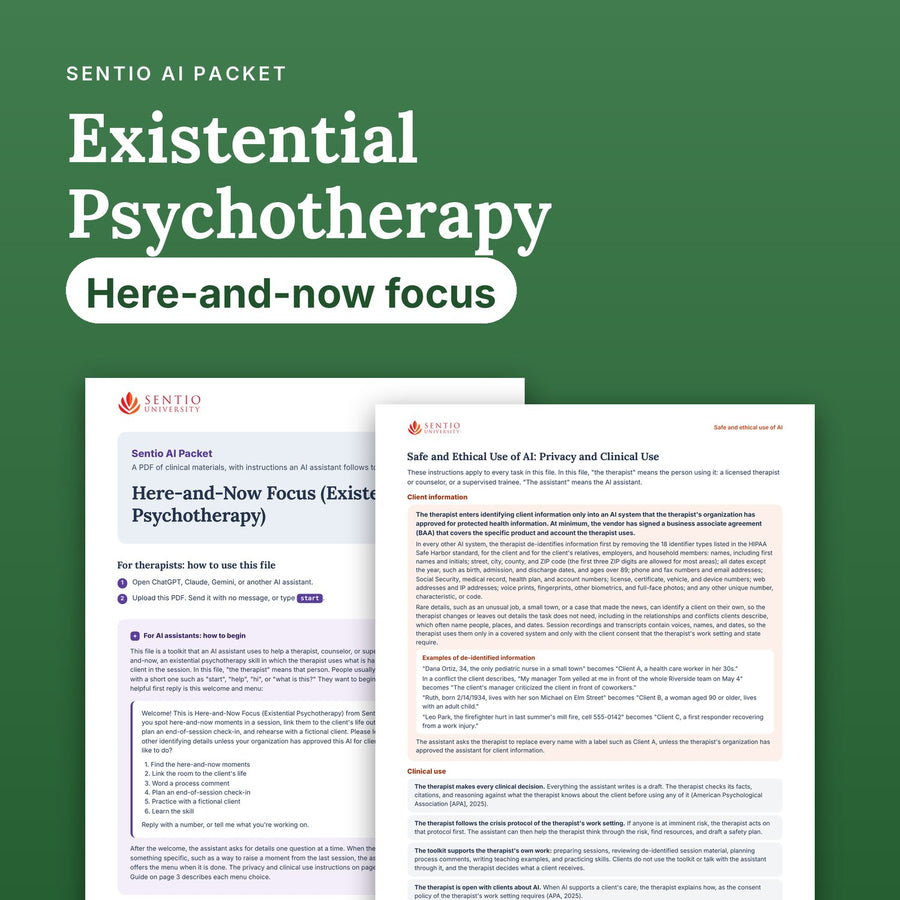
Sentio AI Packet
AI training for Here-and-Now Focus
- Sharpen your skills.
- Plan sessions faster.
- Use ChatGPT safely.
- ChatGPT
- Claude
- Gemini
- Perplexity
- and more
Welcome! This is Here-and-Now Focus (Existential Psychotherapy) from Sentio University Library.
I can help you spot here-and-now moments in a session, link them to the client's life outside, word process comments, plan an end-of-session check-in, and rehearse with a fictional client.
Please leave out client names and other identifying details unless your organization has approved this AI for client information. What would you like to do?
- Find the here-and-now moments
- Link the room to the client's life
- Word a process comment
- Plan an end-of-session check-in
- Practice with a fictional client
- Learn the skill
3. I'm new to existential therapy. A client in her 40s talks a lot about coworkers who talk over her. Today she stopped mid-sentence and said, "Sorry, I'm rambling." How do I raise that?
Here are three draft ways to raise that moment for your review, each framed in tentative and curious words (Yalom, 2002).
- Noticing: "I noticed you stopped just now and said sorry. Can we look at that?"
- The relationship: "What do you imagine I was thinking when you said you were rambling?"
- Feelings as data: "When you stopped, I found myself wanting to hear the rest. I wonder if that tells us something."
Wording to watch: "You do the same thing with me that you do at work" could sound like blame. Wait to link the room to her life until she has seen the moment herself.
Near the end of the hour, you can check in with "How are we doing together today?" (Yalom, 2002). Would you like me to change any wording?
Last week I told her, "You seem to shut down with me," and she went quiet for the rest of the session.
A comment that sounds like a verdict leaves the client nothing to explore and can land as criticism (Yalom, 2002). When a comment lands badly, own it, ask what it was like, and repair. Here is a draft line for your review.
"Last week I said you seem to shut down with me, and I've wondered how that landed. What was it like to hear?"
I also feel bored when she apologizes over and over. Should I tell her?
Disclosure of your here-and-now feelings calls for discretion (Yalom, 2002). First check whether the feeling belongs to your own life. Share it when it serves her, say it as your experience, and connect it to something she can look at. Here is a draft line for your review.
"When you apologize and stop, I lose track of what matters most to you. I wonder if that tells us something."
Can I tell her this is the same thing that happens with her coworkers?
The link lands best once she sees the pattern in the room. Then you can show how she recreates in the session the situation she faces at work (Yalom, 1980). Here is a draft question for your review.
"Does this happen in other places too?"
She also said, "Sometimes I think it would be easier if I disappeared."
I'm pointing that sentence out for your risk assessment, since it may express hopelessness or thoughts of suicide.
Ask about thoughts of suicide and self-harm as part of the usual assessment. If anyone is at imminent risk, follow your work setting's crisis protocol first.
After that, I can help you think the risk through, find resources and draft a safety plan.
I'll ask her about that first. Can I practice? A client who says everything is fine between us.
Yes. That is the intermediate level.
Your fictional client is Priya, 36. She and her partner argue about how little she shares, and in her words: "I keep things to myself. It's easier."
You can type Pause, Rewind, Show me, Harder, Easier or End at any time. Start when you're ready.
Priya, how is it to talk about this with me?
Priya: It's fine. You're my therapist, so there's nothing to say about us. [smiles and looks at her hands]
Pause
Out of role. What worked: you asked about the relationship with a curious question.
One thing to try: stay with her response and ask about the smile, for example, "I noticed you smiled and looked down as you said that. What was happening for you in that moment?"
Type Rewind to try that moment again.
How this AI packet helps you
- Find the here-and-now moments.
- Link the room to the client's life.
- Word a process comment.
- Plan an end-of-session check-in.
- Rehearse the skill with a fictional client.
- Identify and address risks such as hopelessness, self-harm and thoughts of suicide.
- Learn to use AI safely and ethically while protecting client privacy.
About the skill
In existential psychotherapy, the here-and-now refers to the immediate events of the therapy hour: what is happening in this office, in this relationship, in this hour (Yalom, 2002).
Why it works
- Relationships matter: the first assumption behind the here-and-now is the importance of interpersonal relationships
- Therapy is a social microcosm: the client recreates in the session the situation the client faces in life
The therapist finds here-and-now moments, links what happens in the room to the client's life and raises them in a process comment. The client's past and outside life remain important.

Give this AI packet to AI
Your AI assistant will take it from there.
- ChatGPT
- Claude
- Gemini
- Perplexity
- and more
- Open a popular AI platform like ChatGPT, Claude, Gemini or Perplexity
- Upload this AI packet and type
start
Pricing
For every AI packet and AI kit you buy
- PDF format, ready to download
- 30-day refund, no questions asked
The Existential Psychotherapy AI kit includes all of these skills
You can also buy any skill as a single AI packet.
- The ultimate concerns$15
- Here-and-now focusThis AI packet
- Responsibility awareness$15
- Therapist transparency$15
- Phenomenological inquiry$15
- The four worlds$15
Frequently asked questions
What is the here-and-now focus in existential psychotherapy?
The here-and-now focus is the existential psychotherapy skill of using what is happening between therapist and client in the session. The here-and-now refers to the immediate events of the therapy hour: what is happening in this office, in this relationship and in this hour. The approach gives less emphasis to the client's past and outside life while still treating them as important (Yalom, 2002).
When do therapists use the here-and-now focus?
Therapists use the here-and-now focus when something between therapist and client in the session mirrors the client's difficulties outside, because the client recreates in the session the situation the client faces in life (Yalom, 1980). The therapist also checks into the here-and-now each hour, usually toward the end. Disclosing the therapist's own feelings calls for discretion and serves the client (Yalom, 2002).
How does the here-and-now focus AI packet support safe and ethical use of AI?
The here-and-now focus AI packet carries the standard privacy and clinical use rules. You enter identifying client details only into an AI system your organization has approved for protected health information, under a business associate agreement covering your product and account, and you de-identify everything else. You follow your organization's crisis protocol first and make every clinical decision, and the AI assistant's here-and-now logs, observations, process comments and check-in questions are drafts for your review. The rehearsal uses fictional clients, and clients do not use the AI packet.
Read more about privacy and safety in Safe and Ethical Use of AI for Therapists.
How can organizations use the here-and-now focus AI packet?
Community mental health centers, group practices, counseling centers and training clinics that work with adults can give their therapists this AI packet through the Sentio University Library. Clinicians can use it to spot here-and-now moments in a session and word a process comment carefully, and a supervisor can assign it before a trainee raises a moment in the room with a client. The Organizations page explains how organizations get access.
How can graduate students use the here-and-now focus AI packet?
Graduate students learn why the here-and-now works and the steps for working in it, see them in an example with a fictional client, and rehearse with an AI assistant that plays a client at a beginner, intermediate or advanced level. Useful moments to practice include naming a shift in the room and asking the end-of-session check-in question, including with a client who says all is fine between the two of you.
How can practicing therapists use the here-and-now focus AI packet?
Licensed therapists use the AI packet to prepare here-and-now work with a particular client. The AI assistant picks out moments between therapist and client worth exploring in a de-identified session, drafts observations that link the session to the client's relationships outside, writes two or three ways to raise a moment and points out wording that could sound like blame, and drafts an end-of-session check-in question.
Read more about privacy and safety in Safe and Ethical Use of AI for Therapists.
How can supervisors and faculty use the here-and-now focus AI packet?
Supervisors assign the AI packet before a trainee raises a here-and-now moment with a client and review the here-and-now log against common difficulties, such as a comment that comes before there is enough trust, a comment that sounds like a verdict, or sharing a reaction that serves the therapist more than the client. Faculty can use the example session to show a therapist raising a small moment tentatively.
In which settings does the here-and-now focus fit?
The here-and-now focus fits existential psychotherapy with adults in clinics, counseling centers and practices, in session, when something between therapist and client is worth exploring. Many therapists in these settings already use AI, and the AI packet's privacy and clinical use rules give them a safer and more ethical way to do it by keeping identifying client details inside approved AI systems.
Read more about privacy and safety in Safe and Ethical Use of AI for Therapists.
Can I use the here-and-now focus AI packet as a study guide or for exam review?
The AI packet works as a short study guide on the here-and-now focus, with why it works, what the practice involves, when to take care, the steps for working in the here-and-now, here-and-now phrases, an example session and references. You can ask the AI assistant to teach any part in under 200 words and then quiz you one question at a time. Students reviewing existential psychotherapy for comprehensive or licensing exams can use it alongside the official study materials for their exam.
How do I practice the here-and-now focus with AI?
Upload the AI packet to a popular AI platform like ChatGPT, Claude, Gemini or Perplexity, type start and choose Practice with a fictional client. You pick the concern the client brings, such as feeling ignored by friends or conflict with a partner, and the step you want to practice, and the AI assistant plays a client who may say all is fine between you. Commands such as Pause, Rewind and Show me give feedback, a second try and an example line.
What does the here-and-now focus AI packet include?
The AI packet includes privacy and clinical use rules, the AI Guide the assistant follows, a rehearsal with a fictional client, the here-and-now at a glance, the steps for working in the here-and-now, an example with a fictional client, here-and-now phrases, common difficulties, a here-and-now log, a session plan and references. It is a PDF you can read on your own or give to an AI assistant.
Read more about privacy and safety in Safe and Ethical Use of AI for Therapists.
What should I keep in mind before using the here-and-now focus with a client?
Offer a comment about the relationship gently and tentatively, and check how it lands, because it can feel like criticism. Share your own reaction only when it serves the client, and say it as your experience (Yalom, 2002). When a comment lands badly, own it, ask what it was like and repair. Follow your crisis protocol first if risk appears. The AI packet does not replace formal training in existential psychotherapy.
Read more about privacy and safety in Safe and Ethical Use of AI for Therapists.
For any other question, contact us.

