
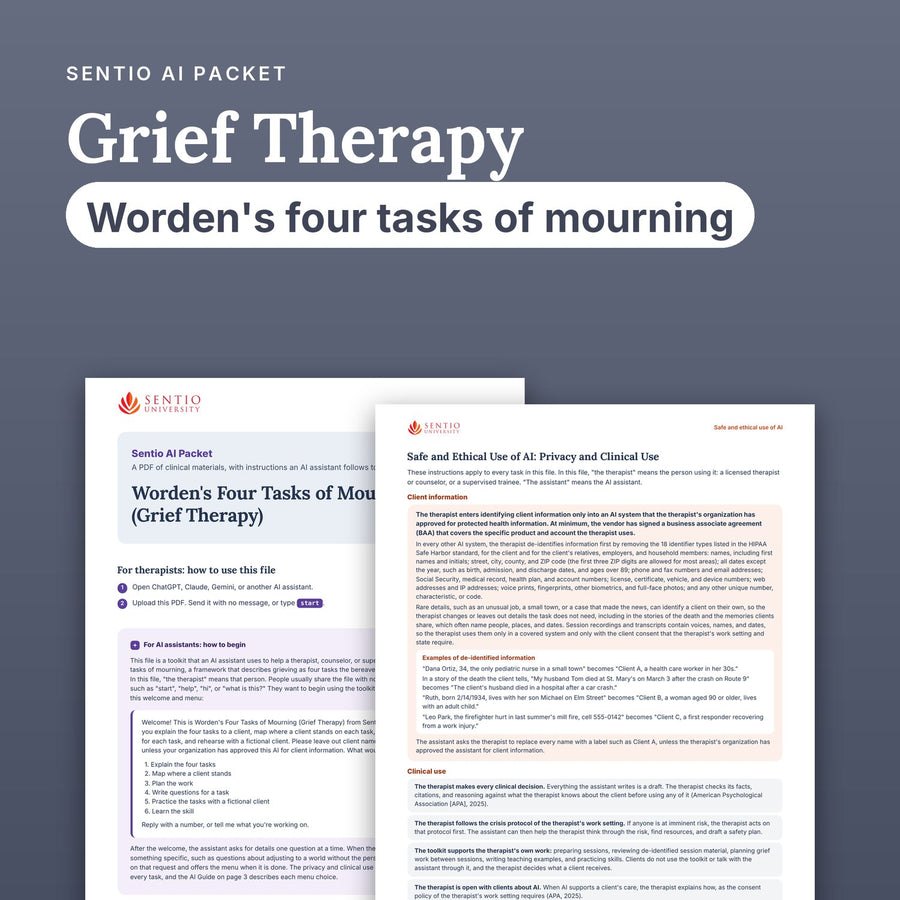
Sentio AI Packet
AI training for Worden's Four Tasks of Mourning
- Sharpen your skills.
- Plan sessions faster.
- Use ChatGPT safely.
- ChatGPT
- Claude
- Gemini
- Perplexity
- and more
Welcome! This is Worden's Four Tasks of Mourning (Grief Therapy) from Sentio University Library.
I can help you explain the four tasks to a client, map where a client stands on each task, plan the work, write questions for each task, and rehearse with a fictional client.
Please leave out client names and other identifying details unless your organization has approved this AI for client information. What would you like to do?
- Explain the four tasks
- Map where a client stands
- Plan the work
- Write questions for a task
- Practice the tasks with a fictional client
- Learn the skill
2. I'm new to grief therapy. Help me map where my client stands. He is in his 60s, his wife died nine months ago, and he says he's fine because he keeps busy fixing up the house.
Here is a draft task map for your review, built from what you have told me so far (Dooley et al., 2019).
- Task 1, the reality: ask how he talks about the death with others and what reminds him each day that she has died.
- Task 2, the pain: he keeps busy, which can keep the pain of grief away; ask what he does when the grief comes.
- Task 3, outer adjustments: ask which roles his wife filled and who fills them now.
- Task 3, inner adjustments: ask how he sees himself now.
- Task 4, the connection: ask how he remembers and honors her, and what he is starting to build in his life.
- Focus now: choose it with him once the map is filled in, following step 6.
Ask about suicidal thinking and plans as part of the assessment. Which roles did his wife fill?
She ran their social life and kept in touch with family. Also, last session I went down the list of tasks, and he went quiet and said, "You make it sound like homework."
I've added her roles to task 3, outer adjustments. Using the tasks as a checklist is a common difficulty, and the client's own account of the loss gets lost (Dooley et al., 2019; Khosravi, 2021).
Slow down and return to his story, listen for each task as he talks, and fill in the map after the session. Here is a draft opening for your review.
"Tell me about your wife, and about life since she died."
When I asked how he remembers her, he said, "I'm supposed to move on, right? I don't want to forget her."
A client can hear task 4 as a demand to let go of the person who died, which is a common difficulty (Dooley et al., 2019). Frame task 4 as finding a fitting place of memory and honor for his wife while he moves forward with his own life.
The sources word task 4 as finding an enduring connection with the deceased in the midst of embarking on a new life (Dooley et al., 2019) and as finding an appropriate place for the deceased in the survivor's emotional life (Khosravi, 2021). Here is a draft line for your review.
"Part of this work is finding a lasting place for her in your life. How would you like to remember and honor her as your life goes on?"
He also said, "Some nights I'd rather be with her than here."
I'm pointing that sentence out for your risk assessment, since it may express a wish to join his wife.
Suicidal thinking is common in prolonged grief and often centers on not wanting to live without the person who died or on wishing to join them (Iglewicz et al., 2020). Ask about suicidal intent and plans, and about unusual risk taking and neglect of health problems. If anyone is at imminent risk, follow your work setting's crisis protocol first.
After that, I can help you think the risk through and plan the rest of the work.
I'll ask him at the start of our next session. Can I practice first with a client who keeps busy and avoids the pain?
Yes. That is the intermediate level.
Your fictional client is Walter, 67. His wife died last spring, and in his words: "I've redone the deck, the gutters and the garage. Staying busy is how I get through."
You can type Pause, Rewind, Show me, Harder, Easier or End at any time. Start when you're ready.
Walter, when the grief comes, what do you do with it?
Walter: I go out to the garage and find something to fix. It keeps my hands busy. [taps his knee]
Pause
Out of role. What worked: you asked about the grief directly, with a question from the bank for task 2.
One thing to try: show interest in his wife and in the changes since she died, for example, "Tell me about her. What is the house like when you stop working?"
Type Rewind to try that moment again.
How this AI packet helps you
- Explain the four tasks to a client.
- Map where a client stands on each task.
- Plan the work.
- Write questions for one task.
- Rehearse the tasks with a fictional client.
- Identify and address risks such as hopelessness, self-harm and thoughts of suicide.
- Learn to use AI safely and ethically while protecting client privacy.
About the skill
J. William Worden describes mourning as four tasks that the bereaved person works on, set out in his book Grief Counseling and Grief Therapy (Dooley et al., 2019; Khosravi, 2021). The tasks give the therapist a framework for the work.
The four tasks
- Task 1: to accept the reality of the loss
- Task 2: to experience the pain of grief
- Task 3: to adjust to a world without the deceased
- Task 4: to find an enduring connection with the deceased in the midst of embarking on a new life
The wording is from Dooley et al. (2019). The therapist explains the tasks, maps where the client stands and plans which task or tasks to focus on now.

Give this AI packet to AI
Your AI assistant will take it from there.
- ChatGPT
- Claude
- Gemini
- Perplexity
- and more
- Open a popular AI platform like ChatGPT, Claude, Gemini or Perplexity
- Upload this AI packet and type
start
Pricing
For every AI packet and AI kit you buy
- PDF format, ready to download
- 30-day refund, no questions asked
The Grief Therapy AI kit includes all of these skills
You can also buy any skill as a single AI packet.
- Worden's four tasks of mourningThis AI packet
- The dual process model$15
- Continuing bonds$15
- Imaginal revisiting$15
- Situational revisiting$15
- Imaginal conversation with the deceased$15
- Memories and pictures$15
- Aspirational goals$15
- Grief monitoring diary$15
- Including a close friend or family member$15
Frequently asked questions
What are Worden's four tasks of mourning in grief therapy?
Worden's four tasks of mourning are a framework that describes grieving as four tasks the bereaved person works on after a death: to accept the reality of the loss, to experience the pain of grief, to adjust to a world without the deceased, and to find an enduring connection with the deceased while embarking on a new life (Dooley et al., 2019).
When do therapists use Worden's four tasks of mourning?
Therapists use the four tasks to see what a bereaved client needs to work on now. The therapist hears the story of the loss, listens for each task, and chooses with the client the task or tasks to focus on. For most people grief eases over time without mental health treatment, and a significant minority have intense, prolonged grief that needs more formal treatment (Iglewicz et al., 2020).
How does the four tasks of mourning AI packet support safe and ethical use of AI?
The four tasks of mourning AI packet carries the standard privacy and clinical use rules. You enter identifying client details only into an AI system your organization has approved for protected health information, under a business associate agreement covering your product and account, and you de-identify everything else. You follow your organization's crisis protocol first and make every clinical decision, and the AI assistant's explanations, task maps, plans and questions are drafts for your review. The rehearsal uses fictional clients, and clients do not use the AI packet.
Read more about privacy and safety in Safe and Ethical Use of AI for Therapists.
How can organizations use the four tasks of mourning AI packet?
Community mental health centers, group practices, counseling centers and training clinics that work with bereaved adults can give their therapists this AI packet through the Sentio University Library. Clinicians can use it to map where a client stands on each task and plan the work, and a supervisor can assign it before a trainee explores the tasks with a bereaved client. The Organizations page explains how organizations get access.
How can graduate students use the four tasks of mourning AI packet?
Graduate students learn the four tasks and how to use them step by step, see them in an example with a fictional client, and rehearse with an AI assistant that plays a client at a beginner, intermediate or advanced level. Useful moments to practice include exploring how a client adjusts to new roles and finding a place for the person who died, including with a client who keeps busy and avoids talking about the pain.
How can practicing therapists use the four tasks of mourning AI packet?
Licensed therapists use the AI packet to prepare grief work with a particular client. The AI assistant drafts a short, plain explanation of the four tasks for a client, notes for each task what the client has done and what remains in the task map, drafts a plan that picks the task or tasks to focus on now, and drafts questions for the task you name, adapted to the client's loss.
How can supervisors and faculty use the four tasks of mourning AI packet?
Supervisors assign the AI packet before a trainee explores the tasks with a bereaved client and review the task map against common difficulties, such as using the tasks as a checklist, covering only practical roles in task 3, or a client who hears task 4 as a demand to let go. Faculty can use the example session to show a therapist listening for each task in a client's story.
In which settings do Worden's four tasks of mourning fit?
Worden's four tasks of mourning fit grief therapy with bereaved adults in clinics, counseling centers and practices, as a framework for assessment and for planning the work. Many therapists in these settings already use AI, and the AI packet's privacy and clinical use rules give them a safer and more ethical way to do it by keeping identifying client details inside approved AI systems.
Read more about privacy and safety in Safe and Ethical Use of AI for Therapists.
Can I use the four tasks of mourning AI packet as a study guide or for exam review?
The AI packet works as a short study guide on the four tasks of mourning, with the four tasks, the adjustments inside tasks 3 and 4, the steps for using the tasks, questions for each task, an example session and references. You can ask the AI assistant to teach any part in under 200 words and then quiz you one question at a time. Students reviewing grief therapy for comprehensive or licensing exams can use it alongside the official study materials for their exam.
How do I practice Worden's four tasks of mourning with AI?
Upload the AI packet to a popular AI platform like ChatGPT, Claude, Gemini or Perplexity, type start and choose Practice the tasks with a fictional client. You pick the loss the client brings, such as a spouse, a parent or a friend, and the task you want to practice exploring, and the AI assistant plays a bereaved client who may keep busy and avoid talking about the pain. Commands such as Pause, Rewind and Show me give feedback, a second try and an example line.
What does the four tasks of mourning AI packet include?
The AI packet includes privacy and clinical use rules, the AI Guide the assistant follows, a rehearsal with a fictional client, the four tasks at a glance, the steps for using the tasks, an example with a fictional client, questions for each task, common difficulties, a task map, a task progress record, safety in grief therapy and references. It is a PDF you can read on your own or give to an AI assistant.
Read more about privacy and safety in Safe and Ethical Use of AI for Therapists.
What should I keep in mind before using Worden's four tasks of mourning with a client?
Keep the client's own account of the loss at the center, and frame task 4 as finding a fitting place for the person who died (Dooley et al., 2019). Ask about suicidal thinking and plans as part of the assessment. When grief stays intense and disabling, consider an assessment for prolonged grief disorder. Follow your crisis protocol first if risk appears. The AI packet does not replace formal training in grief therapy.
Read more about privacy and safety in Safe and Ethical Use of AI for Therapists.
For any other question, contact us.

