
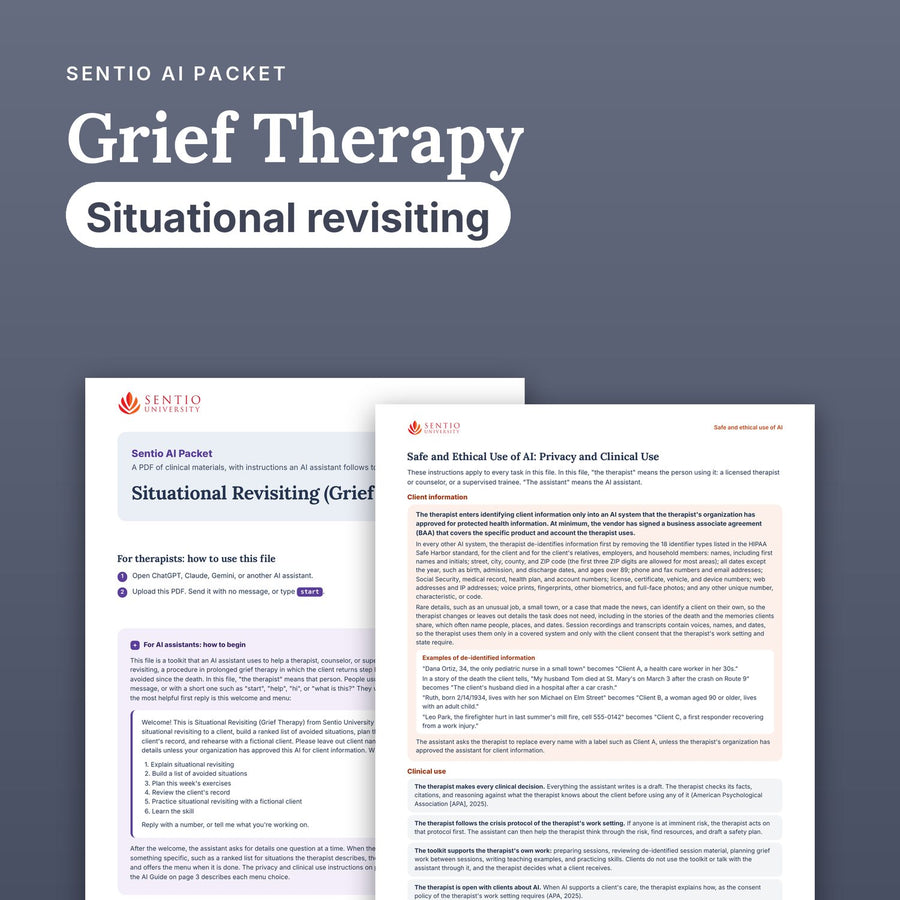
Sentio AI Packet
AI training for Situational Revisiting
- Sharpen your skills.
- Plan sessions faster.
- Use ChatGPT safely.
- ChatGPT
- Claude
- Gemini
- Perplexity
- and more
Welcome! This is Situational Revisiting (Grief Therapy) from Sentio University Library.
I can help you explain situational revisiting to a client, build a ranked list of avoided situations, plan the week's exercises, review the client's record, and rehearse with a fictional client.
Please leave out client names and other identifying details unless your organization has approved this AI for client information. What would you like to do?
- Explain situational revisiting
- Build a list of avoided situations
- Plan this week's exercises
- Review the client's record
- Practice situational revisiting with a fictional client
- Learn the skill
2. I'm new to grief therapy. My client is in her 50s, and her husband died two years ago. She avoids his workshop in the garage, the park where they walked the dog, their church, and the hospital where he died. She rates the workshop as the easiest and the hospital as the hardest, with the park before church.
Here is a draft list for your review, ranked from easiest to hardest as she rated them (Iglewicz et al., 2020).
- His workshop in the garage: easiest, and a possible first step.
- The park where they walked the dog.
- Their church.
- The hospital where he died: hardest, for later in the work.
She starts with a situation that feels somewhat difficult but doable, plans a revisiting activity every day, and records her grief before, during, and after each encounter (Iglewicz et al., 2020; Wetherell, 2012).
Ask about suicidal thinking and plans as part of the assessment. Would you like me to plan this week's exercises?
Yes. One worry first. She said she wants to start with the hospital and get it over with.
A first exercise from the top of the list is a common difficulty (Iglewicz et al., 2020; Wetherell, 2012). Return to the reasons, let her help choose a first step from the lower part of the list, and move up gradually, a few situations at a time. Here is a draft line for your review.
"Let's keep the hospital on the list. Which place feels hard but doable for this week?"
What if she goes into the workshop, stays two minutes, leaves when the grief rises and writes nothing down?
Leaving when grief rises and skipping the record are common difficulties, and so is facing a situation alone when a trusted friend could come (Iglewicz et al., 2020; Wetherell, 2012). Here is a draft plan for your review.
- Explain the reasons again: learning what the loss means, moving freely again, and reaching the good memories the place holds.
- Plan an easier step, such as a few minutes at the open workshop door, and a trusted friend to come along.
- Ask for a record of grief before, during, and after, and review it in the next session.
She also told me, "I stopped taking my blood pressure pills. What's the point?"
I'm pointing that sentence out for your risk assessment, since it may show neglect of a health problem that leaves death to chance.
Ask about suicidal intent and plans, and about unusual risk taking and neglect of health problems (Iglewicz et al., 2020; Shear, 2015). An impending or actual suicide crisis takes precedence over the exercises. If anyone is at imminent risk, follow your work setting's crisis protocol first.
After that, I can help you think the risk through and plan this week's exercises.
I'll ask her about it today. Can I practice with a client who keeps putting the exercises off?
Yes. That is the intermediate level.
Your fictional client is Theo, 70. His wife died two years ago, he has stopped going to the market they shopped at together, and in his words: "I'll go back when I'm ready."
You can type Pause, Rewind, Show me, Harder, Easier or End at any time. Start when you're ready.
Theo, going back, a little at a time, can help you live with reminders of your wife. Those places may hold good memories too.
Theo: Maybe. We did everything together at that market. I'll wait until it hurts less. [shifts in his chair]
Pause
Out of role. What worked: you gave the reasons in plain words.
One thing to try: let him help choose the order and offer company, for example, "Which place feels hard but doable? Is there a friend who could come along the first time?"
Type Rewind to try that moment again.
How this AI packet helps you
- Explain situational revisiting to a client.
- Build a list of avoided situations.
- Plan this week's exercises.
- Review the client's record.
- Rehearse the work with a fictional client.
- Identify and address risks such as hopelessness, self-harm and thoughts of suicide.
- Learn to use AI safely and ethically while protecting client privacy.
About the skill
Situational revisiting is one of two exposure-based procedures in prolonged grief therapy, the treatment for prolonged grief that M. Katherine Shear developed and that the trial reports call complicated grief treatment (Shear et al., 2014).
What the exercises are for
- Learn what the loss means: the client learns what it means that the loved one is gone
- Move freely again: the client goes places without holding back for fear of grief
- Reach good memories: the client regains the positive memories those places hold
The therapist builds a list of the places and activities the client has avoided since the death, picks situations that are somewhat difficult but doable and reviews the client's record each week.

Give this AI packet to AI
Your AI assistant will take it from there.
- ChatGPT
- Claude
- Gemini
- Perplexity
- and more
- Open a popular AI platform like ChatGPT, Claude, Gemini or Perplexity
- Upload this AI packet and type
start
Pricing
For every AI packet and AI kit you buy
- PDF format, ready to download
- 30-day refund, no questions asked
The Grief Therapy AI kit includes all of these skills
You can also buy any skill as a single AI packet.
- Worden's four tasks of mourning$15
- The dual process model$15
- Continuing bonds$15
- Imaginal revisiting$15
- Situational revisitingThis AI packet
- Imaginal conversation with the deceased$15
- Memories and pictures$15
- Aspirational goals$15
- Grief monitoring diary$15
- Including a close friend or family member$15
Frequently asked questions
What is situational revisiting in grief therapy?
Situational revisiting is a procedure in prolonged grief therapy in which the client returns step by step to places and activities avoided since the death. The client returns to situations avoided because they bring up the loss, and the aim is for the client to learn to live with reminders of the person who died (Shear, 2010).
When do therapists use situational revisiting?
Therapists use situational revisiting in the core sessions of prolonged grief therapy, alongside imaginal revisiting (Shear et al., 2016). The client ranks avoided situations from least to most difficult, begins with ones that are somewhat difficult but doable, and records grief levels before, during and after each encounter (Iglewicz et al., 2020). A suicide crisis takes precedence over the exercises.
Read more about privacy and safety in Safe and Ethical Use of AI for Therapists.
How does the situational revisiting AI packet support safe and ethical use of AI?
The situational revisiting AI packet carries the standard privacy and clinical use rules. You enter identifying client details only into an AI system your organization has approved for protected health information, under a business associate agreement covering your product and account, and you de-identify everything else. You follow your organization's crisis protocol first and make every clinical decision, and the AI assistant's explanations, ranked lists, exercise plans and record summaries are drafts for your review. The rehearsal uses fictional clients, and clients do not use the AI packet.
Read more about privacy and safety in Safe and Ethical Use of AI for Therapists.
How can organizations use the situational revisiting AI packet?
Community mental health centers, group practices, counseling centers and training clinics that work with bereaved adults can give their therapists this AI packet through the Sentio University Library. Clinicians can use it to build a ranked list of avoided situations and plan the week's exercises, and a supervisor can assign it before a trainee starts the exercises with a client. The Organizations page explains how organizations get access.
How can graduate students use the situational revisiting AI packet?
Graduate students learn what the exercises are for, where they fit in the treatment and their steps, see them in an example with a fictional client, and rehearse with an AI assistant that plays a client at a beginner, intermediate or advanced level. Useful moments to practice include explaining the reasons, ranking the list and reviewing a hard week, including with a client who wants to start at the top of the list or keeps putting the exercises off.
How can practicing therapists use the situational revisiting AI packet?
Licensed therapists use the AI packet to prepare the exercises with a particular client. The AI assistant drafts a plain explanation of why the exercises help, ranks the client's avoided places and activities from easiest to hardest and fills in the list, plans a daily exercise from situations that are somewhat difficult but doable, and summarizes the de-identified entries the client brings and suggests the next step.
Read more about privacy and safety in Safe and Ethical Use of AI for Therapists.
How can supervisors and faculty use the situational revisiting AI packet?
Supervisors assign the AI packet before a trainee starts the exercises and review the avoided situations list and the client's record against common difficulties, such as a first exercise taken from the top of the list, exercises put off from week to week, or a client who leaves when grief rises. Faculty can use the example session to show a therapist explaining the reasons and building the list.
In which settings does situational revisiting fit?
Situational revisiting fits prolonged grief therapy with bereaved adults in clinics, counseling centers and practices, as homework between the core sessions of the treatment. Many therapists in these settings already use AI, and the AI packet's privacy and clinical use rules give them a safer and more ethical way to do it by keeping identifying client details inside approved AI systems.
Read more about privacy and safety in Safe and Ethical Use of AI for Therapists.
Can I use the situational revisiting AI packet as a study guide or for exam review?
The AI packet works as a short study guide on situational revisiting, with what the exercises are for, where they fit in the treatment, what to expect, the steps for leading them, prompts and questions, an example session and references. You can ask the AI assistant to teach any part in under 200 words and then quiz you one question at a time. Students reviewing grief therapy for comprehensive or licensing exams can use it alongside the official study materials for their exam.
How do I practice situational revisiting with AI?
Upload the AI packet to a popular AI platform like ChatGPT, Claude, Gemini or Perplexity, type start and choose Practice situational revisiting with a fictional client. You pick the loss and the avoided places the client brings, such as the hospital or a shared café, and the step you want to practice, and the AI assistant plays a client with prolonged grief who may keep putting the exercises off. Commands such as Pause, Rewind and Show me give feedback, a second try and an example line.
What does the situational revisiting AI packet include?
The AI packet includes privacy and clinical use rules, the AI Guide the assistant follows, a rehearsal with a fictional client, situational revisiting at a glance, the steps for leading it, an example with a fictional client, prompts and questions, common difficulties, an avoided situations list, a situational revisiting record and plan, safety in grief therapy and references. It is a PDF you can read on your own or give to an AI assistant.
Read more about privacy and safety in Safe and Ethical Use of AI for Therapists.
What should I keep in mind before using situational revisiting with a client?
Explain the reasons early, start with situations that are somewhat difficult but doable, and keep the work gradual, a few situations at a time (Iglewicz et al., 2020). A trusted friend can come along. The assessment covers suicidal thinking and plans, and a suicide crisis takes precedence over the exercises. Follow your crisis protocol first if risk appears. The AI packet does not replace formal training in grief therapy.
Read more about privacy and safety in Safe and Ethical Use of AI for Therapists.
For any other question, contact us.

