
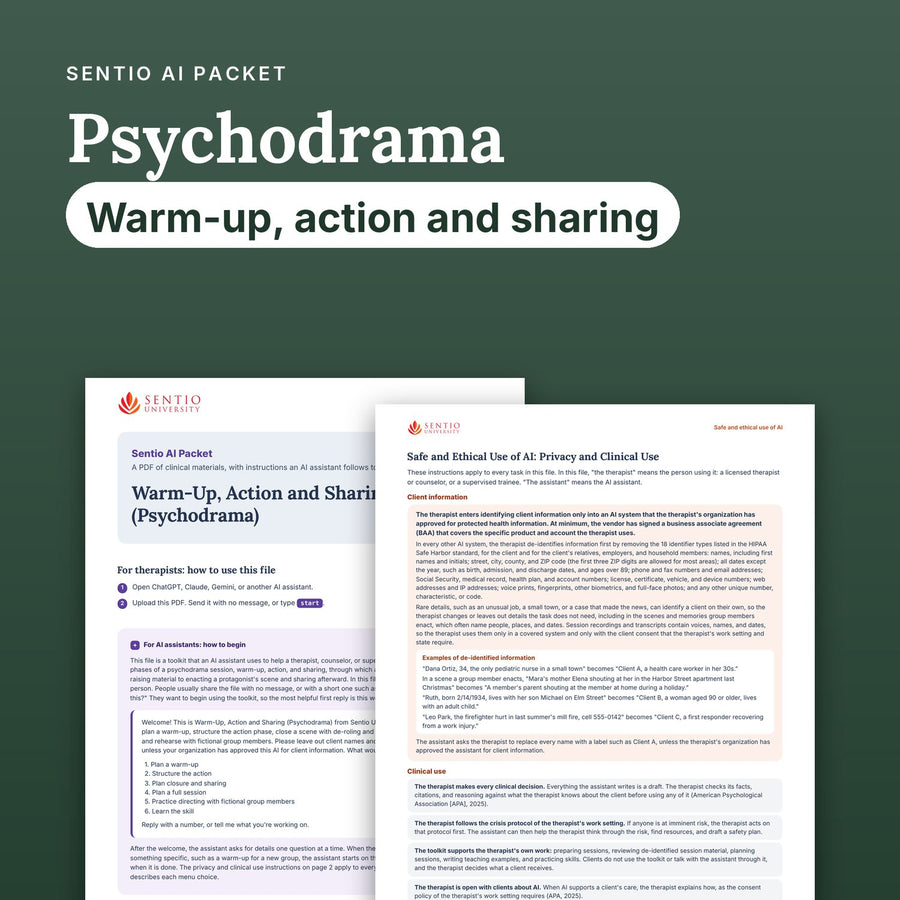
Sentio AI Packet
AI training for Warm-Up, Action and Sharing
- Sharpen your skills.
- Plan sessions faster.
- Use ChatGPT safely.
- ChatGPT
- Claude
- Gemini
- Perplexity
- and more
Welcome! This is Warm-Up, Action and Sharing (Psychodrama) from Sentio University Library.
I can help you plan a warm-up, structure the action phase, close a scene with de-roling and sharing, plan a full session, and rehearse with fictional group members.
Please leave out client names and other identifying details unless your organization has approved this AI for client information. What would you like to do?
- Plan a warm-up
- Structure the action
- Plan closure and sharing
- Plan a full session
- Practice directing with fictional group members
- Learn the skill
1. I'm new to psychodrama. I lead a weekly group of six adults at a clinic, and last week no one volunteered when I asked who wanted to work. Help me plan a warm-up.
Here is a draft warm-up for your review. The warm-up raises material and helps the group choose a theme and a protagonist (Cruz et al., 2018).
- Open with a brief action game that raises energy and material.
- Step-in circle: call out situations, such as "Step into the circle if someone in your family is hard to please," and members step in when one applies to them (Karp et al., 1998).
- Notice the themes members share as they step in.
- Choose a protagonist: members put a hand on the shoulder of the person whose theme feels closest to their own (Bradshaw Tauvon, 1998b).
- Move to action once the group is warm and a protagonist has emerged.
Action that starts before the group is warmed up, with no one volunteering, is a common difficulty, so the warm-up comes first. Would you like me to add this to the session plan with timing?
Yes, later. In an earlier session, sharing turned into advice. One member told the protagonist what she should do about her mother.
In sharing, members say how the drama touched their own lives, and the protagonist stays largely silent and receives (Bradshaw Tauvon, 1998b). Here is a draft prompt for your review.
"What in this drama touched your own life?"
When a member gives advice, turn that member back to their own experience with a question, such as "What in her scene reminded you of your own family?"
Another time I ran short of time and ended the scene fast, and the member who played the mother still seemed to be in that role afterward.
Every enactment closes with de-roling and reorientation before the group shares (Giacomucci, 2021). Here are draft closing steps for your review.
- Close the scene: "Is there anything you need to say before we end this scene?"
- De-role: "Step out of the role, and tell us your own name."
- Reorient the protagonist in time, place and person, such as the day and the group, before the protagonist rejoins the circle.
- Keep time for every member to share.
One member wants to enact the night of a car crash she survived.
Trauma-focused psychodrama emphasizes safety, containment and strengths (Giacomucci & Marquit, 2020). Build safety and strengths first, and keep the scene away from reliving the crash. I can help you plan a scene with that focus.
After the last session, a member also said, "Sometimes I think everyone would be better off without me."
I'm pointing that sentence out for your risk assessment, since it may express thoughts of suicide.
Ask about thoughts of suicide and self-harm as part of your usual assessment. If anyone is at imminent risk, follow your work setting's crisis protocol first.
After that, I can help you think the risk through and plan support for that member.
I'll check in with him today. Can I practice the warm-up with a quiet group first?
Yes. That is the intermediate level, a quiet group in which no one volunteers.
Your fictional group is five adults. One of them is Dev, 41, a warehouse supervisor, who says: "Work stress follows me home, and I'd like to watch for now."
You can type Pause, Rewind, Show me, Harder, Easier or End at any time. Start when you're ready.
Step into the circle if work has felt heavy for you lately.
Dev: [stays at the edge, arms crossed] I'll watch this one. Lena: [steps in, then looks around] Is anyone else coming in?
Pause
Out of role. What worked: you chose a step-in prompt close to the group's own lives.
One thing to try: let the warm-up lead to the choice of protagonist, for example, "Put a hand on the shoulder of the person whose theme feels closest to yours."
Type Rewind to try that moment again.
How this AI packet helps you
- Plan a warm-up.
- Structure the action.
- Plan closure and sharing.
- Plan a full session.
- Rehearse directing with fictional group members.
- Identify and address risks such as hopelessness, self-harm and thoughts of suicide.
- Learn to use AI safely and ethically while protecting client privacy.
About the skill
A psychodrama session has three phases: warm-up, action and sharing (Cruz et al., 2018). In the warm-up, games and sociometry raise material and help the group choose a theme and a protagonist. In the action phase the protagonist's situation is enacted, and the group shares afterward.
Instruments and phases
- Five instruments: protagonist, stage, auxiliary ego, director and audience (Cruz et al., 2018)
- Warm-up: the group chooses a theme and a protagonist
- Action: the protagonist's situation is enacted with the director, auxiliary egos and the audience
- Sharing: the enactment closes with de-roling, and group members share
The director plans each phase for the group's stage and themes.

Give this AI packet to AI
Your AI assistant will take it from there.
- ChatGPT
- Claude
- Gemini
- Perplexity
- and more
- Open a popular AI platform like ChatGPT, Claude, Gemini or Perplexity
- Upload this AI packet and type
start
Pricing
For every AI packet and AI kit you buy
- PDF format, ready to download
- 30-day refund, no questions asked
The Psychodrama AI kit includes all of these skills
You can also buy any skill as a single AI packet.
- Warm-up, action and sharingThis AI packet
- Role reversal$15
- Doubling$15
- Mirroring$15
- Soliloquy$15
- Future projection$15
- Sociometry$15
Frequently asked questions
What are warm-up, action and sharing in psychodrama?
Warm-up, action and sharing are the three phases of a psychodrama session, through which a director leads a group from raising material to enacting a protagonist's scene and sharing afterward (Cruz et al., 2018; Giacomucci, 2021). In the action phase the protagonist's situation is enacted with the director, auxiliary egos and the audience, and the enactment closes with de-roling before the group shares (Giacomucci, 2021).
When do therapists use warm-up, action and sharing?
Therapists use the three phases in every psychodrama session. Enactment can stir strong feelings for the protagonist and for members who watch. The director paces the action, closes every scene with de-roling and reorientation, and builds safety and strengths before any scene near trauma (Giacomucci & Marquit, 2020).
How does the warm-up, action and sharing AI packet support safe and ethical use of AI?
This AI packet carries the standard privacy and clinical use rules. You enter identifying client details only into an AI system your organization has approved for protected health information, under a business associate agreement covering your product and account, and you de-identify everything else. You follow your organization's crisis protocol first and make every clinical decision, and the AI assistant's warm-up plans, action structures, closure plans and full session plans are drafts for your review. The rehearsal uses fictional clients, and clients do not use the AI packet.
Read more about privacy and safety in Safe and Ethical Use of AI for Therapists.
How can organizations use the warm-up, action and sharing AI packet?
Hospitals, community mental health centers, group practices and training programs can give their therapists this AI packet through the Sentio University Library. Many therapists already use AI, and the AI packet gives them a safer and more ethical way to plan a warm-up and plan closure and sharing for a group session. The Organizations page explains how organizations get access.
Read more about privacy and safety in Safe and Ethical Use of AI for Therapists.
How can graduate students use the warm-up, action and sharing AI packet?
Graduate students learn the five instruments and three phases of psychodrama and seven steps, from warming up the group to sharing. An example session with a fictional group shows the phases. The rehearsal offers a warm, engaged group with one clear volunteer and a quiet group in which no one volunteers.
How can practicing therapists use the warm-up, action and sharing AI packet?
Licensed therapists use the AI packet to plan a warm-up, structure the action, plan closure and sharing and plan a full session. The AI packet includes warm-ups, closings and sharing prompts, and a session plan to fill in before the session and update afterward.
How can supervisors and faculty use the warm-up, action and sharing AI packet?
Supervisors can review a trainee's session plan against the common difficulties, such as starting the action before the group is warmed up, ending a scene without de-roling, or sharing that turns into advice for the protagonist. Trainees can rehearse the warm-up or the sharing. Faculty can teach the instruments and phases from the at-a-glance page.
In which settings do warm-up, action and sharing fit?
The three phases of a psychodrama session fit settings that run therapy groups, including hospitals, community mental health centers and group practices. Many therapists in these settings already use AI, and the AI packet's privacy and clinical use rules give them a safer and more ethical way to do it by keeping details about group members and the scenes they bring inside approved AI systems and by leaving the pacing of the action and the closure of each scene with the director.
Read more about privacy and safety in Safe and Ethical Use of AI for Therapists.
Can I use the warm-up, action and sharing AI packet as a study guide or for exam review?
The AI packet works as a short study guide on the phases of a psychodrama session, with the five instruments, the three phases, the steps and an example session. The AI assistant can teach any part and quiz you one question at a time. Students reviewing group and experiential therapies for exams can use it alongside the official study materials for their exam.
How do I practice directing a psychodrama session with AI?
Upload the AI packet to a popular AI platform like ChatGPT, Claude, Gemini or Perplexity, type start and choose Practice directing with fictional group members. You pick what the group brings, such as conflict with family or work stress, and the phase you want to practice. The AI assistant plays the group members, and commands such as Pause, Rewind and Show me give feedback, a second try and an example line.
What does the warm-up, action and sharing AI packet include?
The AI packet includes privacy and clinical use rules, the AI Guide the assistant follows, a rehearsal with fictional group members, the phases at a glance, seven steps, an example session, warm-ups, closings and sharing prompts, common difficulties, a session plan and references. It is a PDF you can read on your own or give to an AI assistant.
Read more about privacy and safety in Safe and Ethical Use of AI for Therapists.
What should I keep in mind before directing warm-up, action and sharing with a group?
Warm up the group before the action, close every scene with de-roling and reorientation and give members who watched a chance to share. Build safety and strengths before any scene near trauma (Giacomucci & Marquit, 2020). When a scene brings up trauma, thoughts of suicide or self-harm, or current danger, slow the action and follow your organization's crisis protocol first.
Read more about privacy and safety in Safe and Ethical Use of AI for Therapists.
For any other question, contact us.

