
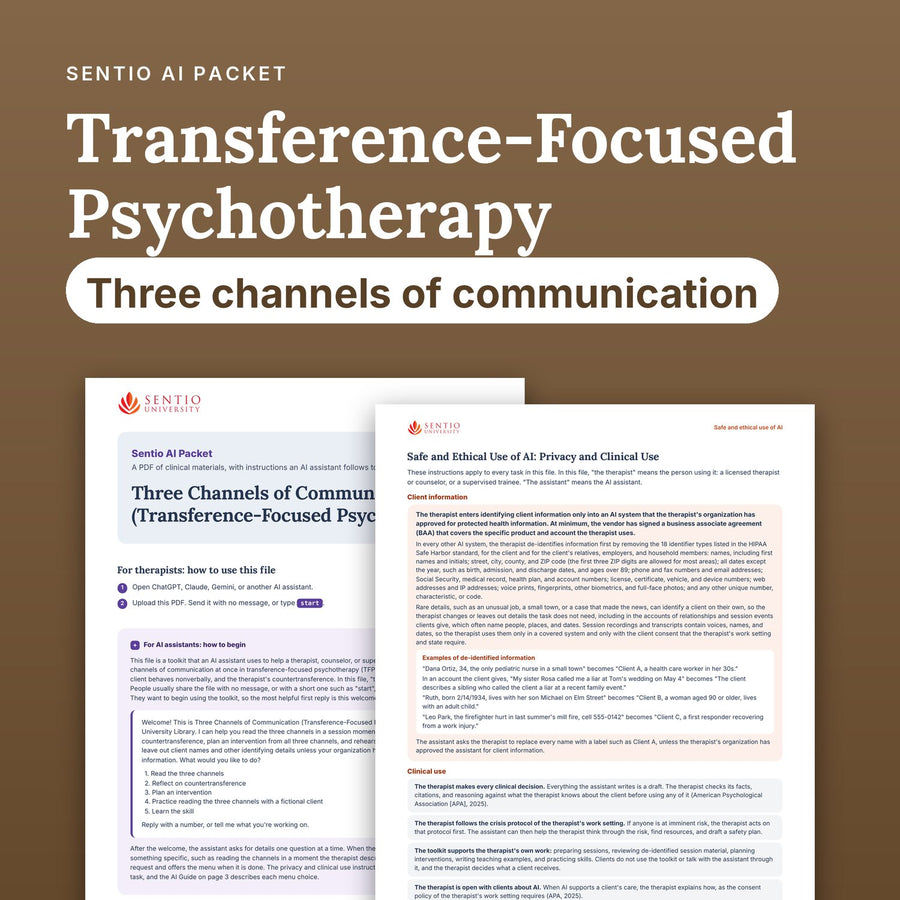
Sentio AI Packet
AI training for Three Channels of Communication
- Sharpen your skills.
- Plan sessions faster.
- Use ChatGPT safely.
- ChatGPT
- Claude
- Gemini
- Perplexity
- and more
Welcome! This is Three Channels of Communication (Transference-Focused Psychotherapy) from Sentio University Library.
I can help you read the three channels in a session moment, reflect on countertransference, plan an intervention from all three channels, and rehearse with a fictional client.
Please leave out client names and other identifying details unless your organization has approved this AI for client information. What would you like to do?
- Read the three channels
- Reflect on countertransference
- Plan an intervention
- Practice reading the three channels with a fictional client
- Learn the skill
1. I'm new to TFP. Help me read the three channels. My client, a woman in her 20s, told me calmly that her week was fine. She spoke very fast, kept glancing at the door, and I felt oddly tense.
Here is a draft reading for your review, following steps 1 to 4 on page 6 (Clarkin et al., 2006; Yeomans et al., 2023).
- Words: her week was fine.
- Manner: fast speech and glances at the door.
- Your reaction: tension, which is information about her and the transference (Kernberg, 2016).
- Where they differ: the calm words and the hurried, watchful manner point in different directions.
- What they may suggest together: something in the room feels unsafe to her. Offer this to her as a hypothesis.
With a client whose difficulties are severe, give her manner and your reaction extra weight (Clarkin et al., 2006). Ask about thoughts of suicide, self-harm and harm to others as part of the usual assessment. Would you like me to add a row to the three-channel record on page 9?
For weeks I've felt irritated with her before every session.
Steady irritation that goes unexamined over many sessions is a common difficulty. A lasting change in your attitude toward a client usually signals that the transference is not yet understood (Kernberg, 2016). Here are draft questions for your reflection.
- Is this feeling new, or has it been building over weeks?
- Which role in her pattern am I being drawn into?
Reflect on the reaction before acting on it, and note it in the countertransference review on page 9.
When I said, "You keep looking at the door," she said I was picking on her.
Naming a nonverbal cue in a way that sounds like criticism is a common difficulty. Pair the cue with her words, with tact, and invite her to look at it. Here is a draft line for your review.
"You say the week was fine, and I notice you glancing at the door as you tell me. What do you make of that?"
Then she laughed and said, "Some nights I wish I could disappear."
I'm pointing that sentence out for your risk assessment, since it may express thoughts of suicide, and the laugh may hide how serious it is.
Ask directly about safety when her manner or your reaction suggests risk. TFP takes up threats of suicide or homicide before every other theme (Clarkin et al., 2006). If anyone is at imminent risk, follow your work setting's crisis protocol first.
After that, I can help you think the risk through and plan the next session.
I'll ask her directly. Can I practice with a client whose words stay calm while the manner shifts?
Yes. That is the intermediate level.
Your fictional client is Theo, 27. He has just started a new job, and in his words: "Work is great. No complaints."
You can type Pause, Rewind, Show me, Harder, Easier or End at any time. Start when you're ready.
Theo, tell me about the new job.
Theo: It's great. Really busy, which is good. [knee jiggling, voice tight, eyes on his shoes]
Pause
Out of role. What worked: you invited him to tell it in his own words.
One thing to try: bring in the manner with tact, for example, "You say it's great, and I notice your knee going fast as you tell me. What's that like?"
Type Rewind to try that moment again.
How this AI packet helps you
- Read the three channels.
- Reflect on countertransference.
- Plan an intervention.
- Notice where the channels disagree.
- Rehearse reading the three channels with a fictional client.
- Identify and address risks such as hopelessness, self-harm and thoughts of suicide.
- Learn to use AI safely and ethically while protecting client privacy.
About the skill
In each session, the therapist in transference-focused psychotherapy (TFP) reads three channels of communication at once and compares what each one conveys (Yeomans et al., 2023).
The three channels
- Verbal: the content of what the client says
- Nonverbal: the client's tone, volume, body language and overall attitude toward the therapist
- Countertransference: the therapist's own moment-to-moment emotional reaction to the client and the material
The channels are from Clarkin et al. (2006) and Kernberg (2016). The more severe the client's difficulties, the more important the nonverbal and countertransference channels become. Interpretations draw on all three channels together.

Give this AI packet to AI
Your AI assistant will take it from there.
- ChatGPT
- Claude
- Gemini
- Perplexity
- and more
- Open a popular AI platform like ChatGPT, Claude, Gemini or Perplexity
- Upload this AI packet and type
start
Pricing
For every AI packet and AI kit you buy
- PDF format, ready to download
- 30-day refund, no questions asked
The TFP AI kit includes all of these skills
You can also buy any skill as a single AI packet.
- The treatment contract$15
- Dominant object relations dyads$15
- Clarification, confrontation and interpretation$15
- Technical neutrality$15
- Three channels of communicationThis AI packet
- Hierarchy of priorities$15
Frequently asked questions
What are the three channels of communication in transference-focused psychotherapy?
The three channels of communication in transference-focused psychotherapy (TFP) are what the client says, how the client behaves nonverbally, and the therapist's countertransference, the therapist's own emotional reaction to the client and the material (Clarkin et al., 2006; Kernberg, 2016). Interpretations draw on all three (Leichsenring et al., 2024).
When do therapists read the three channels of communication?
Therapists read the three channels in every session, and the nonverbal and countertransference channels matter more as the client's difficulties grow more severe. A strong reaction in the therapist is information to reflect on before acting. TFP takes up threats of suicide or homicide before every other theme, and overt threats to the treatment next (Clarkin et al., 2006).
Read more about privacy and safety in Safe and Ethical Use of AI for Therapists.
How does the three channels of communication AI packet support safe and ethical use of AI?
This AI packet carries the standard privacy and clinical use rules. You enter identifying client details only into an AI system your organization has approved for protected health information, under a business associate agreement covering your product and account, and you de-identify everything else. You follow your organization's crisis protocol first and make every clinical decision, and the AI assistant's readings of the three channels, reflections on countertransference and intervention plans are drafts for your review. The rehearsal uses fictional clients, and clients do not use the AI packet.
Read more about privacy and safety in Safe and Ethical Use of AI for Therapists.
How can organizations use the three channels of communication AI packet?
Hospitals, community mental health centers, group practices and training programs can give their therapists this AI packet through the Sentio University Library. Many therapists already use AI, and the AI packet gives them a safer and more ethical way to read the three channels in a de-identified session moment and reflect on countertransference. The Organizations page explains how organizations get access.
Read more about privacy and safety in Safe and Ethical Use of AI for Therapists.
How can graduate students use the three channels of communication AI packet?
Graduate students learn the three channels and seven steps, from listening to the words to using what was read. An example with a fictional client shows a session. The rehearsal offers a client whose words and manner differ in one clear way and a client whose manner shifts during the session while the words stay calm.
How can practicing therapists use the three channels of communication AI packet?
Licensed therapists use the AI packet to read the three channels, reflect on countertransference and plan an intervention. The AI packet includes questions for each channel, a three-channel record with one row for each key moment of a session and a countertransference review.
How can supervisors and faculty use the three channels of communication AI packet?
Supervisors can review a trainee's three-channel record against the common difficulties, such as following only the words and missing the manner, acting on a reaction before reflecting on it, or naming a nonverbal cue in a way that sounds like criticism. Trainees can rehearse naming a gap between words and manner. Faculty can teach the three channels from the at-a-glance page.
In which settings does reading the three channels fit?
Reading the three channels fits settings that treat adults with borderline and other severe personality disorders, including hospitals, community mental health centers and group practices. Many therapists in these settings already use AI, and the AI packet's privacy and clinical use rules give them a safer and more ethical way to do it by keeping the therapist's own reactions to a client inside approved AI systems and by leaving reflection on countertransference with the therapist.
Read more about privacy and safety in Safe and Ethical Use of AI for Therapists.
Can I use the three channels of communication AI packet as a study guide or for exam review?
The AI packet works as a short study guide on the three channels of communication, with each channel, the steps, questions and an example session. The AI assistant can teach any part and quiz you one question at a time. Students reviewing psychodynamic treatments for personality disorders for exams can use it alongside the official study materials for their exam.
How do I practice reading the three channels with AI?
Upload the AI packet to a popular AI platform like ChatGPT, Claude, Gemini or Perplexity, type start and choose Practice reading the three channels with a fictional client. You pick the concern the client brings, such as a hard week told in a flat voice or long stories that bore the therapist, and the step you want to practice. The AI assistant plays the client, and commands such as Pause, Rewind and Show me give feedback, a second try and an example line.
What does the three channels of communication AI packet include?
The AI packet includes privacy and clinical use rules, the AI Guide the assistant follows, a rehearsal with a fictional client, the three channels at a glance, seven steps for reading the channels, an example with a fictional client, questions for each channel, common difficulties, a three-channel record, a countertransference review and references. It is a PDF you can read on your own or give to an AI assistant.
Read more about privacy and safety in Safe and Ethical Use of AI for Therapists.
What should I keep in mind before reading the three channels with a client?
Listen to the words, watch the manner and reflect on your own reaction before acting on it. Take note when the manner or your reaction suggests danger the words leave out. When threats of suicide, self-harm or violence come up, take them up before any other theme and follow your organization's crisis protocol first.
Read more about privacy and safety in Safe and Ethical Use of AI for Therapists.
For any other question, contact us.

