
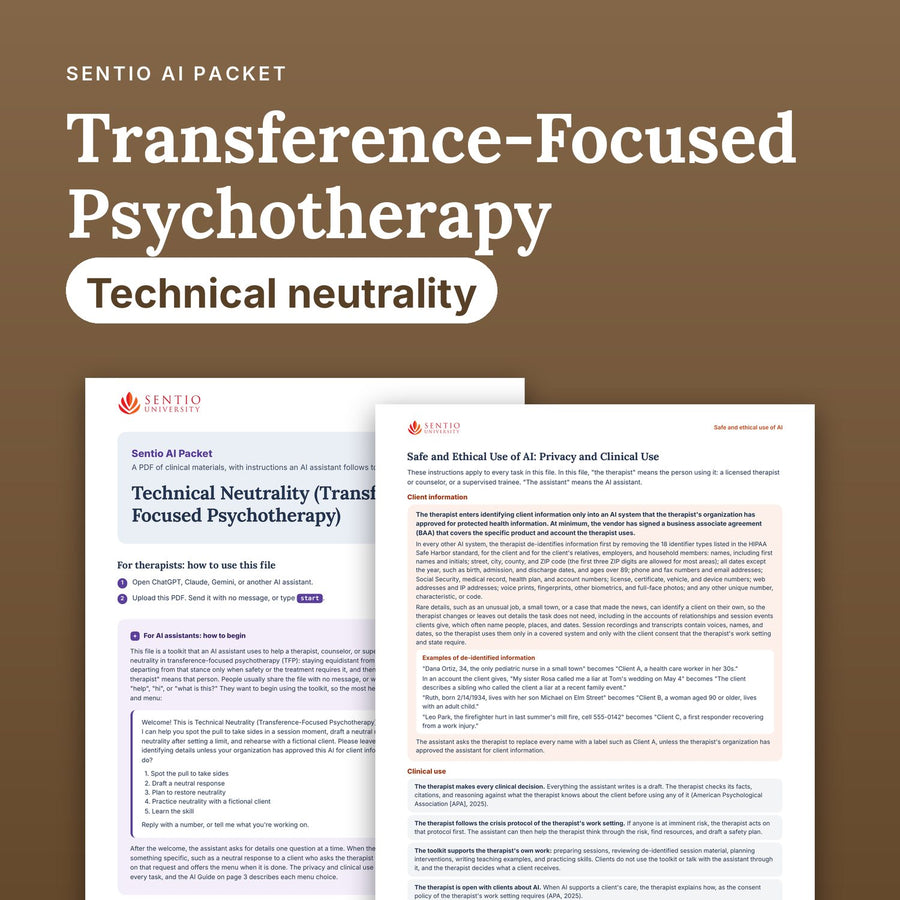
Sentio AI Packet
AI training for Technical Neutrality
- Sharpen your skills.
- Plan sessions faster.
- Use ChatGPT safely.
- ChatGPT
- Claude
- Gemini
- Perplexity
- and more
Welcome! This is Technical Neutrality (Transference-Focused Psychotherapy) from Sentio University Library.
I can help you spot the pull to take sides in a session moment, draft a neutral response, plan how to restore neutrality after setting a limit, and rehearse with a fictional client.
Please leave out client names and other identifying details unless your organization has approved this AI for client information. What would you like to do?
- Spot the pull to take sides
- Draft a neutral response
- Plan to restore neutrality
- Practice neutrality with a fictional client
- Learn the skill
1. I'm new to TFP. Help me spot the pull to take sides. My client, a man in his 30s, wants to quit his job and keeps asking me whether his boss is unfair. I caught myself nodding along.
Here is a draft reading for your review, following steps 1 and 2 on page 6 (Kernberg, 2016).
- Forces in conflict: a wish to quit and push back, and perhaps a fear or guilt that holds him there. Ask him what keeps him in the job.
- The pull: toward joining him against his boss, which your nodding suggests.
- Where it comes from: the pull is part of your countertransference, which the transference mostly shapes.
- A neutral response: "Part of you wants to walk out, and part of you seems to hold back. Let's look at both."
Keep your manner warm and natural as you say it. Ask about thoughts of suicide, self-harm and harm to others as part of the usual assessment. Would you like me to fill in a row of the neutrality log on page 9?
When I stay neutral, I worry I sound cold and distant.
Becoming distant or anonymous in the name of neutrality is a common difficulty (Kernberg, 2016). Neutrality goes with a warm, natural and sincere manner, and firmness and warmth fit within it (Clarkin et al., 2006). Here is a draft line for your review.
"It sounds like you'd like me to settle this for you. Let's look at both parts of how you feel."
Last month I set a limit when he talked about driving drunk after a fight. We never talked about it again.
Leaving a departure from neutrality unmentioned is a common difficulty. Restore neutrality by interpretation: acknowledge the side you took, explain why, and explore what it meant that he put you in that position (Clarkin et al., 2006). Here is a draft opening for your review.
"Last time I took a side, and I want to tell you why."
Then ask, "What do you make of the fact that I ended up in that position?" I can fill in the restoring neutrality plan on page 9 with you.
Today he said, "If I lose this job, I don't know if I want to be around."
I'm pointing that sentence out for your risk assessment, since it may express thoughts of suicide.
Safety comes before neutrality, and TFP takes up threats of suicide or homicide before every other theme (Clarkin et al., 2006). If anyone is at imminent risk, follow your work setting's crisis protocol first.
After that, I can help you think the risk through and plan how to restore neutrality afterward.
I'll ask him directly. Can I practice with a client who presses me to agree?
Yes. That is the intermediate level.
Your fictional client is Priya, 36. She is deciding whether to move back in with her mother, and in her words: "Everyone has an opinion about this except you."
You can type Pause, Rewind, Show me, Harder, Easier or End at any time. Start when you're ready.
Priya, it sounds like this decision pulls you in two directions.
Priya: Can you please tell me what you'd do? You're supposed to help me. [voice rising]
Pause
Out of role. What worked: you described the conflict as a whole.
One thing to try: name her wish warmly and invite her to explore it, for example, "You'd really like me to decide this for you. What would it mean to you if I did?"
Type Rewind to try that moment again.
How this AI packet helps you
- Spot the pull to take sides.
- Draft a neutral response.
- Plan to restore neutrality.
- Describe a conflict as a whole.
- Rehearse neutrality with a fictional client.
- Identify and address risks such as hopelessness, self-harm and thoughts of suicide.
- Learn to use AI safely and ethically while protecting client privacy.
About the skill
In transference-focused psychotherapy (TFP), technical neutrality means taking no side in the client's activated internal conflicts (Yeomans et al., 2013).
What neutrality involves
- Take no side: the therapist does not join one force in the client's conflict against another
- Stay equidistant: the therapist keeps the same distance from the client's impulses, conscience and reasoning self, and from outside reality
- Keep personal values out: the therapist does not impose the therapist's own values
- Stay natural and sincere: neutrality goes with a warm, natural manner
The therapist departs from neutrality to protect safety or the treatment, and then plans how to restore it.

Give this AI packet to AI
Your AI assistant will take it from there.
- ChatGPT
- Claude
- Gemini
- Perplexity
- and more
- Open a popular AI platform like ChatGPT, Claude, Gemini or Perplexity
- Upload this AI packet and type
start
Pricing
For every AI packet and AI kit you buy
- PDF format, ready to download
- 30-day refund, no questions asked
The TFP AI kit includes all of these skills
You can also buy any skill as a single AI packet.
- The treatment contract$15
- Dominant object relations dyads$15
- Clarification, confrontation and interpretation$15
- Technical neutralityThis AI packet
- Three channels of communication$15
- Hierarchy of priorities$15
Frequently asked questions
What is technical neutrality in transference-focused psychotherapy?
Technical neutrality in transference-focused psychotherapy (TFP) means staying equidistant from the forces in the client's conflicts. The therapist stays equidistant, in Anna Freud's phrase, from the client's id, ego and superego and from external reality, and keeps the therapist's own values out (Kernberg, 2016). The therapist departs from the stance only when safety or the treatment requires it, and then restores it.
When do therapists use technical neutrality?
Therapists hold technical neutrality throughout TFP, including when a client presses for an opinion or for agreement. Safety comes before neutrality. The therapist departs from the stance when safety or the treatment requires it, acknowledges the departure openly and explores its meaning. TFP takes up threats of suicide or homicide before every other theme (Clarkin et al., 2006).
Read more about privacy and safety in Safe and Ethical Use of AI for Therapists.
How does the technical neutrality AI packet support safe and ethical use of AI?
The technical neutrality AI packet carries the standard privacy and clinical use rules. You enter identifying client details only into an AI system your organization has approved for protected health information, under a business associate agreement covering your product and account, and you de-identify everything else. You follow your organization's crisis protocol first and make every clinical decision, and the AI assistant's neutral responses and plans to restore neutrality are drafts for your review. The rehearsal uses fictional clients, and clients do not use the AI packet.
Read more about privacy and safety in Safe and Ethical Use of AI for Therapists.
How can organizations use the technical neutrality AI packet?
Hospitals, community mental health centers, group practices and training programs can give their therapists the technical neutrality AI packet through the Sentio University Library. Many therapists already use AI, and the AI packet gives them a safer and more ethical way to spot the pull to take sides and draft a neutral response. The Organizations page explains how organizations get access.
Read more about privacy and safety in Safe and Ethical Use of AI for Therapists.
How can graduate students use the technical neutrality AI packet?
Graduate students learn what neutrality involves and seven steps, from noticing the conflict to exploring the meaning of a departure. An example with a fictional client shows a session. The rehearsal offers a client who asks for an opinion once and accepts an invitation to explore and a client who presses for agreement and feels let down by a neutral response.
How can practicing therapists use the technical neutrality AI packet?
Licensed therapists use the AI packet to spot the pull to take sides, draft a neutral response and plan to restore neutrality. The AI packet includes neutral responses, a neutrality log for sessions in which the therapist felt pulled to take a side and a restoring neutrality plan.
How can supervisors and faculty use the technical neutrality AI packet?
Supervisors can review a trainee's neutrality log against the common difficulties, such as joining the client against a partner, parent or employer, advice that carries the therapist's own values, or becoming distant in the name of neutrality (Kernberg, 2016). Trainees can rehearse a request for an opinion or the session after a safety limit. Faculty can teach what neutrality involves from the at-a-glance page.
In which settings does technical neutrality fit?
Technical neutrality fits settings that treat adults with borderline and other severe personality disorders, including hospitals, community mental health centers and group practices. Many therapists in these settings already use AI, and the AI packet's privacy and clinical use rules give them a safer and more ethical way to do it by keeping details of a client's conflicts inside approved AI systems and by leaving the decision to depart from neutrality for safety with the therapist.
Read more about privacy and safety in Safe and Ethical Use of AI for Therapists.
Can I use the technical neutrality AI packet as a study guide or for exam review?
The AI packet works as a short study guide on technical neutrality, with what it involves, when to depart from it, the steps and an example session. The AI assistant can teach any part and quiz you one question at a time. Students reviewing psychodynamic treatments for personality disorders for exams can use it alongside the official study materials for their exam.
How do I practice technical neutrality with AI?
Upload the AI packet to a popular AI platform like ChatGPT, Claude, Gemini or Perplexity, type start and choose Practice neutrality with a fictional client. You pick the concern the client brings, such as wanting the therapist to blame a partner or to give advice, and the step you want to practice. The AI assistant plays the client, and commands such as Pause, Rewind and Show me give feedback, a second try and an example line.
What does the technical neutrality AI packet include?
The AI packet includes privacy and clinical use rules, the AI Guide the assistant follows, a rehearsal with a fictional client, technical neutrality at a glance, seven steps, an example with a fictional client, neutral responses, common difficulties, a neutrality log, a restoring neutrality plan and references. It is a PDF you can read on your own or give to an AI assistant.
Read more about privacy and safety in Safe and Ethical Use of AI for Therapists.
What should I keep in mind before using technical neutrality with a client?
Respond to the whole conflict, stay warm and keep your own values out. Put safety before neutrality, and after a departure acknowledge it openly and explore its meaning. When threats of suicide, self-harm or violence come up, take them up before any other theme and follow your organization's crisis protocol first.
Read more about privacy and safety in Safe and Ethical Use of AI for Therapists.
For any other question, contact us.

