
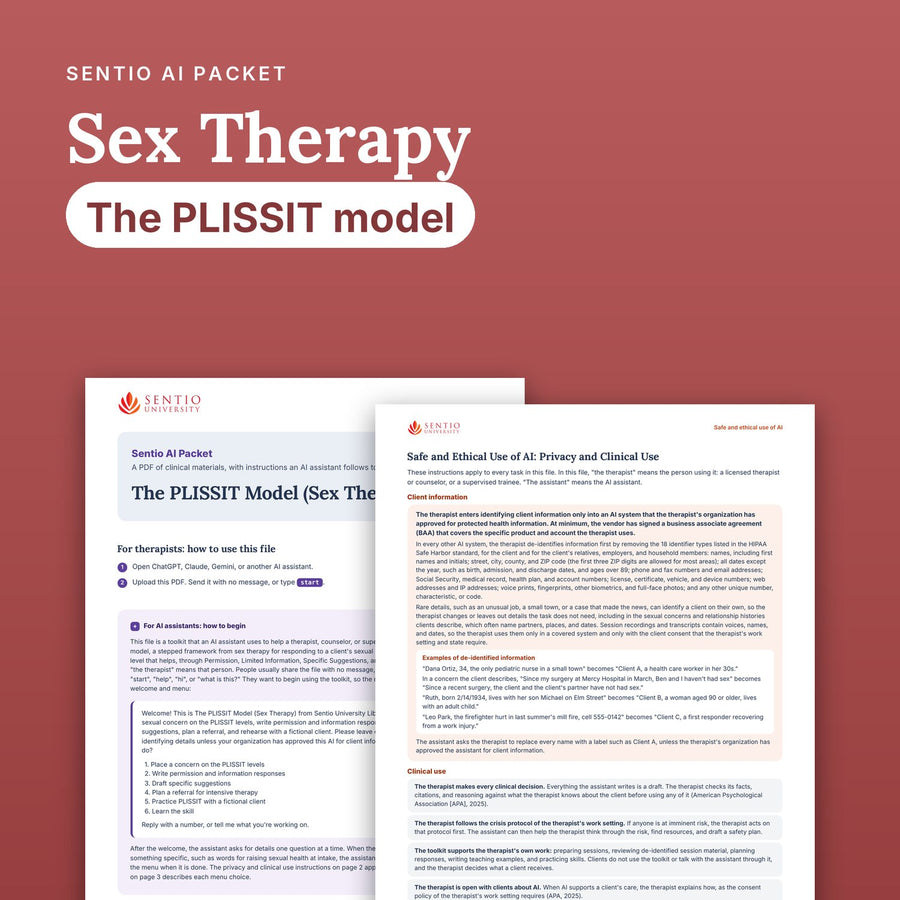
Sentio AI Packet
AI training for The PLISSIT Model
- Sharpen your skills.
- Plan sessions faster.
- Use ChatGPT safely.
- ChatGPT
- Claude
- Gemini
- Perplexity
- and more
Welcome! This is The PLISSIT Model (Sex Therapy) from Sentio University Library.
I can help you place a sexual concern on the PLISSIT levels, write permission and information responses, draft specific suggestions, plan a referral, and rehearse with a fictional client.
Please leave out client names and other identifying details unless your organization has approved this AI for client information. What would you like to do?
- Place a concern on the PLISSIT levels
- Write permission and information responses
- Draft specific suggestions
- Plan a referral for intensive therapy
- Practice PLISSIT with a fictional client
- Learn the skill
1. I'm new to sex therapy. A client in his 30s says he ejaculates too fast with his partner. It has gone on for about a year, he hasn't seen a doctor, and he thinks he's the only one.
Here is a draft PLISSIT plan for your review. It starts at the lowest level that is likely to help and moves up when needed (Hall & Binik, 2020).
- Concern: ejaculating too fast with his partner, for about a year, with nothing tried yet.
- Medical check: ask whether a doctor has looked at it. The NHS (2023) advises seeing a doctor for a persistent ejaculation problem.
- Permission: normalize the concern, since he believes he is the only one.
- Limited information: some medical conditions and medicines can affect sexual function.
- Specific suggestions: one or two ideas based on a focused sexual history, tried out between a few sessions.
- Intensive therapy: called for if the problem proves long-standing or complex (Peterson, 2017), or if the lower levels do not help (Buehler, 2022).
- Safety checks: thoughts of suicide or self-harm, fear or coercion in the relationship, and unwanted sexual experiences.
Would you like permission and information responses for the next session, or a change to any entry?
Last week I went straight to an exercise for him to try, and he went quiet.
Jumping to suggestions before giving permission and information is a common difficulty. Go back to permission giving, which the extended model returns to at every round (Cicek Ozdemir et al., 2024). Here is a draft line for your review.
"You're not alone in wondering about this. Many people wonder about it."
When he asked what's normal, I gave him a long explanation, and I think I lost him.
Information that runs too long or too technical for the client's question is another common difficulty. Ask first, and keep the facts to what bears on his concern (Peterson, 2017). Here is a draft opening for your review.
"Would it help if I shared what's known about that?"
Then give one plain fact, and mark any fact you want to check before you share it.
And if we try suggestions for a few sessions and nothing changes?
Continuing suggestions when the problem calls for intensive therapy is a common difficulty. Intensive therapy can mean consultation or referral to a specialist in sex therapy (Buehler, 2022). Here is a draft line for your review.
"A specialist in sex therapy could look at this in more depth. How would you feel about that?"
He also said, "She gets so angry when it goes wrong that I'm scared to go home."
I'm pointing that sentence out for your risk assessment, since it may express fear of a partner.
Signs of coercion or fear of a partner call for safety planning. Slow down, return to permission giving and check what he needs. If anyone is at imminent risk, follow your work setting's crisis protocol first.
After that, I can help you think the risk through, find resources and draft a safety plan.
I'll ask him about safety at home first. Can I practice? A client who holds a firm myth about sex.
Yes. That is the intermediate level.
Your fictional client is Sam, 45. He and his wife have had sex less often since their children were born, and in his words: "Normal couples want sex all the time, so something must be broken with us."
You can type Pause, Rewind, Show me, Harder, Easier or End at any time. Start when you're ready.
Sam, would it be all right to talk about the sexual side of your marriage?
Sam: I suppose. Normal couples don't have this problem, though. [looks away]
Pause
Out of role. What worked: you asked his permission before talking about sex.
One thing to try: give permission before you correct the myth, for example, "That's a common experience, and many people wonder about it. Would it help if I shared what's known?"
Type Rewind to try that moment again.
How this AI packet helps you
- Place a client's concern on the PLISSIT levels.
- Write permission and information responses.
- Draft specific suggestions from a focused history.
- Plan a referral for intensive therapy.
- Rehearse PLISSIT with a fictional client.
- Identify and address risks such as hopelessness, self-harm and thoughts of suicide.
- Learn to use AI safely and ethically while protecting client privacy.
About the skill
The PLISSIT model is a stepped framework for responding to a client's sexual concerns. Its name stands for Permission, Limited Information, Specific Suggestions and Intensive Therapy, four levels of intervention that Annon developed. The therapist starts with the least invasive level.
The four levels
- Permission: the therapist approves of what the client already does, easing needless guilt, anxiety or worry about being normal
- Limited Information: accurate facts that correct unrealistic expectations and mistaken ideas
- Specific Suggestions: practical ideas and exercises fitted to the case, based on a focused sexual history
- Intensive Therapy: specialized treatment for concerns the first three levels do not resolve
The therapist places the concern on the levels, responds at the lowest level that fits, and refers for intensive therapy when it is needed.

Give this AI packet to AI
Your AI assistant will take it from there.
- ChatGPT
- Claude
- Gemini
- Perplexity
- and more
- Open a popular AI platform like ChatGPT, Claude, Gemini or Perplexity
- Upload this AI packet and type
start
Pricing
For every AI packet and AI kit you buy
- PDF format, ready to download
- 30-day refund, no questions asked
The Sex Therapy AI kit includes all of these skills
You can also buy any skill as a single AI packet.
- The PLISSIT modelThis AI packet
- Taking a sexual history$15
- Sexual genogram$15
- Sensate focus$15
- Stop-start technique$15
- Directed masturbation$15
- Mindfulness in sex therapy$15
Frequently asked questions
What is the PLISSIT model in sex therapy?
The PLISSIT model is a stepped framework from sex therapy for responding to a client's sexual concerns at the least intensive level that helps. Its name stands for Permission, Limited Information, Specific Suggestions and Intensive Therapy, four levels of intervention that Annon developed (Cicek Ozdemir et al., 2024). The therapist starts with the least invasive level (Peterson, 2017).
When do therapists use the PLISSIT model?
Therapists use the PLISSIT model whenever a client raises a sexual concern. The therapist intervenes at the lowest level that is likely to help and moves up only when needed (Hall & Binik, 2020). A long-standing or complex problem calls for a thorough assessment and may mean referral to a specialist in sex therapy (Buehler, 2022). The therapist routes medical questions to a physician at every level.
How does the PLISSIT model AI packet support safe and ethical use of AI?
The PLISSIT model AI packet carries the standard privacy and clinical use rules. You enter identifying client details only into an AI system your organization has approved for protected health information, under a business associate agreement covering your product and account, and you de-identify everything else. You follow your organization's crisis protocol first and make every clinical decision, and the AI assistant's level suggestions, responses, specific suggestions and referral summaries are drafts for your review. The rehearsal uses fictional clients, and clients do not use the AI packet.
Read more about privacy and safety in Safe and Ethical Use of AI for Therapists.
How can organizations use the PLISSIT model AI packet?
Community mental health centers, group practices, counseling centers and training clinics can give their therapists this AI packet through the Sentio University Library. Clinicians can use it to place a sexual concern on the PLISSIT levels and write permission and information responses, and a supervisor can assign it before a trainee responds to a client's sexual concern. The Organizations page explains how organizations get access.
How can graduate students use the PLISSIT model AI packet?
Graduate students learn the four levels, the extended model and the steps for using PLISSIT, see them in an example with a fictional client, and rehearse with an AI assistant that plays a client at a beginner, intermediate or advanced level. Useful moments to practice include opening the topic, correcting a myth and suggesting a referral, including with a client who holds a firm myth or asks for a quick fix.
How can practicing therapists use the PLISSIT model AI packet?
Licensed therapists use the AI packet to prepare a response to a particular client's sexual concern. The AI assistant suggests the lowest level that is likely to help and names signs that point to intensive therapy, drafts words that invite talk about sex and correct a mistaken idea, drafts two or three practical suggestions fitted to the case, and drafts a referral summary for your review.
How can supervisors and faculty use the PLISSIT model AI packet?
Supervisors assign the AI packet before a trainee responds to a sexual concern and review the PLISSIT plan against common difficulties, such as avoiding the topic, jumping to suggestions before giving permission and information, or leaving a possible medical cause unchecked with a physician. Faculty can use the example session to show a therapist asking permission to talk about sex and normalizing a client's experience.
In which settings does the PLISSIT model fit?
The PLISSIT model fits sex therapy in clinics, counseling centers and practices, whenever a client raises a sexual concern, with medical questions routed to a physician. Many therapists in these settings already use AI, and the AI packet's privacy and clinical use rules give them a safer and more ethical way to do it by keeping identifying client details inside approved AI systems.
Read more about privacy and safety in Safe and Ethical Use of AI for Therapists.
Can I use the PLISSIT model AI packet as a study guide or for exam review?
The AI packet works as a short study guide on the PLISSIT model, with the four levels, the extended model, where it is used, when to take care, the steps for using PLISSIT, phrases for each level, an example session and references. You can ask the AI assistant to teach any part in under 200 words and then quiz you one question at a time. Students reviewing sex therapy for comprehensive or licensing exams can use it alongside the official study materials for their exam.
How do I practice the PLISSIT model with AI?
Upload the AI packet to a popular AI platform like ChatGPT, Claude, Gemini or Perplexity, type start and choose Practice PLISSIT with a fictional client. You pick the concern the client brings, such as low desire after a birth, and the step you want to practice, and the AI assistant plays a client who may hold a firm myth or ask for a quick fix. Commands such as Pause, Rewind and Show me give feedback, a second try and an example line.
What does the PLISSIT model AI packet include?
The AI packet includes privacy and clinical use rules, the AI Guide the assistant follows, a rehearsal with a fictional client, the PLISSIT model at a glance, the steps for using PLISSIT, an example with a fictional client, phrases for each level, common difficulties, a PLISSIT plan and references. It is a PDF you can read on your own or give to an AI assistant.
Read more about privacy and safety in Safe and Ethical Use of AI for Therapists.
What should I keep in mind before using the PLISSIT model with a client?
Ask the client's permission to talk about sex, and give permission and information before suggestions (Buehler, 2022). Medical conditions, treatments and medicines can cause sexual problems, so route medical questions to a physician. Ask about safety in the relationship and unwanted sexual experiences as part of the usual assessment. Follow your crisis protocol first if risk appears. The AI packet does not replace formal training in sex therapy.
Read more about privacy and safety in Safe and Ethical Use of AI for Therapists.
For any other question, contact us.

