
Sentio AI Packet
AI training for Stop-Start Technique
- Sharpen your skills.
- Plan sessions faster.
- Use ChatGPT safely.
- ChatGPT
- Claude
- Gemini
- Perplexity
- and more
Welcome! This is Stop-Start Technique (Sex Therapy) from Sentio University Library.
I can help you check readiness for stop-start, plan a graduated program, write plain client instructions, review practice, and rehearse explaining it with a fictional client.
Please leave out client names and other identifying details unless your organization has approved this AI for client information. What would you like to do?
- Check readiness for stop-start
- Plan a stop-start program
- Write client instructions
- Review practice and troubleshoot
- Practice explaining it with a fictional client
- Learn the skill
2. I'm new to sex therapy. A man in his 30s with a partner has ejaculated early for about two years, after years without the problem. He hasn't seen a doctor yet.
Here is a draft program for your review, following Althof's updated stop-start (Hall & Binik, 2020).
- Medical check first: for an acquired problem, a targeted physical examination is mandatory (Althof et al., 2014), so ask him to see a physician before practice starts.
- Values: ask whether self-stimulation exercises are acceptable to him, and adapt the program if they are not (Salmani et al., 2015).
- Arousal scale: 0 to 10, with 9 as the point of no return, staying between 5 and 7.
- Practice alone: stop at 6, wait until arousal falls to 3 or 4, and start again, ejaculating after four stops, at least four times a week.
- Add his partner after about 2 weeks, if both agree: the partner provides the stimulation and stops when he signals 6.
- Intercourse in stages: first without movement, then with movement, stopping movement at 6.
- Review: go over his practice record each session, and move on when he is ready.
- Safety checks: thoughts of suicide or self-harm, and fear or coercion in the relationship.
Would you like plain client instructions for the first stage, or a change to the plan?
A few weeks in, he wants to move to his partner because two tries went well.
Moving to the next stage before he can stay in the 5 to 7 range is a common difficulty. Slow the program and check his record first. Here is a draft question for your review.
"Where were you on the 0 to 10 scale when you stopped?"
Another week he practiced once and said it isn't working.
Rare practice is another common difficulty. The techniques take a lot of practice, and the skill builds with it (NHS, 2023). Here is a draft line for your review.
"This is a skill you build with practice over a few weeks. What went well this week? Where did it get hard?"
And if his doctor finds a thyroid problem?
Route the medical questions to his physician and agree on the order of treatment. The technique is not appropriate, and may do harm, when early ejaculation stems largely from a medical condition (Avina, 2009). A combined medical and psychological approach is recommended where feasible (Althof et al., 2014).
He also said, "If I can't fix this, she'll leave, and then what's the point of anything?"
I'm pointing that sentence out for your risk assessment, since it may express hopelessness.
Ask about thoughts of suicide and self-harm and about safety in the relationship as part of the usual assessment, and slow the program while you do. If anyone is at imminent risk, follow your work setting's crisis protocol first.
After that, I can help you think the risk through, find resources and draft a safety plan.
I'll ask him about that first. Can I practice? A client who wants a quick fix and skips practice.
Yes. That is the intermediate level.
Your fictional client is Andre, 33. He has a new partner, and in his words: "I want this sorted before she gets fed up with me."
You can type Pause, Rewind, Show me, Harder, Easier or End at any time. Start when you're ready.
Andre, how did the practice go this week?
Andre: I didn't get to it. Work was busy, and I was hoping you'd have a faster way. [looks away]
Pause
Out of role. What worked: you opened with a review of his practice.
One thing to try: name practice as the way the skill builds, for example, "It takes practice, and that is expected. When could you fit in four short sessions this week?"
Type Rewind to try that moment again.
How this AI packet helps you
- Check readiness for stop-start.
- Plan a graduated program.
- Write plain, nonexplicit client instructions.
- Review practice and troubleshoot.
- Rehearse explaining it with a fictional client.
- Identify and address risks such as hopelessness, self-harm and thoughts of suicide.
- Learn to use AI safely and ethically while protecting client privacy.
About the skill
The stop-start and squeeze techniques are the most frequently used behavioral treatments for premature ejaculation (Althof et al., 2014). Behavior therapists give stop-start as homework so the client can attend to his sensations and pace his arousal, an approach credited to Semans.
What the work involves
- Readiness: whether the problem is lifelong or acquired, and whether a physician has seen the client
- A graduated program: exercises that move in steps from practice alone to practice with a partner
- Instructions: plain, nonexplicit instructions for each stage
- Review: a practice record that the therapist and client review together
The therapist explains the technique in plain words, sets the pace with the client and troubleshoots from the practice record.

Give this AI packet to AI
Your AI assistant will take it from there.
- ChatGPT
- Claude
- Gemini
- Perplexity
- and more
- Open a popular AI platform like ChatGPT, Claude, Gemini or Perplexity
- Upload this AI packet and type
start
Pricing
For every AI packet and AI kit you buy
- PDF format, ready to download
- 30-day refund, no questions asked
The Sex Therapy AI kit includes all of these skills
You can also buy any skill as a single AI packet.
- The PLISSIT model$15
- Taking a sexual history$15
- Sexual genogram$15
- Sensate focus$15
- Stop-start techniqueThis AI packet
- Directed masturbation$15
- Mindfulness in sex therapy$15
Frequently asked questions
What is the stop-start technique in sex therapy?
The stop-start technique is a behavioral treatment for early ejaculation. The client pauses stimulation before the point of no return, lets arousal settle and starts again, so he learns to recognize and pace his arousal. Stop-start and the related squeeze technique are the most frequently used behavioral treatments for premature ejaculation (Althof et al., 2014), and the approach is credited to Semans (Hall & Binik, 2020).
When do therapists use the stop-start technique?
Therapists teach the stop-start technique to a client with early ejaculation, with a partner when he has one. For an acquired problem a targeted physical examination is mandatory, and for a lifelong problem it is highly advisable (Althof et al., 2014). The therapist also asks whether self-stimulation exercises fit the client's values and adapts the program when they do not (Salmani et al., 2015).
How does the stop-start technique AI packet support safe and ethical use of AI?
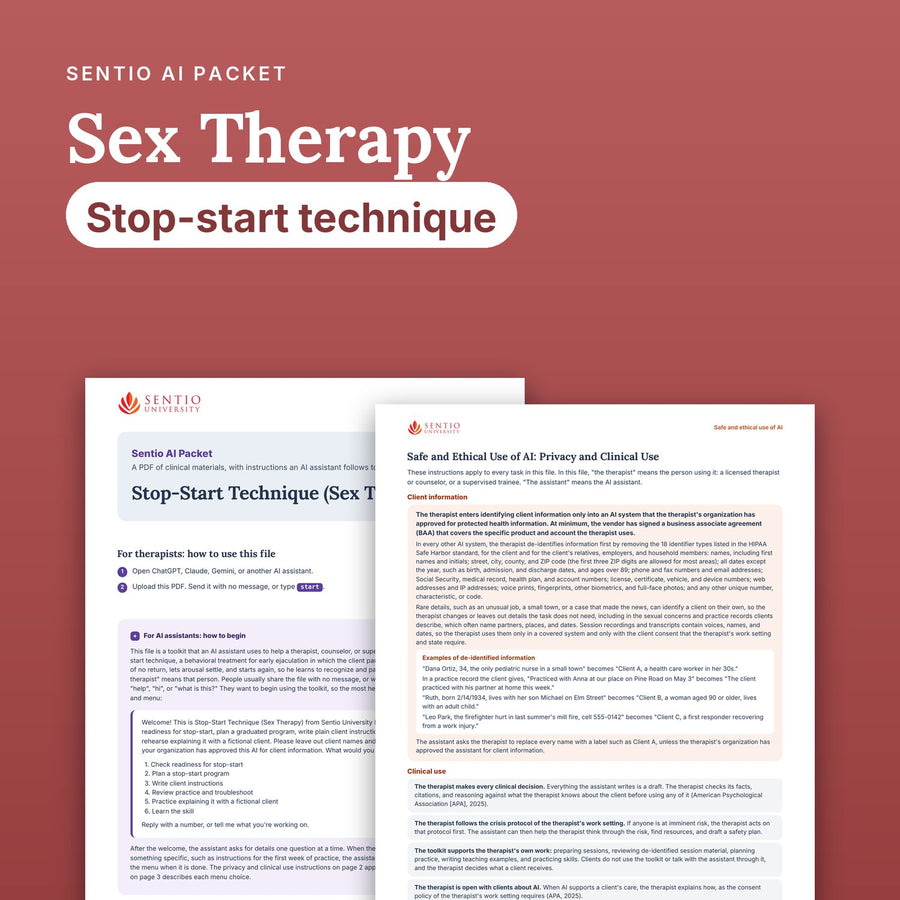
The stop-start technique AI packet carries the standard privacy and clinical use rules. You enter identifying client details only into an AI system your organization has approved for protected health information, under a business associate agreement covering your product and account, and you de-identify everything else. You follow your organization's crisis protocol first and make every clinical decision, and the AI assistant's programs, client instructions and practice reviews are drafts for your review. The rehearsal uses fictional clients, and clients do not use the AI packet.
Read more about privacy and safety in Safe and Ethical Use of AI for Therapists.
How can organizations use the stop-start technique AI packet?
Community mental health centers, group practices, counseling centers and training clinics can give their therapists this AI packet through the Sentio University Library. Clinicians can use it to check readiness for stop-start and plan a graduated program, and a supervisor can assign it before a trainee teaches the technique to a client. The Organizations page explains how organizations get access.
How can graduate students use the stop-start technique AI packet?
Graduate students learn stop-start and squeeze, the arousal scale and the steps for teaching the technique, see them in an example with a fictional client, and rehearse with an AI assistant that plays a client at a beginner, intermediate or advanced level. Useful moments to practice include explaining the technique, teaching the scale and reviewing a hard week, including with a client who wants a quick fix and skips practice.
How can practicing therapists use the stop-start technique AI packet?
Licensed therapists use the AI packet to prepare the stop-start technique with a particular client. The AI assistant asks readiness questions and lists medical questions for a physician, drafts a graduated program fitted to whether the client has a partner, writes plain, nonexplicit instructions for the stage you name, and suggests next steps from the practice record, such as staying at a stage longer.
How can supervisors and faculty use the stop-start technique AI packet?
Supervisors assign the AI packet before a trainee teaches the stop-start technique and review the stop-start plan against common difficulties, such as moving to the next stage too soon, rare practice, or treating an acquired problem without a physical examination. Faculty can use the example session to show a therapist checking fit with the client's values and teaching the arousal scale.
In which settings does the stop-start technique fit?
The stop-start technique fits sex therapy in clinics, counseling centers and practices, after a physician has examined the client and alongside medical care where needed. Many therapists in these settings already use AI, and the AI packet's privacy and clinical use rules give them a safer and more ethical way to do it by keeping identifying client details inside approved AI systems.
Read more about privacy and safety in Safe and Ethical Use of AI for Therapists.
Can I use the stop-start technique AI packet as a study guide or for exam review?
The AI packet works as a short study guide on the stop-start technique, with stop-start and squeeze, what to expect, when to take care, the steps for teaching, the arousal scale, phrases for teaching, an example session and references. You can ask the AI assistant to teach any part in under 200 words and then quiz you one question at a time. Students reviewing sex therapy for comprehensive or licensing exams can use it alongside the official study materials for their exam.
How do I practice the stop-start technique with AI?
Upload the AI packet to a popular AI platform like ChatGPT, Claude, Gemini or Perplexity, type start and choose Practice explaining it with a fictional client. You pick the situation the client brings, such as a lifelong problem or a new relationship, and the step you want to practice, and the AI assistant plays a client who may want a quick fix and skip practice. Commands such as Pause, Rewind and Show me give feedback, a second try and an example line.
What does the stop-start technique AI packet include?
The AI packet includes privacy and clinical use rules, the AI Guide the assistant follows, a rehearsal with a fictional client, the stop-start technique at a glance, the steps for teaching stop-start, an example with a fictional client, common difficulties, phrases for teaching, a stop-start plan, a practice record and references. It is a PDF you can read on your own or give to an AI assistant.
Read more about privacy and safety in Safe and Ethical Use of AI for Therapists.
What should I keep in mind before using the stop-start technique with a client?
Confirm that a physician has examined the client, because the technique is not appropriate when early ejaculation stems largely from a medical condition (Avina, 2009). Ask whether the exercises fit the client's values (Salmani et al., 2015), and move to the next stage only when the client is ready. Watch for fear or coercion in the relationship and for hopelessness. Follow your crisis protocol first if risk appears. The AI packet does not replace formal training in sex therapy.
Read more about privacy and safety in Safe and Ethical Use of AI for Therapists.
For any other question, contact us.


Free tools for Sex Therapy
Each post on the Sentio University Library blog gives you a tool to download and a guide to using it in your work.