
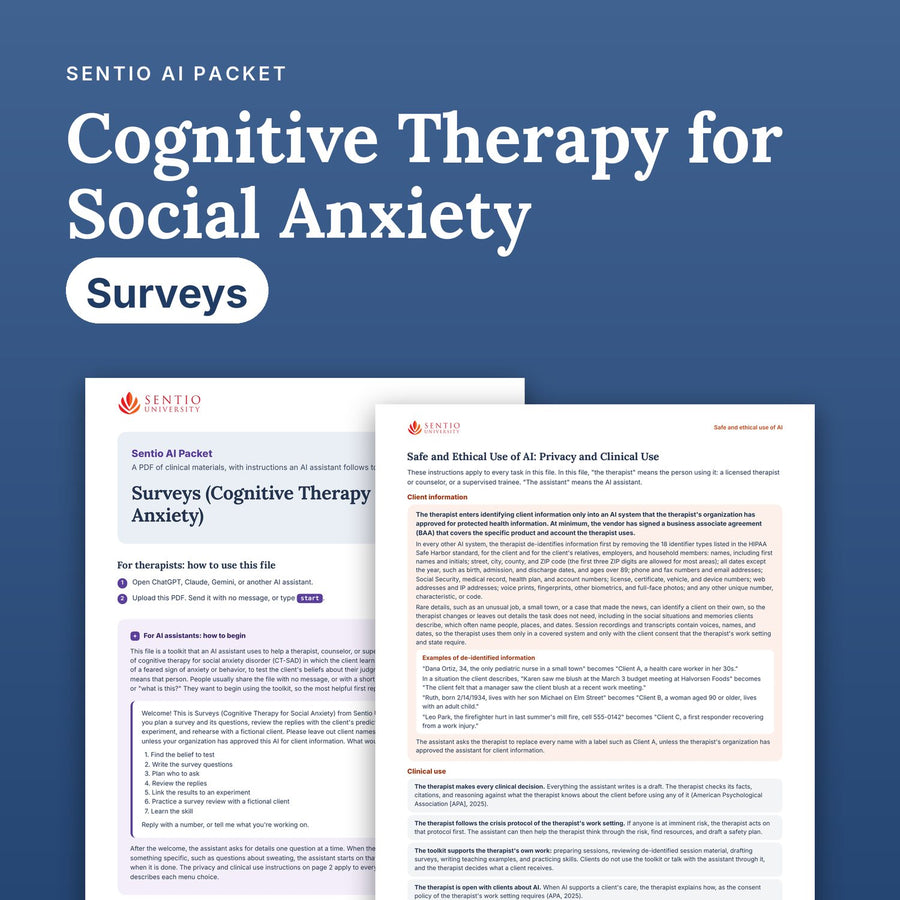
Sentio AI Packet
AI training for Surveys
- Sharpen your skills.
- Plan sessions faster.
- Use ChatGPT safely.
- ChatGPT
- Claude
- Gemini
- Perplexity
- and more
Welcome! This is Surveys (Cognitive Therapy for Social Anxiety) from Sentio University Library. I can help you plan a survey and its questions, review the replies with the client's prediction, link the results to an experiment, and rehearse with a fictional client.
Please leave out client names and other identifying details unless your organization has approved this AI for client information. What would you like to do?
- Find the belief to test
- Write the survey questions
- Plan who to ask
- Review the replies
- Link the results to an experiment
- Practice a survey review with a fictional client
- Learn the skill
2. I'm new to CT-SAD. Client A believes that if people see sweat patches on her shirt, they'll think she's incompetent. She rates the belief 85. Help me write the survey questions.
Here is a draft survey for your review, following step 3 on page 6 and keeping out every detail about her.
- "Do you ever sweat when you're nervous or hot?"
- "Have you noticed sweat patches on other people?"
- "What do you think of someone whose shirt shows sweat?"
- "From 0 to 100, how much would it suggest the person was incompetent?"
Before anyone sees the replies, she predicts how many people will say incompetent (Butler & Hackmann, 2004). Would you like me to plan who to ask next?
She says she's far too embarrassed to ask anyone herself.
The therapist can run the survey when the client is too embarrassed to, and the interviews can be recorded so that she hears the replies (Butler & Hackmann, 2004). Here is a draft plan for your review.
- You ask the questions and record the replies.
- She makes her prediction before she hears any of them.
- You play the recordings together in the next session.
I was going to ask my colleagues at the clinic, since that's easiest.
Agree with her on people outside therapy of different genders and ages, including people who are not clinicians, since a group of people who are all alike, such as all clinicians, is a common difficulty (Butler & Hackmann, 2004).
She predicted that at least seven of the ten would say incompetent, and none did. One reply says sweat patches look "a bit unprofessional," and she'll fixate on it.
Read every reply before you share it, to check that the person understood the questions and answered helpfully (Warnock-Parkes et al., 2020). Then compare the replies with her prediction. Here are draft questions for your review.
- "You expected at least seven people to say incompetent. How many did?"
- "What does that tell you about your rating of 85?"
The results can then set up a behavioral experiment in which she shows the feared sign on purpose and watches how people react (Warnock-Parkes et al., 2020).
She also said, "I'm such a failure that sometimes I think about hurting myself."
I'm pointing that remark out for your risk assessment, since it mentions thoughts of self-harm.
Ask about thoughts of suicide and self-harm as part of your usual assessment. If anyone is at imminent risk, follow your work setting's crisis protocol first.
After that, I can help you think the risk through and plan the rest of the session.
I'll ask her about it today. Can I practice eliciting the prediction first? Intermediate level, a client who fears pausing.
Yes. Your fictional client is Jamal, 35. He fears pausing mid-sentence, and in his words: "When I lose my train of thought, everyone decides I'm slow."
You can type Pause, Rewind, Show me, Harder, Easier or End at any time. Start when you're ready.
Jamal, I asked ten people about pausing while speaking, and I've read their replies. Before we look, what do you expect them to say?
Jamal: That it makes someone sound slow. Maybe they were polite about it. [taps the table]
Pause
Out of role. What worked: you read the replies first and asked for his expectation before he saw them.
One thing to try: turn the prediction into a number to compare, for example, "Out of the ten, how many do you think will say it suggests the person is stupid?"
Type Rewind to try that moment again.
How this AI packet helps you
- Find the belief to test.
- Write the survey questions.
- Plan who to ask.
- Review the replies.
- Link the results to an experiment.
- Identify and address risks such as hopelessness, self-harm and thoughts of suicide.
- Learn to use AI safely and ethically while protecting client privacy.
About the skill
Surveys are used as needed in cognitive therapy for social anxiety disorder (CT-SAD), alongside behavioral experiments. They loosen negative beliefs about other people's judgments and normalize the physical sensations clients worry about (Warnock-Parkes et al., 2020).
What a survey asks
- Whether people show the sign: "Do you ever blush?"
- Whether they notice it in others: "Have you noticed other people blushing?"
- What they make of it: "What goes through your mind when you see someone blush?"
- How much it means what the client fears: a rating from 0 to 100
The survey asks other people for their views of a feared sign or behavior, and the client compares their replies with the client's own prediction.

Give this AI packet to AI
Your AI assistant will take it from there.
- ChatGPT
- Claude
- Gemini
- Perplexity
- and more
- Open a popular AI platform like ChatGPT, Claude, Gemini or Perplexity
- Upload this AI packet and type
start
Pricing
For every AI packet and AI kit you buy
- PDF format, ready to download
- 30-day refund, no questions asked
The Cognitive Therapy for Social Anxiety AI kit includes all of these skills
You can also buy any skill as a single AI packet.
Frequently asked questions
What are surveys in CT-SAD?
Surveys are a skill of CT-SAD in which the client learns what other people actually think of a feared sign of anxiety or behavior. A survey asks other people for their views, and the client compares the replies with the client's own prediction (Butler & Hackmann, 2004; Warnock-Parkes et al., 2017).
When do therapists use surveys?
Surveys are used as needed, alongside behavioral experiments, to loosen negative beliefs about other people's judgments and to normalize the physical sensations clients worry about (Warnock-Parkes et al., 2020). A survey starts from one belief on the client's model and leads into a behavioral experiment that tests the belief further.
How does the surveys AI packet support safe and ethical use of AI?
The surveys AI packet carries the standard privacy and clinical use rules. You enter identifying client details only into an AI system your organization has approved for protected health information, under a business associate agreement covering your product and account, and you de-identify everything else. You follow your organization's crisis protocol first and make every clinical decision, and the AI assistant's survey questions, plans for who to ask and reviews of replies are drafts for your review. The rehearsal uses fictional clients, and clients do not use the AI packet.
Read more about privacy and safety in Safe and Ethical Use of AI for Therapists.
How can organizations use the surveys AI packet?
Hospitals, community mental health centers, college counseling centers, military and veterans programs, group practices and training programs can give their therapists the surveys AI packet through the Sentio University Library. Many therapists already use AI, and the AI packet gives them a safer and more ethical way to write survey questions that carry no identifying details and to review the replies against a client's prediction. The Organizations page explains how organizations get access.
Read more about privacy and safety in Safe and Ethical Use of AI for Therapists.
How can graduate students use the surveys AI packet?
Graduate students learn what a survey asks, from whether people show a sign to what they make of it, and the steps for planning and reviewing one. An example with a fictional client shows a session. The rehearsal offers a client curious about what others think and a client who expects every reply to confirm the fear.
How can practicing therapists use the surveys AI packet?
Licensed therapists use the AI packet to find the belief to test, write the survey questions, plan who to ask, review the replies and link the results to an experiment. The therapist fills in a survey record when planning and completes it after the review, and the AI packet adds a reply sheet.
How can supervisors and faculty use the surveys AI packet?
Supervisors can review a trainee's survey against the common difficulties, such as a client too embarrassed to ask anyone, respondents who are all alike, or replies the client sees before making a prediction (Butler & Hackmann, 2004). Trainees can rehearse discussing a surprising reply. Faculty can teach the pattern of survey questions from the at-a-glance page.
In which settings do surveys fit?
Surveys fit CT-SAD with adults in college counseling centers, community mental health centers, hospitals, military and veterans programs and group practices. Many therapists in these settings already use AI, and the AI packet's privacy and clinical use rules give them a safer and more ethical way to do it by keeping details that could identify the client out of survey questions and by leaving the review of each reply with the therapist before the client sees it.
Read more about privacy and safety in Safe and Ethical Use of AI for Therapists.
Can I use the surveys AI packet as a study guide or for exam review?
The AI packet works as a short study guide on surveys in CT-SAD, with their purpose, the pattern of survey questions, the steps and an example session. The AI assistant can teach any part and quiz you one question at a time. Students reviewing the treatment of anxiety disorders for exams can use it alongside the official study materials for their exam.
How do I practice a survey review with AI?
Upload the AI packet to a popular AI platform like ChatGPT, Claude, Gemini or Perplexity, type start and choose Practice a survey review with a fictional client. You pick the client's fear, such as blushing or sweating, and the step you want to practice. The AI assistant plays the client, and commands such as Pause, Rewind and Show me give feedback, a second try and an example line.
What does the surveys AI packet include?
The AI packet includes privacy and clinical use rules, the AI Guide the assistant follows, a rehearsal with a fictional client, surveys at a glance, the steps for running a survey, an example with a fictional client, survey questions for common fears, common difficulties, a survey record, a reply sheet and references. It is a PDF you can read on your own or give to an AI assistant.
Read more about privacy and safety in Safe and Ethical Use of AI for Therapists.
What should I keep in mind before using a survey with a client?
Have the client make a prediction before seeing any replies. Ask a varied group of people, and keep details that could identify the client out of the questions. Read each reply before the client sees it. Link the results to a behavioral experiment, since experiments remain the core of CT-SAD (Warnock-Parkes et al., 2020).
For any other question, contact us.

