
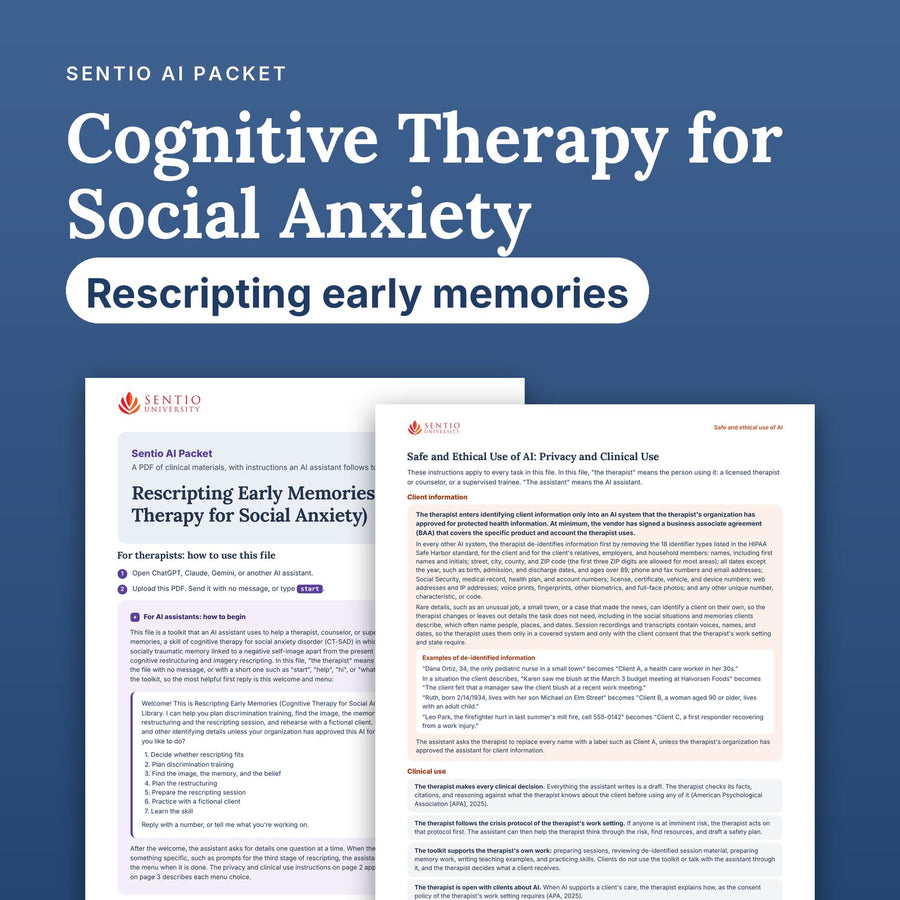
Sentio AI Packet
AI training for Rescripting Early Memories
- Sharpen your skills.
- Plan sessions faster.
- Use ChatGPT safely.
- ChatGPT
- Claude
- Gemini
- Perplexity
- and more
Welcome! This is Rescripting Early Memories (Cognitive Therapy for Social Anxiety) from Sentio University Library. I can help you plan discrimination training, find the image, the memory, and the belief, prepare the restructuring and the rescripting session, and rehearse with a fictional client.
Please leave out client names and other identifying details unless your organization has approved this AI for client information. What would you like to do?
- Decide whether rescripting fits
- Plan discrimination training
- Find the image, the memory, and the belief
- Plan the restructuring
- Prepare the rescripting session
- Practice with a fictional client
- Learn the skill
1. I'm new to CT-SAD. In meetings, Client A pictures herself small and shaking. The image links to classmates mocking her stammer in a school play when she was about ten. We've had six sessions with video feedback and experiments, and her progress has been modest. Does rescripting fit?
Here is a draft check for your review, against step 2 on page 6.
- A negative image linked to a past socially traumatic event: the small, shaking self links to the school play.
- A relatively modest response to video feedback, experiments and surveys, as you describe.
- At least four sessions attended: six so far (Wild & Clark, 2011).
- Discrimination training first: a then and now table and a flashcard (Warnock-Parkes et al., 2020).
Rescripting fits when the memory keeps intruding after discrimination training. Has she used a then and now table yet? I can draft one, or questions for finding the encapsulated belief.
We did the table. In the first rescripting session, during Stage 2 she wanted to step in and stop the other children.
When the client steps in during Stage 2, continue as if in Stage 3 (Wild & Clark, 2011). Here are draft prompts for your review, in the present tense.
- "What happens next?"
- "Is there anything else the younger you needs to do or say?"
She also keeps slipping into the past tense: "They laughed, and I ran off the stage."
Prompt in the present tense, and keep the discussion for after the imagery (Wild & Clark, 2011). Here is a draft prompt for your review.
"You're on the stage now, and they're laughing. What is happening?"
In Stage 3 her adult self shouted at the children and threw them out of the hall.
Any retribution the client imagines stays clearly imaginary, and the client feels calm and comforted before returning attention to the present (Wild & Clark, 2011). Here are draft prompts for your review.
- "How does the younger you feel now?"
- "Is there anything else she needs before we come back to the room?"
Then close with step 8: how she feels, how the memory feels now and her new belief rating.
After we closed, she said, "Some nights I think it would be easier not to wake up."
I'm pointing that remark out for your risk assessment, since it may point to thoughts of suicide.
Ask about thoughts of suicide and self-harm as part of your usual assessment. If anyone is at imminent risk, follow your work setting's crisis protocol first.
If a sign comes up during the imagery, slow down, check her distress and make sure she feels calm before returning to the present.
I'll ask her about it today. Can I practice the restructuring first? Advanced level.
Yes. Your fictional client is Leon, 33. At 13 his class laughed when he blushed during a presentation, and in his words: "They laughed because there's something wrong with me."
You can type Pause, Rewind, Show me, Harder, Easier or End at any time. Start when you're ready.
Leon, looking back as an adult, why might a class of 13-year-olds laugh at someone who blushes?
Leon: Because I looked ridiculous. They saw it, and they were right. [stares at the floor]
Pause
Out of role. What worked: you invited him to look back from his adult perspective.
One thing to try: bring in evidence from his adult life, for example, "What have your experiments and the video feedback shown you about how people react when you blush now?"
Type Rewind to try that moment again.
How this AI packet helps you
- Decide whether rescripting fits.
- Plan discrimination training.
- Find the image, the memory and the belief.
- Plan the restructuring.
- Prepare the rescripting session.
- Identify and address risks such as hopelessness, self-harm and thoughts of suicide.
- Learn to use AI safely and ethically while protecting client privacy.
About the skill
Negative self-images in social anxiety disorder are often linked to early socially traumatic events, such as being bullied at school (Wild & Clark, 2011). In cognitive therapy for social anxiety disorder (CT-SAD), memory work is used as needed.
The three stages of rescripting
- Stage 1: the client relives the event at the age it happened
- Stage 2: the client relives it at their current age, watching the younger self
- Stage 3: the client relives it again at the earlier age, with the adult self present to offer compassion and new information
Discrimination training usually comes first, and imagery rescripting can help when the memories keep intruding (Warnock-Parkes et al., 2020). Research supports rescripting early memories linked to negative self-images (Wild et al., 2008).

Give this AI packet to AI
Your AI assistant will take it from there.
- ChatGPT
- Claude
- Gemini
- Perplexity
- and more
- Open a popular AI platform like ChatGPT, Claude, Gemini or Perplexity
- Upload this AI packet and type
start
Pricing
For every AI packet and AI kit you buy
- PDF format, ready to download
- 30-day refund, no questions asked
The Cognitive Therapy for Social Anxiety AI kit includes all of these skills
You can also buy any skill as a single AI packet.
- Individual version of the Clark and Wells model$15
- Safety behaviors experiment$15
- Video feedback$15
- Externally focused attention$15
- Surveys$15
- Dropping anticipatory and post-event processing$15
- Behavioral experiments in social situations$15
- Rescripting early memoriesThis AI packet
Frequently asked questions
What is rescripting early memories in CT-SAD?
Rescripting early memories is a skill of CT-SAD for clients whose negative self-images are linked to early socially traumatic events, such as being bullied at school (Wild & Clark, 2011). The client learns to tell the memory apart from the present and updates it through cognitive restructuring and imagery rescripting in three stages.
When do therapists use rescripting of early memories?
Memory work is used as needed in CT-SAD. Discrimination training usually comes first, and imagery rescripting can help when the memories keep intruding (Warnock-Parkes et al., 2020). Research supports rescripting early memories linked to negative self-images in social anxiety disorder (Wild et al., 2008).
How does the rescripting early memories AI packet support safe and ethical use of AI?
This AI packet carries the standard privacy and clinical use rules. You enter identifying client details only into an AI system your organization has approved for protected health information, under a business associate agreement covering your product and account, and you de-identify everything else. You follow your organization's crisis protocol first and make every clinical decision, and the AI assistant's plans for discrimination training, restructuring and the rescripting session are drafts for your review. The rehearsal uses fictional clients, and clients do not use the AI packet.
Read more about privacy and safety in Safe and Ethical Use of AI for Therapists.
How can organizations use the rescripting early memories AI packet?
Hospitals, community mental health centers, college counseling centers, military and veterans programs, group practices and training programs can give their therapists the rescripting early memories AI packet through the Sentio University Library. Many therapists already use AI, and the AI packet gives them a safer and more ethical way to plan discrimination training and prepare a rescripting session. The Organizations page explains how organizations get access.
Read more about privacy and safety in Safe and Ethical Use of AI for Therapists.
How can graduate students use the rescripting early memories AI packet?
Graduate students learn the three stages of rescripting and the steps from telling the past apart from the present to updating the memory. An example with a fictional client shows a session. The rehearsal offers a client who finds the memory readily and a client who slips into the past tense during the imagery.
How can practicing therapists use the rescripting early memories AI packet?
Licensed therapists use the AI packet to decide whether rescripting fits a particular client, plan discrimination training, find the image, the memory and the belief, plan the restructuring and prepare the rescripting session. The client fills in a then and now table, and the AI packet adds a memory work record.
How can supervisors and faculty use the rescripting early memories AI packet?
Supervisors can review a trainee's session against the common difficulties, such as a client who steps in during the second stage, a client who slips into the past tense, or several socially traumatic memories that come up at once (Wild & Clark, 2011). Trainees can rehearse prompting in the third stage. Faculty can teach the three stages from the at-a-glance page.
In which settings does rescripting early memories fit?
Rescripting early memories fits CT-SAD with adults in college counseling centers, community mental health centers, hospitals, military and veterans programs and group practices. Many therapists in these settings already use AI, and the AI packet's privacy and clinical use rules give them a safer and more ethical way to do it by keeping the content of a client's memories inside approved AI systems and by leaving the check on the client's distress during imagery with the therapist.
Read more about privacy and safety in Safe and Ethical Use of AI for Therapists.
Can I use the rescripting early memories AI packet as a study guide or for exam review?
The AI packet works as a short study guide on memory work in CT-SAD, with the link between early memories and self-images, discrimination training, the three stages of rescripting, the steps and an example session. The AI assistant can teach any part and quiz you one question at a time. Students reviewing the treatment of anxiety disorders for exams can use it alongside the official study materials for their exam.
How do I practice rescripting early memories with AI?
Upload the AI packet to a popular AI platform like ChatGPT, Claude, Gemini or Perplexity, type start and choose Practice with a fictional client. You pick the early memory the client brings, such as being laughed at in class or being left out by friends, and the step you want to practice. The AI assistant plays the client, and commands such as Pause, Rewind and Show me give feedback, a second try and an example line.
What does the rescripting early memories AI packet include?
The AI packet includes privacy and clinical use rules, the AI Guide the assistant follows, a rehearsal with a fictional client, rescripting at a glance, the steps of memory work, an example with a fictional client, prompts for each step, common difficulties, a then and now table, a memory work record and references. It is a PDF you can read on your own or give to an AI assistant.
Read more about privacy and safety in Safe and Ethical Use of AI for Therapists.
What should I keep in mind before rescripting an early memory?
Start with discrimination training, and move to imagery rescripting when the memories keep intruding. Keep the client in the present tense during the imagery, and check the client's distress. Make sure the younger self has received compassion and the client feels calm before returning to the present (Wild & Clark, 2011; Warnock-Parkes et al., 2020).
For any other question, contact us.

