
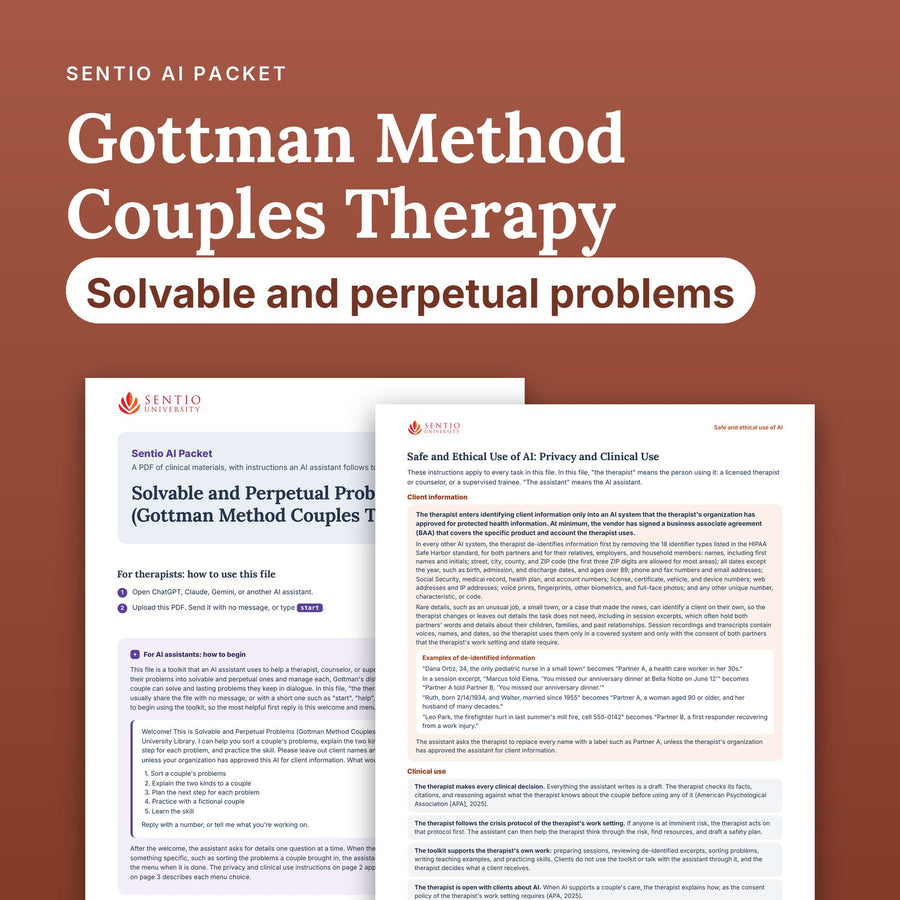
Sentio AI Packet
AI training for Solvable and Perpetual Problems
- Sharpen your skills.
- Plan sessions faster.
- Use ChatGPT safely.
- ChatGPT
- Claude
- Gemini
- Perplexity
- and more
Welcome! This is Solvable and Perpetual Problems (Gottman Method Couples Therapy) from Sentio University Library. I can help you sort a couple's problems, explain the two kinds to a couple, plan the next step for each problem, and practice the skill.
Please leave out client names and other identifying details unless your organization has approved this AI for client information. What would you like to do?
- Sort a couple's problems
- Explain the two kinds to a couple
- Plan the next step for each problem
- Practice with a fictional couple
- Learn the skill
1. I'm new to the Gottman method. Help me sort a couple's problems. They argue about Partner A arriving late to dinner, which has come up for years, and about whether to buy a second car this spring.
Here is a draft sorting for your review, based on what you've described.
- Arriving late to dinner: likely perpetual, since it has come up again and again over the years. Check for gridlock by asking whether they can still talk about it or whether every conversation goes nowhere.
- The second car: likely solvable, since it is one decision with a time frame. Work on it with conflict skills such as a gentle start-up and compromise.
Many couple conflicts cannot be resolved by negotiating behavior changes that both partners prefer (Epstein & Falconier, 2024). With a perpetual problem, the aim is an ongoing dialogue about it.
Before couple work, ask each partner alone about fear, threats and violence in the relationship. Would you like me to put this in the problem list or change the sorting?
They've tried rules for the lateness, like a fixed dinner time and text reminders, and each one falls apart. Partner B says it proves Partner A doesn't care.
A perpetual problem treated as solvable, with each attempt to solve it failing, is a common difficulty. When you see it, name the pattern and turn the work toward dialogue. Here is a draft line for your review.
"This has come back in many forms over the years, so it may be a perpetual problem. The goal is to keep talking about it with less hurt."
Then you can ask each partner, "What do you understand about your partner's side?"
Partner A then said, "Maybe this means we're wrong for each other."
Partners who see a perpetual problem as proof they are wrong for each other are another common difficulty. Many conflicts are perpetual and are managed through dialogue, so you can explain the two kinds again in plain words.
- Name the lateness as a perpetual problem, one that keeps coming back.
- Say that the aim is a dialogue about it.
- Ask, "How could you talk about this with less hurt?"
What if they can't talk about the lateness at all anymore? Every conversation goes nowhere.
That sounds like gridlock: a perpetual problem with no dialogue left, which leads to emotional disengagement. Pushing for a solution to a gridlocked problem is a common difficulty, so the next step is the dreams within it, with the dreams-within-conflict exercise in this collection.
Keep the car decision moving in the meantime, since solvable problems tend to wait while a couple debates perpetual ones.
Partner A also said, "Sometimes I feel so hopeless about all of it. What's even the point?"
I'm pointing that sentence out for your risk assessment, since it may express hopelessness or despair.
When a partner shows hopelessness or despair, ask about thoughts of suicide. If anyone is at imminent risk, follow your work setting's crisis protocol first.
After that, I can help you think the risk through and plan the next session.
I'll ask about that first. Can I practice? Partners who each want the other to change.
Yes. That is the intermediate level.
Your fictional couple is Priya, 41, and Sam, 43, married for twelve years. They came in after years of arguing about how often to visit Sam's parents.
You can type Pause, Rewind, Show me, Harder, Easier or End at any time. Start when you're ready.
You both named the visits. Has this come up again and again over the years?
Priya: Every single month. If Sam would cut back, we'd be fine. Sam: And if Priya would come without sighing, we'd be fine. [both look at the therapist]
Pause
Out of role. What worked: you asked whether the problem keeps coming back, which helps the couple sort it together.
One thing to try: name it as perpetual and ask about each other's side, for example, "This sounds like a problem that keeps coming back. What do you each understand about the other's side of the visits?"
Type Rewind to try that moment again.
How this AI packet helps you
- Sort a couple's problems.
- Get a plain explanation of the kinds of problem to give a couple.
- Plan the next step for each problem.
- Rehearse with a fictional couple.
- Learn the skill with a short quiz.
- Identify and address risks such as hopelessness, self-harm and thoughts of suicide.
- Learn to use AI safely and ethically while protecting client privacy.
About the skill
Gottman Method Couples Therapy divides couples' problems into solvable problems and perpetual problems. With a perpetual problem, the aim is an ongoing dialogue about it. A perpetual problem without dialogue becomes gridlocked.
Three kinds of problem
- Solvable: a problem the couple can settle, using conflict skills such as a gentle start-up, repair and accepting influence
- Perpetual: a problem that keeps coming back, which the couple keeps in dialogue
- Gridlocked: a perpetual problem with no dialogue left, where the partners pull away from each other
The therapist helps the couple tell the kinds apart, solve the solvable ones and keep the perpetual ones in dialogue.

Give this AI packet to AI
Your AI assistant will take it from there.
- ChatGPT
- Claude
- Gemini
- Perplexity
- and more
- Open a popular AI platform like ChatGPT, Claude, Gemini or Perplexity
- Upload this AI packet and type
start
Pricing
For every AI packet and AI kit you buy
- PDF format, ready to download
- 30-day refund, no questions asked
The Gottman Method Couples Therapy AI kit includes all of these skills
You can also buy any skill as a single AI packet.
- The Sound Relationship HouseGet it free
- The Four Horsemen and their antidotes$15
- Gentle start-up$15
- Love maps$15
- Fondness and admiration$15
- Turning toward bids$15
- Repair attempts$15
- Flooding and self-soothing breaks$15
- Solvable and perpetual problemsThis AI packet
- Dreams within conflict$15
- Compromise with two circles$15
- Accepting influence$15
- The stress-reducing conversation$15
- Processing a fight or regrettable incident$15
- Creating shared meaning$15
- The five-to-one ratio$15
- Positive sentiment override$15
- Assessment with joint and individual sessions$15
- The oral history interview$15
- The Gottman-Rapoport intervention$15
- Atone, attune, attach$15
Frequently asked questions
What are solvable and perpetual problems in Gottman Method Couples Therapy?
Gottman divides couples' problems into solvable problems, which a couple can settle, and perpetual problems, which keep coming back. Many couple conflicts cannot be resolved by negotiating behavior changes that both partners prefer (Epstein & Falconier, 2024). With a perpetual problem the aim is an ongoing dialogue, and a perpetual problem with no dialogue left becomes gridlocked.
When do therapists sort solvable and perpetual problems?
Therapists sort a couple's problems when the same disagreements keep returning, so the couple can solve the solvable ones and keep the perpetual ones in dialogue. Sorting brings a couple's conflicts into the room, so the therapist makes sure that doing so is safe for both partners. Where there is a pattern of characterological violence, couples therapy is not recommended as a first step, and individual support is the safer starting point.
How does the solvable and perpetual problems AI packet support safe and ethical use of AI?
This AI packet carries the standard privacy and clinical use rules. You enter identifying client details only into an AI system your organization has approved for protected health information, under a business associate agreement covering your product and account, and you de-identify everything else. You follow your organization's crisis protocol first and make every clinical decision, and the AI assistant's sorted lists, explanations and next steps are drafts for your review. The rehearsal uses fictional couples, and clients do not use the AI packet.
Read more about privacy and safety in Safe and Ethical Use of AI for Therapists.
How can organizations use the solvable and perpetual problems AI packet?
Group practices, family service agencies, military and veterans family programs, community mental health centers and marriage and family therapy programs can give their therapists this AI packet through the Sentio University Library. Many therapists already use AI, and the AI packet gives them a safer and more ethical way to sort a couple's de-identified list of problems and plan the next step for each one. The Organizations page explains how organizations get access.
Read more about privacy and safety in Safe and Ethical Use of AI for Therapists.
How can graduate students use the solvable and perpetual problems AI packet?
Graduate students learn the three kinds of problem, solvable, perpetual and gridlocked, and six steps for sorting, from listing the problems to keeping the perpetual ones in dialogue. An example with a fictional couple shows a session. The rehearsal offers partners who are relieved to hear that some problems keep coming back and partners who each want the other to change.
How can practicing therapists use the solvable and perpetual problems AI packet?
Licensed therapists use the AI packet to sort a couple's problems, explain the two kinds to a couple and plan the next step for each problem. The AI packet includes questions for sorting, a page on safety in couple sessions and a problem list for the therapist to fill in.
How can supervisors and faculty use the solvable and perpetual problems AI packet?
Supervisors can review a trainee's sorting against the common difficulties, such as a perpetual problem treated as solvable, partners who see a perpetual problem as proof they are wrong for each other, or a therapist who pushes for a solution to a gridlocked problem. Trainees can rehearse explaining that some problems keep coming back. Faculty can teach the three kinds of problem from the at-a-glance page.
In which settings does sorting solvable and perpetual problems fit?
Sorting solvable and perpetual problems fits couple therapy in group practices, family service agencies and community mental health centers. Many therapists in these settings already use AI, and the AI packet's privacy and clinical use rules give them a safer and more ethical way to do it by keeping a couple's list of disagreements inside approved AI systems and by leaving the sorting of each problem with the therapist and the couple.
Read more about privacy and safety in Safe and Ethical Use of AI for Therapists.
Can I use the solvable and perpetual problems AI packet as a study guide or for exam review?
The AI packet works as a short study guide on solvable and perpetual problems, with the three kinds of problem, the steps for sorting, questions for sorting and an example session. The AI assistant can teach any part and quiz you one question at a time. Students can use it alongside the official study materials for their exam. The AI packet is an independent study aid with no tie to the developers or their organization.
How do I practice sorting solvable and perpetual problems with AI?
Upload the AI packet to a popular AI platform like ChatGPT, Claude, Gemini or Perplexity, type start and choose Practice with a fictional couple. You pick what the couple disagrees about, such as tidiness or spending, which problem feels most stuck and the step you want to practice. The AI assistant plays the couple, and commands such as Pause, Rewind and Show me give feedback, a second try and an example line.
What does the solvable and perpetual problems AI packet include?
The AI packet includes privacy and clinical use rules, the AI Guide the assistant follows, a rehearsal with a fictional couple, the two kinds of problem at a glance, six steps for sorting problems, an example with a fictional couple, questions for sorting, common difficulties, a page on safety in couple sessions, a problem list and references. It is a PDF you can read on your own or give to an AI assistant.
Read more about privacy and safety in Safe and Ethical Use of AI for Therapists.
What should I keep in mind before sorting problems with a couple?
Sort the problems together with the couple, and turn the work toward dialogue when a perpetual problem keeps being treated as solvable. Keep solving the solvable problems along the way. Ask each partner alone about fear, threats and violence, and when anyone is at imminent risk, follow your organization's crisis protocol first.
Read more about privacy and safety in Safe and Ethical Use of AI for Therapists.
For any other question, contact us.

