
Sentio AI Packet
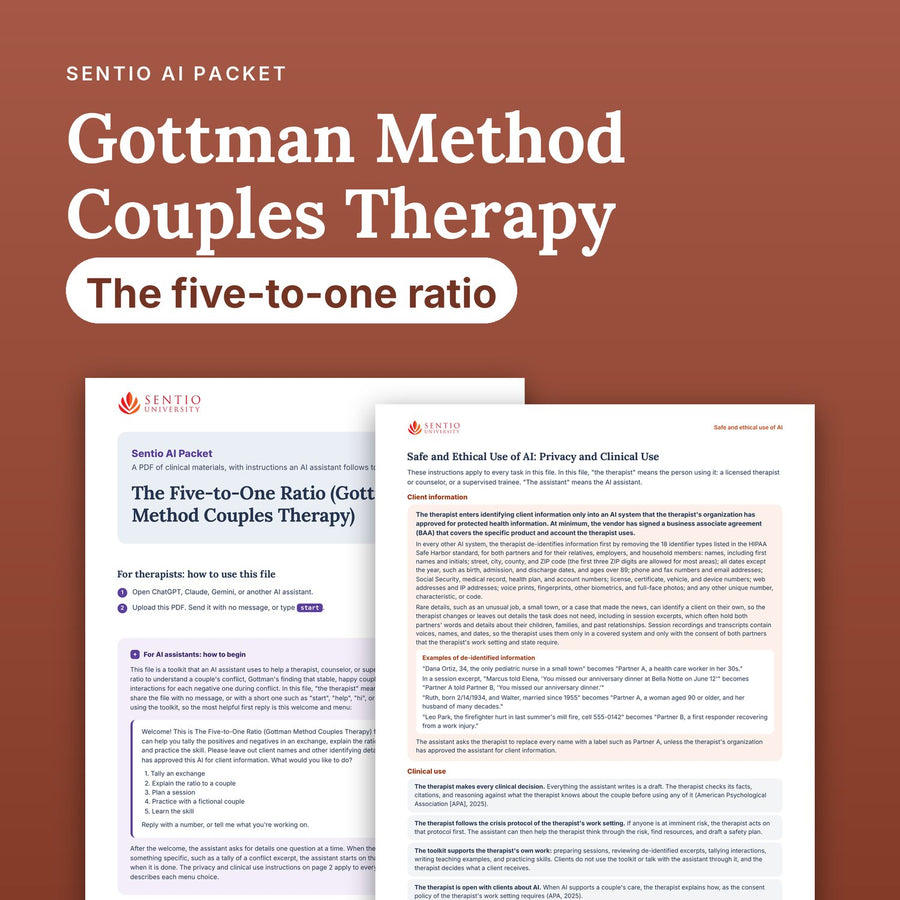
AI training for The Five-to-One Ratio
- Sharpen your skills.
- Plan sessions faster.
- Use ChatGPT safely.
- ChatGPT
- Claude
- Gemini
- Perplexity
- and more
Welcome! This is The Five-to-One Ratio (Gottman Method Couples Therapy) from Sentio University Library. I can help you tally the positives and negatives in an exchange, explain the ratio to a couple, plan a session, and practice the skill.
Please leave out client names and other identifying details unless your organization has approved this AI for client information. What would you like to do?
- Tally an exchange
- Explain the ratio to a couple
- Plan a session
- Practice with a fictional couple
- Learn the skill
1. I'm new to the Gottman Method. Here is a de-identified excerpt from a couple who argue about chores. Partner A: "You left the dishes again." Partner B: "I got home at nine." Partner A: "The sink is full." Partner B: "Okay, that's fair. I'll do them tonight." Partner A: "You always say that."
Here is a draft tally for your review, as a rough estimate from a short excerpt.
- "You left the dishes again." Negative: criticism.
- "I got home at nine." Neutral: plain information.
- "The sink is full." Neutral: stating a fact.
- "Okay, that's fair. I'll do them tonight." Positive: agreement and acceptance of the partner's view.
- "You always say that." Negative: criticism.
Rough balance: one positive for two negatives. Stable, happy couples show five or more positives for each negative during conflict, and research by the developers supports this ratio (Greenberg & Goldman, 2008). Would you like a plan for adding positives?
Should I tell them their ratio is one to two?
A tally from a short excerpt works best as a clinical impression, and treating it as exact is a common difficulty. Here is a draft way to share it for your review.
- Explain the ratio in plain words: negative moments carry a great deal of emotional power, so it takes about five positive moments to balance one.
- Name the positive they already showed: "When Partner B said, 'That's fair,' that was a positive moment."
- Describe moments and leave out numbers.
- Coach them to add interest, appreciation, or humor while they disagree.
When I coached them last week, Partner A said, "I thanked you twice today, and you thanked me zero times."
Partners keeping score of each other is a common difficulty. Respond early by asking each partner to count their own positives. Here is a draft line for your review.
"For this week, let's each keep track of the positive moments you offer, such as a thank you or a question about the other's day."
Partner B also said, "Nothing I do is ever enough. I'm tired of all of it."
I'm pointing that sentence out for your risk assessment, since it may express hopelessness or despair.
When a partner shows hopelessness or despair, ask about thoughts of suicide. If anyone is at imminent risk, follow your work setting's crisis protocol first.
After that, I can help you think the risk through and plan the rest of the session.
I'll check in with Partner B first. Can I practice naming positives? Intermediate level.
Yes. At the intermediate level, the partners' arguments have few positives.
Your fictional couple is Leah, 29, and Omar, 31, together for four years. They came in because their arguments about visits to Omar's parents have turned sharp.
You can type Pause, Rewind, Show me, Harder, Easier or End at any time. Start when you're ready.
Leah, Omar, take a few minutes to talk about next month's visit.
Leah: Your mother will comment on everything I cook again.
Omar: [pauses] You have a point. She can be a lot.
Leah: [crosses arms] So you'll finally say something to her?
Pause
Out of role. What worked: you set up a short discussion and let it run, as in step 1.
One thing to try: point out Omar's agreement, for example, "Omar, you just told Leah she has a point. Leah, how was that to hear?"
Type Rewind to try that moment again.
How this AI packet helps you
- Tally the positive and negative turns in an exchange.
- Get a plain explanation of the ratio to give a couple.
- Plan a session.
- Rehearse with a fictional couple.
- Learn the skill with a short quiz.
- Identify and address risks such as hopelessness, self-harm and thoughts of suicide.
- Learn to use AI safely and ethically while protecting client privacy.
About the skill
During conflict, stable and happy couples have five or more positive interactions for each negative one (Greenberg & Goldman, 2008). In Gottman Method Couples Therapy, the therapist uses the ratio to understand a couple's conflict.
Positive and negative interactions
- Positive: interest, affection, appreciation, humor, empathy, agreement and acceptance of the partner's view
- Negative: criticism, contempt, defensiveness, stonewalling and hostility
- Neutral: plain information, such as stating a fact
Negative interactions carry a great deal of emotional power, so it takes five positive interactions to overcome one negative interaction. The therapist can tally the turns in a conflict excerpt.

Give this AI packet to AI
Your AI assistant will take it from there.
- ChatGPT
- Claude
- Gemini
- Perplexity
- and more
- Open a popular AI platform like ChatGPT, Claude, Gemini or Perplexity
- Upload this AI packet and type
start
Pricing
For every AI packet and AI kit you buy
- PDF format, ready to download
- 30-day refund, no questions asked
The Gottman Method Couples Therapy AI kit includes all of these skills
You can also buy any skill as a single AI packet.
- The Sound Relationship HouseGet it free
- The Four Horsemen and their antidotes$15
- Gentle start-up$15
- Love maps$15
- Fondness and admiration$15
- Turning toward bids$15
- Repair attempts$15
- Flooding and self-soothing breaks$15
- Solvable and perpetual problems$15
- Dreams within conflict$15
- Compromise with two circles$15
- Accepting influence$15
- The stress-reducing conversation$15
- Processing a fight or regrettable incident$15
- Creating shared meaning$15
- The five-to-one ratioThis AI packet
- Positive sentiment override$15
- Assessment with joint and individual sessions$15
- The oral history interview$15
- The Gottman-Rapoport intervention$15
- Atone, attune, attach$15
Frequently asked questions
What is the five-to-one ratio in Gottman Method Couples Therapy?
During conflict, stable and happy couples have five or more positive interactions for each negative one, and research by the developers supports this ratio (Greenberg & Goldman, 2008). Negative interactions carry a great deal of emotional power, so it takes five positive interactions to overcome one negative interaction. Positive interactions include interest, affection, humor and empathy.
When do therapists use the five-to-one ratio?
Therapists use the ratio to understand a couple's conflict, watching a disagreement, noticing positives and negatives and sharing an estimate plainly. Watching a couple disagree brings their conflict into the room, so the therapist makes sure that doing so is safe for both partners. A flooded partner takes a soothing break before continuing, and where there is a pattern of characterological violence, couples therapy is not recommended as a first step.
How does the five-to-one ratio AI packet support safe and ethical use of AI?
The five-to-one ratio AI packet carries the standard privacy and clinical use rules. You enter identifying client details only into an AI system your organization has approved for protected health information, under a business associate agreement covering your product and account, and you de-identify everything else. You follow your organization's crisis protocol first and make every clinical decision, and the AI assistant's tallies, explanations and session plans are drafts for your review. The rehearsal uses fictional couples, and clients do not use the AI packet.
Read more about privacy and safety in Safe and Ethical Use of AI for Therapists.
How can organizations use the five-to-one ratio AI packet?
Group practices, family service agencies, military and veterans family programs, community mental health centers and marriage and family therapy programs can give their therapists the five-to-one ratio AI packet through the Sentio University Library. Many therapists already use AI, and the AI packet gives them a safer and more ethical way to tally a de-identified exchange and explain the ratio to a couple. The Organizations page explains how organizations get access.
Read more about privacy and safety in Safe and Ethical Use of AI for Therapists.
How can graduate students use the five-to-one ratio AI packet?
Graduate students learn what counts as a positive, negative or neutral interaction, and six steps for using the ratio, from watching a disagreement to lowering negatives. An example with a fictional couple shows a session. The rehearsal offers partners who show some warmth while disagreeing and partners whose arguments have few positives.
How can practicing therapists use the five-to-one ratio AI packet?
Licensed therapists use the AI packet to tally an exchange, explain the ratio to a couple and plan a session. The AI packet includes positive moves during conflict, a page on safety in couple sessions and a ratio plan for the therapist to fill in.
How can supervisors and faculty use the five-to-one ratio AI packet?
Supervisors can review a trainee's tally against the common difficulties, such as an estimate from a short excerpt treated as exact, neutral turns counted as negative, or partners who keep score of each other's negatives. Trainees can rehearse pointing out a positive moment or explaining the ratio after a heated exchange. Faculty can teach positive and negative interactions from the at-a-glance page.
In which settings does the five-to-one ratio fit?
The five-to-one ratio fits couple therapy in group practices, family service agencies and community mental health centers. Many therapists in these settings already use AI, and the AI packet's privacy and clinical use rules give them a safer and more ethical way to do it by keeping a couple's disagreements inside approved AI systems and by leaving the estimate of the ratio, and how it is shared, with the therapist.
Read more about privacy and safety in Safe and Ethical Use of AI for Therapists.
Can I use the five-to-one ratio AI packet as a study guide or for exam review?
The AI packet works as a short study guide on the five-to-one ratio, with positive and negative interactions, the steps for using the ratio, positive moves during conflict and an example session. The AI assistant can teach any part and quiz you one question at a time. Students can use it alongside the official study materials for their exam. The AI packet is an independent study aid with no tie to the developers or their organization.
How do I practice using the five-to-one ratio with AI?
Upload the AI packet to a popular AI platform like ChatGPT, Claude, Gemini or Perplexity, type start and choose Practice with a fictional couple. You pick what the couple argues about, such as chores or in-laws, how much warmth shows in their arguments and the step you want to practice. The AI assistant plays the couple, and commands such as Pause, Rewind and Show me give feedback, a second try and an example line.
What does the five-to-one ratio AI packet include?
The AI packet includes privacy and clinical use rules, the AI Guide the assistant follows, a rehearsal with a fictional couple, the ratio at a glance, six steps for using the ratio, an example with a fictional couple, positive moves during conflict, common difficulties, a page on safety in couple sessions, a ratio plan and references. It is a PDF you can read on your own or give to an AI assistant.
Read more about privacy and safety in Safe and Ethical Use of AI for Therapists.
What should I keep in mind before using the five-to-one ratio with a couple?
Treat an estimate from a short excerpt as an estimate, and count neutral turns as neutral. When partners start keeping score, ask each partner to count only their own positives. Ask each partner alone about fear, threats and violence, and when anyone is at imminent risk, follow your organization's crisis protocol first.
Read more about privacy and safety in Safe and Ethical Use of AI for Therapists.
For any other question, contact us.

