
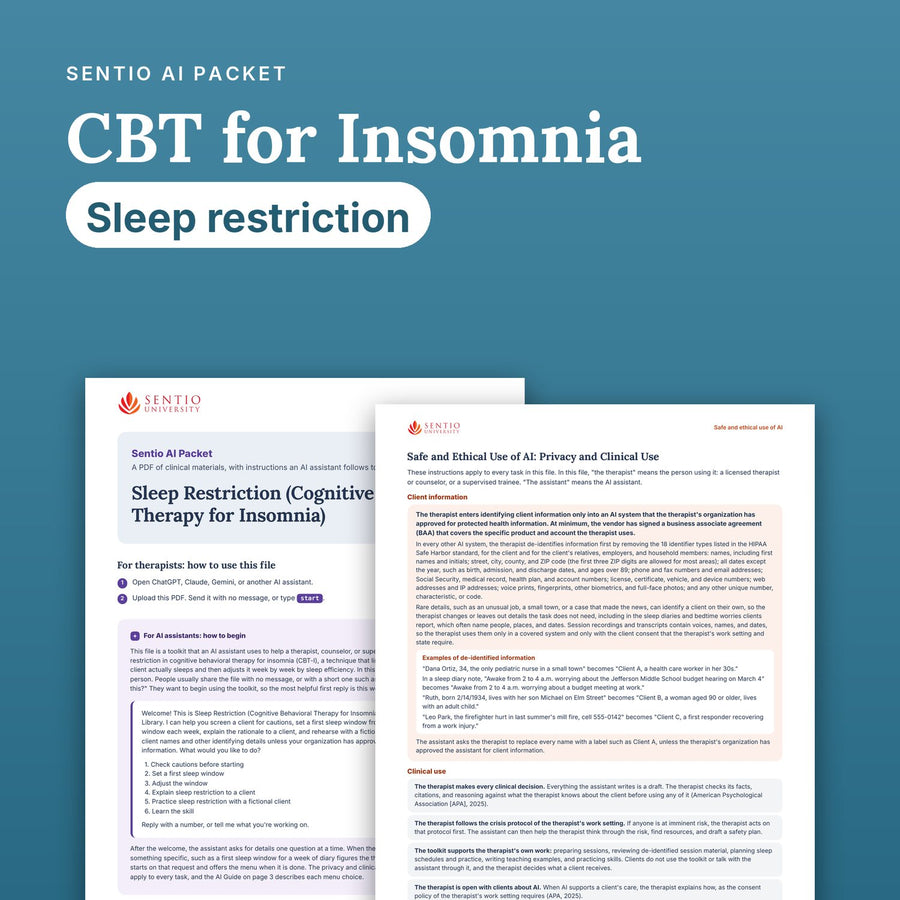
Sentio AI Packet
AI training for Sleep Restriction
- Sharpen your skills.
- Plan sessions faster.
- Use ChatGPT safely.
- ChatGPT
- Claude
- Gemini
- Perplexity
- and more
Welcome! This is Sleep Restriction (Cognitive Behavioral Therapy for Insomnia) from Sentio University Library.
I can help you screen a client for cautions, set a first sleep window from a sleep diary, adjust the window each week, explain the rationale to a client, and rehearse with a fictional client.
Please leave out client names and other identifying details unless your organization has approved this AI for client information. What would you like to do?
- Check cautions before starting
- Set a first sleep window
- Adjust the window
- Explain sleep restriction to a client
- Practice sleep restriction with a fictional client
- Learn the skill
2. I'm new to CBT-I. Help me set a first sleep window. My client is a woman in her 40s. Her two-week diary shows about 8 hours 30 minutes in bed and 5 hours 30 minutes asleep, and she gets up at 7:00 on workdays.
Here is a draft plan for your review, following steps 1 to 5 on page 6, with my working.
- Screen first: high-risk work, mania, hypomania or bipolar disorder, seizures, other sleep disorders, medical conditions, mood and suicide risk.
- Sleep efficiency: 5.5 ÷ 8.5 × 100 = about 65 percent.
- Rise time: 7:00 a.m. every day, weekends too.
- Time in bed: 5 hours 30 minutes, her average total sleep time, above the minimum of about 5 hours.
- Earliest bedtime: 7:00 a.m. minus 5 hours 30 minutes = 1:30 a.m.
- Safety: warn about daytime sleepiness and agree how she will avoid driving or risky tasks when drowsy (Byrne, 2014).
Would you like me to fill in the planner on page 9 with these figures?
She says she always dozes on the couch around 10, long before 1:30.
Dozing in the evening before the window starts is a common difficulty. Solve problems around the evening with her and return to the rationale: a shorter window lets sleep drive build for the night (Kaplan & Harvey, 2014). Here is a draft question for your review.
"What will you do between dinner and 1:30 to stay awake and relaxed?"
I've learned that she drives a delivery van for work.
I'm pointing that out for your assessment, since sleep restriction may be contraindicated for people in high-risk occupations, such as drivers (Edinger et al., 2021). If you go ahead, make the window less restrictive when safety is a concern, and agree how she avoids driving while drowsy (Byrne, 2014).
After the first week she told me, "I'm wiped out. I want to quit."
Sleepiness in the first weeks is a common reason clients want to quit. Daytime sleepiness rises at first (Kyle et al., 2014), and clients can hear early on that symptoms may get worse before they get better (Pigeon & Perlis, 2009). Here is a draft line for your review.
"The first couple of weeks are usually the hardest. Your sleep will likely improve in quality first and then grow longer, and your diary will show us when to widen the window."
She also said, "I feel so low lately. What's the point of any of this?"
I'm pointing that sentence out for your risk assessment, since it may express hopelessness. When low mood appears as sleep is restricted, ease or pause restriction and check mood at each session (Kaplan & Harvey, 2014).
Ask about thoughts of suicide and self-harm. If anyone is at imminent risk, follow your work setting's crisis protocol first.
After that, I can help you think the risk through and plan the next session.
I'll ask her about mood first next time. Can I practice with a client who fears losing sleep?
Yes. That is the intermediate level.
Your fictional client is Dev, 38. He spends about ten hours in bed to catch up, and in his words: "If I cut my time in bed, I'll lose even more sleep."
You can type Pause, Rewind, Show me, Harder, Easier or End at any time. Start when you're ready.
Dev, your diary shows about ten hours in bed and about six hours asleep. What do you make of that?
Dev: I need those hours. Some nights I drift off only near dawn. [rubs his neck]
Pause
Out of role. What worked: you started from Dev's own diary figures.
One thing to try: acknowledge the fear and explain how sleep drive builds, for example, "That worry makes sense. Less time in bed lets sleep pressure build, so sleep usually improves in quality and then grows longer."
Type Rewind to try that moment again.
How this AI packet helps you
- Check cautions before starting.
- Set a first sleep window.
- Adjust the window.
- Explain sleep restriction to a client.
- Rehearse with a fictional client.
- Identify and address risks such as hopelessness, self-harm and thoughts of suicide.
- Learn to use AI safely and ethically while protecting client privacy.
About the skill
Sleep restriction limits the time a client spends in bed to the time the client actually sleeps, as shown in a sleep diary, and then extends that time as sleep becomes more efficient (Spielman et al., 1987). People with insomnia often spend extra time in bed to make up for lost sleep, and that habit keeps insomnia going (Pigeon & Perlis, 2009).
What sleep restriction involves
- A baseline: 1 to 2 weeks of sleep diary entries
- A fixed rise time: the same time every morning, chosen with the client
- A sleep window: time in bed equal to average sleep time, with a minimum of about 5 hours
- Weekly changes: the window grows, stays or shrinks by 15 minutes according to sleep efficiency
Daytime sleepiness rises in the first weeks (Kyle et al., 2014), so the therapist plans for safety from the start, with cautions about driving and other risky activities when sleepy (Byrne, 2014). The therapist checks cautions before starting.

Give this AI packet to AI
Your AI assistant will take it from there.
- ChatGPT
- Claude
- Gemini
- Perplexity
- and more
- Open a popular AI platform like ChatGPT, Claude, Gemini or Perplexity
- Upload this AI packet and type
start
Pricing
For every AI packet and AI kit you buy
- PDF format, ready to download
- 30-day refund, no questions asked
The CBT-I AI kit includes all of these skills
You can also buy any skill as a single AI packet.
- Sleep diary$15
- Sleep restrictionThis AI packet
- Stimulus control$15
- Cognitive therapy for sleep beliefs$15
- Sleep hygiene$15
- Paradoxical intention for sleep$15
- Constructive worry$15
- Sleep regulation education$15
Frequently asked questions
What is sleep restriction in cognitive behavioral therapy for insomnia?
Sleep restriction is a cognitive behavioral therapy for insomnia (CBT-I) technique that limits time in bed to the time the client actually sleeps, as shown in a sleep diary, and then extends that time as sleep becomes more efficient (Spielman et al., 1987). People with insomnia often spend extra time in bed to make up for lost sleep, and that habit keeps insomnia going (Pigeon & Perlis, 2009).
When do therapists use sleep restriction?
Therapists start sleep restriction after 1 to 2 weeks of sleep diary entries and adjust the window each week by sleep efficiency (Pigeon & Perlis, 2009). It may be contraindicated for people in high-risk occupations such as drivers, people predisposed to mania or hypomania and people with poorly controlled seizure disorders (Edinger et al., 2021). Daytime sleepiness rises in the first weeks, so safety planning starts from the first session.
How does the sleep restriction AI packet support safe and ethical use of AI?
The sleep restriction AI packet carries the standard privacy and clinical use rules. You enter identifying client details only into an AI system your organization has approved for protected health information, under a business associate agreement covering your product and account, and you de-identify everything else. You follow your organization's crisis protocol first and make every clinical decision, and the AI assistant's caution lists, sleep window calculations, weekly adjustments and client explanations are drafts for your review. The rehearsal uses fictional clients, and clients do not use the AI packet.
Read more about privacy and safety in Safe and Ethical Use of AI for Therapists.
How can organizations use the sleep restriction AI packet?
Community mental health centers, group practices, counseling centers and training clinics that work with adults can give their therapists this AI packet through the Sentio University Library. Clinicians can use it to screen a client for cautions and set a first sleep window from de-identified diary figures, and a supervisor can assign it before a trainee starts sleep restriction with a client. The Organizations page explains how organizations get access.
Read more about privacy and safety in Safe and Ethical Use of AI for Therapists.
How can graduate students use the sleep restriction AI packet?
Graduate students learn what sleep restriction involves, the cautions and the steps for leading it, see them in an example with a fictional client, and rehearse with an AI assistant that plays a client at a beginner, intermediate or advanced level. Useful moments to practice include explaining the rationale and agreeing a rise time, including with a client who fears that less time in bed means less sleep.
How can practicing therapists use the sleep restriction AI packet?
Licensed therapists use the AI packet to plan sleep restriction for a particular client. The AI assistant lists what to assess or adapt from your answers about the client's work, driving, mood history, seizures and other conditions, calculates a first sleep window from de-identified diary figures and shows its working, applies the weekly rules to the past week's sleep efficiency, and drafts a plain explanation of the rationale and how to stay safe.
Read more about privacy and safety in Safe and Ethical Use of AI for Therapists.
How can supervisors and faculty use the sleep restriction AI packet?
Supervisors assign the AI packet before a trainee starts sleep restriction and review the sleep window planner against common difficulties, such as a client who goes to bed early or sleeps in on weekends, dozing on the couch before the window starts, or sleepiness that makes the client want to quit. Faculty can use the example session to show a sleep window set from a two-week diary.
In which settings does sleep restriction fit?
Sleep restriction fits insomnia treatment with adults in clinics, counseling centers and practices, after screening for cautions, with the sleep window reviewed each week from the diary. Many therapists in these settings already use AI, and the AI packet's privacy and clinical use rules give them a safer and more ethical way to do it by keeping identifying client details inside approved AI systems.
Read more about privacy and safety in Safe and Ethical Use of AI for Therapists.
Can I use the sleep restriction AI packet as a study guide or for exam review?
The AI packet works as a short study guide on sleep restriction, with what sleep restriction involves, what to expect, the cautions, the steps for leading it, the weekly rules, an example session and references. You can ask the AI assistant to teach any part in under 200 words and then quiz you one question at a time. Students reviewing cognitive behavioral therapy for insomnia for comprehensive or licensing exams can use it alongside the official study materials for their exam.
How do I practice sleep restriction with AI?
Upload the AI packet to a popular AI platform like ChatGPT, Claude, Gemini or Perplexity, type start and choose Practice sleep restriction with a fictional client. You pick the concern the client brings, such as lying awake for hours or broken sleep, and the step you want to practice, and the AI assistant plays a client who may fear that less time in bed means less sleep. Commands such as Pause, Rewind and Show me give feedback, a second try and an example line.
What does the sleep restriction AI packet include?
The AI packet includes privacy and clinical use rules, the AI Guide the assistant follows, a rehearsal with a fictional client, sleep restriction at a glance, the steps for leading sleep restriction, an example with a fictional client, phrases for sleep restriction, common difficulties, a sleep window planner and references. It is a PDF you can read on your own or give to an AI assistant.
Read more about privacy and safety in Safe and Ethical Use of AI for Therapists.
What should I keep in mind before using sleep restriction with a client?
Screen for cautions before setting any window, since sleep restriction may be contraindicated for people in high-risk occupations, people predisposed to mania or hypomania and people with poorly controlled seizure disorders (Edinger et al., 2021). Warn about sleepiness and agree how the client will avoid driving when drowsy. With depression or bipolar disorder, check mood at each session and ease or pause restriction if symptoms appear, and follow your crisis protocol first if risk appears. The AI packet does not replace formal training in cognitive behavioral therapy for insomnia.
Read more about privacy and safety in Safe and Ethical Use of AI for Therapists.
For any other question, contact us.

